
FINANCE
Top CD Rates Rise, but Inflation Still Takes the Gain
Online banks lifted CD rates across four terms, yet most savers still earn 1.71% while inflation runs 3.4%.

Top one-year certificates of deposit now pay 4.35% APY, and Popular Direct lists 4.50% on three-year and five-year terms. Online banks have been lifting those CD rates for a month. The typical 12-month CD still pays 1.71%.
Inflation is running at 3.4%, and three Federal Reserve officials voted in July to raise the policy rate.
Online Banks Quietly Lifted CD Yields
The headline this week is that leading CD rates moved up across four terms. The move did not come from the big branch banks that still set the national average. It came from online banks and credit unions that have been bidding for term deposits since mid-August.
Deposit-rate analyst Ken Tumin logged the raises on August 19, after several large online issuers marked term CDs higher even as their savings APYs sat still.
https://x.com/KenTumin/status/2090157008217411601
ONLINE BANK CD HIKES IN AUGUST
- Synchrony 16-month: APY moved from 4.00% to 4.30%.
- Marcus 18-month: APY moved from 3.80% to 4.30%.
- American Express 10-month: APY moved from 4.00% to 4.25%.
- CFG Bank 12-month: APY moved from 4.05% to 4.30%.
- Bread Savings 18-month: APY moved from 4.00% to 4.50%.
- Credit One 13-month: APY moved from 4.15% on 12 months to 4.55%.
A September 1 survey of up to 1,300 banks and credit unions now shows Quorum Federal Credit Union at 4.30% on six months and 4.35% on one year. Popular Direct, which asks for a $10,000 minimum, sits at 4.50% on both three-year and five-year certificates. CFG Bank’s 4.30% one-year CD still carries a $500 minimum.
Those are real offers. They are also a thin slice of the market. Bread Savings has already bounced its three-year CD from 3.85% in May to 4.00% in June, down to 3.80% in July, then back to 4.25% in August. Promotional APYs can ricochet. A week of higher leaderboard yields is not a new rate cycle.
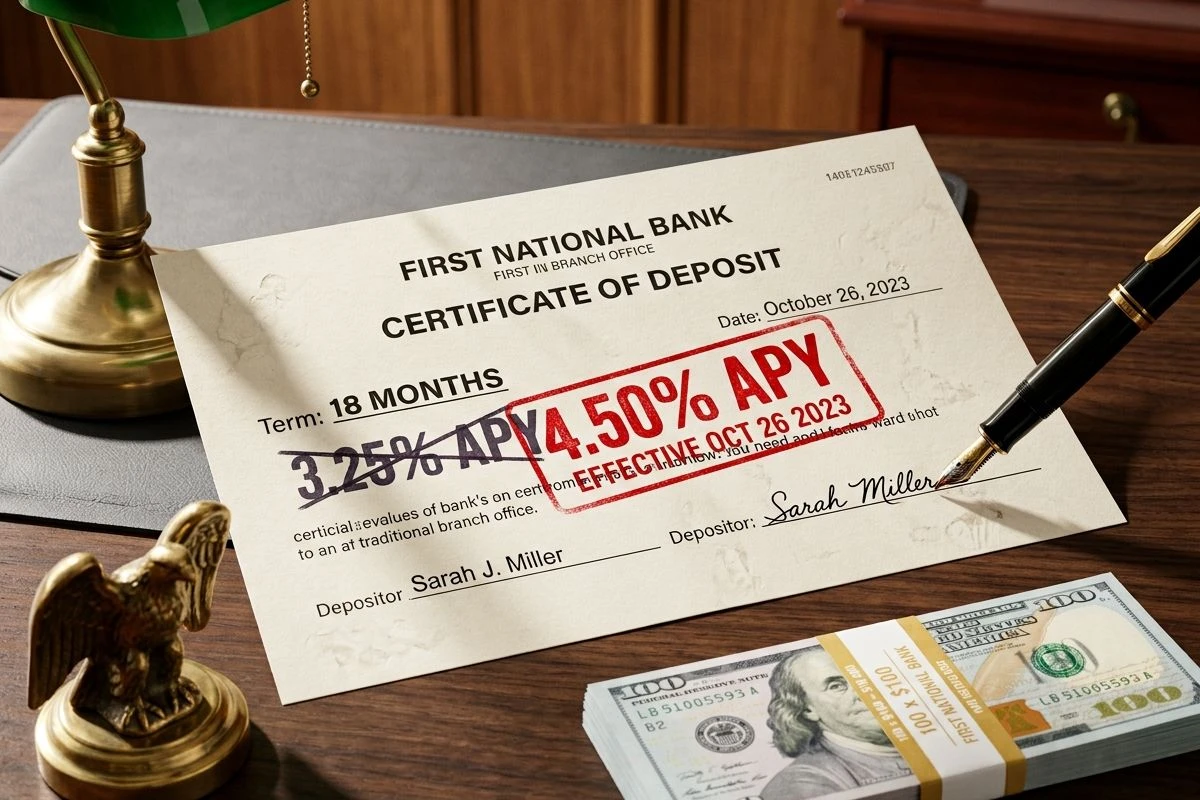
The Gap Most Savers Never See
The Federal Deposit Insurance Corporation’s national deposit rates for August, weighted by each institution’s share of deposits, still show how little the average account pays. The same week the leaderboards flashed 4.50%, the FDIC’s 12-month CD printed 1.71%.
TOP CD YIELDS VERSUS THE NATIONAL RATE
| Term | Top APY (Sept. 1) | FDIC national rate | Gap |
|---|---|---|---|
| 6-month | 4.30% (Quorum FCU) | 1.41% | 2.89 points |
| 1-year | 4.35% (Quorum FCU) | 1.71% | 2.64 points |
| 3-year | 4.50% (Popular Direct) | 1.34% | 3.16 points |
| 5-year | 4.50% (Popular Direct) | 1.36% | 3.14 points |
On $10,000, a 4.35% one-year CD pays $435 of interest. The same cash at the FDIC’s 1.71% national rate pays $171. That is $264 left on the table for anyone who never leaves a low-yield bank. The weekly survey average for one-year CDs, which mixes large banks with high-yield shops, is 2.04%, up one hundredth of a point from 2.03% on August 23. The “rise across four terms” is a leaderboard story. It is barely visible in the averages.
The FDIC’s 12-month CD national rate series has been climbing in tiny steps, from 1.53% in April to 1.71% in August, while top advertised yields stay more than two points higher. Savings accounts in that same FDIC table still pay 0.38%. Money market accounts pay 0.63%.
The curve is still inverted. The one-year survey average at 2.04% sits above the five-year average at 1.74%, a pattern that has held since February 2023. Banks are not paying extra for your five-year money because they expect to need it. They are paying to keep it from walking to the next online offer.
July’s Minutes Leave a Hike on the Table
The lock-in pitch still sounds like 2024, when the Federal Reserve was cutting. That is not the committee savers are dealing with now. The funds rate sits in a 3.50% to 3.75% range, the lowest since September 2022, after three cuts in late 2025 took it down from a 4.25% to 4.50% range. It has not moved in 2026.
The July 28-29 FOMC minutes show a 9-3 vote to hold. Cleveland’s Beth Hammack, Minneapolis’s Neel Kashkari, and Dallas’s Lorie Logan preferred a quarter-point increase. Staff told the committee that inflation remained elevated. Total PCE inflation was 4.1% in May and core PCE was 3.4%; the staff’s June estimate was 3.7% and 3.3%. The jobless rate was 4.2% in June.
At that meeting, market pricing fully discounted a 25-basis-point hike by September. The next gathering is September 15-16. Chair Kevin Warsh has pulled forward guidance, so savers do not get a hint in the statement. The Fed’s July hold and three dissents already pushed longer yields up even without a policy change.
A five-year CD at 4.50% looks generous next to a 1.36% national average. It looks less generous if the hikers win a round later this month and new certificates start with a 4 at a higher handle. Early withdrawal penalties are the price of changing your mind.
After Inflation, Top CDs Pay About 1%
Stated APY is not what a saver keeps. The Bureau of Labor Statistics said consumer prices up 3.4 percent in the 12 months through July, after 3.5% through June.
THE REAL YIELD ON A TOP CD
- Headline inflation: The CPI-U rose 3.4% year over year in July and 0.1% on the month, seasonally adjusted.
- Energy shock: Energy prices were up 14.7% over the year, with gasoline up 24.6%.
- Core prices: All items less food and energy rose 2.5% over the year; food rose 3.0%.
- After inflation: A 4.35% one-year CD clears about 0.95 point before tax; a 4.50% five-year CD clears about 1.10 points if 3.4% holds.
The FDIC’s 1.71% 12-month average is 1.69 points behind 3.4% inflation. Money left in a typical branch CD is losing buying power every month. Even the 4.35% leaderboard yield is a thin real return once federal and state tax on interest come out, and those taxes hit ordinary income.
That is the part the “cash is productive” line skips. A top CD still beats a 0.38% savings account by a wide margin. It does not rebuild the 5% real cushion savers had when advertised yields were above 5% and inflation was falling. Energy is doing a lot of the damage this year, and that can reverse. Until it does, the 4.50% sticker is a lot closer to standing still than it looks on a rate table.
What the Fine Print Costs on 4.50%
The highest number is rarely the cleanest account. Membership rules, minimums, and the channel you use can change the APY by a full point on the same bank’s CD.
CONDITIONS THAT CUT THE STATED YIELD
- High minimums: Popular Direct’s 4.50% three-year and five-year CDs need $10,000 to open, which shuts out smaller balances that CFG will take at $500.
- Credit union gates: Quorum’s 4.35% one-year lead is a federal credit union offer, so membership comes first, and the rate is not on every street corner.
- Brokered versus direct: On August 26, new three-year non-callable brokered CDs from Ally and Capital One paid 4.35% at Fidelity, Vanguard, and Schwab, while the same banks’ own websites listed 3.44% and 3.45%.
- Teaser caps: Some savings accounts advertise 4.50% only on the first few thousand dollars, then drop to a much lower APY on the rest.
- Early exit: Breaking a CD to chase a hike, or to cover an emergency, usually costs months of interest and can wipe the extra yield that made the term look smart.
Shop APY, not the advertised interest rate, because APY includes compounding and is the number that compares across banks. Then read the penalty, the minimum, and whether the issuer is a bank with FDIC insurance or a credit union with NCUA coverage. Large balances should be split so each ownership category stays inside the limit at each institution.
Keep Cash You Might Need in Savings
A one-year CD at 4.35% is only a hair above the best liquid accounts. Ken Tumin’s August 31 tap of online savings showed a top APY of 4.34%, unchanged from the week before, with the big-five online average at 3.14%. CIT Bank’s widely listed high-yield savings account pays 4.10%, about six times a 0.63% survey average for savings.
Since the first cut of this cycle on September 18, 2024, the funds rate has fallen 175 basis points, from 5.25%-5.50% to 3.50%-3.75%. The highest online savings APY has fallen 116 basis points, from 5.50% to 4.34%. Money-market fund yields have fallen faster; VMFXX’s SEC yield dropped 164 basis points, from 5.27% to 3.63%. Banks have been slower to cut liquid deposits than the Fed has been to cut, and slower still this past week.
So the one-year CD is not buying much extra yield over a top savings account. It is buying a rate lock. That lock helps if savings APYs roll over after the next Fed meeting. It hurts if you need the cash, or if the hikers get a vote and new CDs pay more while yours is frozen.
Emergency funds belong in a savings account you can tap without a penalty. Money with a date attached, a tuition bill, a home purchase, a tax payment, is the cash that can sit in a CD matched to that date. A ladder of three-month, six-month, and one-year certificates keeps some of the 4.30% to 4.35% range in reach without handing a bank your money until 2031.
Banks can live with that split. They are already easing other credit even without a cut, with small-business loan rates already falling. Paying up for a five-year CD while cutting loan coupons is a deposit grab, not a gift certificate for savers.
A Five-Year Lock Bets Against a Hike
The useful part of this week’s bump is short. Six-month and one-year certificates at 4.30% to 4.35% let a saver capture most of the leaderboard without signing up for a 2026 policy surprise. The 4.50% three-year and five-year prints are the duration sale. They pay a little more in exchange for a long bet that Chair Warsh’s committee does not raise, and that 3.4% inflation does not stick.
HOW CASH YIELDS GOT HERE
- September 18, 2024: The Fed makes the first cut of the cycle, with the funds rate then at 5.25% to 5.50%.
- September to December 2025: Three more cuts take the target range to 3.50% to 3.75%, where it still sits.
- July 28-29, 2026: The committee holds on a 9-3 vote; three members want a quarter-point hike, and markets price a September increase.
- August 19, 2026: Online banks mark term CDs higher, including Synchrony, Marcus, American Express, CFG, Bread Savings, and Credit One.
- September 1, 2026: Leaderboards show 4.35% on one year and 4.50% on three and five years, while the FDIC 12-month rate remains 1.71%.
- September 15-16, 2026: The next FOMC meeting decides whether those promotional APYs were a last look at 4.5% or a pause before higher offers.
If you already hold a high-yield savings balance, moving a slice you will not need for a year into a 4.35% CD is a small, clean trade. Rolling the rest at three- and six-month terms keeps optionality into the September meeting. Stretching for 4.50% through 2031 is a call that the hikers stay in the minority and that prices cool. The banks posting that number are asking you to make it.
Disclaimer: This article is news reporting and analysis of advertised deposit yields, and it is for information only. It is not investment, tax, or banking advice and is not a recommendation to open, close, or ladder any certificate of deposit or savings account. Readers should consult a qualified financial advisor or tax professional about their own cash needs, deposit-insurance coverage, and tax treatment of interest before moving money. Yields, minimums, penalties, and Fed policy cited here reflect the sources as of September 2, 2026 and can change without notice.


Space Cargo Buys Into France’s Zero-G Flight Company

The $399 Omni Walks Away, Then Asks for a Dock

TECNO’s 0mm Bezelless Phone Still Needs a Rim

The Ryobi Tools That Unblocked a Garage Workbench

Ripple’s 700 Million XRP Re-Lock Repeats a Yearlong Pattern

The 2026 Kawasaki Ninja ZX-10R Matches Honda’s Price

Chainlink Puts Official US Inflation and GDP Onchain

Google Pushes Gemini Daily Brief off the Chat Screen

The Crosshair A16 HX Outruns Its Own Power Brick

Cloover Turns a $350 Million Installer Book Into a Utility

Trump Iran Threat Wiped $238M Crypto Longs Then Flipped

30-Year Yield Hits 5.32% Highest Since 2007 as Debt Supply Locks In Costs

Oil Crashes Below $80 as Iran Talks Restart and Markets Split

Walter’s TWG Insists No Fraud as Insurer Probes Force Cleanup

Astute’s $1.2M bet makes B2B creator deals feed AI discovery

Strategy Parks $1.59B Cash While Bitcoin Stack Stays Flat

BlackRock Turns Cash Empire Into Stablecoin Reserve Rails

The 20% Savings Ideal Meets a 2.7% Reality Check

SpaceX Stock Rebound Tests Real Demand Before Huge Unlock

Amber’s €7M locks Mittelstand knowledge inside Europe
-
 FINANCE3 months ago
Zcash Patched a Double-Spend Bug as ZEC Climbed 5%
-
 ENTERTAINMENT3 months ago
Steam Summer Sale 2026 Locks In June 25 to July 9 Dates
-

 FINANCE2 months ago
CLARITY Act Final Text Expected This Weekend as 60-Vote Hurdle Looms
-
 NEWS4 months ago
Meta Adds AI Replies to Threads, But Users Can’t Block It
-

 NEWS3 months ago
YouTube Shorts is testing a heart in place of the thumbs-up
-

 NEWS1 month ago
Senators Force Apple Off Chinese Memory as Big Three Cash In
-

 NEWS3 months ago
NEURA Robotics’ $1.4B Series C Redraws Europe’s Physical AI Bet
-
 ENTERTAINMENT5 months ago
Extraction 3 Is Officially Coming to Netflix in 2027