
BUSINESS
Cloover Turns Profitable While Independent Installers Keep the Customer
Cloover hit a $350 million run rate with independent installers still owning every sale, backed by a $350 million EIF guarantee.

Cloover has turned profitable three years after launch at a $350 million revenue run rate, and it has added a $100 million financing line.
The Berlin platform still does not knock on doors. Independent installers sell every job, keep the customer, and grow the book that a $350 million European Investment Fund guarantee now helps to fund.
The EIF Puts $350 Million Behind Installer Sales
Cloover GmbH said on 1 September 2026 that the new facility lifts total financing capacity to more than $1.3 billion. That pool pays for solar, heat pumps, batteries and other home kit across the company’s markets, and it will soon cover jobs in the UK, France and Poland.
The public layer is the point of the structure. Cloover said the book is underpinned by a $350 million guarantee from the European Investment Fund. In January it had already cited a €300 million EIF guarantee beside a $1.2 billion debt line and a $22 million Series A led by MMC Ventures and QED Investors.
That is a lot of credit on a thin equity base. Seed funding in May 2024 was $114 million, led by Lowercarbon Capital, after a €7 million pre-seed in October 2023. The working machine is debt plus a public backstop, which is how a three-year-old firm can pay a local crew when the unit goes in.
THE CAPITAL STACK BEHIND CLOOVER
| Layer | Amount | What it does |
|---|---|---|
| New facility, 1 Sept 2026 | $100 million | Adds financing capacity |
| Total financing capacity | More than $1.3 billion | Pays for kit and installs |
| EIF guarantee (company figure) | $350 million | Underpins the loan book |
| Series A equity, January 2026 | $22 million | MMC Ventures and QED led |
The EIF product behind deals of this type is the InvestEU Sustainability Guarantee for green loans, an intermediated cover for small firms, private individuals and housing associations. Cloover says that backing helps it lend to self-employed workers and homeowners over 60, groups high-street lenders often skip.
The money is chasing a hole public grants do not fill. BUILD UP, the European Commission’s renovation portal, still puts the annual shortfall of at least €165 billion on energy upgrades in buildings. Cloover’s answer is a 25-year private loan, sold in the van, with the Union taking part of the credit risk.
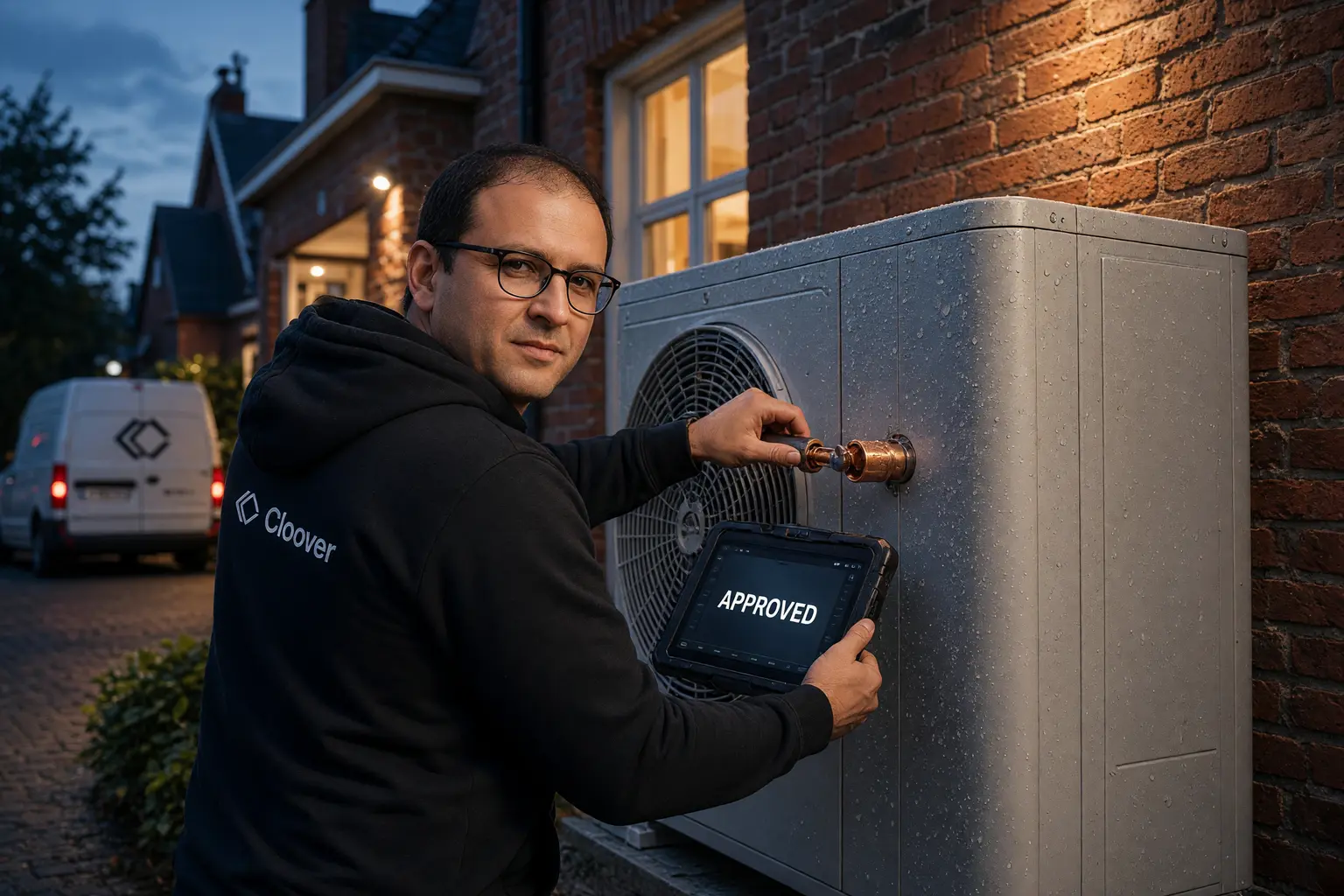
Independent Firms Still Own the Front Door
Jodok Betschart, Cloover’s co-founder and chief executive, built the company around the firms that already have the customer. “These SMEs are doing more than 85% of all the installations in people’s homes,” he said. “They’re doing a great job, but they’re often held back by limited working capital.”
The company line is almost the same. Cloover GmbH said it skipped a sales force and wrote software for the independent installers who serve around 85 percent of the market. About 20,000 installations a year now run through those partnerships, and Cloover said it grows only as they do.
Every project so far was sold by an independent installer. The local firm keeps its name, its customers and its choice of hardware. Cloover supplies the credit check, the software, and now energy products of its own.
WHAT THE INSTALLER KEEPS
- The brand: The local firm sells under its own name, including the later power-plant offer.
- The customer: Households stay with the installer they already trust, not a new utility logo.
- The hardware: The crew still picks the panels, pumps and batteries it wants to fit.
- The cash: Cloover takes the household payment risk and pays the installer after a successful fit.
On its own site Cloover puts more than 500 partners on the platform and claims those firms see 39% more revenue, 26% more customers and 32% more efficiency. It also claims financing packages can lift a smaller firm’s revenue by as much as a third. Betschart said company revenue has risen four-fold since the January Series A, which is a steep climb into a $350 million run rate.
Enpal, 1KOMMA5° and E.ON Solar still fight for the same rooftops with their own last-mile brands. Cloover’s wager is that most of Europe’s work will keep flowing through regional outfits that cannot hold much stock and cannot wait months to get paid.
What Households Sign in Under Two Minutes?
The household offer is built to remove the cheque that used to kill the job. Cloover said customers get a decision in under two minutes, pay nothing upfront, and can spread the cost over up to 25 years.
THE HOUSEHOLD CONTRACT
- Upfront cash: Zero down, with Cloover paying the installer after the fit is done.
- The clock: Credit and identity checks run in about two minutes on the platform.
- The term: Repayment can run as long as 25 years, with extra repayments allowed at any time.
- The file: Cloover says there is no Schufa hit and no entry in the land register.
- The pass rate: The company puts its acceptance rate at more than 90%.
That last pair is the mixed part of the story. A 25-year energy loan with no land charge and no standard German credit-file mark is easy to sell on a kitchen table. It also leaves a household tied to a platform that wants the relationship to last for decades, which is exactly how Betschart describes it.
We reach households through the installers they already trust, and then we turn each of those homes into a power plant, and each homeowner into a participant in the energy market. That is a relationship that lasts for decades, not a single transaction.
Jodok Betschart, co-founder, Cloover GmbH statement
Founded in 2023 by Betschart, Peder Broms and Valentin Gönczy, the firm started in Stockholm and moved its base to Berlin. It now lists offices and partners across five European markets, including Germany, Switzerland, Sweden, the Netherlands and a newer Vienna office in Austria.
Heat Pump Sales Dropped 22% Across Europe
Cloover is printing profit in a trade that recently shrank. The European Heat Pump Association’s 2025 market report found that heat pump sales fell 22 percent in 2024, to about 2.31 million units across 19 countries.
Germany, Europe’s biggest heating market, saw a 48% drop. The Czech Republic fell 64%. The UK rose 56%, and France still led on volume with 546,000 units. The installed stock in those 19 countries reached about 25.5 million, or roughly 12% of households.
EHPA blamed weaker subsidies, a sluggish economy, cheaper gas after the 2022 spike, and a lot of bad information about heat pumps. On the 2015 to 2021 trend, it said Europe would miss a 60 million unit goal for 2030 by 15 million units.
Residential solar had a hard year too, with last-mile studies putting 2024 installations down about 20%. Cloover’s pitch is that the bottleneck was never the panel. It was the cash, the paperwork, and a sales motion that asked a household to write a five-figure cheque before the scaffold went up.
If that reading is right, a slump in unit sales is exactly when an installer needs someone else to hold the credit risk. Cloover’s 20,000 jobs a year are still a slice of a 2.31 million heat-pump market, let alone solar and batteries. The $1.3 billion capacity is how it wants that slice to widen without hiring a retail army.
The Power Plant Wears Someone Else’s Badge
The next product is not another loan. Once the kit is in, Cloover Energy runs a home energy system, sells dynamic and fixed tariffs, and pools solar, batteries, heat pumps and EV chargers into a virtual power plant.
Cloover calls that an AI-native neo-utility. It owns no power stations. Its capacity is the installed base, and the product is what those homes can do for the grid. Models forecast generation and use house by house, then schedule storage and flexible loads inside limits the household sets, so a battery charges when power is cheap and a heat pump runs when it costs least.
Pooled across thousands of homes, that shift earns in three ways the company names: batteries feed power back when it is scarce, moved demand cuts grid fees, and the fleet trades on the intraday market as prices move in real time. Installers offer that plant to customers under their own name. Cloover runs the market processes in the background.
Valentin Gönczy, the co-founder who leads product, said everything from underwriting to in-home optimisation runs on AI. “The incumbents are adding AI to systems built decades ago. We can do in seconds what takes them days, and the gap widens as we scale.”
The regulatory stick is already in the diary. Cloover said feed-in tariffs and net-metering schemes that carried rooftop solar for two decades are being phased out or rebuilt across Europe, in several markets as soon as 2027. A fixed export payment goes away. A household that can trade flexibility in real time has a replacement cheque, at least on paper.
Global power demand is the backdrop Cloover wants attached to that cheque. The IEA’s Electricity 2026 outlook puts average growth at 3.6 percent a year through 2030, as industry, cars, cooling and data centres draw more current and grids lag behind.
New Offices Open in the UK, France and Poland
The $100 million line is also a map. Cloover said it is opening offices in the UK, France and Poland, three markets where heat-pump policy, installer density and household credit rules all differ from Germany.
France already leads Europe on heat-pump volume. Poland is a fast-growing heating market with a heavy coal and gas legacy. The UK has lagged on installer skills, with trade surveys last year showing fewer crews able to fit pumps than in Germany, even as British sales rose from a low base.
Large energy retailers in those countries already sell green home kit and green loans. Fintech lenders are in the same queue. Cloover’s claim is that SME installers still do most of the physical work, and that a two-minute credit decision inside the quote is what those firms lacked.
HOW THE MONEY STACKED UP
- October 2023: Raises €7 million in pre-seed funding as a Stockholm-born climate fintech.
- May 2024: Closes a $114 million seed round led by Lowercarbon Capital, with QED Investors and 9900 Capital in the round.
- January 2026: Adds a $22 million Series A and a $1.2 billion debt facility, with a €300 million EIF guarantee, and names Germany, Switzerland, Sweden and the Netherlands as live markets.
- 1 September 2026: Declares profit at a $350 million run rate, adds $100 million of capacity, cites a $350 million EIF guarantee, and says UK, France and Poland offices are opening.
Bosch Ventures, Centrotec and Earthshot Ventures joined the Series A, which puts kit makers in the cap table beside the lenders. The unnamed European bank that provided the January debt line still has not been named in Cloover’s public statements.
Peder Broms Says the Hardware Already Works
Peder Broms, the co-founder who has served as chief financial officer, put the remaining gap in one line. “The hardware for the energy transition already works,” he said. “What has been missing is a company that makes it affordable, reaches people through the installer they know, and turns their homes into a real energy business.”
Affordable, in this model, means a 25-year payable with no deposit, underwritten fast enough to close while the quote is still on the table. The installer they know is the SME that already has the van. The energy business is a virtual plant that trades quarter-hours of flexibility Cloover does not generate itself.
Cloover GmbH likes to say profit at this scale is uncommon among fast-growing energy companies that still put growth ahead of margins. The quieter fact is who carries the customer: more than 500 local firms, 20,000 jobs a year, and a Union guarantee on the loans that make those jobs possible. The next test is whether that same crew can sell a power plant, not just a pump, once the offices in London, Paris and Warsaw are open.
Disclaimer: This article is news reporting and analysis of Cloover GmbH’s 1 September 2026 announcement and related public figures. It is informational only and does not constitute investment, lending, energy-tariff or household-finance advice. Readers considering solar, heat-pump or home-energy loans, or any investment in private energy platforms, should consult a qualified financial adviser or licensed credit broker in their country before acting. Figures, product terms, office plans and guarantee amounts reflect the named company, EIF, EHPA, IEA and Commission sources as of 2 September 2026 and may change.


Space Cargo Buys Into France’s Zero-G Flight Company

The $399 Omni Walks Away, Then Asks for a Dock

TECNO’s 0mm Bezelless Phone Still Needs a Rim

The Ryobi Tools That Unblocked a Garage Workbench

Ripple’s 700 Million XRP Re-Lock Repeats a Yearlong Pattern

The 2026 Kawasaki Ninja ZX-10R Matches Honda’s Price

Chainlink Puts Official US Inflation and GDP Onchain

Google Pushes Gemini Daily Brief off the Chat Screen

The Crosshair A16 HX Outruns Its Own Power Brick

Cloover Turns a $350 Million Installer Book Into a Utility

Trump Iran Threat Wiped $238M Crypto Longs Then Flipped

30-Year Yield Hits 5.32% Highest Since 2007 as Debt Supply Locks In Costs

Oil Crashes Below $80 as Iran Talks Restart and Markets Split

Walter’s TWG Insists No Fraud as Insurer Probes Force Cleanup

Astute’s $1.2M bet makes B2B creator deals feed AI discovery

Strategy Parks $1.59B Cash While Bitcoin Stack Stays Flat

BlackRock Turns Cash Empire Into Stablecoin Reserve Rails

The 20% Savings Ideal Meets a 2.7% Reality Check

SpaceX Stock Rebound Tests Real Demand Before Huge Unlock

Amber’s €7M locks Mittelstand knowledge inside Europe
-
 FINANCE3 months ago
Zcash Patched a Double-Spend Bug as ZEC Climbed 5%
-
 ENTERTAINMENT3 months ago
Steam Summer Sale 2026 Locks In June 25 to July 9 Dates
-

 FINANCE2 months ago
CLARITY Act Final Text Expected This Weekend as 60-Vote Hurdle Looms
-
 NEWS4 months ago
Meta Adds AI Replies to Threads, But Users Can’t Block It
-

 NEWS3 months ago
YouTube Shorts is testing a heart in place of the thumbs-up
-

 NEWS1 month ago
Senators Force Apple Off Chinese Memory as Big Three Cash In
-

 NEWS3 months ago
NEURA Robotics’ $1.4B Series C Redraws Europe’s Physical AI Bet
-
 ENTERTAINMENT5 months ago
Extraction 3 Is Officially Coming to Netflix in 2027