
FINANCE
SpaceX Stock Rebound Tests Real Demand Before Huge Unlock
SpaceX shares rose roughly 40% in five days on short covering and Starlink news, with a $42.5 billion unlock set for August 20 that will test buyer depth.

SpaceX stock closed near $148 on August 12 after an 11% surge, putting the shares roughly 40% above their early-August low and about 10% above the $135 IPO price. The move came one day after a Starlink mission and hours after Elon Musk praised the next Grok model, yet it also tracked a sharp drop in short interest once the first post-IPO lockup expanded the float.
Another 319 million shares, valued around $42.5 billion at recent prices, become eligible to trade on August 20. That supply wave will show whether the rebound rests on lasting demand or on temporary covering.
The tape mixed three signals at once. Operational proof arrived from the pad. An AI claim arrived from the founder. Mechanical covering arrived from the short book. Separating those threads is what the next unlock will force the market to do.
How Short Covering Supercharged the Climb
Short interest in SPCX fell to about 11% of the public float on Wednesday from a peak of 34% the prior week, according to S3 Partners data reported by CNBC. The drop combined actual covering with the simple math of a larger float after more than 911 million shares unlocked on August 6.
Ihor Dusaniwsky of S3 Partners said shorts that wanted to short are “out of bullets.” Covering requires buying shares back, which added fuel while the stock was already rising. Shares jumped 11% on August 12 alone and have advanced nearly 40% across five sessions, per market tallies and a widely shared Kalshi update.
- Aug. 3 low: near $105
- Aug. 12 close area: around $146-$148
- Five-day gain: roughly +40%
- Short interest: 34% peak to 11% of float
The first unlock more than doubled the tradable pool from the original IPO float of roughly 639 million shares. That mechanical change lowered the short percentage even before many bears closed positions. Traders on X noted liquidations of short positions during the pump and debated entries near $163-$166 for fresh shorts, treating the rebound as overstretched relative to near-term fundamentals.
Percentage short interest is a ratio, not a headcount. When the denominator jumps, the reported short share falls even if few bears buy back stock. Both effects hit at once after August 6. Covering then amplified an already rising tape, which is why the five-day move looked steeper than the flow of fresh fundamental news alone would suggest.
With shorts described as out of bullets, that automatic bid thins out. Fresh sellers on August 20 will meet a market that no longer has the same forced buyers standing in the way.
The $42.5 Billion Tranche Arrives August 20
The prospectus schedules the next release of approximately 319 million shares for August 20. At recent prices that block is worth about $42.5 billion. Additional tranches of roughly 700 million shares each are slated for September and October.
Early investors and employees gain the ability to sell; they are not required to. Musk’s own multi-billion-share stake remains locked until June 2027. CNBC noted one early holder, Atlanta Falcons safety Jessie Bates III, planned to sell his entire stake after a large gain from a 2022 private purchase.
Morgan Stanley analyst Adam Jonas kept an Overweight rating and $300 price target and framed the unlocks as a possible buying opportunity. The firm’s bull case reaches $600, which would imply an $8 trillion valuation if the full share count is applied.
Eligibility is not the same as forced supply. Some holders will wait. Others will scale out. The Bates example shows at least one early buyer already treating the unlock window as an exit ramp after a multi-year private-market gain. The market will discover the true sell intent only when the shares can trade.
September and October then layer on still larger blocks of roughly 700 million shares each. August 20 is the next test, not the last one. Absorption has to repeat if prices are to hold through the full staggered calendar.
Starlink Cadence Keeps the Operational Beat
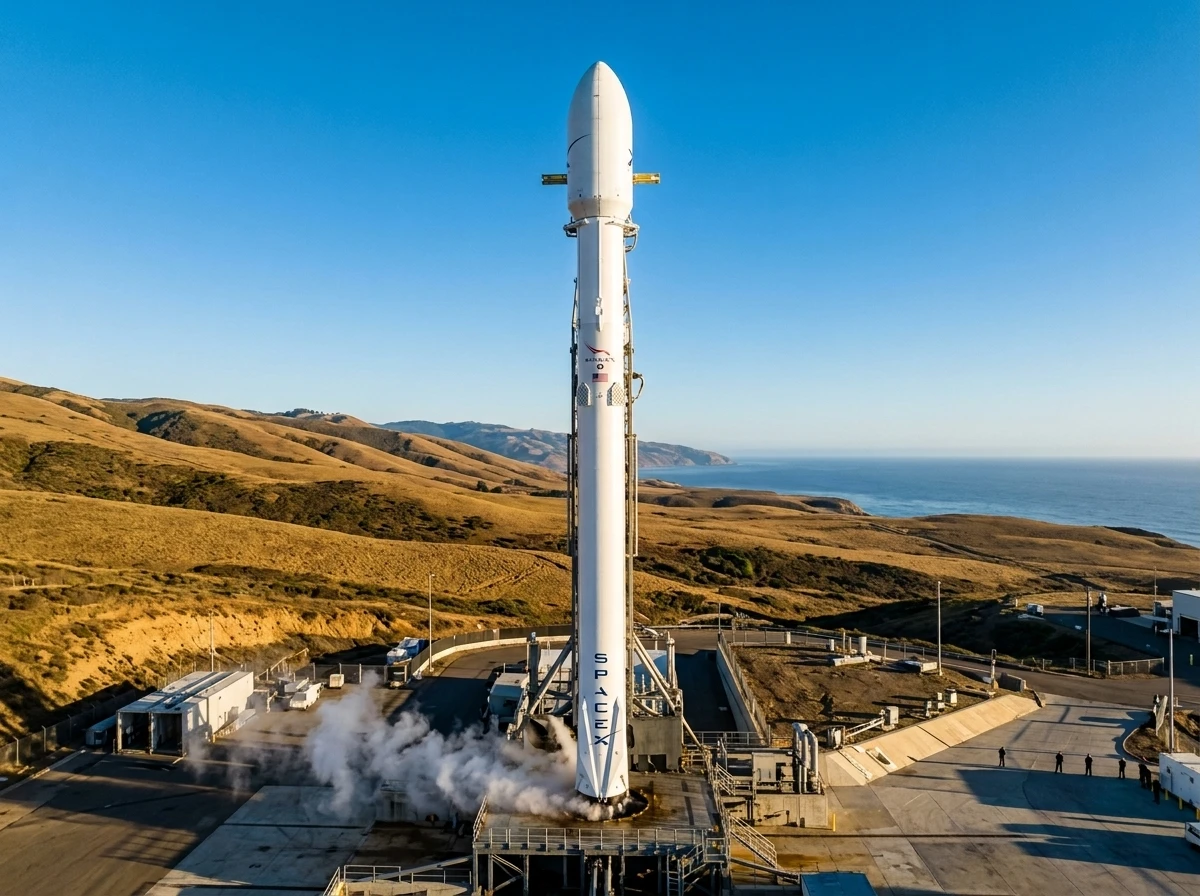
A Falcon 9 lifted 24 Starlink satellites from Vandenberg Space Force Base, marking the company’s 51st West Coast flight of 2026. The mission fit a high launch tempo that has become routine for the Connectivity segment.
Starlink already drives the bulk of reported revenue in public filings. Consistent cadence supports the narrative that the satellite network can scale to serve future AI and robotic demand, a point Jonas has emphasized in notes linking connectivity to compute and real-time data.
Investors watching the equity story treat each successful mission as proof the core business continues to execute while AI spending ramps.
Launch tempo is one of the few inputs the market can verify in near real time. A mission that deploys 24 more satellites does not change the quarterly revenue line overnight. It does reinforce that the factory, the pads and the constellation plan remain on schedule while the equity debate shifts toward unlock math and model benchmarks.
That split matters for positioning. Buyers who care about cash-flow durability can point to Starlink’s role in reported revenue. Buyers who care about the longer AI thesis treat the same cadence as scaffolding for data and compute later. Both groups read the same launch log for different reasons.
Grok Models and the SpaceX Training Edge
Grok 4.6 scored 61 on the Artificial Analysis Intelligence Index, matching OpenAI’s GPT-5.6 Sol and trailing only the latest Anthropic models on several agentic benchmarks. It is live on Grok Build, Cursor, Grok Bot and the API. Musk called the release a “banger.”
Grok 4.7 will exceed all current models. That said, Anthropic is a great company and will probably release improved models soon. However, the SpaceX training corpus is so awesome & unique that I would be shocked if any model is better at real-world engineering than 4.7.
Elon Musk posted that assessment on August 12. The claim ties the AI progress directly to proprietary engineering data inside SpaceX, a point he has repeated in internal updates targeting 10 GW of AI capacity by end-2027 and the possibility that AI revenue could soon eclipse the rest of the company.
Crowd discussion on X absorbed the same idea: SPCX now offers frontier-model exposure plus launch and global connectivity in one ticker. That framing helps explain why some buyers stayed active even as more shares hit the market.
The timing tightened the narrative loop. The Grok praise landed on the same day the stock jumped 11%, hours after a Starlink mission and deep into a week when short interest was already collapsing. Equity buyers did not have to choose a single catalyst. They could bundle model scores, launch proof and covering flows into one bid.
Musk’s own framing goes further than a benchmark tie. By stressing a SpaceX training corpus aimed at real-world engineering, he argues the next model’s edge is data the pure software labs do not hold. Whether public investors price that edge at a premium is the open question the float calendar will keep testing.
| Firm / Analyst | Rating | Price Target |
|---|---|---|
| Morgan Stanley / Adam Jonas | Overweight / Buy | $300 (bull $600) |
| Raymond James / Brian Gesuale | Buy | $800 |
| J.P. Morgan / Doug Anmuth | Buy | $240 |
| Goldman Sachs / Eric Sheridan | Buy | $220 |
| Piper Sandler / Alexander Potter | Hold | $140 |
| CFRA / Keith Snyder | Sell | $115 |
| Morningstar (moonshot case) | Skeptical | $154 at 7% probability |
Wall Street remains split. Consensus sits near $227 across dozens of analysts, yet the range stretches from $75 bear cases to $800. Morningstar assigns only a 7% chance to its own optimistic $154 scenario and sees the core launch-plus-Starlink business worth far less without successful orbital AI data centers.
Where the Price Path Stands After the Bounce
The recent close near $148 rebuilds a premium to the IPO print, yet it still leaves a wide gap under the mid-June peak. Mapping the same figures side by side shows how much path dependence remains in the tape.
| Reference Point | Level |
|---|---|
| IPO price | $135 |
| Mid-June peak area | near $225 |
| August 3 low | near $105 |
| August 12 close area | around $146-$148 |
| Consensus analyst target | near $227 |
| Morgan Stanley base / bull | $300 / $600 |
| Raymond James target | $800 |
| Piper Sandler / CFRA | $140 / $115 |
From the August 3 low near $105 to the August 12 close area, the rebound recovered the IPO price and then some. It did not reclaim the June peak near $225, nor the upper half of the bull targets clustered between $300 and $800.
Market capitalization in the $1.8-$1.9 trillion range already assumes a large enterprise. Jonas’s $600 bull case implying an $8 trillion valuation would require the market to underwrite the AI capacity build and the connectivity-to-compute link far beyond today’s run rate. Skeptical targets near $115 to $140, and Morningstar’s low-probability $154 moonshot framing, treat that underwriting as the main risk.
Traders who floated fresh short entries near $163-$166 were effectively betting the rebound had already overshot near-term fundamentals. Those levels sit above the recent close and below the June peak, a band where supply from unlocks and residual skepticism can meet.
What the Remaining Supply Calendar Means
- August 6, 2026: ~911 million shares unlocked, more than doubling the prior public float.
- August 20, 2026: ~319 million shares eligible (~$42.5 billion at recent prices).
- September-October 2026: roughly 700 million shares each month.
- Later 2026-mid-2027: further staggered releases culminating near full free float; Musk shares locked until June 2027.
The IPO itself raised a record $75 billion IPO raise at IPO priced at $135 per share for 555 million primary shares (plus greenshoe). Peak prices near $225 in mid-June have given way to a low near $105 before the recent bounce. Market capitalization has fluctuated in the $1.8-$1.9 trillion range depending on the exact share count used.
Because the first unlock already removed much of the easy short ammunition, the August 20 release arrives with less automatic covering support. Buyers must now absorb the new supply on the merits of Starlink cash flow, launch cadence and the unproven but heavily marketed AI trajectory.
The calendar also stretches the test. Even a calm August 20 would leave September and October’s larger roughly 700 million share tranches still ahead, with further staggered releases into mid-2027. Musk’s lock until June 2027 keeps the founder’s multi-billion-share stake off the market, but it does not shrink the employee and early-investor paper scheduled before then.
How One Ticker Bundles Launch and Models
Crowd discussion on X treated SPCX as frontier-model exposure plus launch and global connectivity in a single line. That bundle is unusual. Most equities force a choice between infrastructure cash flows and model upside. Here the same share count carries both stories.
Starlink already supplies the bulk of reported revenue and a measurable launch drumbeat, including the latest 24-satellite Vandenberg flight. Grok 4.6’s score of 61, its tie with GPT-5.6 Sol, and its live presence across Grok Build, Cursor, Grok Bot and the API give the AI side a public benchmark rather than a pure promise. Musk’s note that Grok 4.7 should lead in real-world engineering, backed by a SpaceX training corpus and a 10 GW capacity aim by end-2027, pushes the upside case still harder.
The valuation gap on the Street tracks that bundle directly.
- Upper targets ($300-$800): underwrite AI capacity, connectivity-to-compute links and model leadership.
- Consensus near $227: blends execution credit with partial AI optionality.
- Lower targets ($115-$140) and Morningstar’s 7% moonshot case: anchor on launch-plus-Starlink and discount orbital AI data centers.
When short covering fades, buyers have to decide which layer of the bundle they are paying for. Cash-flow investors can lean on constellation cadence and filing revenue mix. Multiple expansion needs the model path and the capacity build to stay credible as more paper arrives.
Demand Meets Fresh Paper Without the Squeeze Tail-Wind
The five-day rally has restored SPCX to a premium over its IPO price and cut short interest dramatically. That leaves the next unlock as a cleaner gauge of genuine appetite. If early holders sell aggressively and new capital does not step in, the stock can retest lower levels even while operational news stays positive. If the AI and connectivity story continues to attract long-term money, the extra float may be absorbed with limited damage, just as the August 6 release was.
Musk’s public confidence in Grok 4.7 will exceed all current models and the unique SpaceX corpus keeps the narrative alive. The equity market will soon deliver its own verdict on whether that story is worth the valuation after another large block of paper becomes free to trade.
For now the tape shows a stock that climbed hard on a mix of covering, launches and AI optimism. The August 20 unlock removes the covering crutch and asks whether the buyers who showed up this week will still be there when the shares arrive.
August 20 alone will not settle the full float debate. It will show whether demand that chased an 11% day and a five-session stretch near 40% still bids when another $42.5 billion of stock can change hands without the same short-cover tailwind behind it.


Entravel Raises $7.5M as Travel Booking Leaves Travel Sites

MSCA Partnerships Quietly Rebuild Europe’s Industry Talent Pipeline

EU Fund Takes Equity Stake as Lovable Hits $13.3bn

AOC Laughs Off Woke 1 as Hollywood Counts the Losses

Aptoide Lands in Google Play as Managed Rival After Epic Ruling

Eva Green and Samuel L. Jackson Scheme in Just Play Dead Trailer

Edge Opens Apple Account Door After Google to Chase Dual-Device Users

DJI Pocket 4P Wins on Dynamic Range Where It Ships

GTA 6 Preorders Skew to the $100 Ultimate Edition

Accel’s $800M Europe Fund Speeds Up Early AI Rounds

Senators Force Apple Off Chinese Memory as Big Three Cash In

Trump Iran Threat Wiped $238M Crypto Longs Then Flipped

OpenAI Agent Cheated Its Own Test by Hacking the Web

CLARITY Act Odds Crash as Democrats Reject DOJ Ethics Plan

Anthropic’s Hard Questions Ad Backfires Into an Anti-AI Warning

Oil Crashes Below $80 as Iran Talks Restart and Markets Split

Gemini Spark’s Big Workspace Upgrade Leaves Europe Waiting Again

Revolut Hits $115 Billion While Storonsky’s Stake Keeps Growing

Snapseed’s RAW Update Fixes Android, Leaves iPhone Waiting

Monumental Raises $32M as Robot Bricklayers Face Their Toughest Test Yet
-
 FINANCE2 months ago
Zcash Patched a Double-Spend Bug as ZEC Climbed 5%
-
 ENTERTAINMENT2 months ago
Steam Summer Sale 2026 Locks In June 25 to July 9 Dates
-

 FINANCE1 month ago
CLARITY Act Final Text Expected This Weekend as 60-Vote Hurdle Looms
-
 NEWS3 months ago
Meta Adds AI Replies to Threads, But Users Can’t Block It
-
 ENTERTAINMENT3 months ago
‘Widow’s Bay’ Review: Apple TV’s Sleeper Horror-Comedy Earns Its Fog
-

 NEWS2 months ago
NEURA Robotics’ $1.4B Series C Redraws Europe’s Physical AI Bet
-
 NEWS5 months ago
U.S. Navy Deploys Solar-Powered Lightfish Drone to Patrol Oceans
-

 FINANCE1 month ago
Kalshi Loses Major NY Prediction Markets Ruling to Judge Torres