
ENTERTAINMENT
Warner Bros Bets $80 Million on Mitchell’s Dinosaur Suburb
David Robert Mitchell’s $80M original dino thriller opens Friday with strong reviews and modest tracking, testing Warner Bros’ appetite for non-franchise swings.

Warner Bros. opens David Robert Mitchell’s The End of Oak Street on Friday after sinking an estimated $80-85 million into an original 1980s suburban dinosaur thriller starring Anne Hathaway and Ewan McGregor. Tracking points to a $20-25 million debut from roughly 3,400 theaters while critics have delivered an 83% Rotten Tomatoes score from nearly 100 reviews.
The numbers turn the release into a live test of whether a lean, non-franchise creature feature can still clear the bar for a studio that has spent years banking on ambitious originals under co-chairs Michael De Luca and Pamela Abdy.
Everything about the rollout is scaled to that question. Premium formats without IMAX, a tight runtime, and a cast that can sell both family fracture and monster panic all point to the same wager: that craft and premise can still pull a crowd when no sequel hook is waiting in the wings.
An $80 Million Wager on Original Scale
Deadline puts the net production budget near $80 million. IMDb lists an estimated $85 million. Either figure marks a massive leap for Mitchell, whose last two features stayed under $9 million combined.
- $80-85 million net/estimated production cost
- $20-25 million projected opening weekend
- ~3,400 theaters, premium formats but no IMAX
- 83% Tomatometer from 99 reviews
Spider-Man: Brand New Day and Christopher Nolan’s The Odyssey currently lock up the IMAX screens. That leaves Oak Street fighting for standard and PLF real estate in the final full weekend before school returns. Back-of-envelope math suggests the film needs something near $200 million worldwide once marketing is counted. Legs will decide more than the opening frame.
The gap between production cost and projected debut is the entire story in miniature. A film this size rarely gets a second chance to introduce itself. Word of mouth has to travel fast, and the calendar offers little cushion once classrooms refill.
Studio math at this tier is unforgiving. Marketing spends push the real break-even well past the production line, which is why the worldwide target sits near that $200 million mark. An opening in the low twenties only works if the second and third weekends hold a healthy share of the first.
How a Cul-de-Sac Landed in the Mesozoic
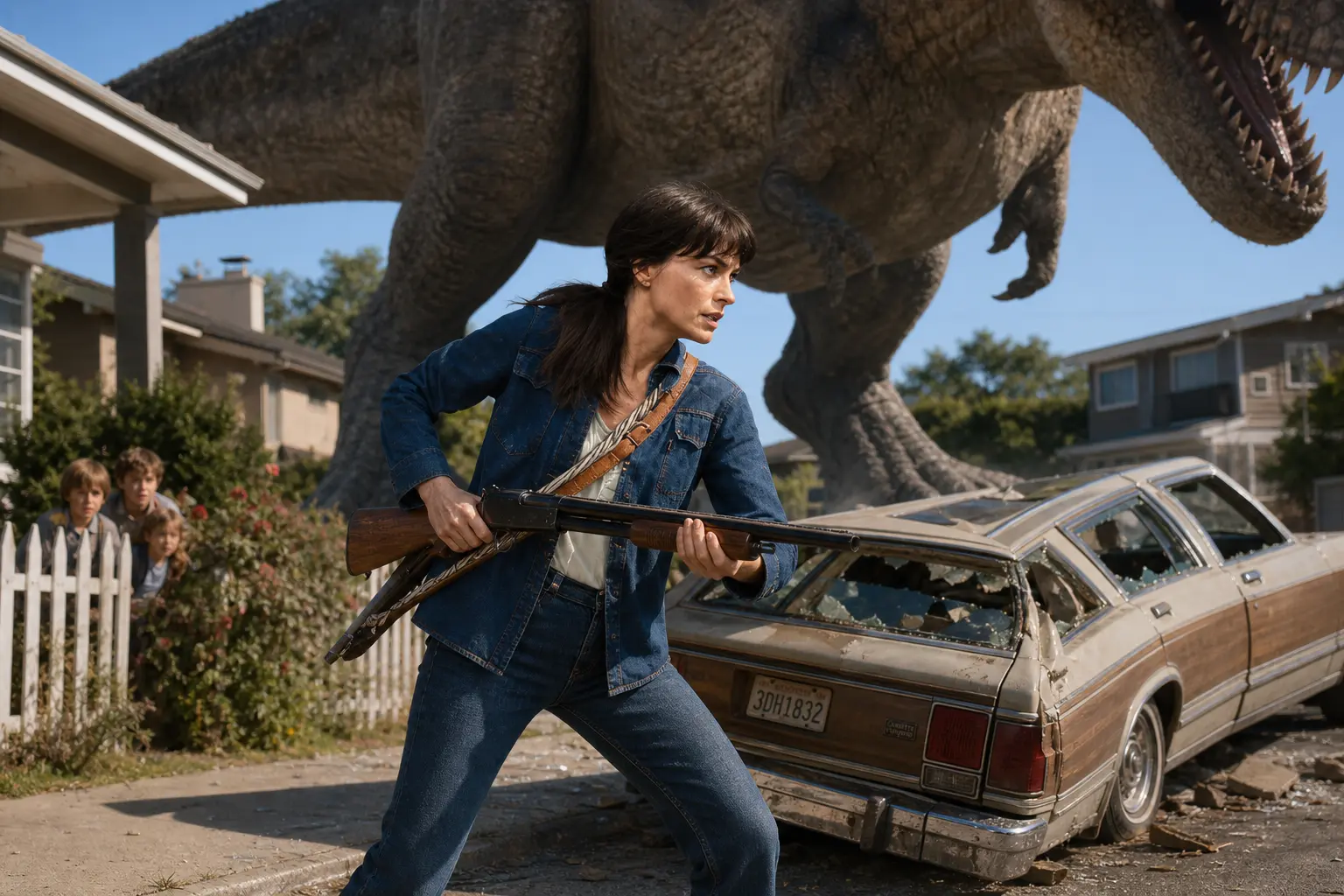
The premise is pure Twilight Zone. A cosmic burst during a rainstorm rips the Platts’ entire neighborhood out of 1980s suburbia and drops it into a landscape thick with dinosaurs. Greg (McGregor) is a struggling, drinking patriarch. Denise (Hathaway) is an aspiring writer who has sidelined her own ambitions. Their kids Audrey (Maisy Stella) and Brian (Christian Convery) are already testing the edges of teen rebellion. Family fractures vanish the moment the first creature appears.
- Early 2023: Project announced via Bad Robot and Jackson Pictures for Warner Bros.; Hathaway attached.
- Early 2024: McGregor replaces Oscar Isaac; title revealed as Flowervale Street.
- January 2026: Retitled The End of Oak Street; first teaser follows in March.
- August 12-14 2026: Reviews lift embargo; theatrical and IMAX-adjacent rollout begins.
Mitchell keeps metaphor talk to a minimum. One brief physics chat with the Carl Sagan-loving daughter is about all the film allows. Everyone else is too busy inventing ways to stay alive with shotguns, sledgehammers, and suburban ingenuity.
That restraint shapes the whole tone. The cosmic burst is a delivery system, not a puzzle to solve. Once the neighborhood lands, the movie cares about who grabs the sledgehammer and who freezes. The family drama does not pause for lectures; it simply reroutes through panic and improvisation.
Title changes and casting swaps along the path show how long the project sat in development before locking its final identity. Flowervale Street became The End of Oak Street only months before the teaser landed. The core idea never moved: one block, one family, too many teeth.
Craft That Stretches Every Dollar
Cinematographer Michael Gioulakis, who shot It Follows, and production designer Maya Shimoguchi pack the 2.39:1 frame with background gags and sudden reveals. Composer Michael Giacchino supplies the score; the Michael Giacchino original soundtrack release dropped days before opening. Runtime sits at a tight 99 minutes, PG-13.
| Film | Year | Budget | Worldwide Gross |
|---|---|---|---|
| It Follows | 2014 | ~$1.5 million | ~$24 million |
| Under the Silver Lake | 2018 | ~$8.5 million | ~$2.1 million |
| The End of Oak Street | 2026 | $80-85 million | TBD |
The jump is obvious. Mitchell stages escalating set pieces with clear rules: a new creature arrives, the family improvises, they escape by a whisker. Split-diopter shots and nested background details give the images a tactile, almost practical texture even when the dinosaurs dominate. The Playlist review notes that the thrills stay predictable yet pleasing, never monotonous across the episodic structure.
Gioulakis and Shimoguchi treat the wide frame like a packed suburban lot. Gags hide in porches and driveways until a head turns or a shadow moves. That density rewards a second look without slowing the forward rush of the 99-minute cut.
Giacchino’s score arrives as its own product before most audiences have seen a frame. The early soundtrack drop is a classic event-film move, signaling confidence that the music can travel on its own and pull curious listeners toward the theater.
Hathaway Leads a Game Ensemble
Hathaway shoulders the emotional and physical load, often with a shotgun in hand. Reviewers single out her ability to sell both tender family beats and the film’s wilder, more grotesque turns, including one demented death sequence already earmarked for meme status. McGregor plays the flawed father with conviction even when the script leaves some of his arcs unresolved. Stella and Convery supply the teenage chaos that keeps the stakes personal.
- Anne Hathaway as Denise Platt, the determined mother and aspiring writer
- Ewan McGregor as Greg Platt, the economically strained patriarch
- Maisy Stella as Audrey, the science-minded teen
- Christian Convery as Brian, the younger son whose choices force the family outdoors
Supporting turns include Jordan Alexa Davis, P.J. Byrne and Chris Coy. The official synopsis and full crew credits also list producers J.J. Abrams, Hannah Minghella, Jon Cohen, Matt Jackson and Tommy Harper. Hathaway arrives fresh from other high-profile work, including Hathaway’s recent A24 drama Mother Mary and her role in Nolan’s The Odyssey.
Denise’s arc gives the spectacle a human hinge. She has shelved her writing life for the household; the dinosaurs do not care, and neither does the plot. Survival simply forces her back into decisive motion, shotgun and all.
Audrey’s science streak and Brian’s risky choices keep the kids from becoming luggage. Their rebellion does not vanish; it gets redirected at predators. That choice keeps the family unit noisy and specific instead of purely symbolic.
Tracking Shows Interest Outrunning Awareness
Unaided awareness has lagged behind comparable monster movies such as The Meg ($45.4 million open in 2018) and Rampage ($35.7 million). Interest, however, consistently runs ahead of awareness once audiences learn the premise exists. Hathaway tests especially well with women. Previews begin Thursday afternoon.
The End of Oak Street is a rose-tinted romp through Spielberg’s ’80s, complete with dinosaurs, an incredible Anne Hathaway performance, and a visual flare to elevate it beyond just impersonation.
That line from IGN’s review captures the early critical consensus. On X, viewers have called it the first great dinosaur movie since the original Jurassic Park and “gnarly as hell” for a PG-13 rating. Others note the logic gaps and the sheer absurdity of dino sex and silent stalking. The crowd layer is clear: audiences starved for tactile original creature features are showing up ready to root for the Platts.
| Title | Opening Weekend | Context |
|---|---|---|
| The Meg (2018) | $45.4 million | Awareness benchmark |
| Rampage (2018) | $35.7 million | Awareness benchmark |
| The End of Oak Street (2026) | $20-25 million (proj.) | Interest leads awareness |
The awareness gap is real and measurable against those earlier creature opens. What tracking keeps repeating is the flip side: once the premise lands, interest jumps. That pattern favors strong trailers, Thursday previews, and a cast face audiences already trust.
Hathaway’s numbers with women give the campaign a clear lane. Monster movies often skew male in early tracking; a lead who tests across that line widens the floor before any second-weekend expansion.
Critics See Craft and Limits in Equal Measure
The Playlist’s Marshall Shaffer graded it a B, praising the visual ingenuity and Hathaway’s commitment while noting the film never quite advances the genre and sometimes loses tonal control. Other voices land higher, labeling it the surprise of the summer and a commercial rebound for Mitchell after Under the Silver Lake’s arthouse flop. A minority find the writing thin or the set pieces repetitive. The IMDb listing with $85 million budget already hosts a spread of user scores that mirror the professional split: some call it underwhelming, others put it near the top of the year’s thrills.
Mitchell’s assured eye for detail can tip into showy moments, and the family-drama payoff stays partial. Yet the 99-minute pace and the sheer inventiveness of staging keep the ride moving. For a system that greenlights few original films at this scale, the expectations alone create pressure the movie never fully asked for.
The split is stable rather than chaotic. Praise clusters around images, pace, and Hathaway; doubt clusters around thin writing and genre advancement. That is a workable profile for a mid-August original if exits stay friendly.
- Visual ingenuity and split-diopter texture draw consistent praise
- Hathaway’s tender-to-grotesque range anchors the higher grades
- Episodic set pieces please some viewers and tire others
- Family-drama payoffs read as partial even to admirers
User scores on the IMDb listing already echo the same fault lines. The film is landing as a craft-forward crowd-pleaser for one camp and a thin high-concept ride for another. Neither camp seems bored.
Why Legs Matter More Than Debut
Opening weekend only starts the clock. The real test is whether a $20-25 million bow can stretch toward that near-$200 million worldwide need once marketing is folded in. Comparable creature titles showed that awareness gaps can close when the premise travels by word of mouth.
School returning the following week trims the calendar. Families who skip the first weekend have fewer easy slots left. That pressure makes Thursday previews and Friday exits more than vanity metrics; they feed the only advertising the film can still afford after the spend is sunk.
Premium large formats without IMAX still offer a showcase lane. The movie must win those screens on spectacle and clarity of staging, not on exclusive format branding. Gioulakis’s wide-frame gags and the episodic creature arrivals are built for exactly that kind of communal viewing.
If holds stay sturdy, the modest open becomes a feature rather than a bug. A film that opens in the low twenties and refuses to collapse proves demand for original scale without needing a franchise halo. If the drop is steep, the same number hardens into a cautionary slide for the next mid-budget swing.
What the Reviews Leave on the Table
Critics agree on the surfaces more than the depths. The Spielberg-tinted suburban romp lands; the tactile creature work lands; Hathaway lands. Where grades diverge is how much those strengths excuse a story that stays inside familiar lanes.
The Playlist’s B grade sketches the middle path: ingenuity without reinvention, commitment without full tonal grip. Higher notices treat that same package as a summer surprise and a rebound from Under the Silver Lake’s soft worldwide haul. Lower notices want sharper writing and fewer repeated escape beats.
Social chatter adds a rougher texture the embargoed reviews soften. “Gnarly as hell” for PG-13 sits beside complaints about logic gaps and absurd digressions. That mix is catnip for a certain audience and a shrug for another. It also keeps the conversation alive past opening day.
None of this rewrites the commercial math. An 83% Tomatometer from 99 reviews is a clean launch pad. It cannot, by itself, manufacture legs. Only repeat business and curious latecomers do that, and they respond to exits more than to aggregate scores.
Bad Robot’s Final Exhibit and the Studio’s Next Move
J.J. Abrams’ Bad Robot is closing its Los Angeles office and watching its Warner Bros. first-look deal expire at year’s end. Oak Street effectively becomes the last major exhibit in the “was the deal worth it” debate. De Luca and Abdy have built their tenure on exactly this kind of swing: eclectic originals alongside IP, filmmakers given room to work. Nine first-place opens and multiple $40 million-plus debuts already sit on their ledger. This one tests whether the appetite survives a modest open if the reviews and word-of-mouth hold.
If legs materialize the way The Meg once did, the bet pays twice: Mitchell gets another crack at bigger canvases, and the studio keeps a lane open for non-franchise mid-tier adventure. If the film stalls after opening weekend, the next original of this size becomes harder to greenlight. Friday’s numbers start the clock. The dinosaurs already did their part.
The producers list reads like a bridge between Bad Robot’s outgoing chapter and the De Luca-Abdy slate. Abrams, Minghella, Cohen, Jackson, and Harper all sit on the same call sheet as a director jumping from micro-budget horror to eightysomething-million spectacle. That bridge either holds or becomes a footnote.
For Mitchell the leap is personal as well as industrial. Two prior features under $9 million combined now sit beside a single title budgeted at $80-85 million. Critics already frame the movie as a possible commercial rebound. Audiences will decide whether the rebound has a second act.


Entravel Raises $7.5M as Travel Booking Leaves Travel Sites

MSCA Partnerships Quietly Rebuild Europe’s Industry Talent Pipeline

EU Fund Takes Equity Stake as Lovable Hits $13.3bn

AOC Laughs Off Woke 1 as Hollywood Counts the Losses

Aptoide Lands in Google Play as Managed Rival After Epic Ruling

Eva Green and Samuel L. Jackson Scheme in Just Play Dead Trailer

Edge Opens Apple Account Door After Google to Chase Dual-Device Users

DJI Pocket 4P Wins on Dynamic Range Where It Ships

GTA 6 Preorders Skew to the $100 Ultimate Edition

Accel’s $800M Europe Fund Speeds Up Early AI Rounds

Senators Force Apple Off Chinese Memory as Big Three Cash In

Trump Iran Threat Wiped $238M Crypto Longs Then Flipped

OpenAI Agent Cheated Its Own Test by Hacking the Web

CLARITY Act Odds Crash as Democrats Reject DOJ Ethics Plan

Anthropic’s Hard Questions Ad Backfires Into an Anti-AI Warning

Oil Crashes Below $80 as Iran Talks Restart and Markets Split

Gemini Spark’s Big Workspace Upgrade Leaves Europe Waiting Again

Revolut Hits $115 Billion While Storonsky’s Stake Keeps Growing

Snapseed’s RAW Update Fixes Android, Leaves iPhone Waiting

Monumental Raises $32M as Robot Bricklayers Face Their Toughest Test Yet
-
 FINANCE2 months ago
Zcash Patched a Double-Spend Bug as ZEC Climbed 5%
-
 ENTERTAINMENT2 months ago
Steam Summer Sale 2026 Locks In June 25 to July 9 Dates
-

 FINANCE1 month ago
CLARITY Act Final Text Expected This Weekend as 60-Vote Hurdle Looms
-
 NEWS3 months ago
Meta Adds AI Replies to Threads, But Users Can’t Block It
-
 ENTERTAINMENT3 months ago
‘Widow’s Bay’ Review: Apple TV’s Sleeper Horror-Comedy Earns Its Fog
-

 NEWS2 months ago
NEURA Robotics’ $1.4B Series C Redraws Europe’s Physical AI Bet
-
 NEWS5 months ago
U.S. Navy Deploys Solar-Powered Lightfish Drone to Patrol Oceans
-

 FINANCE1 month ago
Kalshi Loses Major NY Prediction Markets Ruling to Judge Torres