
NEWS
DJI Pocket 4P Wins on Dynamic Range Where It Ships
Hands-on with the DJI Osmo Pocket 4P shows 17-stop dual cameras and 4K240 at a sharp price, but the FCC Covered List leaves US buyers with Insta360 as the.

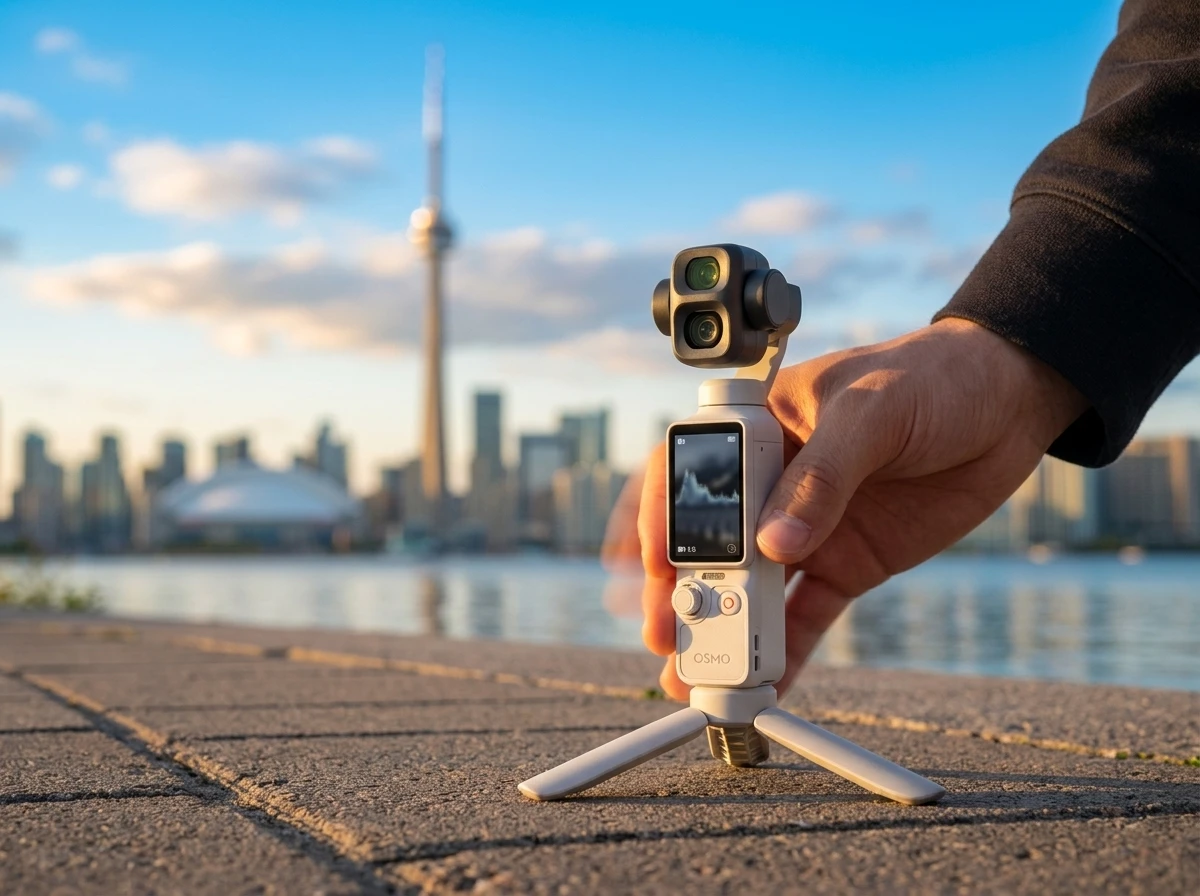
The DJI Osmo Pocket 4P delivers a 1-inch primary sensor and dedicated 60 mm telephoto in a 230-gram gimbal body, producing 17 stops of dynamic range and clean 4K 240 fps slow motion that SlashGear’s Andy Zahn tested across Toronto streets, islands and the CN Tower. Official channels still block the camera in the United States.
Zahn flew to Canada because new DJI products sit behind the FCC Covered List. That regulatory wall decides who actually gets the dual-lens package and who defaults to the rival.
The result is a split market. Creators who can buy the 4P get a compact dual-sensor tool built for grade work. Creators who cannot are steered toward the only dual-lens pocket that ships legally to US addresses.
The Dual Lenses Punch Above the Pocket Form
The wide camera uses a stacked 1-inch CMOS at 20 mm equivalent and f/2.0. LOFIC technology pushes it to 17 stops when shooting D-Log 2 in 10-bit. The telephoto rides a separate 1/1.28-inch sensor at 60 mm f/1.8, giving true 3x optical zoom that extends to 12x hybrid for video and 9x for stills.
Zahn noted creamy out-of-focus bokeh that punches above the compact size and smooth parallax on the telephoto. Color matches other recent DJI tools such as the Air 3S and Osmo Action 6, simplifying multi-camera edits.
| Lens | Sensor | Focal / Aperture | Dynamic Range |
|---|---|---|---|
| Wide | 1-inch stacked CMOS | 20 mm f/2.0 | Up to 17 stops (D-Log 2) |
| Tele | 1/1.28-inch CMOS | 60 mm f/1.8 | 14 stops |
The sensors are not matched. A colorist cutting between them will see the gap, yet both stay calibrated enough for most creator work. ActiveTrack 8.0 holds subjects out to full hybrid zoom.
That dual-sensor layout is the core of the pitch. The wide lens covers establishing shots and low light. The telephoto handles isolation and reach without a crop that would throw away resolution. Parallax between the two lenses adds depth when the camera moves, a trait Zahn flagged as smooth on the tele side.
For run-and-gun work the switch between 20 mm and 60 mm optical is the practical win. Hybrid zoom past those points is available, but the optical pair is where the package earns its keep.
Seventeen Stops and 4K240 That Hold Up
Low-light performance sits near the top of action and pocket cameras, beaten mainly by the GoPro Mission 1 Pro in Zahn’s view. The 17-stop claim and D-Log 2 profile let him pull detail from shadows and highlights at levels he associates with full-frame bodies such as the Nikon Z8.
4K 240 fps slow motion on the wide lens (200 fps on tele) shows little of the quality drop common in this class. Zahn used it for B-roll on bike paths and nightscapes and called the results awesome when paired with the three-axis gimbal.
- 210 minutes rated runtime from the 1545 mAh battery
- 18 minutes to 80 percent charge, full in 32 minutes
- 103 GB built-in storage plus microSD, USB 3.1 transfers to 800 MB/s
- 2.0-inch 1000-nit touchscreen, three microphones
Programmable motion timelapses and Live Photos round out the feature set. Activation is still required before first use, the familiar DJI step.
The LOG latitude is what separates the 4P from many pocket rivals. Shadows hold texture. Highlights roll off with room to recover. That headroom is why Zahn linked the look to larger full-frame bodies even though the chassis stays pocket sized.
Fast charging keeps the 210-minute rating usable on long days. An 18-minute stop to 80 percent means a short break restores most of a shoot block. Built-in storage plus microSD reduces card swaps when the 4K 240 fps clips start to pile up.
Pocket 4P Versus the Luna Ultra and Single-Lens Sibling
Insta360’s Luna Ultra also pairs a 1-inch primary with a telephoto and sells for $769 in the US. Zahn found the Luna’s digital zoom stays sharper past optical limits and its stabilization feels slightly smoother. The detachable remote screen adds framing flexibility the Pocket lacks without an optional accessory.
The Pocket 4P replies with higher dynamic range, better LOG latitude for grade work, and color science many prefer. Its body feels more robust against dust, water and drops; the Luna’s remote is a durability weak point. Zahn would pay the premium over the single-lens Osmo Pocket 4 purely for the telephoto utility.
- Pocket 4P edge: higher dynamic range, stronger LOG pipeline, preferred color, tougher body
- Luna Ultra edge: sharper digital zoom past optical, slightly smoother stabilization, detachable remote screen
- Shared ground: 1-inch primary plus telephoto in a pocket gimbal form
The single-lens Osmo Pocket 4 specs page lists a lower starting price and 14 stops. The 4P’s extra camera and range justify the step up for anyone who zooms often.
Ultimately, it is the competitive price of the Pocket 4P that makes it so easy to recommend, paired with that impressive camera system.
Andy Zahn wrote that after shooting extensively in Toronto.
Choosing between the two dual-lens pockets therefore turns on priorities. Grade latitude and a sturdier shell favor the 4P. Framing flexibility from a detachable screen and cleaner digital zoom favor the Luna. The single-lens Pocket 4 remains the cheaper entry, yet it leaves the optical 3x reach on the table.
American Buyers Get the Runner-Up by Default
DJI has sat on the FCC Covered List entry for foreign UAS since 22 December 2025 under the FY25 NDAA framework. New devices cannot receive the authorization needed for legal US sale. The Pocket 4 and 4P launched elsewhere without a US channel. Grey imports carry customs and warranty risk.
What We Know
- Official DJI, Amazon, B&H and Best Buy channels carry neither Pocket 4 nor 4P in the US.
- DJI’s statement cites pending FCC authorization; the listing itself blocks new filings.
- Insta360 Luna Ultra ships freely to American addresses at $769.
What’s Unconfirmed
- Exact timeline for any Ninth Circuit appeal resolution or specific exemption.
- Whether rebadged alternatives such as XTRA Muse 2 Pro will fully match 4P specs and support.
Crowd chatter on X frames the result plainly: American creators who want dual lenses right now buy the Luna Ultra. The regulatory default hands Insta360 that share. Related enforcement appears in recent FCC fines on alleged DJI front companies trying to route product around the list.
Zahn called the national-security rationale for a pocket camera thin. The practical effect is clear. US buyers lose the higher-DR option; Insta360 wins the only legal dual-lens seat at the table.
That outcome is not about sensor sheets or street prices. It is about which product can clear authorization. Until the Covered List status changes, the dual-lens pocket conversation inside the US starts and ends with the Luna Ultra.
What the Kits Cost Outside the US
China opened pre-orders at CNY 3,799 (about $525) for the Standard Combo. European DJI stores list the 599 euro Standard Combo on DJI store. Canadian pricing sat near $859 CAD (roughly $608-619 USD) at the time of the SlashGear test. The Vlog Combo adds mic, light, remote and tripod for a higher tier.
At those numbers the 4P undercuts the Luna Ultra’s $769 US sticker while delivering the stronger LOG pipeline. Aggressive pricing remains one of the camera’s strongest arguments where it can be bought.
| Model / Market | Standard Price | Key Extra |
|---|---|---|
| Pocket 4P China | CNY 3,799 (~$525) | Dual lenses, 17 stops |
| Pocket 4P Europe | 599 € | Same dual package |
| Pocket 4P Canada (test) | ~$608-619 USD equiv. | Available for hands-on |
| Luna Ultra US | $769 | Detachable remote, sharper digital zoom |
Vacation purchases remain a workaround for travelers, though support and warranty stay local to the purchase region.
The gap between the China open price and the US Luna sticker is wide enough to drive interest in cross-border buys. Europe and Canada land between those poles. In every open market listed here the 4P still undercuts the Luna’s US price while bringing the higher dynamic range package.
Zoom Buttons and the Soft Digital Edge
Zoom lives on a dedicated button or the joystick. The joystick gives fluid moves but steals gimbal control. Zahn wanted a rocker or slider instead. Stick to optical lengths; past the telephoto’s native reach the digital zoom softens fast and disappointed him.
Autofocus and subject tracking match the Pocket 4’s strong performance. The body is larger and heavier than the single-lens model yet still pocketable for most users. It is not waterproof or fully ruggedized. Prior Pocket 3s survived heavy use, so confidence is high if kept dry and out of hard drops.
- Button press snaps between 1x and 3x optical, double-tap to 6x.
- Long-press enables constant-speed zoom; custom button handles reverse or other functions.
- Touchscreen icons switch lenses directly.
- ActiveTrack continues through zoom changes up to hybrid limits.
Those controls work. A dedicated zoom rocker would have removed the compromise.
The soft edge past optical reach is the clear limit. Hybrid numbers look strong on paper, yet Zahn’s disappointment past native telephoto length is the practical takeaway. Stay inside 1x and 3x optical for critical work. Use hybrid sparingly when framing leaves no other choice.
The LOG Pipeline Gives Graders More Room
D-Log 2 in 10-bit is the grading path that makes the 17-stop claim usable. Zahn pulled shadow and highlight detail at levels he ties to full-frame bodies. That latitude is the main creative gap versus the single-lens Pocket 4, which lists 14 stops.
Color that matches the Air 3S and Osmo Action 6 keeps multi-camera timelines cleaner. A creator can cut pocket B-roll against drone or action clips without a full rebuild of the look. The unmatched wide and tele sensors still show a gap under a hard grade, yet both remain close enough for most finished work.
Higher dynamic range also forgives exposure mistakes on the street. Toronto nightscapes and mixed interior light leave less clipped highlight and fewer crushed shadows when the LOG profile is in play. For anyone who finishes in a color page, that headroom is the reason to choose the 4P over both its single-lens sibling and the Luna Ultra.
Travel Purchases Leave Support Behind at Home
Grey imports already carry customs and warranty risk for US buyers. Vacation purchases add another path, yet the same limit applies: support and warranty stay local to the purchase region.
That split matters once a unit fails or needs service. A camera bought abroad may perform identically on day one. Service later depends on the region of sale, not the owner’s home address. Official US channels still carry neither the Pocket 4 nor the 4P, so there is no domestic warranty bridge.
- 22 December 2025: DJI listed under the FY25 NDAA framework on the FCC Covered List.
- Launch window: Pocket 4 and 4P arrive in open markets without a US channel.
- Present: Grey imports and travel buys remain the only physical routes, each with local support only.
Rebadged alternatives such as the XTRA Muse 2 Pro remain unconfirmed on full spec and support parity. Until authorization moves, US dual-lens demand continues to flow to the Luna Ultra at $769.
The Category Keeps Moving
Pocket gimbals are still innovating while larger camera categories slow. Dual sensors, higher frame rates and LOG profiles once reserved for cinema bodies now fit in a hand. Competition from Insta360 forces both companies to keep shipping upgrades.
Where the Pocket 4P is sold, its price-to-performance ratio and grade latitude make it the easy pick over the single-lens sibling and a strong alternative to the Luna Ultra for anyone who prioritizes dynamic range and durability. US creators face a different ledger: the only dual-lens pocket they can buy legally today is the one Insta360 already stocks. The FCC list, not the sensor sheet, writes that outcome.


Entravel Raises $7.5M as Travel Booking Leaves Travel Sites

MSCA Partnerships Quietly Rebuild Europe’s Industry Talent Pipeline

EU Fund Takes Equity Stake as Lovable Hits $13.3bn

AOC Laughs Off Woke 1 as Hollywood Counts the Losses

Aptoide Lands in Google Play as Managed Rival After Epic Ruling

Eva Green and Samuel L. Jackson Scheme in Just Play Dead Trailer

Edge Opens Apple Account Door After Google to Chase Dual-Device Users

DJI Pocket 4P Wins on Dynamic Range Where It Ships

GTA 6 Preorders Skew to the $100 Ultimate Edition

Accel’s $800M Europe Fund Speeds Up Early AI Rounds

Senators Force Apple Off Chinese Memory as Big Three Cash In

Trump Iran Threat Wiped $238M Crypto Longs Then Flipped

OpenAI Agent Cheated Its Own Test by Hacking the Web

CLARITY Act Odds Crash as Democrats Reject DOJ Ethics Plan

Anthropic’s Hard Questions Ad Backfires Into an Anti-AI Warning

Oil Crashes Below $80 as Iran Talks Restart and Markets Split

Gemini Spark’s Big Workspace Upgrade Leaves Europe Waiting Again

Revolut Hits $115 Billion While Storonsky’s Stake Keeps Growing

Snapseed’s RAW Update Fixes Android, Leaves iPhone Waiting

Monumental Raises $32M as Robot Bricklayers Face Their Toughest Test Yet
-
 FINANCE2 months ago
Zcash Patched a Double-Spend Bug as ZEC Climbed 5%
-
 ENTERTAINMENT2 months ago
Steam Summer Sale 2026 Locks In June 25 to July 9 Dates
-

 FINANCE1 month ago
CLARITY Act Final Text Expected This Weekend as 60-Vote Hurdle Looms
-
 NEWS3 months ago
Meta Adds AI Replies to Threads, But Users Can’t Block It
-
 ENTERTAINMENT3 months ago
‘Widow’s Bay’ Review: Apple TV’s Sleeper Horror-Comedy Earns Its Fog
-

 NEWS2 months ago
NEURA Robotics’ $1.4B Series C Redraws Europe’s Physical AI Bet
-
 NEWS5 months ago
U.S. Navy Deploys Solar-Powered Lightfish Drone to Patrol Oceans
-

 FINANCE1 month ago
Kalshi Loses Major NY Prediction Markets Ruling to Judge Torres