
NEWS
Samsung Bets Its Biggest Foldable Order Yet on the Galaxy Z Fold 8
Samsung’s new panel orders make the untested Z Fold 8 Wide its top-volume foldable, a wager placed days before Apple’s rival foldable iPhone arrives.

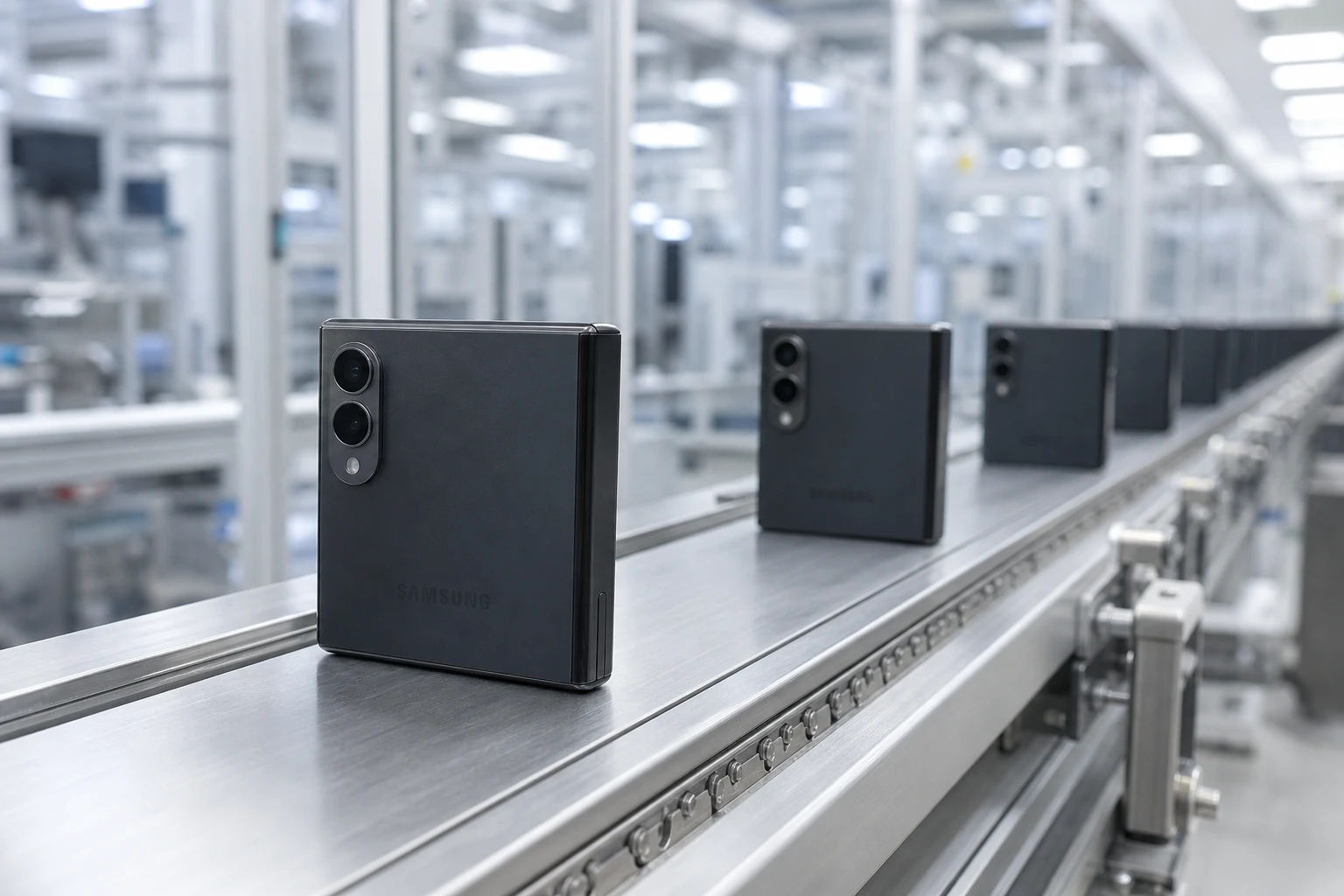
Samsung has ordered 2.8 million panels for the Galaxy Z Fold 8, its untested wide-screen foldable, more than either proven sibling model. That is above the 2 million planned for the Galaxy Z Fold 8 Ultra and the 1.5 million for the Galaxy Z Flip 8, according to a supply chain report from Korean outlet ETnews. Samsung will unveil all three phones in London on July 22.
The number is bigger than a parts order. Samsung is handing its highest-volume production slot to a shape it has never sold, racing to define the format before Apple’s rumored foldable iPhone arrives this autumn, all while its own display business quietly builds the very screens that rival phone will use.
The Order Sheet Behind This Week’s Reveal
The split reverses Samsung’s own earlier plan. As recently as this spring, assembly lines for the Wide and Ultra models ran close to even before suppliers were told to tilt sharply toward the new shape, a shift multiple Korean and Asian trade outlets reported this week.
| Model | Panel Production Target | Design Notes | Europe Launch Price |
|---|---|---|---|
| Galaxy Z Fold 8 (Wide) | 2.8 million | 4:3 passport shape, dual 50MP camera, no telephoto lens | €1,999 |
| Galaxy Z Fold 8 Ultra | 2 million | Traditional tall body, three-camera system | €2,199 (up to €2,799 for 1TB) |
| Galaxy Z Flip 8 | 1.5 million | Clamshell, about 13.2mm folded, about 180g | €1,299 |
These are panel orders, not finished phones sitting in boxes. Samsung expects total finished output across the whole Z series this cycle to land between 5.5 million and 6 million units, with the figures above serving as opening targets rather than a hard ceiling.
Samsung’s Confidence Nearly Tripled Since Spring
The 2.8 million figure did not appear overnight. Suppliers first heard a three-month forecast that allotted roughly 100,000 units to the Wide model, a number revised up to between 300,000 and 400,000 by the end of May, per Korean supply chain reporting at the time.
An annual plan of around one million units for the Wide model was still circulating in early June. By the time ETnews published its account this month, that plan had grown to 2.8 million, nearly tripling in about six weeks and overtaking both established models along the way.
Panel orders are not sales, and Samsung has moved them before. The company raised Galaxy Z Fold 7 production twice in 2025 after early demand outran expectations, and it finished last year with Fold-line shipments still climbing while the Flip line slid for a second straight year.
Fold-style shipments grew from 2.09 million units in 2023 to 2.32 million in 2024, while Flip shipments fell from 3.66 million to 2.89 million over the same stretch, before Samsung projected total foldable output climbing toward 7 million units in 2026.
Racing Apple to Define the Passport Shape
Apple is widely expected to release its first foldable iPhone this autumn, using a similar 4:3 body that Samsung has watched leak for months. Reporting points to a September launch alongside the iPhone 18 Pro line, with a roughly 7.8 inch inner display, a cover screen near 5.5 inches, and a starting price close to $1,999.
Samsung’s first tri-fold model will ship in very limited volumes, but scale is not the objective.
Liz Lee, an associate director at Counterpoint Research, made that observation in a December analysis of Samsung’s foldable strategy, months before Apple’s rumored entry began reshaping the competitive math around the shape both companies now want to own.
The crease is where the two companies diverge hardest. Apple’s version is expected to measure under 0.15 millimeters deep with a fold angle near 2.5 degrees, shallower than the 0.7 millimeter crease and 3 to 4 degree angle measured on today’s Galaxy Z Fold 7 hinge.
Two Fixes for the Same Crease
Samsung has not published a crease measurement for its new Flex Titanium panel, so it is not yet clear whether the fix beats Apple’s target. The two companies are attacking the same physical dip from opposite directions, and a third rival has taken a third path entirely.
- Samsung’s Flex Titanium: swaps the polymer layer under the glass for a stiff titanium-alloy film, backed by a micro-perforated titanium plate that flexes without cracking and pulls the visible dip toward flat.
- Apple’s Ultra-Thin Glass: chemically shaved thinner at the crease and thicker at the edges, paired with a 3D-printed hinge and an expanding adhesive that fills the gap when the panel opens.
- Oppo’s laser-smoothed layer: the Find N6 uses a photopolymer coating smoothed by laser to make its crease nearly invisible, an approach neither Samsung nor Apple has adopted.
Each company is betting its own engineering philosophy solves a problem that has defined every book-style foldable since the category began. None of the three has shipped a device proving it yet.
The Flip Line and Samsung Display Carry the Risk
The Flip Absorbs the Cut
The Flip 8’s 1.5 million panel target caps a multi-year slide. Flip-style shipments fell from 3.66 million units in 2023 to 2.89 million in 2024, the same span in which Fold-style shipments kept climbing toward last year’s records.
Two unconfirmed reports now suggest the Flip 8 could be the last of its kind: a Weibo post from May 2026 and a follow-up from X account @fireuniverse8 in late June. Samsung has not addressed either claim publicly, and the clamshell line has weathered shrinking orders before without disappearing.
Samsung Display Wins Either Way
Samsung profits from this race no matter which shape wins. Samsung Display holds a three-year exclusive deal to supply Apple’s foldable OLED, meaning a win for Apple’s design still funnels revenue back to Samsung’s own display arm.
That arrangement makes Samsung an unusual kind of competitor. It needs the Fold 8 Wide to outsell Apple’s device, and it needs Apple’s device to sell well enough to justify the panel deal either way.
What Could Go Wrong With Samsung’s Bet?
Samsung’s biggest risk is that buyers stick with the shape they already know. A cold reception to the Wide model would blunt Samsung’s pitch against Apple before Apple even ships its rival device, even though Samsung can trim panel orders the way it always does.
Samsung has trimmed and raised targets constantly since the original Fold arrived in 2019. Industry watchers have already floated a familiar exit ramp for the Wide model: strong early sellthrough pushes the number higher, weak results shrink it to a one-generation experiment, much like the Galaxy Z TriFold.
Rising component costs add a separate layer of risk that has nothing to do with consumer taste. Memory chipmakers are diverting mobile DRAM and NAND capacity toward the AI server boom’s demand for high-bandwidth memory, squeezing supply and pushing smartphone prices up industry-wide.
Samsung will find out how the bet lands within weeks. Pre-orders are expected to open alongside the July 22 keynote, with retail units on shelves by around August 11, the first real signal of whether the passport shape sells like Samsung is now building it to.
Frequently Asked Questions
When Is the Galaxy Unpacked Event, and Where Is It Held?
Samsung is expected to hold Galaxy Unpacked on July 22, 2026, in London, a shift from the New York and Seoul venues used in recent years. Pre-orders are expected to open the same day, with the phones reaching store shelves around August 11.
Is Samsung Ending the Galaxy Z Flip Line?
Nothing is confirmed. A Weibo post from May 2026 and a follow-up from X account @fireuniverse8 in late June both claimed the Flip 8 will be Samsung’s last clamshell foldable, but Samsung has not addressed the rumor, and the Flip has survived cycles of shrinking orders before.
Could Samsung’s Production Targets Still Change?
Yes. Panel forecasts shared with suppliers are starting points, not fixed ceilings, and Samsung raised Galaxy Z Fold 7 output twice in 2025 after demand outran its original plan. The same could happen in reverse if the Wide model sells slower than the 2.8 million target implies.
What Will Apple Call Its Foldable iPhone?
The name is still unsettled. Reporting has used “iPhone Fold” and “iPhone Ultra” interchangeably, with some leakers favoring Ultra for its premium positioning and others sticking with Fold as the working name inside Apple’s own rumor mill.
Why Are Foldable Phone Prices Rising in 2026?
A global shortage of mobile DRAM and NAND flash is the main driver, as memory makers redirect capacity toward high-bandwidth memory for AI servers. That squeeze is pushing launch prices for Samsung’s and Apple’s foldables higher than their predecessors, independent of any single feature upgrade.


Replit Opens Its London Office Inside an AI Crowd

Straight Circle Trailer Lands Without a U.S. Date

Anemo Labs Bets £700,000 on an AI Sense of Smell

Nintendo Prices the Zelda 40th Switch 2 at $519

Copilot Capital Buys the Autopilot Already Running 90 GW

Ground A Raises €9.1 Million for a Pallet Laser

Gibney’s Musk Film Opens in Venice Without Its Subject

Torvalds Blames AI for a Full-Fat Linux 7.3-rc2

Dexter Returns Sharper, Older, and Stuck Between Killers

Meta’s Muse Agent Can Spend Before the Privacy Lock

Walter’s TWG Insists No Fraud as Insurer Probes Force Cleanup

30-Year Yield Hits 5.32% Highest Since 2007 as Debt Supply Locks In Costs

PCE Stays at 3.7% as Gas and Tariffs Outrun Coming Revisions

Evernorth S-4 Clears Path for Active XRP Treasury on Nasdaq

Astute’s $1.2M bet makes B2B creator deals feed AI discovery

Strategy Parks $1.59B Cash While Bitcoin Stack Stays Flat

CLARITY Act Cloture Opens a Door Ethics Still Blocks

Instinct Hits $2.5 Billion as AI Agent Access Sparks Trust Fights

Oracle’s 2.8 GW Bloom Deal Exposes the AI Power Bypass

AI data centers win as RAM kits jump nearly 500 percent
-
 FINANCE3 months ago
Zcash Patched a Double-Spend Bug as ZEC Climbed 5%
-
 ENTERTAINMENT3 months ago
Steam Summer Sale 2026 Locks In June 25 to July 9 Dates
-

 FINANCE2 months ago
CLARITY Act Final Text Expected This Weekend as 60-Vote Hurdle Looms
-
 NEWS4 months ago
Meta Adds AI Replies to Threads, But Users Can’t Block It
-
 ENTERTAINMENT5 months ago
Extraction 3 Is Officially Coming to Netflix in 2027
-

 NEWS3 months ago
YouTube Shorts is testing a heart in place of the thumbs-up
-

 NEWS1 month ago
Senators Force Apple Off Chinese Memory as Big Three Cash In
-

 NEWS3 months ago
NEURA Robotics’ $1.4B Series C Redraws Europe’s Physical AI Bet