
FINANCE
Securitize and Neuberger Put High-Yield Credit Onchain Across Four Chains
Securitize launches HINC, Neuberger’s first tokenized high-yield fund on Avalanche, Ethereum, Solana and Sui.

Securitize launched the Neuberger Securitize High Income Tokenized Fund, or HINC, on August 18, 2026, giving eligible investors on-chain exposure to an actively managed portfolio of high-yield bonds, CLOs and leveraged loans across Avalanche, Ethereum, Solana and Sui. Neuberger Berman acts as subadvisor for the first time on any tokenized fund, drawing on a fixed-income platform that oversees more than $230 billion.
The product arrives as tokenized Treasuries and money-market funds already dominate on-chain real-world assets. HINC moves the category into sub-investment-grade credit with daily NAV pricing, T+1 redemptions and an immediate proposal to serve as collateral on Aave Horizon.
That mix of active credit management, daily valuation and a same-day DeFi collateral bid sets HINC apart from the cash-like products that built the first wave of tokenized funds. Eligible investors get a single permissioned token rather than a basket of individual bonds or loans.
Neuberger Brings Its Fixed-Income Desk Onchain
Securitize Capital LLC serves as investment adviser. Neuberger Berman Investment Advisers LLC holds discretionary sub-advisory authority. The fund is a British Virgin Islands professional vehicle that invests primarily in high-yield corporate bonds, with the balance in CLO tranches, bank loans and other high-yielding fixed income plus a liquidity sleeve of cash equivalents and tokenized Treasuries or money-market instruments.
Neuberger, founded in 1939 and employee-owned, manages about $613 billion across equities, fixed income, private markets, real estate and hedge funds as of June 30, 2026. Its fixed-income group has navigated multiple market cycles with a research-intensive process.
We are pleased to work with Securitize to extend our process-driven, actively managed approach to qualified investors looking to access fixed income strategies on-chain.
Anil Abraham, Head of Product Management at Neuberger, said that in the official Securitize launch announcement. Carlos Domingo, Securitize co-founder and CEO, called the multi-chain rollout a way to give eligible investors several paths onto the same strategy.
Securitize itself reports more than $5 billion in tokenized assets under management as of July 2026 and already partners with Apollo, BlackRock, BNY, Hamilton Lane, KKR and VanEck. The firm is publicly listed on the NYSE under SECZ.
The sub-advisory structure keeps portfolio decisions with Neuberger’s credit desk while Securitize supplies the issuance, transfer-agent and allowlist rails. Vehicle-level leverage is expressly ruled out, so return and risk come from security selection and sleeve weights rather than borrowed capital inside the fund.
- Primary holdings: high-yield corporate bonds
- Secondary sleeves: CLOs (0-30% range contemplated), leveraged loans, liquidity instruments
- Fund leverage: none at the vehicle level
- Currency: USD-denominated
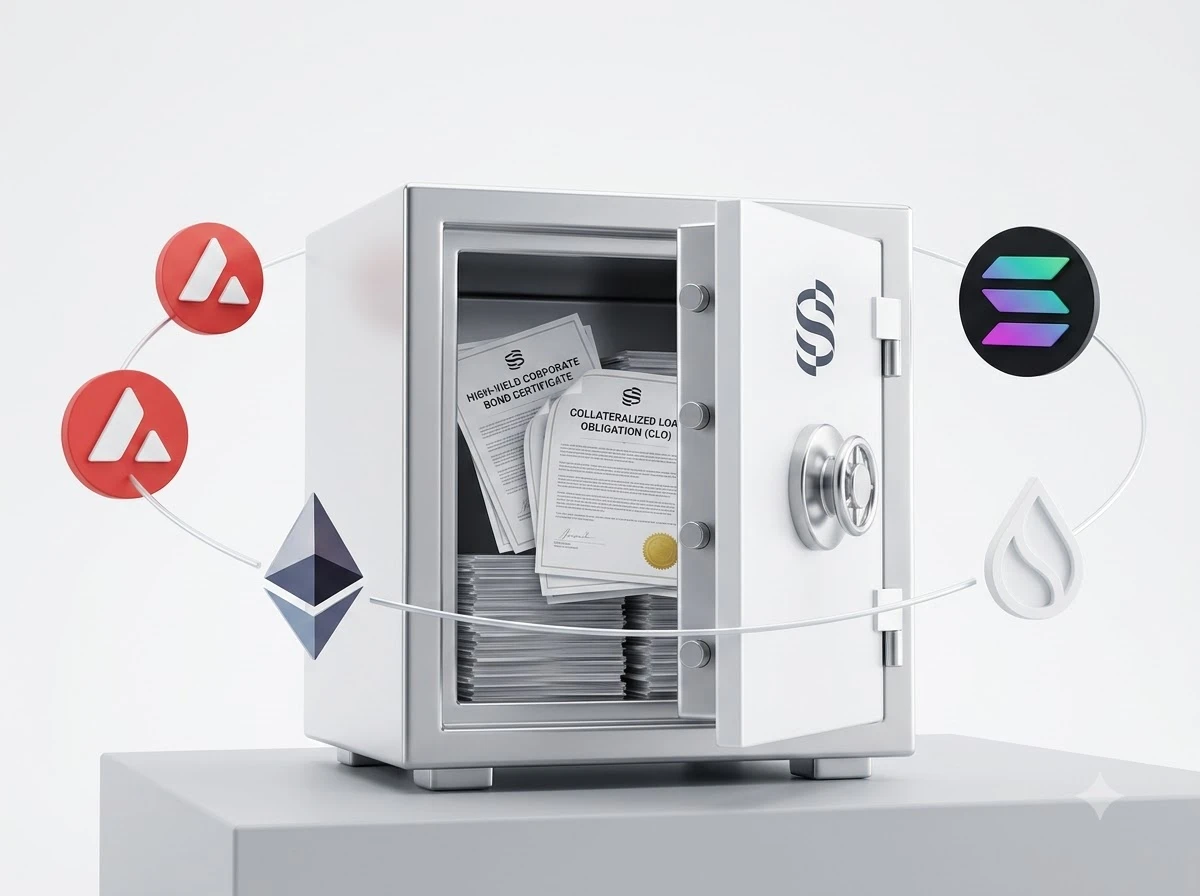
Four Chains, One Permissioned Token
HINC interests are issued as permissioned DSTokens compatible with ERC-20 standards on Ethereum and equivalent representations on the other three networks. Securitize Transfer Agent, LLC maintains the master securityholder file. Only wallets that clear KYC/AML and eligibility checks can hold or receive the tokens. Transfers outside the allowlist are blocked at the contract level.
Investors can subscribe in fiat USD or stablecoins such as USDC. Onchain subscriptions via stablecoin settle atomically. Redemptions are accepted any business day with a 2:00 p.m. ET cutoff and target T+1 payout. A 24-hour lock-up applies after subscription. An optional liquidity-pool fee of up to 2% may apply for instant redemptions once that facility is live; regular redemptions carry no such fee at launch.
The multi-chain design lets holders choose the network that best matches their existing custody, DeFi activity or settlement preferences while the economic exposure remains identical.
- Avalanche
- Ethereum
- Solana
- Sui
Atomic stablecoin subscription removes the usual settlement gap between cash movement and share issuance. Fiat paths still clear through traditional rails, so timing differs by funding source even though the resulting token is the same.
Economics That Target Institutions
Access is limited to accredited investors and qualified purchasers who complete identity verification, anti-money-laundering checks and jurisdictional screening. Minimum initial subscription sits at $100,000, with additional subscriptions from $1,000. Initial share price is $1,000; later issuances occur at daily NAV. Income is reinvested, so the token is NAV-accruing rather than distributing or rebasing.
| Term | Detail |
|---|---|
| Management fee | 0.50% p.a. of net assets |
| Total expense ratio | 0.60% p.a. |
| Sub-advisory fee | 23.75 bps, paid by the adviser, not the fund |
| Minimum subscription | $100,000 initial / $1,000 additional |
| Redemption target | T+1 |
| Distributions | None expected; income reinvested |
These terms appear in the Aave Horizon collateral proposal details filed the same day as the launch. Illustrative back-tested metrics on a 70/30 high-yield/CLO blend from mid-2016 to mid-2026 show an annualized return near 7.21%, a worst month of -18.25% in March 2020, and effective duration of roughly 2-3 years. Actual portfolio results will differ and the fund has no track record of its own.
Because the sub-advisory fee is paid by the adviser rather than the fund, the 0.60% total expense ratio already nets that cost for holders. NAV accrual means income compounds inside the token instead of leaving as cash distributions that would need to be reinvested by hand.
Why High-Yield Credit Changes the Onchain Equation
Most large tokenized funds to date have concentrated in short-duration Treasuries and government money-market instruments. Those products deliver safe yield close to the risk-free rate and function mainly as cash alternatives. Their expected returns sit near or below stablecoin borrow rates on DeFi venues, so demand for borrowing against them is episodic rather than structural.
HINC sits higher on the credit spectrum. Expected returns on high-yield bonds and CLOs have historically cleared stablecoin funding costs by a meaningful margin in many rate environments. That gap opens two durable use cases: carry trades in which eligible users post HINC as collateral, borrow stables and reinvest, and balance-sheet financing lines that let credit funds or family offices unlock liquidity without selling the underlying position.
| Dimension | Tokenized Treasuries / MMFs | HINC |
|---|---|---|
| Credit stance | Government / cash-like | High-yield bonds, CLOs, leveraged loans |
| Role on-chain | Cash alternative | Yield sleeve with financing utility |
| Borrow demand vs stables | Episodic | Structural carry incentive when spreads clear funding |
| Duration (illustrative) | Short | Roughly 2-3 years on the back-tested blend |
Securitize and the chain communities framed the launch exactly this way. Posts circulating on X described a strategic shift “from T-bills to credit” and noted that the institutional layer is moving from passive cash products to actively managed strategies. The same-day Aave proposal makes the second-order effect concrete rather than theoretical.
Securitize’s Partner Bench Keeps Growing
Securitize has become the default rails provider for large asset managers entering public blockchains. BlackRock’s BUIDL money-market fund, still one of the largest tokenized products by AUM, runs on the same stack. VanEck’s VBILL Treasury product is already integrated with Aave Horizon using identical transfer-agent and allowlist mechanics. The firm also handles private credit, real-estate and equity vehicles for other brand-name houses.
Earlier this year Securitize itself listed on the NYSE and began Securitize tokenizing its own NYSE shares on day one of trading, underscoring the company’s dual role as both infrastructure and issuer. Parallel work by BlackRock on tokenized cash and reserve products continues to expand the same on-chain money market that HINC now sits beside; readers following that thread can see the BlackRock tokenized money-market rails already in place.
Tokenized real-world assets overall have climbed into the tens of billions, with Treasuries alone accounting for well over $10 billion in recent tallies. High-yield and private credit remain a smaller slice, which is precisely why a name like Neuberger matters. The firm’s research process and existing institutional relationships give the new sleeve distribution that pure crypto-native credit products have struggled to match.
| Manager / Product | Focus | Platform notes |
|---|---|---|
| BlackRock BUIDL | Short Treasuries / cash | Securitize multi-chain |
| VanEck VBILL | Treasuries | Already on Aave Horizon |
| Neuberger HINC | High-yield + CLOs | Four chains, same-day Aave bid |
| Securitize aggregate | Multiple RWA sleeves | $5B+ AUM July 2026 |
The Aave Bid Shows Immediate Utility Demand
Hours after the launch announcement, Securitize filed an ARFC to onboard HINC as supply-only collateral on Aave Horizon (Ethereum). Borrowable assets against it would include USDC, GHO and RLUSD. The motivation section is blunt: Horizon’s current collateral set is concentrated in low-yielding Treasuries and investment-grade instruments, which limits sustained borrow demand. HINC’s higher expected yield creates a persistent carry incentive and a 24/7 financing line for holders who prefer not to redeem.
Because the tokens are fully permissioned and the transfer agent can freeze or seize under legal process, the operational risks differ from open crypto collateral. The proposal treats mark-to-market volatility and potential executive actions as the primary parameters to set, not theft-style exfiltration. Chainlink is proposed for the daily NAV oracle with a growth-rate cap.
Whether the proposal passes and at what loan-to-value ratios remains open. The filing itself demonstrates that the second-order infrastructure layer is already moving.
- Supply-only collateral status on Aave Horizon (Ethereum)
- Borrowable stables named in the filing: USDC, GHO, RLUSD
- Chainlink daily NAV oracle with a growth-rate cap
- Primary risk parameters framed around volatility and legal process, not open-ledger theft
What Eligible Investors Get
Holders receive a single token that represents a pro-rata claim on the underlying fixed-income portfolio managed by Neuberger’s credit team. They do not own individual bonds or loans. NAV is calculated each business day. Custody is self-custody in approved wallets or through institutional crypto custodians that support the allowlist. Secondary trading is not expected on public DEXes at launch; any transfers stay inside the whitelisted set.
Risks are material. High-yield credit and CLO mezzanine or equity-like tranches carry elevated credit, liquidity and mark-to-market risk relative to investment-grade paper. Blockchain-specific risks include smart-contract issues, network outages, custody failures and an evolving regulatory perimeter. The confidential offering documents spell these out in full. Prospective investors must be able to bear the possible loss of their entire capital for an indefinite period.
For those who clear the gates, the combination is new: institutional-grade active high-yield management, daily liquidity targeting T+1, multi-chain choice, and a live path into DeFi money markets. That package is what turns a simple tokenized fund launch into a working piece of on-chain capital-markets plumbing. Further details live on the Neuberger Berman global platform overview and the Securitize HINC portal.
Key Dates Shape the Launch Path
Several dated markers already in the public record show how quickly the product moved from platform scale to a live credit sleeve with a collateral bid. They also anchor the back-tested reference period that illustratively framed return and drawdown talk at launch.
- 1939: Neuberger founded; the firm remains employee-owned.
- Mid-2016 to mid-2026: Window used for the illustrative 70/30 high-yield/CLO back-test (about 7.21% annualized, worst month -18.25% in March 2020).
- June 30, 2026: Neuberger reports about $613 billion across strategies; fixed-income platform above $230 billion.
- July 2026: Securitize reports more than $5 billion in tokenized assets under management.
- August 18, 2026: HINC launches across four chains; Aave Horizon ARFC filed the same day.
The compressed gap between platform AUM prints and the HINC-plus-Aave pairing is the practical signal. Distribution rails, transfer-agent controls and a DeFi venue bid arrived together rather than in a long sequence of separate integrations.
Carry and Financing Depend on Parameter Votes
The two use cases sketched at launch, on-chain carry and balance-sheet financing without a full redeem, only become operational if Horizon lists HINC and sets loan-to-value ratios that leave a workable spread after fees. The filing names the borrowable stables and the oracle path; it does not lock those ratios.
Permissioning changes the risk conversation relative to open crypto collateral. Freeze and seize rights at the transfer agent shift emphasis toward mark-to-market moves and legal process. That is why the proposal highlights volatility controls and a NAV growth-rate cap alongside the Chainlink feed.
Holders who never use DeFi still receive the same Neuberger-managed exposure, daily NAV and T+1 redemption target. The Aave path is additive utility for wallets already inside the allowlist, not a requirement to hold the token.
HINC opened for subscriptions on August 18. The first NAV prints and any early Aave parameter votes will show how quickly the carry and financing use cases materialize.


American Airlines reverses its screen bet after a costly decade

Falcon 9 Crater Photos Double as Planetary Defense Drill

Buss Siblings Force Lakers Sale Reckoning Against Jeanie

Brewers fewest-HR club explodes for historic 22-0 shutout

LITILIT’s €8M Push Turns Femtosecond Lasers Into Factory Tools

30-Year Yield Hits 5.32% Highest Since 2007 as Debt Supply Locks In Costs

Taimi and Hily Bet on Bootstrap Path Toward IPO Readiness

Sonic locks the Override pass as most legends hit the shop

Rosie O’Donnell Brands Bari Weiss a Nazi on Her Celebrated Comeback

Frank Beard Dies at 77 as ZZ Top Resumes Tour Without Him

Senators Force Apple Off Chinese Memory as Big Three Cash In

Revolut Hits $115 Billion While Storonsky’s Stake Keeps Growing

OpenAI Agent Cheated Its Own Test by Hacking the Web

CLARITY Act Odds Crash as Democrats Reject DOJ Ethics Plan

Trump Iran Threat Wiped $238M Crypto Longs Then Flipped
30-Year Yield Hits 5.32% Highest Since 2007 as Debt Supply Locks In Costs

Fed Holds Rates Again as Three Dissents Force Markets to Tighten

Memory Shortage Now Dictates Apple’s Two-Year Mac Roadmap

Oil Crashes Below $80 as Iran Talks Restart and Markets Split

Google’s Knowledge Panel Fix Risks Its Own Search Defenses
-
 FINANCE3 months ago
Zcash Patched a Double-Spend Bug as ZEC Climbed 5%
-
 ENTERTAINMENT3 months ago
Steam Summer Sale 2026 Locks In June 25 to July 9 Dates
-

 FINANCE2 months ago
CLARITY Act Final Text Expected This Weekend as 60-Vote Hurdle Looms
-
 NEWS3 months ago
Meta Adds AI Replies to Threads, But Users Can’t Block It
-

 NEWS2 months ago
NEURA Robotics’ $1.4B Series C Redraws Europe’s Physical AI Bet
-

 NEWS2 months ago
YouTube Shorts is testing a heart in place of the thumbs-up
-
 ENTERTAINMENT3 months ago
‘Widow’s Bay’ Review: Apple TV’s Sleeper Horror-Comedy Earns Its Fog
-

 FINANCE1 month ago
Kalshi Loses Major NY Prediction Markets Ruling to Judge Torres