
ENTERTAINMENT
Emily Watson joins Mackenzie Crook’s Mars Express as the Beagle 2 near-miss becomes cinema
Emily Watson and Toby Jones star as the Pillingers in Mackenzie Crook’s debut, the true story of farmers who built a Mars lander that almost worked.

Emily Watson has confirmed she will star opposite Toby Jones as Judith and Colin Pillinger in Mackenzie Crook’s feature directorial debut Mars Express, the true story of the English couple who built a Mars lander with almost no spacecraft experience and nearly made contact with the Red Planet.
Watson revealed the casting while speaking to Screen Daily at the Sarajevo Film Festival, where she heads the jury and received the honorary Heart of Sarajevo award. The film, produced by Big Talk Studios and Altitude and developed with BBC Film, is set to shoot in the UK later this year with a soundtrack of Britpop classics.
Watson and Jones play the farmers who challenged the giants
Jones, Crook’s co-star from the BAFTA-winning Detectorists, takes the role of Colin Pillinger. Watson plays his wife Judith. The pair had no prior experience of building spacecraft. They pulled together a team of misfits, raised support by touring conferences with a cardboard model their daughter made on a kitchen table, and hitched a ride on the European Space Agency’s Mars Express orbiter.
Joe Bone wrote the script from Colin Pillinger’s book My Life On Mars: The Beagle 2 Diaries. Altitude is handling international sales and will release the film theatrically in the UK and Ireland. Production notes circulating among casting circles place the shoot in Leeds in September.
| Role | Person | Known for |
|---|---|---|
| Director | Mackenzie Crook | Detectorists (creator, BAFTA), The Office, Pirates of the Caribbean |
| Colin Pillinger | Toby Jones | Detectorists, Mr Bates vs The Post Office |
| Judith Pillinger | Emily Watson | Chernobyl, Dune: Prophecy, two Oscar nominations |
| Writer | Joe Bone | The Vanishing (co-writer), Guinness record 80 stage characters |
| Producers | Big Talk / Altitude | With BBC Film association |
Watson comes to the project after Chernobyl, the ensemble of Chloe Zhao’s Hamnet, and while preparing for the second season of HBO’s Dune: Prophecy. She has also wrapped Mira Nair’s Amri.
The Jones and Watson pairing gives the film a ready dramatic axis. He carries the Detectorists link to Crook; she arrives with recent prestige television and two Oscar nominations behind her. Together they play partners who treated a planetary landing as a family and conference-circuit project rather than a national agency brief.
That domestic scale is the casting point. The story asks audiences to believe a couple with no spacecraft background could assemble a team, sell a cardboard model, and reach the Martian surface. Familiar faces with a track record in ordinary British resolve make the pitch land.
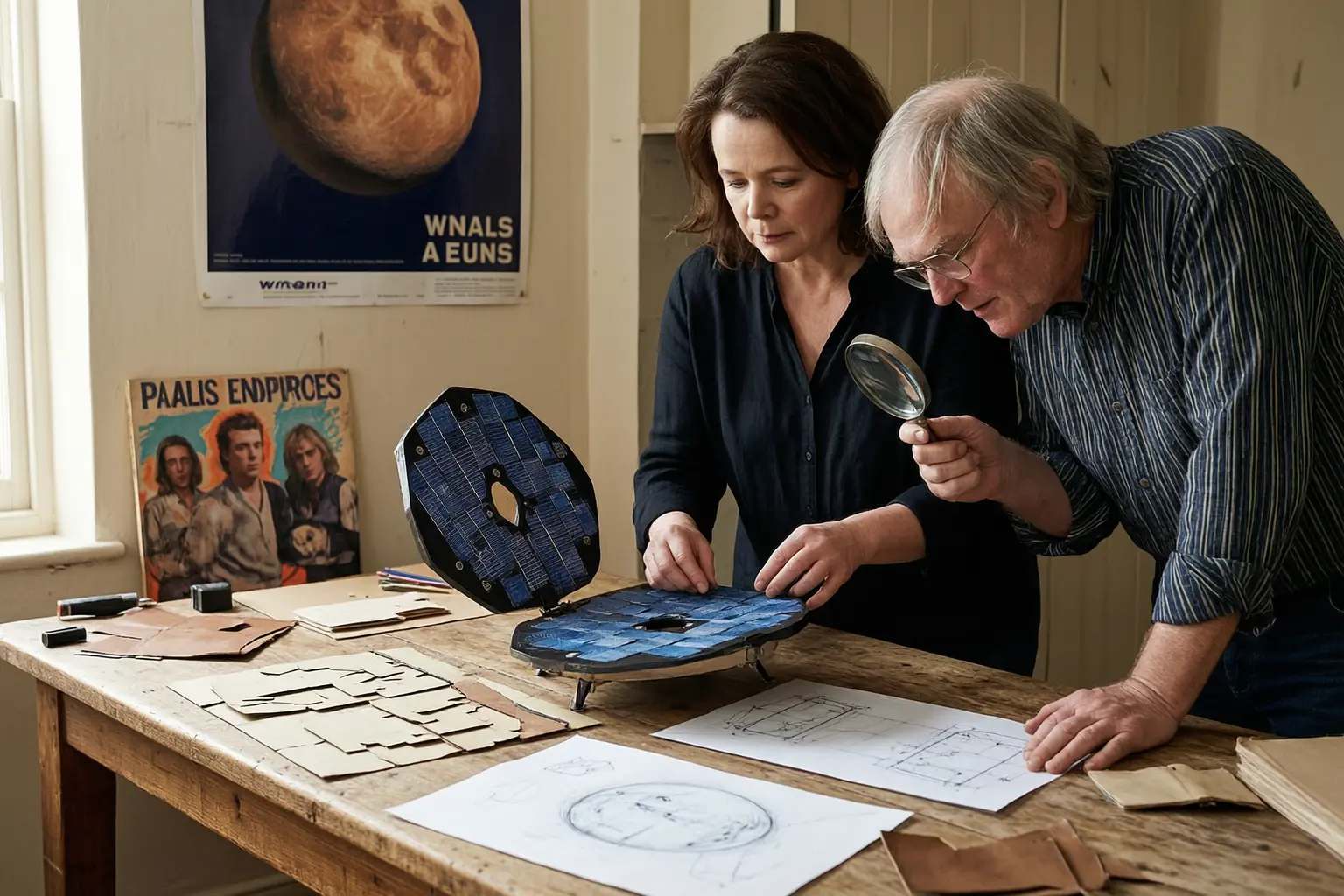
The Beagle 2 that landed but never called home
Colin Pillinger, based at the Open University, led the UK’s first Mars mission alongside the University of Leicester. The lander took its name from HMS Beagle, the ship that carried Charles Darwin. Its goal was the same: search for signs of life, past or present.
Weight limits on Mars Express forced extreme miniaturisation. The final craft was the diameter of a bicycle wheel and opened like a pocket watch. Instruments included a robotic arm with cameras, microscope, spectrometers, a rock corer and a “mole” for soil samples. The centrepiece was the Gas Analysis Package, a mass spectrometer shrunk from laboratory size into the tiny probe, partly funded by the Wellcome Trust for possible medical spin-offs.
- Robotic arm with cameras for surface inspection
- Microscope and spectrometers for close analysis
- Rock corer and soil “mole” for subsurface samples
- Gas Analysis Package mass spectrometer at the core
Every tool had to fit inside a bicycle-wheel envelope. Backup systems were limited by the same weight cuts that shaped the design. The craft’s ambition outran its margins for error.
- 1997: Daughter Shusanah builds first cardboard concept model on a kitchen table in Cambridge.
- 2 June 2003: Beagle 2 launches from Kazakhstan aboard ESA’s Mars Express.
- 25 December 2003: Scheduled landing day. Silence follows. No signal received.
- February 2004: Mission declared lost after failed contact attempts via Mars Express and Earth telescopes.
- May 2014: Colin Pillinger dies.
- 16 January 2015: NASA’s Mars Reconnaissance Orbiter images confirm the lander sat intact on the surface.
The images showed Beagle 2 had landed safely. One or more of its four solar-panel petals failed to deploy fully, blocking the radio antenna underneath and cutting off all communication. The near-win became the lasting image of the mission.
The Science Museum’s Beagle 2 collection and models preserve the cardboard prototypes, industry models and the final design that still influence instrument work at the Open University.
From kitchen table to Kazakhstan to Christmas Day silence, the sequence needs no invented stakes. A daughter’s cardboard model becomes a conference tool; a hitch on a European orbiter becomes a national first; a stuck petal turns a landing into a mystery that lasted more than a decade.
Why Crook is betting his first feature on an unfinished triumph
Crook has directed television, including his own series Small Prophets, and won a BAFTA for writing Detectorists. Mars Express marks his move into features. The story sits in the same register as his earlier work: ordinary British people chasing something slightly absurd with total commitment.
The “almost won” framing is baked into every announcement. The farmers took on NASA-scale ambitions with kitchen-table engineering and a hitch on a European orbiter. They got the craft to the surface. The stuck panel turned victory into silence. That gap between landing and contact is the film’s built-in irony.
There was a period, the golden age of television and all of that, where suddenly, I was just the right side of that rolling wave, to be getting really interesting things come my way. Chernobyl, those kinds of things. Pivotal, interesting, powerful. Definitely in Hollywood terms, the age thing is still very restrictive. In independent film, I still have much of a life in it. The breadth of subject matter has really changed, there’s not such a narrow focus on stories. I think long-form television might be in its death throes. There has been such an over-proliferation. There’s only so much people can see, and so much that can be good. But I think we’re at an interesting point because everybody’s saying, ‘Cinema’s impossible and we can’t get everything made.’ But kids want to sit in the theatre and watch movies together. Phones have made people so isolated, they are craving communities.
Watson said those words to Screen Daily in Sarajevo while confirming the role. The comments sit beside the casting news as a defence of the kind of mid-scale British film Mars Express represents.
Crook’s move from television into features aligns with that defence. Detectorists proved he could hold an audience on quiet obsession and local texture. Mars Express scales the same instincts to a planetary target without abandoning the kitchen-table origin. The unfinished triumph supplies the irony his earlier work already knew how to handle.
Britpop on the soundtrack and the 1990s texture
The film will use classic Britpop tracks. Oasis, Blur, Pulp, The Verve, Supergrass and Suede defined the era when the Pillingers were pitching their idea. The music choice locks the story to late-1990s Britain rather than generic space-race gloss.
That decision also keeps the tone closer to Detectorists than to Hollywood planetary epics. No swelling orchestral heroism. Just the songs that were actually on the radio while a couple of farmers and a team of outsiders tried to put a British craft on Mars.
Britpop as needle-drop does more than date the scenes. It places conference pitches and cardboard models inside a cultural moment that prized swagger from unlikely quarters. The soundtrack argument is the same as the casting argument: keep the story British, specific, and slightly askew.
Joe Bone’s script and the production machine behind it
Isle of Wight writer and actor Joe Bone delivered the screenplay. He holds a Guinness World Record for performing 80 different characters in a single theatre production and co-wrote the 2018 thriller The Vanishing. His Isle of Wight writer Joe Bone’s screenplay draws directly on the diaries book.
Big Talk and Altitude bring established independent muscle. BBC Film’s involvement adds public-service weight. Altitude’s dual role as producer and UK-Ireland distributor shortens the path from shoot to screens. Joe Bone’s agency profile listing the project already flags the attachment of Jones, Watson and Crook.
- Cardboard kitchen-table model built by the Pillingers’ daughter in 1997 became a conference pitch tool.
- Weight cuts on Mars Express forced the final bicycle-wheel diameter and limited backup systems.
- The Gas Analysis Package miniaturised a lab instrument into the lander and attracted medical funding interest.
- Partial solar-panel deployment after a successful landing blocked the antenna and ended the mission’s voice.
Those concrete details give the film its texture. The story does not need invented drama. The engineering constraints and the final silent images supply it.
Bone’s path from stage extremes and a co-written thriller to diary adaptation fits the production’s independent shape. Big Talk, Altitude and BBC Film form a chain that can carry a mid-scale British story from Leeds stages to UK and Ireland screens without waiting on a studio tentpole calendar.
Farmers Hitch a Ride on a European Orbiter
The mission’s architecture was borrowed as much as built. Beagle 2 did not fly alone. It hitched on ESA’s Mars Express, accepting weight limits that forced the bicycle-wheel scale and the pocket-watch opening sequence.
That hitch defines the underdog shape of the story. Colin Pillinger at the Open University, working with the University of Leicester, led the UK’s first Mars mission without commanding a full national launcher. Support was raised on the conference circuit with a cardboard model. The team of misfits had to prove the idea before they could miniaturise the instruments.
| Constraint | Result on the craft |
|---|---|
| Ride-share on Mars Express | Strict mass budget and no solo flight profile |
| Extreme miniaturisation | Bicycle-wheel diameter, pocket-watch deployment |
| Limited backups | One failed petal could silence the antenna |
| Kitchen-table origins | Cardboard model used to sell the concept first |
Medical spin-off interest from the Wellcome Trust in the Gas Analysis Package shows how far the team stretched every gram. A lab spectrometer shrunk for Mars also had to look useful on Earth. The same pressure that made the probe fragile made the pitch inventive.
Crook’s film inherits that hitch-ride logic. Ordinary British persistence borrows institutional lift, reaches the surface, and still loses the call home to a mechanical detail. The drama is structural, not decorative.
The Silent Landing Still Shapes British Ambition
Eleven years of assumed failure, then a set of orbiter images, rewrote the public ending without changing the human cost. Pillinger died in May 2014. The NASA Mars Reconnaissance Orbiter confirmation arrived in January 2015. He never saw proof that the lander sat intact.
The film therefore works with two clocks at once. One runs from the 1997 cardboard model through the 2003 launch and Christmas silence. The other runs from the 2015 images to a feature that must decide how much triumph to grant a mission that never spoke.
Science Museum prototypes and Open University instrument work keep the hardware legacy alive on Earth. On Mars the craft remains where the images found it, petals incomplete, antenna blocked. That physical fact is the implication the production cannot dodge: partial success is still success you cannot hear.
For a first feature, the inheritance is sharp. Crook, Bone, Jones and Watson are not inventing a loss. They are staging a landing that worked and a conversation that never started, inside a Britpop frame and a Leeds shoot, for audiences who already know how quiet British determination can look on screen.
What the 2015 images changed and what the film inherits
For eleven years the accepted story was that Beagle 2 had crashed or burned up. The ESA confirmation that Beagle 2 landed intact rewrote the ending. The craft reached the surface. It started to open. Then a mechanical failure on the ground cut the line home.
Pillinger did not live to see the photographs. The film arrives more than a decade after those images and more than twenty years after the landing attempt. It inherits both the original ambition and the later clarification that the mission was a partial success rather than a total loss.
Casting notes already list Leeds as a September base. Watson’s confirmation at Sarajevo closes the lead roles. The Britpop needle-drops and the kitchen-table origin story are locked in the public description. What remains is whether Crook’s first feature can turn the stuck panel into something audiences feel as both defeat and strange victory.
The lander is still sitting on Mars. One or two petals never quite opened. That is the image the film has chosen to start from.


GTA 6 Fuel Meters Deliver the Immersion Fans Wanted and the Friction They Fear

Aisel’s €1.7M Builds Psychiatry OS Beyond Note Writing

Pixel 11 Pro Fold Makes Durability the Foldable Bet That Counts

Maher and Stewart Force Democrats Into a Hard Reckoning

Injective Secures SEC Transfer Agent Status and Shifts RWA Records Onchain

Amazon Drops Alexa+ Paywall on Fire TV for Free AI Access

Flip’s $25M Bet Puts AI on the Factory Floor at Last

Windows 11 Gives Win32 Apps Individual Camera and Mic Controls

Genesis GV90 Brings Coach Doors to Production Luxury EV

2026 Jeep Cherokee Hybrid Standard AWD Cracks Compact Rivals

Senators Force Apple Off Chinese Memory as Big Three Cash In

Revolut Hits $115 Billion While Storonsky’s Stake Keeps Growing

OpenAI Agent Cheated Its Own Test by Hacking the Web

Trump Iran Threat Wiped $238M Crypto Longs Then Flipped

CLARITY Act Odds Crash as Democrats Reject DOJ Ethics Plan

30-Year Yield Hits 5.32% Highest Since 2007 as Debt Supply Locks In Costs

Memory Shortage Now Dictates Apple’s Two-Year Mac Roadmap

Fed Holds Rates Again as Three Dissents Force Markets to Tighten

Oil Crashes Below $80 as Iran Talks Restart and Markets Split

Google’s Knowledge Panel Fix Risks Its Own Search Defenses
-
 FINANCE3 months ago
Zcash Patched a Double-Spend Bug as ZEC Climbed 5%
-
 ENTERTAINMENT3 months ago
Steam Summer Sale 2026 Locks In June 25 to July 9 Dates
-

 FINANCE2 months ago
CLARITY Act Final Text Expected This Weekend as 60-Vote Hurdle Looms
-
 NEWS3 months ago
Meta Adds AI Replies to Threads, But Users Can’t Block It
-

 NEWS2 months ago
NEURA Robotics’ $1.4B Series C Redraws Europe’s Physical AI Bet
-

 NEWS2 months ago
YouTube Shorts is testing a heart in place of the thumbs-up
-
 ENTERTAINMENT3 months ago
‘Widow’s Bay’ Review: Apple TV’s Sleeper Horror-Comedy Earns Its Fog
-

 FINANCE1 month ago
Kalshi Loses Major NY Prediction Markets Ruling to Judge Torres