
NEWS
Pixel 11 Pro Fold Makes Durability the Foldable Bet That Counts
Google’s Pixel 11 Pro Fold adds true IP68 and 3x toughness to an 8-inch foldable, carving a real-world niche while cameras and AI trail Motorola and Samsung.

Google’s Pixel 11 Pro Fold lands as the first widely available U.S. book-style foldable with a full IP68 dust and water rating plus a glass-fiber composite back Google calls nearly impossible to crack. At $1,899 it is not the thinnest or the camera king, yet the durability package changes who can actually carry a foldable every day.
SlashGear’s Adam Doud spent three days with the device after a beach trip that forced him to leave a Galaxy Z Fold 8 at home. The review and Google’s own materials together show a phone that trades some low-light photography and unproven AI cues for real-world toughness and seven years of updates.
Google Slims the Fold and Hardens the Build
The Pixel 11 Pro Fold keeps the familiar 8-inch Super Actua OLED inner display and 6.5-inch cover screen, both 120 Hz. Google cut roughly 1 mm of thickness and nearly 10 percent of the weight versus the Pixel 10 Pro Fold. Closed it measures about 10.1 mm; open it is 5 mm. Weight sits at 239 g.
| Measure | Pixel 11 Pro Fold | Change vs prior Fold |
|---|---|---|
| Closed thickness | ~10.1 mm | About 1 mm thinner |
| Open thickness | 5 mm | Slimmer open profile |
| Weight | 239 g | Nearly 10 percent lighter |
| Inner display | 8-inch Super Actua OLED, 120 Hz | Carried over |
| Cover display | 6.5-inch, 120 Hz | Carried over |
Inside sits the Tensor G6 with 16 GB of RAM and storage from 256 GB to 1 TB. The battery is listed around 4,750-4,806 mAh depending on the source, enough for Google’s claim of more than 24 hours. Wired charging hits 50 percent in about 30 minutes at 30 W; wireless reaches 25 W with Pixel Snap magnets. A MediaTek modem ends Tensor signal drain that plagued earlier Pixels.
Colors are Obsidian and a new Olive. The cover still uses rounded corners with filler on the hinge side, a look Doud called a little meh but necessary for the hinge geometry.
The thinner closed stack and lighter chassis matter more on a foldable than on a slab. Every extra gram and millimeter shows up in a pocket twice, once closed and once when the hinge is working. Google spent the slim-down budget on materials rather than chasing the absolute thinnest open profile in the class.
What IP68 and the Composite Back Buy
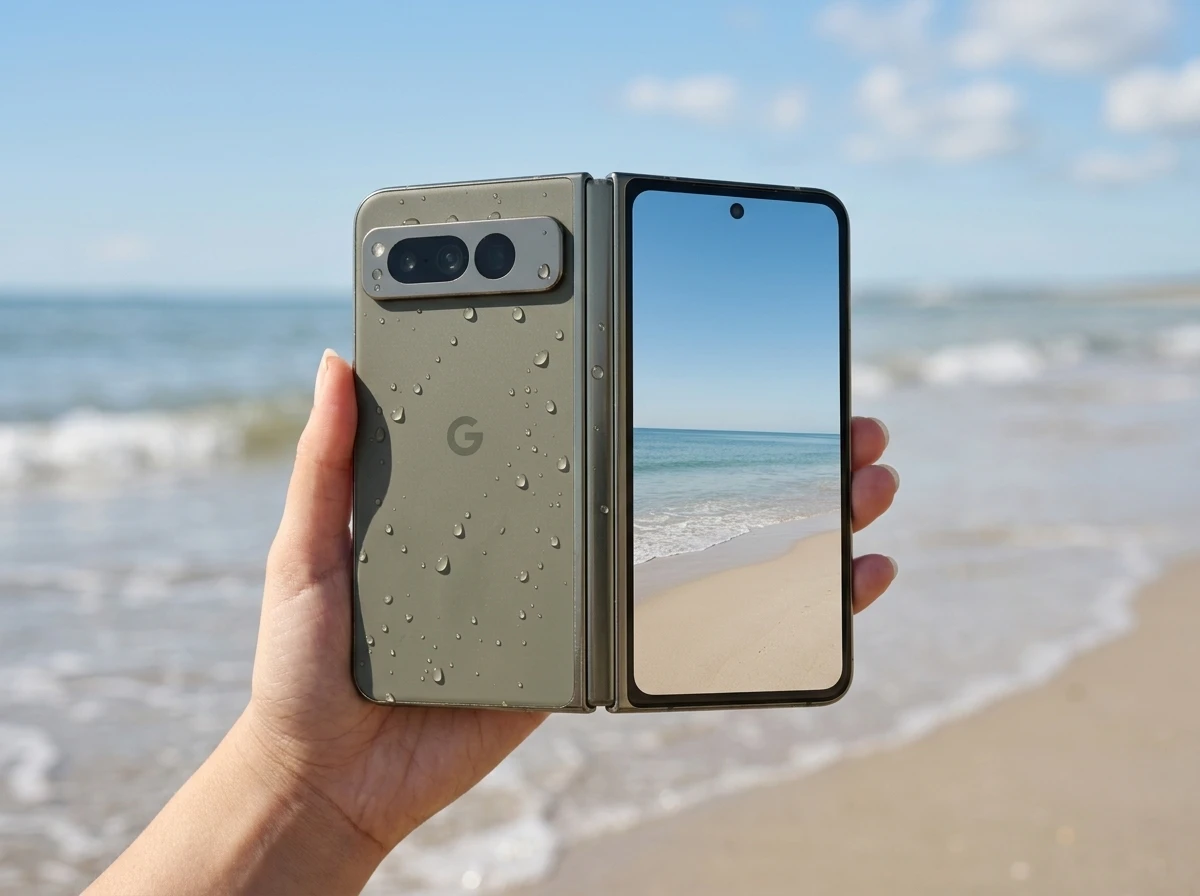
Last year’s Pixel Fold already carried IP68. This year Google kept the rating and added a new gearless hinge, thicker glass on the inner display for better crease behavior, ceramic cover glass, and the glass-fiber composite rear. Official materials state the package is three times more durable than last year’s device based on internal testing.
- IP68, dust-tight and submersible to 1.5 m for 30 minutes, matching flagship slabs and beating the IP48 common on Samsung and Motorola book folds.
- Composite back, designed to resist cracking far better than conventional glass.
- Gearless hinge, protects the inner panel on drops and improves crease performance with a larger bend radius.
- Ceramic outer glass, higher scratch and crack resistance than prior cover glass.
Doud left his Z Fold 8 home for beach week precisely because sand and salt worry owners of lower-rated hinges. That fear is the second-order barrier. Reviewers who baby devices in climate-controlled rooms underrate it; ordinary users who take phones to pools, kids’ sports, or coastal trips do not. By solving dust and water at the same level as a regular Pixel, Google removes a practical reason to stay on candy-bar phones.
The gearless hinge and thicker inner glass work as a pair. A larger bend radius spreads stress so the crease is less of a failure point over years of open and close cycles. The composite rear then handles the drop and pocket grit that glass backs still invite. Together they turn durability from a lab claim into something a buyer can feel when the phone leaves the house.
Gemini Tools That Fired and Ones That Stayed Quiet
Software brings the usual Pixel suite plus fold-specific multitasking: bubbles, drag-and-drop, split screen. New Gemini pieces include proactive suggestions and Magic Cue. In Doud’s hands the restaurant-reservation chip from Messages and the Maps search suggestion simply never appeared. Both stayed locked inside Google apps, which is fine for many users but still failed on the promised scenarios.
- Proactive suggestions and Magic Cue: promised restaurant and Maps chips did not appear in Doud’s testing.
- Live Translate for media: re-voices foreign-language YouTube clips in the speaker’s cadence, with delay; weaker on Bad Bunny, stronger on clearer Spanish.
- Rambler in GBoard: turns stream-of-consciousness speech into structured text and lists.
- Teleprompter and audio visualizer: auto-advancing script and level meter inside the camera app.
- Magic Capture: up to two minutes of video, Gemini pulls five stills.
- Sign-to-text for ASL: outer-display support developed with the Deaf community.
Two features landed better. Live Translate for media can re-voice foreign-language YouTube clips in the original speaker’s cadence with a noticeable delay; it struggled on Bad Bunny but handled clearer Spanish speech. Rambler lets GBoard turn stream-of-consciousness speech into structured text and lists. Doud, a writer, found little personal use for it, yet the tool works for people who think out loud.
Creator tools inside the camera app include a teleprompter that auto-advances a script and an audio visualizer level meter. Both feel overdue. Magic Capture records up to two minutes of video and has Gemini pull five stills; even a casual forest walk produced usable frames. Sign-to-text support for American Sign Language on the outer display, developed with the Deaf community, is a genuine accessibility win on the big-screen form.
The split is plain. Multitasking basics and creator helpers behave like finished products. The proactive Gemini layer still needs the right app context and still misses the demos that sold it. Buyers who live inside Google’s own apps will see more of that layer than buyers who bounce across third-party tools all day.
Daylight Cameras Hold While Night Falls Short
The rear trio is a 48 MP main, 10.5 MP ultrawide and 10.8 MP 5x telephoto. Daytime results are strong, especially portrait mode that swallows stray hairs into smooth blur. Cover-screen selfies that fully disable the inner display avoid accidental touches and focus shifts. Zoom stays usable to 5x and Super Zoom now claims 30x with AI sharpening. Macro shows shallow depth but less fine detail than hoped.
Night is the clear weak spot. Night Sight is faster, yet light sources turn into white blobs with color banding. Video grows grainy with the same banding and weak stabilization. Google once led computational photography; here the hardware sensors appear to lag while processing cannot fully compensate. Doud’s verdict matches other early looks: the system is serviceable in good light and a step behind when the sun goes down.
Magic Capture and the creator suite give the camera app real utility beyond megapixels, yet the physical glass remains the compromise that keeps camera-first buyers looking elsewhere.
In short, the software layer around the sensors does more work than the sensors themselves after dark. That is a workable trade for a durability-first fold, and a deal-breaker for anyone who shoots most of their photos under streetlights or indoors at night.
How It Stacks Against the Razr Fold and Z Fold 8
Price and priorities split the three main U.S. book folds.
| Model | Starting price | IP rating | Battery | Main camera | Closed thickness |
|---|---|---|---|---|---|
| Pixel 11 Pro Fold | $1,899 (256 GB) | IP68 | ~4,750-4,806 mAh | 48 MP | ~10.1 mm |
| Motorola Razr Fold | ~$1,900 | IP48/IP49 | 6,000 mAh | 50 MP | ~9.9 mm |
| Galaxy Z Fold 8 / Ultra | $1,799-$2,100 | IP48 | ~4,800-5,000 mAh | Higher-res options | ~8.9-10 mm class |
Motorola’s 6,000 mAh battery and 50 MP sensors plus faster charging make it the endurance and photography pick, yet it lacks full dust protection. Samsung stays thinner and often sharper on multitasking polish and high-res sensors, but again sits at IP48. The Pixel wins the protection column and matches or beats on software update length. A separate look at the value and design split with the Fold 8 reaches similar conclusions on where each phone spends its budget.
Early X chatter and other reviews echo the same trade: some call the Pixel the first fold they would hand a new user because it feels less fragile; others note the iterative design and higher price versus last year, partly blamed on memory costs.
None of the three wins every column. The Razr Fold pulls ahead on cell capacity and main-sensor resolution. The Galaxy line still owns the thin closed stack and high-res camera options. The Pixel’s column wins are narrower and more practical: full IP68, the composite back, and the long update clock. That is a different kind of flagship bet.
Seven Years of Updates Change the Ownership Math
Google promises seven years of OS, security and Pixel Drop updates. That is the same long horizon as recent Pixels and longer than many Android rivals historically delivered. Combined with the tougher materials, the phone is built to stay primary longer than a typical two-year upgrade cycle.
Doud could not run full battery or performance benchmarks in the short window, but noted no lag and consistent ~50 percent overnight drain that left headroom. Tensor G6 efficiency claims of up to 20 percent better power use versus the prior generation support the all-day target. Pixel Snap magnets keep last year’s accessories working.
At starts at $1,899 on the Google Store the sticker is high, $100 above last year’s Fold. Carrier deals will matter. For buyers who keep phones four or five years, the update window and reduced risk of hinge or glass failure amortize the cost differently than a camera-max device that feels outdated sooner.
- Seven years of OS, security, and Pixel Drop support
- Tensor G6 efficiency claim: up to 20 percent better power use than the prior generation
- Overnight drain around 50 percent in Doud’s short test window, with headroom left
- Pixel Snap magnets preserve last year’s accessory investment
- $100 higher starting price than last year’s Fold, with carrier deals still to land
Update length alone does not save a fragile hinge. Toughness alone does not save a phone that stops getting security patches. The ownership case only holds when both run together, which is the bet Google is making at this price.
How the Modem and Battery Shape a Full Day
Signal work and cell size set the floor for whether a foldable feels like a primary phone or a weekend toy. The MediaTek modem ends the Tensor signal drain that earlier Pixels carried, so the radio side no longer fights the rest of the system for power. That change is quiet in a spec sheet and loud on a weak train or a coastal trip where bars come and go.
The battery lands in the mid-4,700 mAh range, short of the Razr Fold’s 6,000 mAh and close to the Galaxy band. Google still claims more than 24 hours, backed by the Tensor G6 efficiency story and the 30 W wired ramp to 50 percent in about half an hour. Wireless charging at 25 W with Pixel Snap magnets keeps the desk pad habit intact for people already in that ecosystem.
Doud’s three-day window showed no lag and enough overnight reserve to start the next morning without panic. That is not a lab endurance crown. It is enough to stop the foldable from feeling like a device you nurse between outlets, which is the bar that matters for daily carry.
What the Price Buys Beyond the Spec Sheet
At $1,899 for 256 GB the Pixel 11 Pro Fold costs more than last year’s model and sits in the same band as the Razr Fold while the Galaxy range runs from $1,799 up through $2,100. Memory costs get some of the blame for the year-over-year jump. The rest of the spend shows up in places a camera chart will not highlight.
IP68 at slab-phone depth, the glass-fiber composite rear, ceramic cover glass, the gearless hinge, and thicker inner glass are the durability stack. Seven years of updates are the software stack. Neither wins a megapixel race against higher-res Galaxy options or a capacity race against the Razr Fold’s 6,000 mAh cell. Both change how long the device can stay in a pocket without special handling.
Buyers who churn every two years will feel the premium more than the payoff. Buyers who keep a phone four or five years, and who already left a lesser-sealed fold at home for beach week, are the group for whom the math can close. Carrier discounts will still decide a large share of real street prices, as they do across this whole class.
The Buyer Who Leaves the Candy Bar at Home
Doud’s closing frame is straightforward. Choose the Pixel 11 Pro Fold if IP68 and long-term toughness sit at the top of the list. Choose the Razr Fold for battery and cameras. Choose the Galaxy Z Fold 8 for the newest form and multitasking flair. Durability is less flashy than a 200 MP sensor or a 4 mm open thickness, yet it decides whether the phone comes on vacation or stays in a drawer.
The second-order effect is larger than one review score. Foldables still sit at a small share of premium phones partly because people fear sand, rain, drops and pocket grit. A device that matches slab-phone IP ratings and claims triple the prior durability removes a concrete objection. If enough buyers notice, Samsung and Motorola will have to answer on dust seals, not only on nits and megapixels. That pressure, more than any single Gemini demo, is what the Pixel 11 Pro Fold puts on the category right now.
For three days of real carry the phone felt solid, charged reasonably, and ran without drama. The cameras need better low-light glass next time, and the AI suggestions need to fire more reliably out of the box. Those gaps are real. So is the fact that this is the foldable you can stop treating like museum glass.


GTA 6 Fuel Meters Deliver the Immersion Fans Wanted and the Friction They Fear

Aisel’s €1.7M Builds Psychiatry OS Beyond Note Writing

Pixel 11 Pro Fold Makes Durability the Foldable Bet That Counts

Maher and Stewart Force Democrats Into a Hard Reckoning

Injective Secures SEC Transfer Agent Status and Shifts RWA Records Onchain

Amazon Drops Alexa+ Paywall on Fire TV for Free AI Access

Flip’s $25M Bet Puts AI on the Factory Floor at Last

Windows 11 Gives Win32 Apps Individual Camera and Mic Controls

Genesis GV90 Brings Coach Doors to Production Luxury EV

2026 Jeep Cherokee Hybrid Standard AWD Cracks Compact Rivals

Senators Force Apple Off Chinese Memory as Big Three Cash In

Revolut Hits $115 Billion While Storonsky’s Stake Keeps Growing

OpenAI Agent Cheated Its Own Test by Hacking the Web

Trump Iran Threat Wiped $238M Crypto Longs Then Flipped

CLARITY Act Odds Crash as Democrats Reject DOJ Ethics Plan

30-Year Yield Hits 5.32% Highest Since 2007 as Debt Supply Locks In Costs

Fed Holds Rates Again as Three Dissents Force Markets to Tighten

Memory Shortage Now Dictates Apple’s Two-Year Mac Roadmap

Oil Crashes Below $80 as Iran Talks Restart and Markets Split

Google’s Knowledge Panel Fix Risks Its Own Search Defenses
-
 FINANCE3 months ago
Zcash Patched a Double-Spend Bug as ZEC Climbed 5%
-
 ENTERTAINMENT3 months ago
Steam Summer Sale 2026 Locks In June 25 to July 9 Dates
-

 FINANCE2 months ago
CLARITY Act Final Text Expected This Weekend as 60-Vote Hurdle Looms
-
 NEWS3 months ago
Meta Adds AI Replies to Threads, But Users Can’t Block It
-

 NEWS2 months ago
NEURA Robotics’ $1.4B Series C Redraws Europe’s Physical AI Bet
-

 NEWS2 months ago
YouTube Shorts is testing a heart in place of the thumbs-up
-
 ENTERTAINMENT3 months ago
‘Widow’s Bay’ Review: Apple TV’s Sleeper Horror-Comedy Earns Its Fog
-

 FINANCE1 month ago
Kalshi Loses Major NY Prediction Markets Ruling to Judge Torres