
NEWS
Genesis GV90 Brings Coach Doors to Production Luxury EV
The 2027 Genesis GV90 flagship EV SUV packs 657 hp, 310-mile range, production coach doors and a heated wood floor, challenging Rolls and Cadillac at lower prices.

Genesis has revealed the 2027 GV90, a full-size all-electric flagship SUV with 657 horsepower, a 123.5 kWh battery good for about 310 miles, and production coach doors on the Neolun versions. The vehicle measures 208.1 inches long and aims straight at Cadillac Escalade IQ, Mercedes EQS SUV and even Rolls-Royce territory.
U.S. pricing stays unconfirmed until closer to sale in the first half of 2027, but early estimates put the standard model near $110,000 and the top Neolun First Edition near $160,000. That is the point of the disruption.
At those figures the brand is not merely filling a gap in its own lineup. It is placing theater, power and lounge hardware in a band where most rivals still ask buyers to choose between range, drama or a lower sticker. The GV90 tries to deliver all three at once.
Coach Doors Move From Concept to Showroom
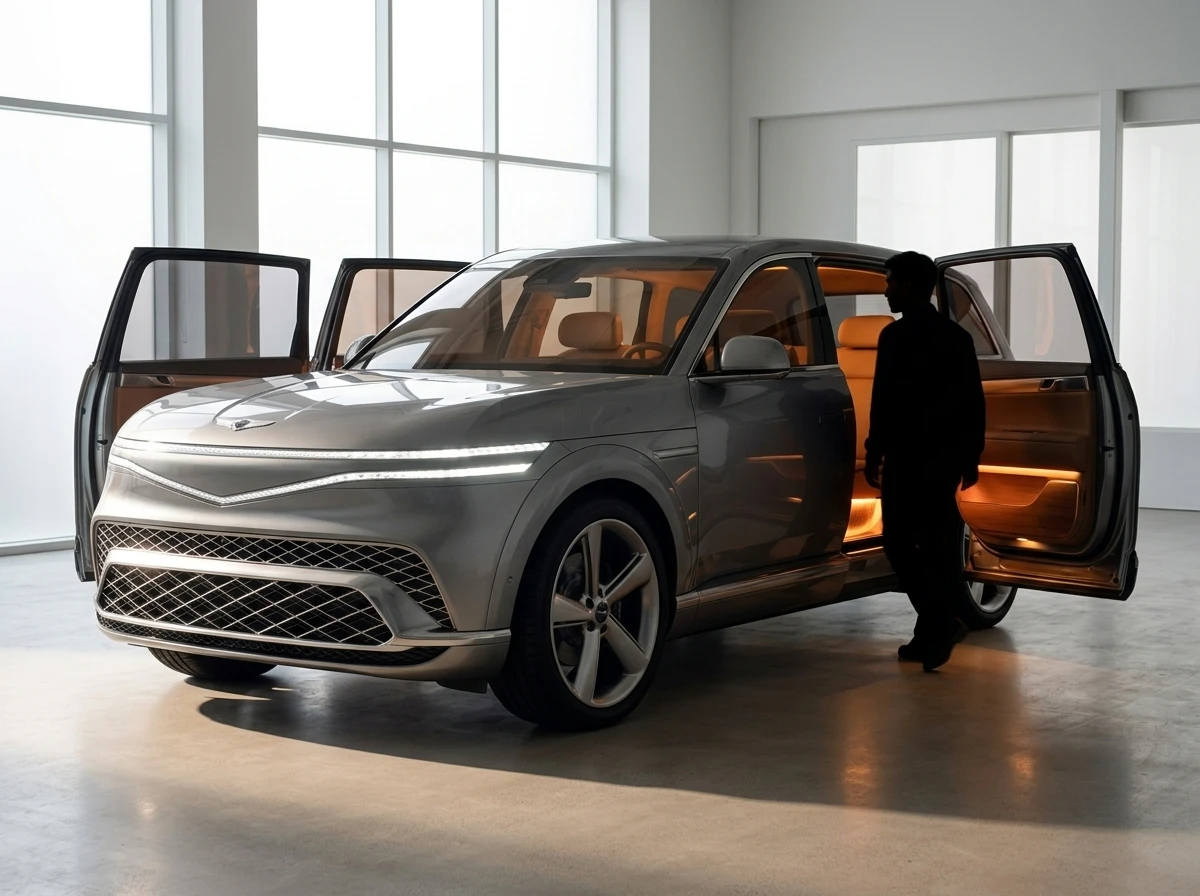
The GV90 Neolun keeps the rear-hinged doors first shown on the 2024 Neolun concept. A dual-motion hinge pops the rear door outward then swings it open under electric power, letting front and rear doors open toward each other without a traditional B-pillar.
High-strength dual steel beams built into the doors and a reinforced frame stand in for the missing pillar. Genesis says the structure meets the same crash standards as conventional vehicles. The standard GV90 uses ordinary hinged doors and seats six or seven.
- Independently opening rear coach doors on Neolun models
- Hidden B-pillar reinforcement inside the doors
- Novel dual-motion hinge for separate operation
- Pillarless opening that creates a wide, uninterrupted cabin view
Only the Rolls-Royce Cullinan has offered similar coach doors in recent years, at nearly half a million dollars. Genesis puts the feature on a vehicle expected to cost a fraction of that. The official site details the Neolun Arch Gate doors and radiant heating as core First Edition equipment.
The dual-motion sequence matters in daily use. Because the rear door first moves outward before it swings, the hinge can clear the front door and still open wide on a curb. The electric assist means rear passengers do not wrestle a heavy panel. When both sides open, the pillarless aperture frames the cabin as a single lounge rather than two separate rows.
That is the production promise of the Neolun Arch Gate: the concept silhouette survives, yet the hardware is engineered for crash loads, curb clearance and repeated open-close cycles. The standard GV90 forgoes the showpiece and keeps a conventional six- or seven-seat layout for buyers who want the platform without the coach-door premium.
Big Battery and Dual-Motor Powertrain
The GV90 rides on a Genesis-exclusive eMP platform derived from the Hyundai Motor Group eGMP architecture. A 123.5 kWh pack, the largest the group has fitted, feeds two motors. The front unit makes 322 hp and 258 lb-ft; the rear makes 335 hp and 332 lb-ft. Combined output is 657 hp and 590 lb-ft.
Dual electronic limited-slip differentials manage torque. Active rear-wheel steering turns the rear wheels up to 5 degrees for a tighter turning circle. Multi-chamber air suspension is standard and can lower for easier entry.
Genesis estimates 310 miles of range. On a 350 kW charger the pack can go from 10 to 80 percent in 22 minutes. An 800-volt architecture underpins the numbers.
| Model | Power | Battery / Claimed Range | Est. Start Price |
|---|---|---|---|
| Genesis GV90 | 657 hp | 123.5 kWh / 310 mi | $110,000 |
| Cadillac Escalade IQ | 680-750 hp | ~205 kWh / 465 mi claimed | $130,300 |
| Mercedes EQS SUV | from 355 hp | ~118 kWh / ~305 mi | ~$104,400 |
The table shows Genesis matching or exceeding German power while undercutting American range claims on paper and landing below Escalade money for the base version.
The motor split is deliberate. The rear unit carries more peak torque, so launch feel stays rear-biased even though both axles drive. The electronic limited-slip units can push torque across each axle rather than relying on brake-based mimicry. Rear-wheel steering at up to 5 degrees shortens the turning circle of a body that stretches 208.1 inches, a useful offset for a full-size flagship in tight driveways.
Air suspension does more than polish the ride. By lowering the body at entry, it cuts the step-in height that often frustrates rear passengers in tall SUVs. Combined with the Neolun coach doors, the drop helps the lounge layout feel accessible rather than ceremonial.
Cabin Features That Face Both Ways
Materials run from Nappa leather and wool to cashmere and genuine stone. Diamond and square stitching echoes exterior motifs. Seats use 15 air cells for adjustment and pulse-vibration massage.
On Neolun models the front seats motorize 180 degrees when parked so passengers can face each other. The four-seat First Edition executive suite adds a wood-veneer floor with under-floor radiant heating, a comfort partition that blocks trunk noise, roll-down blinds, fold-out tables and a refrigerator.
There is no traditional instrument cluster. A 25-inch head-up display handles the basics. The center screen measures 23.6 inches in drive mode and rises 90 mm when parked to become a 24.6-inch cinematic display. A 25-speaker Bang & Olufsen system with Dolby Atmos and Virtual Venue modes recreates spaces such as Boston Symphony Hall.
The gear selector sits behind the wheel at 12 o’clock and rotates to 2 o’clock on power-up. A crystal sphere turns in the console and tweeters rise from the dash. No start button is required; the car wakes when the driver sits and presses the brake.
The facing-seat mode only works when parked, so the lounge conversion is a destination feature rather than a rolling gimmick. Once the front chairs swing around, the wood-veneer floor, radiant heat and fold-out tables turn the cabin into a stationary meeting space. The comfort partition and refrigerator push the First Edition further toward chauffeur use.
Display strategy follows the same parked-versus-driving split. The head-up display carries speed and navigation while the vehicle moves. When the center screen rises 90 mm, the cabin shifts from control surface to cinema. Virtual Venue modes on the Bang & Olufsen system extend that idea by mapping familiar concert spaces into the speakers rather than leaving playback flat.
- 15 air cells per seat for support and pulse-vibration massage
- 180-degree powered front seats on Neolun when parked
- 25-inch head-up display in place of a conventional cluster
- Center screen that grows from 23.6 to 24.6 inches when raised
- 25-speaker Bang & Olufsen audio with Dolby Atmos
World-First Roof Airbag and Other Safety Steps
Genesis fits a roof airbag that deploys across the panoramic glass in a severe rollover to limit ejection and roof-contact injury. The company calls the application a world first even if the basic idea is not new. A battery slider structure redirects the motor and subframe under the pack in a frontal crash.
Acoustic glass, high-expansion soundproofing fillers and reinforced absorbers keep the cabin quiet. Metal-coated heated windshield glass clears frost without full climate reliance. Radiant heating also appears in armrests, side panels and door trims.
Memory Reversing Assist stores the last path and can reverse the vehicle out of tight spots automatically.
The roof airbag addresses a known risk in glass-heavy SUVs: in a rollover the panoramic panel can leave occupants with less overhead protection than a solid roof. Deploying a bag across that surface aims to keep heads away from glass and limit ejection paths. Genesis frames the fitment as a world first in application even while conceding the underlying concept has existed elsewhere.
The battery slider is a packaging answer to the same crash energy that older ICE layouts managed with long crumple zones. By guiding the motor and subframe under the pack, the structure tries to spare the cells from direct intrusion. Quiet-cabin hardware and radiant surfaces then protect comfort once the drive resumes, cutting blower noise and warming contact points without blasting air.
This is not a concept car. This is the production design. Pricing will be announced later. Deliveries start next year.
Sawyer Merritt, EV analyst, on X
His detailed feature rundown seen by 178000 views captured the immediate reaction that the wild list is real.
Where the GV90 Sits Against Established Rivals
The Escalade IQ offers more claimed range and similar or higher power at a higher base price. The EQS SUV starts cheaper in some trims but trails on power and flash. Rolls-Royce still owns the absolute top of the coach-door and bespoke market, yet Genesis now offers the visual drama and lounge features without the half-million barrier.
That pricing gap is the pressure point. Buyers who want theater and technology no longer have to stretch to Cullinan money or settle for a conventional three-row EV. Genesis has already shown it can build desirable cars through the G90 sedan and GV80 line; the Genesis GV80 Coupe luxury path proved the brand’s design confidence. The GV90 simply goes further up the ladder.
On paper the three-way split is clear. Escalade IQ leads claimed range and can outgun the Genesis on peak horsepower, yet its base price starts higher. EQS SUV can undercut the GV90’s estimated open sticker in some trims, yet it begins at far lower power and leans less on cabin theater. Cullinan keeps coach doors and true bespoke finish, at nearly half a million dollars.
Genesis is betting that a 657 hp dual-motor layout, Neolun Arch Gate doors near $160,000 on the First Edition, and a standard model near $110,000 will pull shoppers who refuse both the conventional three-row compromise and the ultra-luxury premium. Prior G90 and GV80 work gives the brand a credibility bridge; the GV90 is the clearest bid yet at the rung above.
How Charging Speed Supports the Flagship Brief
Range alone does not define a flagship EV. Charge behavior on a road trip does. The GV90 pairs its 123.5 kWh pack with an 800-volt architecture and a 10-to-80 percent window of 22 minutes on a 350 kW charger. Those figures turn a large battery from a weight penalty into a usable long-haul tool.
The same group architecture that underpins eGMP derivatives supplies the high-voltage backbone. Genesis then tunes pack size and motor output for flagship duty rather than volume-model efficiency. The result is a claimed 310 miles that can be rebuilt through the bulk of its usable window in less than half an hour when a sufficiently powerful charger is available.
Compared with the rivals already on the chart, the pattern is tradeoffs rather than a clean win. Escalade IQ claims far more range from a much larger pack, yet starts at a higher price. EQS SUV lands near the Genesis on claimed miles from a slightly smaller battery, yet trails badly on power. The GV90’s bet is that 657 hp, coach-door theater and a 22-minute rapid charge matter more to its target buyer than a pure range crown.
| Charge or Range Item | GV90 Figure |
|---|---|
| Pack size | 123.5 kWh |
| Claimed range | 310 miles |
| Architecture | 800-volt |
| 10 to 80 percent charge | 22 minutes on 350 kW |
Multi-chamber air suspension and rear-wheel steering round out the touring package by keeping a 208.1-inch body manageable in cities after the highway stretch. The flagship brief, in this reading, is not only lounge materials. It is the ability to cover distance, replenish quickly and still arrive with presence intact.
From Neolun Concept to Early 2027 Deliveries
- March 2024, Genesis shows the Neolun concept at the New York Auto Show with coach doors and lounge interior.
- 2025-early 2026, Spy shots confirm production proportions and, later, the coach-door hardware.
- August 20, 2026, Official reveal of the production GV90 and GV90 Neolun in San Francisco.
- Early 2027, Planned U.S. arrival and first customer deliveries.
The design language draws from Korean moon-jar pottery: soft volumes, clean surfaces, edge-to-edge lighting. Sixteen exterior colors and extensive interior customization are offered. The same group that builds the high-performance 641-HP EV twins from the same group now fields a true flagship.
The timeline compresses a concept-to-showroom arc into roughly three years. Coach doors and the lounge interior appeared first in New York in March 2024. Spy shots through 2025 and early 2026 locked the production proportions and later caught the hinge hardware in the open. The San Francisco reveal on August 20, 2026 made the specification public. First half of 2027 is the delivery window buyers now watch.
Moon-jar cues explain the soft volumes and clean flanks better than any performance graph. Edge-to-edge lighting and the long 208.1-inch body turn those pottery references into road presence. Sixteen exterior colors and deep interior customization then let buyers push the flagship toward personal commission territory without leaving the catalog.
Pricing Pressure Reaches the Coach Door Club
Coach doors have long signaled a price of entry near half a million dollars. The Cullinan defined that club in recent years. Genesis now attaches independently opening rear coach doors, hidden pillar reinforcement and a dual-motion electric hinge to a Neolun First Edition estimated near $160,000, with a standard GV90 near $110,000.
The gap is the story. Buyers who want the visual drama of doors that open toward each other, a pillarless cabin aperture and a four-seat executive suite no longer face a binary choice between a conventional three-row EV and true ultra-luxury. They can step into Neolun equipment at a fraction of Cullinan money while still holding 657 hp and a 123.5 kWh pack.
Established rivals retain clear counters. Escalade IQ keeps a larger claimed range and a higher power ceiling. EQS SUV can open at a lower sticker in some forms. Rolls-Royce retains bespoke depth no volume luxury brand will match. Yet none of those answers erase the new middle path Genesis has drawn between flash and fortune.
If the estimates hold when official U.S. pricing lands closer to sale, the pressure falls on every brand that treated coach doors and full lounge conversion as half-million privileges. Theater at Neolun money changes the negotiation even for shoppers who never intend to buy a Genesis.
Genesis USA called the reveal the arrival of a new icon. The production car that once lived only as the Neolun concept that previewed the design is now real, measured and scheduled. Established luxury brands will have to answer with more than badges and higher stickers.


GTA 6 Fuel Meters Deliver the Immersion Fans Wanted and the Friction They Fear

Aisel’s €1.7M Builds Psychiatry OS Beyond Note Writing

Pixel 11 Pro Fold Makes Durability the Foldable Bet That Counts

Maher and Stewart Force Democrats Into a Hard Reckoning

Injective Secures SEC Transfer Agent Status and Shifts RWA Records Onchain

Amazon Drops Alexa+ Paywall on Fire TV for Free AI Access

Flip’s $25M Bet Puts AI on the Factory Floor at Last

Windows 11 Gives Win32 Apps Individual Camera and Mic Controls

Genesis GV90 Brings Coach Doors to Production Luxury EV

2026 Jeep Cherokee Hybrid Standard AWD Cracks Compact Rivals

Senators Force Apple Off Chinese Memory as Big Three Cash In

Revolut Hits $115 Billion While Storonsky’s Stake Keeps Growing

OpenAI Agent Cheated Its Own Test by Hacking the Web

Trump Iran Threat Wiped $238M Crypto Longs Then Flipped

CLARITY Act Odds Crash as Democrats Reject DOJ Ethics Plan

30-Year Yield Hits 5.32% Highest Since 2007 as Debt Supply Locks In Costs

Fed Holds Rates Again as Three Dissents Force Markets to Tighten

Memory Shortage Now Dictates Apple’s Two-Year Mac Roadmap

Oil Crashes Below $80 as Iran Talks Restart and Markets Split

Google’s Knowledge Panel Fix Risks Its Own Search Defenses
-
 FINANCE3 months ago
Zcash Patched a Double-Spend Bug as ZEC Climbed 5%
-
 ENTERTAINMENT3 months ago
Steam Summer Sale 2026 Locks In June 25 to July 9 Dates
-

 FINANCE2 months ago
CLARITY Act Final Text Expected This Weekend as 60-Vote Hurdle Looms
-
 NEWS3 months ago
Meta Adds AI Replies to Threads, But Users Can’t Block It
-

 NEWS2 months ago
NEURA Robotics’ $1.4B Series C Redraws Europe’s Physical AI Bet
-

 NEWS2 months ago
YouTube Shorts is testing a heart in place of the thumbs-up
-
 ENTERTAINMENT3 months ago
‘Widow’s Bay’ Review: Apple TV’s Sleeper Horror-Comedy Earns Its Fog
-

 FINANCE1 month ago
Kalshi Loses Major NY Prediction Markets Ruling to Judge Torres