
NEWS
Unitree’s 542% IPO Pop Prices Demos Far Ahead of Real Work
Unitree shares soared 542% after raising $905 million, valuing the humanoid maker near $9 billion even as commercial use stays limited to research and shows.

Unitree Robotics shares jumped 542% to 968.1 yuan in early trading on their Shanghai STAR Market debut Wednesday, after the Hangzhou humanoid maker raised 6.1 billion yuan ($905 million) at 150.80 yuan a share. The stock hit as high as 1,100 yuan, valuing the company near 61 billion yuan or about $9 billion.
The pop made Unitree the first onshore-listed pure-play humanoid robot company and crowned months of retail frenzy that saw the offering oversubscribed more than 8,000 times.
How far the debut numbers ran
Unitree, formally Yushu Technology and ticker 688836, sold roughly 40.4 million shares, or about 10% of the enlarged capital. Existing backers include Tencent; AI firm DeepSeek put in about 140.8 million yuan just before listing.
The first-day move topped the 466% surge by memory chipmaker CXMT on the same board a month earlier. Retail odds of receiving shares sat near 0.018% after clawbacks from institutions.
- IPO price: 150.80 yuan
- Early close/reference: 968.1 yuan (+542%)
- Intraday high: 1,100 yuan
- Capital raised: 6.1 billion yuan ($905 million)
- Implied valuation: ~61 billion yuan ($9 billion)
Trading volume quickly exceeded 20 billion yuan in some session tallies as Chinese retail money chased the name.
That combination of a thin free float, a pure-play story and a board built for tech listings left little supply against a flood of orders. The 8,000-times oversubscription and the 0.018% retail allocation odds explain why the open gap was so wide once secondary trading began.
What Unitree actually builds and ships
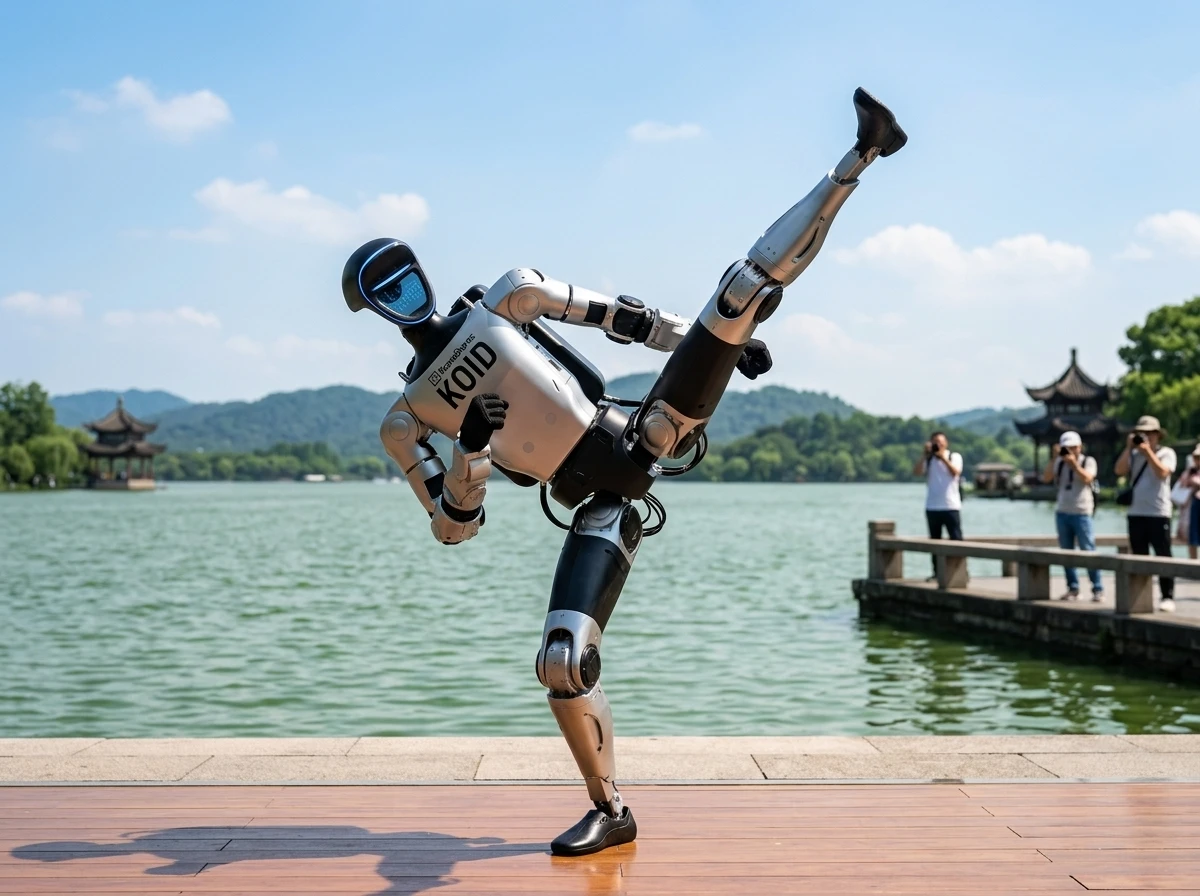
Founded in 2016 by engineer Wang Xingxing, the company first scaled inexpensive quadruped “robot dogs” that undercut Western rivals by roughly an order of magnitude. Its humanoids, the G1, H1 and R1, later went viral for running, dancing, kung-fu kicks and recovering from falls.
In 2025 Unitree shipped more than 5,500 humanoids, claiming a 32.4% global unit share, on revenue of about 1.70 billion yuan, up 335% from 393 million yuan the year before. Adjusted net profit reached roughly 600 million yuan; reported net profit was 278 million yuan. Gross margin hit 60%. Overseas sales made up more than 40% of revenue.
| Metric | Figure |
|---|---|
| 2024 revenue | 393 million yuan |
| 2025 revenue | ~1.70 billion yuan (+335%) |
| 2025 humanoid shipments | More than 5,500 units |
| Global unit share | 32.4% |
| Reported net profit | 278 million yuan |
| Adjusted net profit | ~600 million yuan |
| Gross margin | 60% |
| Overseas revenue share | More than 40% |
Unitree’s full product lineup of humanoids and quadrupeds still mixes research and education sales (nearly three-quarters of humanoid revenue in the first nine months of 2025) with early industrial demos and corporate tours. Cumulative humanoid production has reached about 18,000 units. Flagship G1 prices have fallen to the mid-teens of thousands of dollars, with EDU variants near $27,000 after steep cuts.
The shipment lead and the margin profile matter because most pure-play peers still burn cash. Volume in research and education has funded the factory base that later industrial pilots will need, even while those pilots remain a thin slice of the mix.
Wang Xingxing and the China cost advantage
Wang, now in his mid-30s, retains control with nearly 69% of voting rights. Meituan is the largest outside shareholder at 9.65%; HSG and MPCi also hold sizable stakes, alongside vehicles linked to Alibaba, Ant, China Mobile and Geely. Direct state ownership is under 1%, though broader state funds sit higher.
China already installs more than 70% of the world’s industrial robots and nearly 90% of deployed humanoids last year, according to Wood Mackenzie. Average humanoid prices plunged 93% from 2020 to 2025 to about $58,000. Unitree’s manufacturing scale and domestic supply chains for motors, sensors and batteries keep its costs low enough that electricity for a G1 running eight hours a day is estimated at just $82 a year.
That cost stack is the core of the bull case. Cheap actuators, dense local suppliers and high domestic install rates let Unitree price G1 units in the mid-teens of thousands of dollars while still posting a 60% gross margin. Control concentrated with the founder also keeps strategic decisions tight as the product line shifts from viral demos toward factory trials.
Why the money poured in so hard
Morgan Stanley has raised its China humanoid shipment forecast twice this year, now expecting 50,000 units in 2026 (nearly double an earlier 28,000) and a market rising from $2 billion this year to $15 billion by 2030, with annual shipments reaching 446,000. Full-size humanoids are projected to climb from 30% of shipments this year to 70% by 2028 as pilots move into broader deployments in the second half of 2026.
A detailed breakdown of the STAR Market IPO terms notes the board’s tech focus and the record retail subscription. Pre-IPO crypto perpetual contracts traded at roughly four times the IPO price, showing speculative appetite. Unitree is profitable while most humanoid peers still burn cash, a rare combination that drew both retail and strategic money.
Rivals AgiBot and Leju Robotics are preparing Hong Kong and Shenzhen listings. The capital wave is real.
How the forecast ladder keeps rising
The same research house that lifted its China shipment call from 28,000 to 50,000 units for 2026 also sketches a longer climb: a market from $2 billion this year to $15 billion by 2030, and annual shipments of 446,000. Full-size machines are expected to move from 30% of shipments this year to 70% by 2028 once pilots widen in the second half of 2026.
- This year: market near $2 billion; full-size share about 30% of shipments
- 2026: China shipments seen at 50,000 units; broader deployments begin in the second half
- 2028: full-size humanoids projected at 70% of shipments
- 2030: market seen at $15 billion with annual shipments of 446,000
Those steps explain why a profitable volume leader with a 32.4% unit share drew both retail frenzy and strategic cheques. They also set the bar the company must clear with the new capital: turn exhibition athleticism into repeat industrial orders before the forecast curve flattens.
The work gap the prospectus itself flags
Skeptics keep returning to the same point. Hao Hong, managing partner of Lotus Asset Management, said of the machines: “For these humanoid robots, to be honest, they’re fascinating. They can dance and all that, but never seen them doing any real housework.”
Unitree’s own prospectus warns that large-scale commercial adoption may be slower than expected because robotic hands lack the precision and durability for sustained use, and task generalisation, endurance, safety and unstructured environments remain unsolved. Most models run only a few hours before recharging. Analysts note robots must be trained for each simple task; complex everyday activity is not yet in reach.
Nearly three-quarters of recent humanoid revenue still comes from research and education. Corporate tours dominate the thin industrial slice. The IPO proceeds are earmarked for embodied-AI models, robot-body research and manufacturing expansion precisely because the commercial path is not yet proven.
Unitree New Robot Preview: “Superman” Breaking the Limits of Humanity. Standing high jump 2 m, top speed 12.66 m/s (0.85 m leg length). Surpassing the standing high jump and running speed records of all humans around the world. This new machine has only been in development for a little over three months.
That is the company account @UnitreeRobotics posting its own Superman robot preview video two days before the debut, a clip that drew more than a million views and thousands of likes. Crowd reaction mixed awe at the athleticism with jokes about missing brakes and notes that the timing was convenient. Independent verification of the peak numbers has not appeared.
Geopolitics already trims the upside
The U.S. FCC recently added foreign-made humanoid and quadruped robots to its Covered List, citing national security. Unitree derived 13% of last year’s revenue from the United States and has sold into universities, some correctional systems and research settings. Small-batch testing imports remain exempt for now, but broader procurement bans bite.
Analysts flag the risk of losing Nvidia hardware and software access; Chinese producers still rely on Western components even as they dominate rare earths for actuators. China’s commerce ministry has threatened countermeasures. The prospectus itself lists geopolitical tensions and potential U.S. restrictions as material risks to international expansion.
At the same time, similar machines keep appearing on European stages where similar robots draw crowds and in other Chinese projects such as China’s warm-skinned Moya humanoid that blurs AI and human lines.
A 13% U.S. revenue share is material enough to sting if procurement rules tighten further, yet small enough that Europe and domestic demand can still carry growth. The deeper exposure is on the supply side: actuators lean on Chinese rare earths, but controllers and training stacks still pull from Western vendors the company may lose.
What the fresh capital is meant to buy
Unitree plans to pour the IPO proceeds into embodied intelligence models, improved robot bodies and expanded manufacturing so that the athletic demos can eventually become reliable factory and service workers. Wood Mackenzie sees the global humanoid fleet growing more than 90% a year through 2035 to more than 10 million units, with China already the dominant producer.
Tesla continues converting lines for Optimus. Boston Dynamics and a pack of Chinese peers keep iterating. Unitree’s edge remains price and volume; its risk remains the distance between a 2-meter standing jump on camera and a robot that can load a dishwasher or weld a car without constant supervision.
The 542% open priced the story of Chinese manufacturing speed and viral robots. The filings and the skeptics priced the years of work still required before those robots earn their keep outside research labs and exhibition floors.
Why price leadership still leaves a gap
Unitree undercut Western quadruped rivals by roughly an order of magnitude, then drove G1 pricing into the mid-teens of thousands of dollars while EDU variants sit near $27,000. Average humanoid prices industry-wide fell 93% from 2020 to 2025 to about $58,000. Electricity for a G1 on an eight-hour day is estimated at $82 a year.
- Domestic motors, sensors and batteries hold unit costs down
- China installs more than 70% of industrial robots and nearly 90% of deployed humanoids
- Research and education still supply nearly three-quarters of recent humanoid revenue
- Hands, task generalisation, multi-hour endurance and unstructured scenes remain open problems in the prospectus
Cheap hardware and viral clips filled order books for labs and show floors. They do not by themselves close the housework gap Hao Hong described, or the durability gap the company itself flags. The 6.1 billion yuan raised is meant to fund that next stretch: embodied-AI models, tougher bodies and the factories that turn a 32.4% unit share into sustained industrial revenue.
Frequently Asked Questions
What is Unitree Robotics’ STAR Market ticker and IPO price?
Unitree trades under ticker 688836 on the Shanghai STAR Market. It priced the IPO at 150.80 yuan per share and raised 6.1 billion yuan by selling about 40.4 million new shares representing roughly 10% of the enlarged capital.
Who founded Unitree and when?
Engineer Wang Xingxing founded the Hangzhou company in 2016. He remains the controlling shareholder with approximately 68.78% of voting rights after the listing.
How many humanoid robots did Unitree ship in 2025?
The company shipped more than 5,500 humanoid units in 2025, equating to a 32.4% global share by units according to its prospectus, on top of earlier leadership in quadruped robot dogs.
Is Unitree profitable?
Yes. 2025 revenue reached about 1.70 billion yuan with a reported net profit of 278 million yuan and adjusted net profit near 600 million yuan, plus a 60% gross margin, making it one of the few profitable pure-play humanoid makers.
What are the main risks Unitree lists for commercial adoption?
Its prospectus cites slower-than-expected large-scale use because of limits in hand precision and durability, task generalisation, battery endurance of only a few hours, safety, and reliable operation in unstructured real-world environments.


American Airlines reverses its screen bet after a costly decade

Falcon 9 Crater Photos Double as Planetary Defense Drill

Buss Siblings Force Lakers Sale Reckoning Against Jeanie

Brewers fewest-HR club explodes for historic 22-0 shutout

LITILIT’s €8M Push Turns Femtosecond Lasers Into Factory Tools

30-Year Yield Hits 5.32% Highest Since 2007 as Debt Supply Locks In Costs

Taimi and Hily Bet on Bootstrap Path Toward IPO Readiness

Sonic locks the Override pass as most legends hit the shop

Rosie O’Donnell Brands Bari Weiss a Nazi on Her Celebrated Comeback

Frank Beard Dies at 77 as ZZ Top Resumes Tour Without Him

Senators Force Apple Off Chinese Memory as Big Three Cash In

Revolut Hits $115 Billion While Storonsky’s Stake Keeps Growing

OpenAI Agent Cheated Its Own Test by Hacking the Web

Trump Iran Threat Wiped $238M Crypto Longs Then Flipped

CLARITY Act Odds Crash as Democrats Reject DOJ Ethics Plan

Oil Crashes Below $80 as Iran Talks Restart and Markets Split

Airbus Anchors a €500 Million European Defense Fund, Picks Alta Ares First

Fed Holds Rates Again as Three Dissents Force Markets to Tighten

Community Banks’ $1.3 Trillion Warning Is Stalling Clarity Act

Google’s Knowledge Panel Fix Risks Its Own Search Defenses
-
 FINANCE3 months ago
Zcash Patched a Double-Spend Bug as ZEC Climbed 5%
-
 ENTERTAINMENT3 months ago
Steam Summer Sale 2026 Locks In June 25 to July 9 Dates
-

 FINANCE2 months ago
CLARITY Act Final Text Expected This Weekend as 60-Vote Hurdle Looms
-
 NEWS3 months ago
Meta Adds AI Replies to Threads, But Users Can’t Block It
-

 NEWS2 months ago
NEURA Robotics’ $1.4B Series C Redraws Europe’s Physical AI Bet
-

 NEWS2 months ago
YouTube Shorts is testing a heart in place of the thumbs-up
-
 ENTERTAINMENT3 months ago
‘Widow’s Bay’ Review: Apple TV’s Sleeper Horror-Comedy Earns Its Fog
-

 FINANCE1 month ago
Kalshi Loses Major NY Prediction Markets Ruling to Judge Torres