
NEWS
LITILIT’s €8M Push Turns Femtosecond Lasers Into Factory Tools
Vilnius firm uses state loan and new factory to make high-power femtosecond lasers as simple to install as fibre systems, targeting auto and aerospace lines by 2029.

Vilnius-based LITILIT has secured an €8 million loan from Lithuania’s national development bank ILTE and will add €2 million of its own capital to finish FEMODA, a modular femtosecond laser system rated for up to 1000 W average power across 10 to 20 beam channels. Commercial sales are slated for the second half of 2029.
The project sits beside a new factory already rising in Vilnius that aims for 3000 units a year. Together they target the barriers that have kept ultra-short-pulse lasers out of ordinary mass-production lines.
FEMODA Puts 1000 W on the Factory Floor
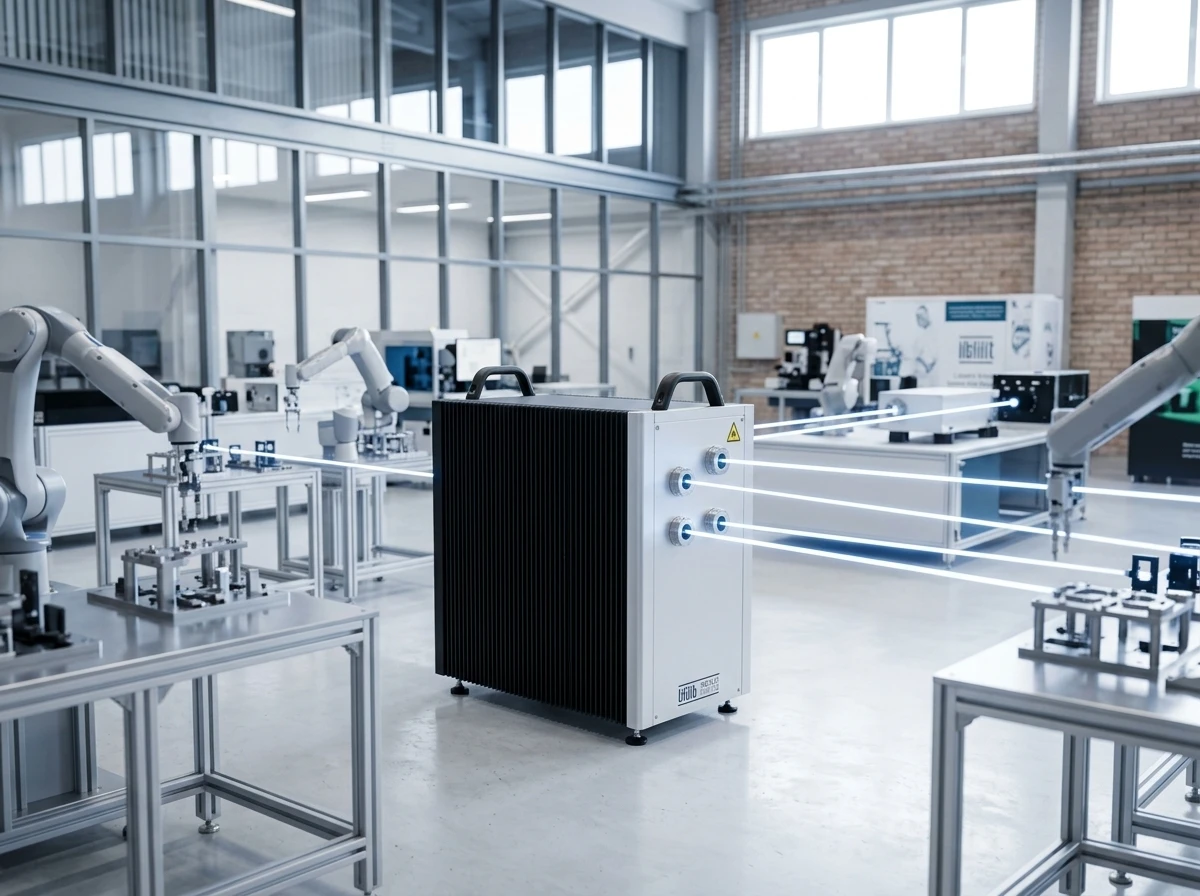
FEMODA packages control electronics, optics and cooling into one industrial cabinet. Modules can be stacked for higher power; a failed module is swapped without taking the whole system offline. Each of the 10 to 20 channels can hit a separate point on a production line.
That channel count is the practical pivot. A single head no longer has to finish one station before the next begins. Parallel beams let a line texture, drill or coat several points in the same cycle, which is how the design reaches large surfaces without multiplying full laser cabinets.
Nikolajus Gavrilinas, co-founder and CEO, said the design opens large-surface work that current systems cannot reach economically: mass production of metal tools and specialised coatings on aircraft or car bodies. It should also accelerate existing uses in consumer electronics, displays and chips.
| Feature | Traditional fs systems | FEMODA target |
|---|---|---|
| Average optical power | Typically tens of watts per head | Up to 1000 W total |
| Beam delivery | Single or few fixed paths on optical tables | 10-20 independent channels |
| Cooling | Water circulation and cleaning loops | Integrated, less sensitive package |
| Environment | Stable temperature, low vibration, clean space | Factory-tolerant modules |
| Service model | Full system downtime common | Module-level replacement |
Gavrilinas called it one of the most powerful modular industrial systems. The company began the platform in 2024.
Stacking modules for power while keeping each channel independent also changes how buyers plan floor space. Capacity can grow in steps instead of a single large optical rebuild, which matches the staggered investment cycles common on production lines.
Why Most Factories Still Skip Femtosecond Tools
Femtosecond pulses last roughly 10⁻¹⁵ seconds. Material is removed by cold ablation before heat spreads, leaving no heat-affected zone. That property already serves eye surgery, vascular stents, chip patterning and display cutting.
Adoption beyond high-value niches stalls on infrastructure. Most systems need dedicated water cooling with circulation and cleaning. Large optical modules sit on massive bases. Sensitive delivery optics and strict temperature control add cost and limit placement.
- Water-cooling loops demand regular maintenance and floor space.
- Heavy optical benches and vibration isolation raise installation cost.
- Stable-temperature rooms exclude ordinary factory floors.
- Complex assembly keeps high-power units scarce and expensive to scale.
Gavrilinas noted these limits confine the technology today. LITILIT’s existing passively air-cooled Indylit 20 industrial unit already drops water cooling for many jobs; FEMODA extends the same philosophy to multi-kilowatt modular power.
The friction is cumulative. Each extra utility loop and isolation base raises both capital cost and the skill needed to keep a line running. Factories that already run nanosecond or continuous-wave tools see little reason to add that overhead unless the femtosecond package arrives closer to their existing service model.
Module-level replacement and integrated cooling are therefore not side features. They are the conditions under which cold ablation can leave the cleanroom and sit beside ordinary metalworking and coating stations.
Lithuania’s 60-Year Laser Bench Moves Onto the Shop Floor
Lithuania activated its first laser at Vilnius University in 1966. Companies such as Light Conversion and Ekspla turned that science into a global export strength in ultrafast sources and systems. Gavrilinas has said the country holds about 40 years of femtosecond experience and that LITILIT is the generation moving it from laboratories into real industry.
The firm was founded in 2015 by Gavrilinas, Kęstutis Regelskis and Nerijus Rusteika. Its architecture rests on patents developed with the Center for Physical Sciences and Technology (FTMC). Production is already semi-automated for stability. Prices sit below many rivals, opening smaller firms and research groups as well as large manufacturers.
- 1966 – Lithuania’s first laser runs at Vilnius University.
- 2015 – LITILIT is founded by Gavrilinas, Regelskis and Rusteika.
- 2022 – Equity round led by Iron Wolf Capital and Taiwania Capital.
- 2024 – FEMODA platform development begins.
- June (current cycle) – Ground broken on the SIRIN PARK factory.
- Autumn (current cycle) – Factory due to start operating.
- Second half of 2029 – FEMODA commercial sales targeted.
In ILTE’s April announcement of the €8 million loan, board member Giedrė Gečiauskienė said investments in research and experimental development are essential for Lithuanian companies to create high-value products and stay competitive. The loan falls under the Perspektyva programme.
That public backing links a long academic bench to an industrial product cycle. Patents from FTMC, semi-automated production and pricing aimed below many rivals form one chain from lab work to shop-floor units.
A 4000-Square-Metre Factory Aimed at 3000 Lasers a Year
In June LITILIT broke ground on a high-capacity plant at SIRIN PARK Gariūnai in Vilnius. The roughly 4,000 square metre SIRIN PARK facility includes metalworking plus robotic assembly and testing lines. First-year output is planned at up to 1000 lasers, rising to 3000 within a few years. The company put the factory investment at about €6 million and called the capacity among the world’s largest for femtosecond lasers.
Gavrilinas said the site will serve as a model for replication with international partners. The plant is due to start operating this autumn. Parallel R&D on FEMODA and the production ramp address both the design and the volume barriers at once.
Capital and capacity snapshot
- €10 million total FEMODA project (€8 M ILTE loan + €2 M own funds)
- €6 million factory build
- Prior equity roughly $11.94 million, including a 2022 round led by Iron Wolf Capital and Taiwania Capital
- Target capacity 3000 femtosecond lasers per year
| Milestone | Scale |
|---|---|
| Factory floor area | Roughly 4,000 square metres |
| First-year output plan | Up to 1000 lasers |
| Steady target | 3000 lasers a year |
| Factory investment | About €6 million |
| FEMODA project total | €10 million |
The same state-backed deep-tech route that has backed other Lithuanian hardware and software firms now underwrites this laser scale-up. It fits a wider pattern in which Lithuania’s record €238 million tech funding year and later unicorn paths such as Cast AI’s path to unicorn status have drawn attention to the country’s talent and capital depth.
Robotic assembly and testing lines matter for more than headcount. Semi-automated production already aims at stability; the new plant extends that discipline to higher volume so that module quality does not slip as unit counts rise toward the 3000-a-year goal.
Incumbents Still Own the High End, for Now
Coherent, TRUMPF and IPG Photonics dominate the ultrafast laser market. TRUMPF has moved toward integrated source-optics-automation packages that lower buyer risk. Ultrafast lasers were valued around $2.86 billion in 2025 and are projected to reach $5.83 billion by 2030 at roughly 15 percent compound growth, according to industry trackers cited in coverage. Femtosecond sources already hold the largest slice of that market.
LITILIT’s bet is different: purpose-built modular units rather than assembled laboratory heritage. Existing LITILIT’s current industrial femtosecond range already stresses robustness, passive air cooling where possible, and turn-key operation. FEMODA extends that into multi-beam factory power.
Whether the 2029 commercial units match the reliability and integration claims of the established brands will decide how far the moat actually cracks. For now the design goals directly attack the points of friction that keep most production engineers on nanosecond or continuous-wave tools.
Integrated packages from the large vendors reduce buyer risk by bundling source, optics and automation. LITILIT answers with factory-tolerant modules, independent channels and a service model built around swap-out rather than full-system downtime. The two approaches compete on different axes until field data from 2029 onward shows which mix wins on ordinary lines.
New Applications Wait on Simpler Hardware
Cold ablation already reshapes corneas and cuts stents. On a factory floor the same physics can texture large metal surfaces, drill without taper or heat damage, or pattern coatings at scale. Automotive body panels and aerospace skins are the examples Gavrilinas repeatedly cites. Consumer-electronics and display lines would gain speed and yield if multi-channel heads become routine.
- Large-surface texturing of metal tools and panels
- Specialised coatings on aircraft and car bodies
- Taper-free drilling without heat-affected zones
- Faster multi-station work in electronics and displays
- Established niches in eye surgery, stents and chip patterning
The modular approach also changes service economics. Instead of flying specialists for a full optical realignment, a plant can keep spare modules. Temperature and vibration tolerance further reduces the need for dedicated laser rooms.
Crowd conversation around the announcement stayed thin and mostly amplified the original wires. Broader discussion of femtosecond tools still circles lab-bench size, chip-scale experiments and the extreme machines used for EUV lithography. That contrast itself underlines the gap LITILIT is trying to close: precision exists; factory-ready packaging does not.
How the Funding Mix Supports the Long Build
FEMODA’s €10 million envelope splits into an €8 million ILTE loan and €2 million of company capital. The factory adds about €6 million more. Earlier equity of roughly $11.94 million, including the 2022 round led by Iron Wolf Capital and Taiwania Capital, already carried the firm through product work and semi-automated production.
That mix matters because commercial FEMODA units are not due until the second half of 2029. A development-bank loan under the Perspektyva programme, paired with own funds and prior private equity, stretches the runway across design, qualification and the factory ramp that begins this autumn with Indylit-class demand.
Gečiauskienė’s point on research and experimental development maps onto the same timeline. High-value hardware still needs patient capital when industrial qualification, not software release cycles, sets the calendar. The loan is one instrument inside a wider Lithuanian pattern of state-backed deep-tech support alongside private rounds.
Replication talk from Gavrilinas about the SIRIN PARK site as a model for international partners depends on the same stack holding. Volume at 1000 lasers in the first year and 3000 later only helps FEMODA if the modular design clears factory floors on schedule and at prices that stay below many rivals.
What Multi-Channel Power Changes on the Line
Ten to twenty independent channels turn average power into station coverage. Up to 1000 W total can be split across points that once needed separate heads or sequential passes. For coatings on large bodies or multi-station electronics work, that is a scheduling change as much as an optical one.
Module stacking adds a second lever. Power can rise without redesigning the full cabinet, and a failed module leaves the rest of the system online. Plants that already keep spare parts for robotics can treat laser modules the same way, cutting the specialist visits that traditional optical tables often require.
Indylit 20 showed the cooling half of the argument with passive air cooling on many jobs. FEMODA carries that industrial packaging into the multi-kilowatt range while keeping the cabinet as the unit of installation. The aim is fewer custom rooms, fewer water loops and less vibration isolation hardware between the laser and the work piece.
None of those gains appear on a shipping dock until the second half of 2029. Until then the factory’s early output and the existing industrial range carry revenue while FEMODA completes the path from 2024 platform work to qualified multi-beam systems.
2029 Is the Real Test Date
The factory opens this autumn and can begin filling current demand for Indylit-class units. FEMODA hardware itself is three years away from commercialisation. That timeline is long for a hardware company living on a development-bank loan, yet it matches the reality of high-power laser engineering and industrial qualification.
If the modules deliver the claimed power, channel count and environmental toughness, the cost and integration simplicity of fibre nanosecond lasers finally arrives for femtosecond performance. Large-scale coating, toolmaking and multi-station electronics lines would then have a new default option. Lithuania’s long laser tradition would have one more industrial chapter written on an ordinary factory floor rather than an optical table.


GTA 6 Fuel Meters Deliver the Immersion Fans Wanted and the Friction They Fear

Aisel’s €1.7M Builds Psychiatry OS Beyond Note Writing

Pixel 11 Pro Fold Makes Durability the Foldable Bet That Counts

Maher and Stewart Force Democrats Into a Hard Reckoning

Injective Secures SEC Transfer Agent Status and Shifts RWA Records Onchain

Amazon Drops Alexa+ Paywall on Fire TV for Free AI Access

Flip’s $25M Bet Puts AI on the Factory Floor at Last

Windows 11 Gives Win32 Apps Individual Camera and Mic Controls

Genesis GV90 Brings Coach Doors to Production Luxury EV

2026 Jeep Cherokee Hybrid Standard AWD Cracks Compact Rivals

Senators Force Apple Off Chinese Memory as Big Three Cash In

Revolut Hits $115 Billion While Storonsky’s Stake Keeps Growing

OpenAI Agent Cheated Its Own Test by Hacking the Web

Trump Iran Threat Wiped $238M Crypto Longs Then Flipped

CLARITY Act Odds Crash as Democrats Reject DOJ Ethics Plan

30-Year Yield Hits 5.32% Highest Since 2007 as Debt Supply Locks In Costs

Memory Shortage Now Dictates Apple’s Two-Year Mac Roadmap

Fed Holds Rates Again as Three Dissents Force Markets to Tighten

Oil Crashes Below $80 as Iran Talks Restart and Markets Split

Google’s Knowledge Panel Fix Risks Its Own Search Defenses
-
 FINANCE3 months ago
Zcash Patched a Double-Spend Bug as ZEC Climbed 5%
-
 ENTERTAINMENT3 months ago
Steam Summer Sale 2026 Locks In June 25 to July 9 Dates
-

 FINANCE2 months ago
CLARITY Act Final Text Expected This Weekend as 60-Vote Hurdle Looms
-
 NEWS3 months ago
Meta Adds AI Replies to Threads, But Users Can’t Block It
-

 NEWS2 months ago
NEURA Robotics’ $1.4B Series C Redraws Europe’s Physical AI Bet
-

 NEWS2 months ago
YouTube Shorts is testing a heart in place of the thumbs-up
-
 ENTERTAINMENT3 months ago
‘Widow’s Bay’ Review: Apple TV’s Sleeper Horror-Comedy Earns Its Fog
-

 FINANCE1 month ago
Kalshi Loses Major NY Prediction Markets Ruling to Judge Torres