
NEWS
Kausable’s €12 Million Seed Targets Factories, Not Chatbots
Heidelberg’s kausable raised €12 million so factories, grids and clinics can adapt AI from a handful of examples instead of another training run.

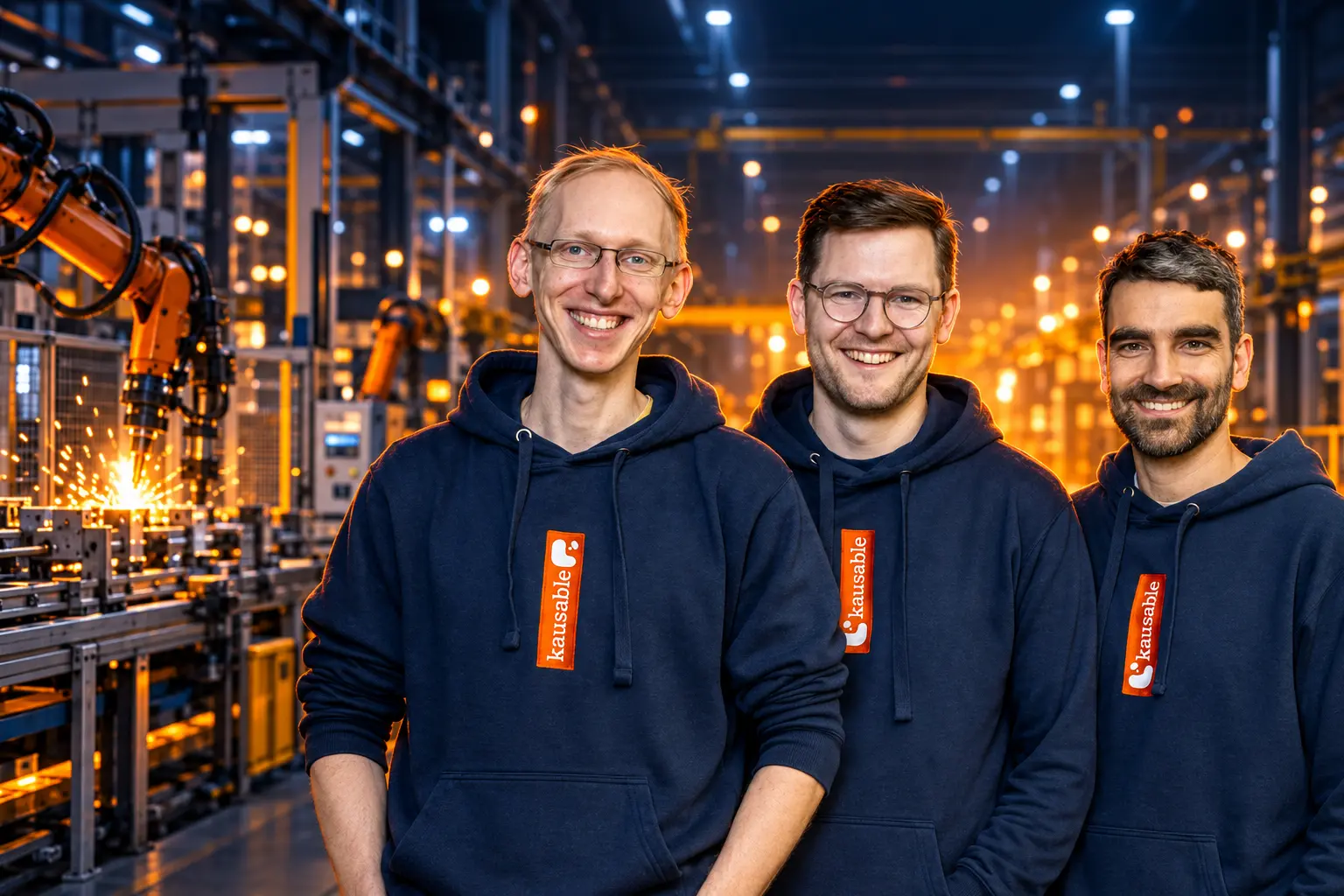
Heidelberg’s kausable closed a €12 million seed round on 23 July 2026 to sell factories and grids a model that adapts without retraining. UVC Partners and Entourage led, with HTGF and Mätch VC following on. The cheque is large for a nine-person lab. The buyer it is written for is not a chatbot user.
Andreas Unseld, a partner at UVC Partners, put the stake on industrial control, the slow, expensive work of fitting a new model to every plant, line and sensor stack. That is the round’s real customer, even when the pitch still says frontier AI.
Industrial Operators Need Models That Do Not Start Over
Nearly every factory, grid and clinic already runs on systems it can barely predict, Unseld said, and hanging a fresh model on each one is slow. kausable’s claim is that the same causal prior can transfer, so the next line or the next patient does not become another training project.
Nearly every industrial company runs on complex systems it struggles to predict and control, and today, applying AI to each one is slow and expensive. kausable makes that effort collapse. That turns AI from a series of costly one-off projects into something that can be rolled out across an entire industrial landscape, which is why we led this round.
Andreas Unseld, Partner, UVC Partners
Dr Benjamin Herdeanu, the CTO, has been blunt about where that lands first. Physical AI is a priority because robots keep meeting objects and layouts that were never in the training set, and collecting enough real examples is hard. Demand forecasting is the earlier commercial path, he said, because the problems are lower dimensional and can ship while the wider platform is still being built.
Hendryk Hosemann, senior investment manager at HTGF, described the same buyer in plainer terms after the round. He said the fund was underwriting a new wave of AI aimed at Europe’s core industries, not another general chat stack. The sovereignty line in the announcement sits on top of that. The people who feel the cost of retraining are plant engineers, grid operators and clinicians, not ministry working groups.
TipPFN Tries to See a Blackout Before It Hits
The first public proof point is TipPFN, an in-context model for critical transitions posted on 12 May 2026 as arXiv 2605.12308. Yunus Sevinchan, Kai Ueltzhöffer and colleagues at kausable wrote it with Juan Nathaniel and Pierre Gentine among the Columbia University co-authors. The model is a prior-data fitted network. It is trained on synthetic dynamical systems, then asked, in one forward pass, how close a new time series sits to a tipping point.
Herdeanu said the team tested it across 15 domains, including ecological systems, biomedical series and energy infrastructure. Examples he gave were epileptic seizures from EEG traces and power-grid blackouts. Gregor Ramien, the COO, said the blackout model had never seen an electrical grid in training. It received frequency data and estimated how close the system was to a critical transition.
Johannes Haux, the CEO, later told HTGF the grid work could flag blackouts with several minutes of lead time. Jan Beisswenger of Mätch VC, which led the pre-seed, called TipPFN the best work he had seen on early detection of those shifts. The preprint still describes a research system, with sim-to-real examples and some real-world series, not a certified warning tool.
WHERE TIPPFN HAS BEEN TRIED
| Setting | What the team says it saw | What it was trained on |
|---|---|---|
| Power grids | Proximity to blackouts, including minutes of lead time in later comments by Haux | Synthetic causal systems, then live frequency traces the model had not seen |
| Medicine | Seizure risk from EEG | A handful of examples after the synthetic prior |
| Ecology and other dynamics | Critical transitions in previously unseen tipping regimes | TipBox, a generator of stochastic bifurcation scenarios |
That table is the industrial argument in miniature. The costly object is a rare failure, a seizure, a trip, a collapse, and the lab is trying to price a warning from little new data rather than from another full training run.
Three Physicists Left Heidelberg With a Different Bet
Haux, Herdeanu and Ramien founded kausable in 2025 as three physicists who had already left the university. They knew each other from research at Heidelberg University, Haux told HTGF, but they did not spin out on graduation day. Herdeanu, after his doctorate, worked at secunet, the German cybersecurity firm. The source announcement also flags startup and banking work among the three. Idea work started in 2024. The company incorporated in early 2025, went through the Startup BW Pre-Seed programme, and raised about €1.5 million in pre-seed, with Mätch VC as lead, before the seed.
Ilir Aliu, who runs a European physical-AI studio and interviewed Haux in early September 2026, said Haux came out of Björn Ommer’s Heidelberg computer-vision lab, the group that later produced Black Forest Labs. Robin Rombach and Andreas Blattmann, Black Forest Labs co-founders, are on the angel list. That is the “ties to Black Forest Labs” line in the round, a shared lab and cheque-writers, not a product partnership the companies have announced.
FROM LAB NOTE TO SEED CHEQUE
- 2024: The founders start shaping the idea while already out of university posts.
- Early 2025: kausable GmbH is incorporated in Heidelberg and joins Startup BW Pre-Seed.
- 2025: A pre-seed of about €1.5 million closes, led by Mätch VC, and is discussed around ICML.
- 12 May 2026: The TipPFN preprint goes up on arXiv.
- 23 July 2026: The €12 million seed closes, led by UVC Partners and Entourage.
- 31 August 2026: Haux tells HTGF the next proof is value with design partners, not another paper alone.
Haux has described a split of labour that is more company than seminar. Herdeanu leads research, Ramien runs engineering teams, and Haux talks to investors, partners and customers. He also said the “world model” label is now overused, and that kausable’s version builds a situation-specific model at inference with no classical gradient update. You show it data. It predicts from the best causal account it can form on the spot.
Who Is Writing the €12 Million Checks?
UVC Partners and Entourage led the €12 million seed on 23 July 2026, with HTGF and Mätch VC in follow-on. PitchBook records that seed at about $13.7 million and lists the office at Carl-Friedrich-Gauß-Ring 5 in Heidelberg. Add the 2025 pre-seed and total capital is €13.5 million. The money is meant to grow the nine-person team and push the rapid-learning model, including a first product layer.
THE MONEY AROUND KAUSABLE
| Round | Amount | Who led | When |
|---|---|---|---|
| Pre-seed | About €1.5 million | Mätch VC | 2025 |
| Seed | €12 million | UVC Partners and Entourage, with HTGF and Mätch VC | 23 July 2026 |
| Total raised | €13.5 million | Those firms plus angels | Through July 2026 |
The angel roll is where the sovereignty story gets messy, and useful. Named backers include people at Black Forest Labs, OpenAI, Google DeepMind, Noxtua and ELLIS, among them Sandro Gianella of OpenAI, Dorothy Chou as a DeepMind strategic advisor, Dr Michael Bolle, formerly of Robert Bosch’s board, Dr Jens Buchner of Neura Robotics, and the Pionix co-founders. Bosch, robots, EV charging, cybersecurity and hosting sit on that list. So do US lab operators. Europe is writing the priced round. The advice network is not only European.
Pieterjan Bouten, co-founder of Entourage, called it an ambitious scientific bet: models that adapt, infer causality and solve problems they have never seen, rather than remembering a larger past. That is also a bet against that scaling path most language labs still fund, the one that buys more data and more compute each time the world shifts.
Synthetic Cause and Effect, Not Customer Data
The method is the commercial wedge. kausable trains on synthetic causal systems, not on vast customer logs. Haux said more data still helps, because the approach is Bayesian and the model updates as evidence arrives, but useful performance is supposed to arrive from far fewer examples than a standard foundation model needs. Privacy is a side effect. Control over which systems the model can understand is, in his words, a defensible edge.
Ramien draws a harder line against language models. Those systems, he said, infer the world from billions of text tokens. kausable trains on abstract cause-and-effect structure, then transfers that prior into a new domain. The same idea sits under TabPFN, the tabular foundation model on synthetic data published in Nature in 2025, which learned to solve small tables in a single forward pass after pretraining on structural causal models. TipPFN is that family pointed at tipping points. A clear primer on how prior-data fitted networks work is that the network is trained on a prior over tasks, then does in-context learning at inference instead of a new optimisation loop.
WHAT THE LAB IS NOT DOING
- No weight surgery per task: Haux said adaptation does not use classical gradient updates; the model reads a short context and predicts.
- No customer-data lake: Training is synthetic causal systems, with real traces added later as a handful of examples.
- No chat interface as the product: Early targets are forecasting, robotics, energy and industrial what-if questions.
- No claim of a finished warning system: TipPFN is a preprint with held-out tipping regimes, not a regulator-ready grid or EEG product.
Haux’s door example is the one he keeps using. A person sees a door opened once or twice and can open a different door. Today’s models, he said, often need huge data and a retrain when the hinges change. kausable wants the second door to be a context window, not a new training job.
A Nine-Person Lab Still Has to Prove It on a Factory Floor
Herdeanu still calls kausable a research company that plans to become more product-focused over the next year through customer pilots. Haux told HTGF the missing proof is proof of value with partners, including a design-partner discussion around industrial what-if questions. Job ads in Heidelberg and Karlsruhe, including a team assistant Gregor Ramien is hiring himself, still describe a nine-person research-led group that is building a product layer and wants models in front of real customers. Open roles have included a machine meta-learner, an ML product engineer and an enablement software engineer.
The physical-AI case is the one that keeps coming back, because a robot that meets a new material cannot wait for a data-centre retrain. That is also where the claim is easiest to oversell. A practitioner’s objection after Haux’s September conversation was simple: adaptation has to be tested on new scenes, objects and cameras with no retuning. TipPFN’s own paper is honest that conventional deep classifiers fail when they leave their training distribution. The lab has shown transfer from synthetic bifurcations into some real series. It has not shown a robot, a substation or a ward running this as a daily control loop.
WHAT WE KNOW
- The round: €12 million seed on 23 July 2026, led by UVC Partners and Entourage, with HTGF and Mätch VC, on top of about €1.5 million pre-seed.
- The paper: TipPFN is public as of 12 May 2026, with kausable and Columbia authors, trained on synthetic tipping systems.
- The team: Nine people at the round, still hiring in Heidelberg, with Haux, Herdeanu and Ramien as CEO, CTO and COO.
WHAT IS UNCONFIRMED
- Named customers: Design partners and pilots are described; no contracted factory, hospital or grid operator has been named.
- Lead times in the field: Minutes of blackout warning come from Haux’s later interview, not from a published operational trial.
- Physical robots: Robotics is a stated priority, not a shipped controller.
Ramien’s longer view is a stack in which language and vision models remain interfaces, and a causal layer sits underneath taking decisions. Because the method is cheaper at adaptation time, he also argues it cuts the compute bill. That is the pitch Unseld bought for industry. The next fact that matters is narrower. Someone has to strap the model to a live system, change a sensor, and see whether the second door opens without another training run.
Disclaimer: This article is news reporting and analysis of a completed funding round and published research. It is informational only and is not medical advice, investment advice or a recommendation to buy, sell or use any security, model or clinical tool. TipPFN’s examples around seizures and power grids are research claims, not licensed diagnostic or grid-control products, and readers should consult a qualified physician, grid engineer or licensed financial adviser before acting on any related decision. Figures, headcount, job ads and commercial status reflect the cited papers, filings and interviews as dated in the piece and may change as the company hires and runs pilots.

UPI MDR Delay Hands Traders the Calendar After Paytm Falls

Google Messages Builds Nine In-Chat Games After Samsung’s Exit

Anthropic’s $100 Million Academy Trains the Firms That Bill Both Sides

Toyota’s Electric C-HR Leaves the Cheap Twin to Subaru

Markets Bet the Fed Skips October After Hawkish Minutes

The Orchard Bug Forced Zcash to Open an Empty Pool

The $5.99 Game That Won Steam’s 2026 Summer Sale

Don Lee Joins Hemsworth as Extraction 3 Starts Shooting

YouTube Shorts Retires Dislikes and Swaps Likes for Hearts

Atlantic City Turned WWE’s Return Into a Civic Night
-
 NEWS5 months ago
The Orchard Bug Forced Zcash to Open an Empty Pool
-
 GAMING5 months ago
The $5.99 Game That Won Steam’s 2026 Summer Sale
-
 ENTERTAINMENT7 months ago
Don Lee Joins Hemsworth as Extraction 3 Starts Shooting
-
 NEWS5 months ago
YouTube Shorts Retires Dislikes and Swaps Likes for Hearts
-
 NEWS5 months ago
Atlantic City Turned WWE’s Return Into a Civic Night
-
 NEWS4 months ago
NEURA Robotics Is Spending Its $1.4B on a Machine Stack
-
 AUTO6 months ago
Kawasaki Bets the New Z1100 Against Its Own Supercharger
-

 BUSINESS5 months ago
Norway’s Export Bank Backs Nscale’s $790 Million Narvik Loan