
NEWS
CuspAI’s $2.6 Billion Bet Echoes AI Drug Discovery’s Playbook
CuspAI’s fivefold valuation jump to $2.6 billion mirrors the financing pattern AI drug discovery ran years ago, where hype outran commercial proof.

CuspAI, a Cambridge, UK, AI materials discovery startup, closed a $450 million Series B on July 20, pushing its valuation from $520 million to $2.6 billion in under a year. Kleiner Perkins and NEA led the round. Total funding now tops $650 million, and the raise arrives with a new coalition of chip and industrial giants attached.
Venture capital has run this exact play before, in AI drug discovery, where similar leaps in valuation preceded years of clinical grinding and a battered public stock. CuspAI is now making the same wager on materials science. The proof, so far, is mostly a promise.
CuspAI’s Chip-Giant Coalition
CuspAI’s technology, a platform called MIRA, uses generative and agentic AI to propose new molecules and materials against a specific brief, then rank the strongest candidates before anyone runs a physical test. Researchers describe the properties they need, and the software generates, evaluates, and prioritizes candidates from there.
Alongside the raise, the company launched what it calls the AI Materials Foundry, a coalition it says now includes more than 48 technology companies, industrial firms, and research institutions. Founding members include NVIDIA, Meta’s Fundamental AI Research team, Samsung, Hyundai Motor Group, Applied Materials, Tokyo Electron, and Lam Research, alongside chip-equipment maker ASML.
CuspAI was co-founded by CEO Chad Edwards and AI researcher Max Welling. The company also added AI pioneers Yann LeCun and Geoffrey Hinton to its advisory board, plus Abhi Talwalkar, who sits on AMD’s board and chairs Lam Research, and John Giannandrea, a former senior executive at both Apple and Google now working part time to build out a California presence for the company.
The clearest proof point so far is smaller than the funding round itself: a project with chemicals producer Kemira to design materials that pull PFAS compounds out of water.
| Metric | Figure |
|---|---|
| Series B raised | $450 million |
| New valuation | $2.6 billion |
| Valuation last September | $520 million |
| Total raised to date | $650 million+ |
| AI Materials Foundry partners | 48+ |
That is a fivefold jump in valuation in well under a year, on a technology that has yet to put a single chip material into production.
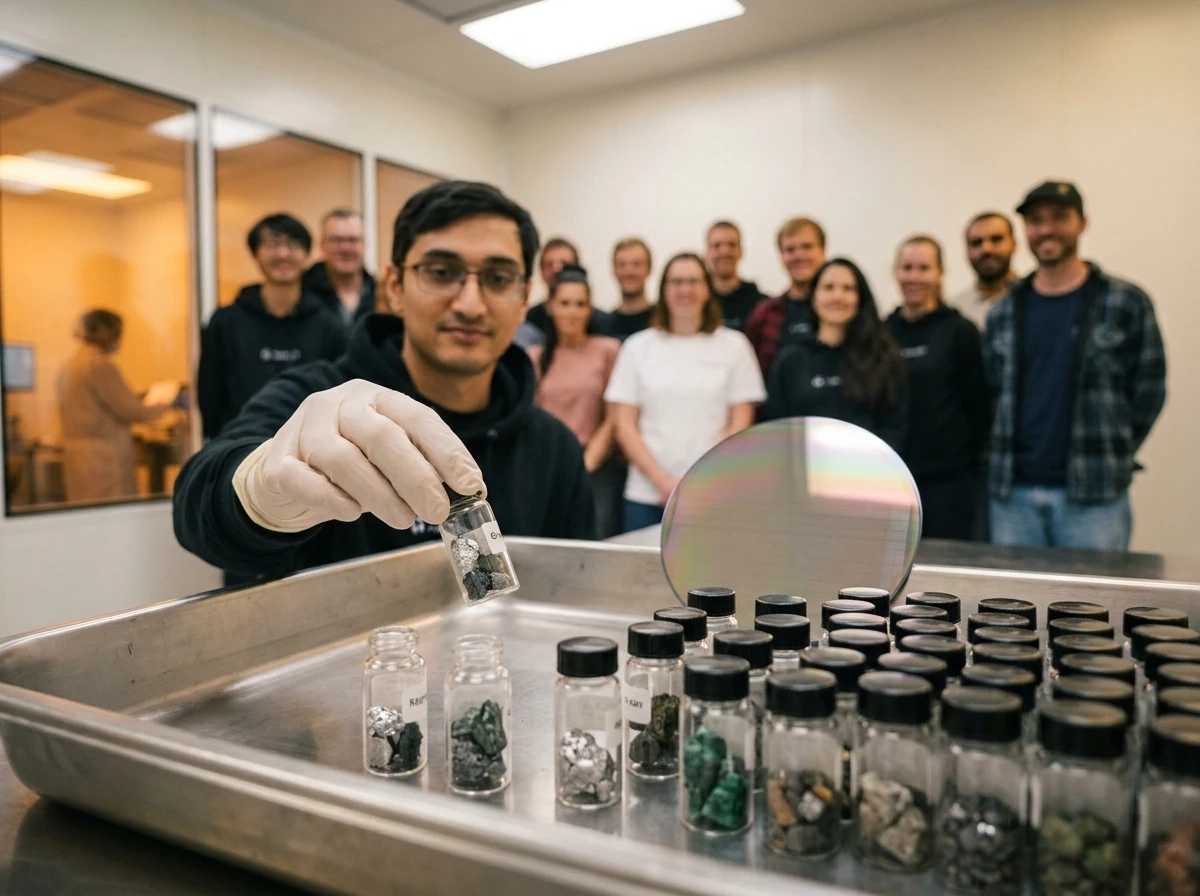
Chipmakers Are Scrambling for Scarce Materials
CuspAI is pointing most of its resources at one industry. CEO Chad Edwards said semiconductor projects will make up 80% of the company’s research this year, aimed squarely at the industry’s reliance on scarce metals such as iridium and ruthenium.
Edwards said chipmakers have been “frantically searching for new materials,” pulling the company in multiple directions at once.
The anxiety is not abstract. In early July, Micron alone lost 13% of its value in a single trading session, erasing roughly $138 billion in market value, while Intel and AMD fell 9% and 7% on doubts about whether massive AI infrastructure spending will pay off. Separately, research firm IDC has warned the global smartphone market could see its steepest annual decline on record this year, tied to what it called a shock originating in the memory supply chain, and Deloitte’s semiconductor outlook projected price spikes of up to 50% for memory components by mid-year.
Venture Capital Already Ran This Play
This is not the first time investors have bet nine or ten figures on AI compressing a slow physical science. AI drug discovery drew similar enthusiasm years ago, and its track record is the closest available preview of what CuspAI now has to prove.
Recursion Pharmaceuticals, one of the highest-profile public names in that space, trades around $3.15 a share, down roughly 25% so far this year and about 36% over the past twelve months. One analysis of the stock described it as still carrying a steep valuation premium, with meaningful revenue from its own drug candidates not expected until at least 2027.
The science has not stood still. Recursion’s REC-4881 showed a 43% median reduction in polyp burden in an ongoing trial, and Insilico Medicine’s rentosertib, discovered through an AI-driven biology workflow, is considered the industry’s leading AI-designed drug candidate. Neither has reached the market as an approved medicine.
| Company | The AI Science Bet | Where Things Stand |
|---|---|---|
| CuspAI | $2.6 billion valuation for chip and energy materials | No candidate material yet at commercial development stage |
| Recursion Pharmaceuticals | Public since 2021, AI drug discovery platform | Stock near $3.15, down about 36% over one year |
| Insilico Medicine | AI-designed candidate rentosertib | Still in clinical trials, no marketed drug yet |
The parallel is not exact. Materials do not need regulatory approval the way a new drug does, and an alloy can move from lab to fab far faster than a molecule clears a clinical trial. But the financing pattern is identical: a big valuation now, a provable product later.
A Crowded Field Is Chasing the Same Bet
CuspAI is not alone in this race, and that crowding is itself part of the story.
- Orbital Materials – a DeepMind alumni spinout applying AI to industrial materials design
- XtalPi – valued at $2.5 billion for AI-driven molecular and materials discovery
- Periodic Labs – founded by former OpenAI and Google DeepMind researchers, valued at $1 billion
- Lila Sciences – Flagship Pioneering’s automated-science venture, more than $550 million raised
Established software incumbents Dassault Systèmes and Schrödinger already sell molecular simulation tools to many of the same industrial customers, so CuspAI has to win business away from entrenched vendors while also outrunning newer, better-funded rivals.
Has Any AI-Discovered Material Actually Shipped?
Not yet, and CuspAI is not unusual in that. Reporting on the round found that CuspAI has not advanced any project to the point where a candidate material is ready for commercial development, and its named competitors are in the same position. The technology remains a promise backed by very large checks.
- Materials as a wedge: a Tech Startups funding roundup argues materials sit upstream of chipmaking, energy, and manufacturing at once, so a real breakthrough would reach far beyond software margins.
- Not yet proven: coverage of the round notes CuspAI has no project at a commercial-ready stage, and neither do its rivals.
- The historical skeptic: analysts covering Recursion Pharmaceuticals describe its stock as carrying a steep valuation premium with meaningful revenue still years away.
The Kemira water-treatment project remains the closest thing to a finished result, a narrower, lower-stakes application than redesigning materials for Applied Materials or Samsung.
The Bigger Bet Behind Bezos’s Check
Bezos Expeditions’ participation fits a pattern of its own. The Jeff Bezos-founded investment firm also backed Prometheus, an AI manufacturing startup that raised $12 billion at a $41 billion valuation in June 2026. Bezos Expeditions typically takes smaller minority stakes across a portfolio that includes Anthropic, Perplexity AI, Physical Intelligence, and Figure AI, rather than leading rounds outright.
CuspAI’s raise fits a broader shift in where the biggest venture checks are landing. Mega-rounds surging 77% to 738 deals captured $307 billion this year, or roughly two-thirds of total venture funding, according to CRV’s own review of the market. Deep-tech wagers on physical, capital-intensive problems are drawing some of that money too. an $18.5 million very low Earth orbit factory bet from startup NewOrbit is a smaller example of the same appetite for hard science over software.
CuspAI itself frames the raise as room to move faster, saying on its own company blog that the funding will let it move faster across the US, APAC and Europe.
CuspAI now has the money, the chip-industry roster, and, per Bezos Expeditions’ own pattern, plenty of company making the same wager. What it does not have yet is a shipped material. That is what the next year actually measures.


Veridue Raises $4 Million to Speed Energy Deal Diligence

Healey Adds a £150m Rung for Northern Scale-Ups

Ten Deals Took Most of Europe’s August Tech Money

Holmes Hired Fielder to Film Her Last Days

Molten Bets £100m of Plc Cash on Late-Stage Tech

Garlinghouse Cited Dutch Gold, and London Got the Bars

byFounders Bets $4.3 Million on Fluencify After $2M ARR

Alpha Gang Puts A-List Stars on a Zellner Wager

Angel Bets a Recut PG-13 Chase on Ritchson and Wilson

Flex IT and T1A Combine to Own Corporate Device Supply

Walter’s TWG Insists No Fraud as Insurer Probes Force Cleanup

30-Year Yield Hits 5.32% Highest Since 2007 as Debt Supply Locks In Costs

PCE Stays at 3.7% as Gas and Tariffs Outrun Coming Revisions

Evernorth S-4 Clears Path for Active XRP Treasury on Nasdaq

Astute’s $1.2M bet makes B2B creator deals feed AI discovery

Strategy Parks $1.59B Cash While Bitcoin Stack Stays Flat

Instinct Hits $2.5 Billion as AI Agent Access Sparks Trust Fights

Oracle’s 2.8 GW Bloom Deal Exposes the AI Power Bypass

Amber’s €7M locks Mittelstand knowledge inside Europe

CLARITY Act Cloture Opens a Door Ethics Still Blocks
-
 FINANCE3 months ago
Zcash Patched a Double-Spend Bug as ZEC Climbed 5%
-
 ENTERTAINMENT3 months ago
Steam Summer Sale 2026 Locks In June 25 to July 9 Dates
-

 FINANCE2 months ago
CLARITY Act Final Text Expected This Weekend as 60-Vote Hurdle Looms
-
 NEWS4 months ago
Meta Adds AI Replies to Threads, But Users Can’t Block It
-
 ENTERTAINMENT5 months ago
Extraction 3 Is Officially Coming to Netflix in 2027
-

 NEWS3 months ago
YouTube Shorts is testing a heart in place of the thumbs-up
-

 NEWS1 month ago
Senators Force Apple Off Chinese Memory as Big Three Cash In
-

 NEWS3 months ago
NEURA Robotics’ $1.4B Series C Redraws Europe’s Physical AI Bet