
NEWS
Pixel-Flo Lands £5.25m to Break MicroLED’s Mass-Transfer Bottleneck
Pixel-Flo has raised £5.25m in seed funding, led by Northern Gritstone, with SCVC, Parkwalk and HTGF joining, to scale its slot-die MicroLED mass-transfer process.

Pixel-Flo, a University of Sheffield spin-out developing manufacturing technology for MicroLED displays, has raised £5.25 million in seed funding. The round was led by Northern Gritstone, with participation from SCVC, the Parkwalk Northern Universities Venture Fund, and German investment firm HTGF.
The funding is earmarked for a step that the wider MicroLED industry has flagged for years: the mass-transfer stage, the part of the production line that has kept the technology from displacing LCD and OLED in anything beyond niche devices. Pixel-Flo’s answer, branded Continuous-Flo, adapts a standard coating technique to the problem of placing millions of micro-LED die at micron-level accuracy over large substrates, with the company describing the approach as backplane-agnostic and a single step for RGB.
A £5.25m bet on the step that decides whether MicroLED scales
Pixel-Flo was founded in 2025 by Dr Rick Smith, Dr Suneal Ghataora and Simon Jones, all three of them rooted in the University of Sheffield’s School of Electrical and Electronic Engineering. The company is commercialising research that grew out of a specific frustration with how the wider industry has tried to move micro-LED die from a wafer onto a backplane.
The seed round is structured to take the team from a working laboratory process to industrial scale. Per the announcement, the £5.25 million will fund team expansion, the fit-out of new laboratory and office facilities, continued product development, and an international growth push that already has the company exhibiting at the industry’s biggest Asian trade shows. The University of Sheffield’s 2025 commercialisation recap lists Pixel-Flo among eleven new spinouts from the academic year, alongside battery materials company AmpliSi and AI tooling outfit DigitalCNC.
Pixel-Flo at a glance:
- Founded: 2025, incorporated 15 April 2025; University of Sheffield spin-out
- Headquarters: The Innovation Centre, 217 Portobello, Sheffield
- Headcount: 2 to 10 employees at last count, with engineering and business-development hires open
- Round: £5.25m seed, led by Northern Gritstone, with SCVC, Parkwalk NUVF and HTGF
Why mass transfer is the problem every MicroLED roadmap runs into
A micro-LED display is built by taking millions of LED die, each smaller than a grain of sand, off one wafer and placing them onto a backplane with micron-level positional accuracy. Conventional pick-and-place tools, the same family of machines used in chip packaging for decades, were not designed for that workload, and the industry has run into the same wall at every panel size. The challenge of placing millions of LED die to micron level accuracy over large substrates at extremely high yield is just too great, and likely to prevent the adoption of microLED in anything but niche applications, Pixel-Flo’s own technology page warns.
That is the bottleneck the company is built around. Square stamps and carriers miss LED die at the edge of the wafer, and smaller (lower cost) die can’t be handled. Scaling economics are not working. Unit cost does not reduce with substrate size, a pre-requisite for reducing cost in display manufacturing. Complexity is limiting throughput and yield. Several display makers, including Tianma at Display Week 2026, continue to show MicroLED prototypes at ever-larger sizes, but commercial volumes have stayed constrained. Per the Yole Group’s post-show report from Display Week 2026, XR, OLED, and microLED are racing ahead, with the MicroLED track in particular still gated on transfer throughput and repair yield.
Inside the Continuous-Flo process: slot-die, meniscus forces, one RGB step
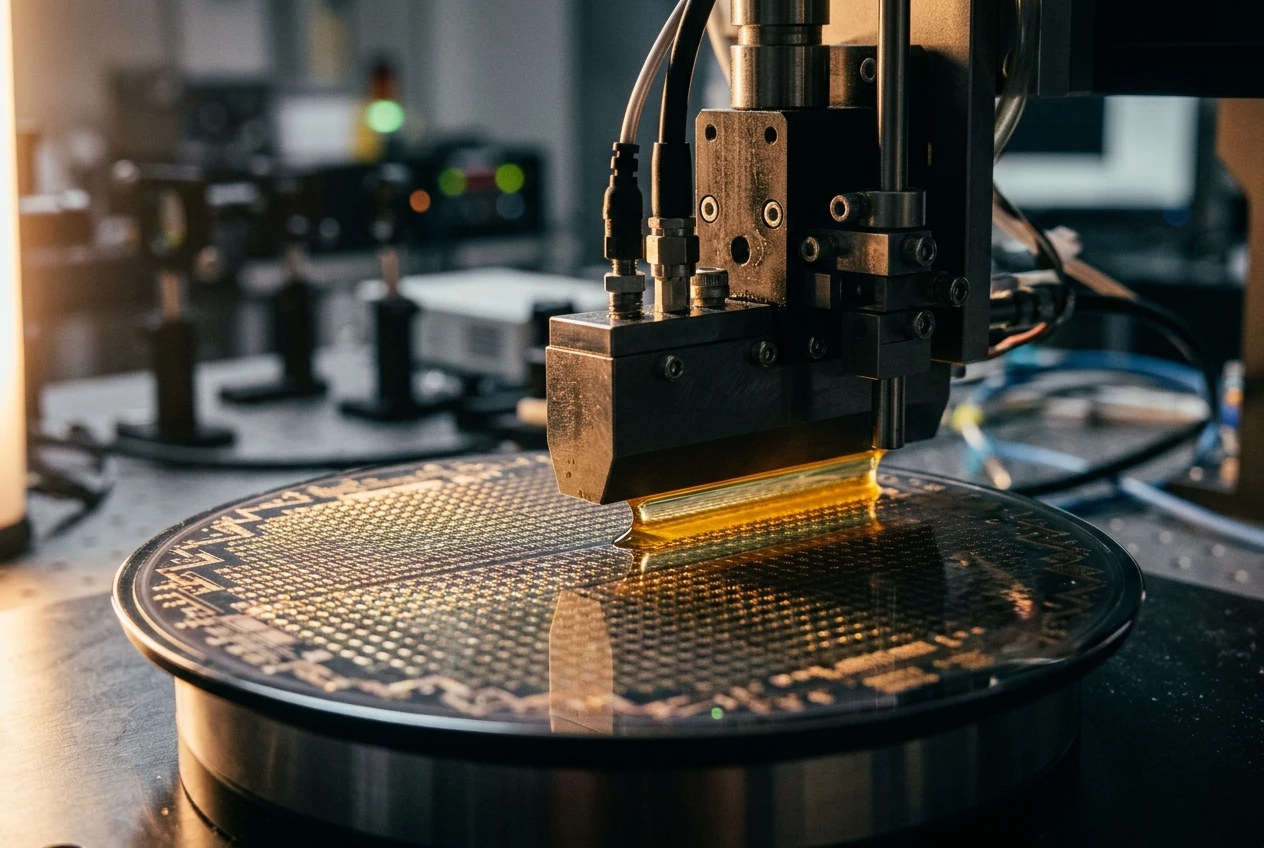
Pixel-Flo’s Continuous-Flo process is, on the company’s own description, an industrially scalable fluidic self-assembly approach built around a tool the coatings industry has used for decades. The slot-die process uses meniscus forces to continuously guide the micro-LEDs into place, and Pixel-Flo describes the method as backplane-agnostic and as enabling a single step for RGB, a meaningful difference from the multi-step placement sequences most display makers are working with.
How the three-step process works, in Pixel-Flo’s own framing:
- Release known-good die into an ink. Unlike mechanical systems, no die are lost due to the mismatch between the round LED wafer and a square carrier, and there is no stamp mura, the visible patchiness that comes from contact transfer, because the die are randomised in the ink.
- Pattern traps on the substrate. The locations that will receive each die are defined using standard photolithographic equipment and materials already present in the array line, giving micron-level placement accuracy.
- Assemble the die into the traps. The slot-die head sweeps the ink across the substrate, and Pixel-Flo’s meniscus-guiding technique drives an extremely high interaction rate between the die and the traps, allowing fast throughput.
How that approach compares, on the dimensions Pixel-Flo itself flags:
| Approach | Throughput on large substrates | Backplane compatibility | RGB steps |
|---|---|---|---|
| Conventional pick-and-place | Limited; unit cost does not fall with substrate size | Backplane-agnostic in principle | Multiple placement steps for R, G and B |
| Early fluidic self-assembly | Constrained by die placement accuracy and yield | Varies by implementation | Varies by implementation |
| Continuous-Flo (Pixel-Flo) | Continuous throughput; cost falls with substrate size | Backplane-agnostic | Single step for RGB, per Pixel-Flo |
The company is also explicit on the cost angle. With Continuous-Flo, unit cost reduces with increasing substrate size due to the fundamental scalability of slot-die, and smaller die can be assembled than is possible with mechanical systems, enabling significant cost reductions in materials.
The investor syndicate: Northern Gritstone, SCVC, Parkwalk, HTGF
Northern Gritstone sits at the centre of the round. The Manchester- and Leeds-headquartered firm, which runs a third office at the same Portobello Innovation Centre that houses Pixel-Flo, completed 24 investments in 2025 from pre-seed through Series B, and lists Northern Gritstone as the lead on this seed. Simon Braham, head of portfolio at Northern Gritstone, said in a Prolific North feature that the firm’s Northern Arc portfolio is anchored in deeptech and life sciences, with companies like photonic-computing firm Optalysys and infrared-sensor company Phlux already in the stable.
SCVC, a deeptech specialist venture firm, is back in a Northern Gritstone-led seed for the second time in this year’s coverage; the firm co-led a £4m round into University of Manchester spinout PhovIR in 2025. Parkwalk, the long-running UK early-stage firm, joined the round through the Northern Universities Venture Fund it co-runs with Northern Gritstone. The German fourth investor, High-Tech Gründerfonds, writes initial pre-seed and seed tickets starting at €800,000 and can follow on up to €30m, with backing from the Federal Ministry for Economic Affairs, KfW Capital and a roster of industrial LPs including BASF, Robert Bosch and SAP.
From a Sheffield lab to an Asian commercial floor
Pixel-Flo’s strategy is unusually Asia-forward for a Sheffield spin-out at this stage. In the space of a few months, the company has had Rick Smith give an invited talk on the Continuous-Flo process at Electronic Displays in Nuremberg, exhibited at Touch Taiwan 2026 from April 8 to 10 at Booth L529 in the Micro and Mini LED Pavilion, and taken Booth 644 at Display Week 2026 in Los Angeles from May 5 to 7, with an invited paper, 102.1, titled Slot-Die Based Fluidic Self Assembly, a Scalability Breakthrough in MicroLED Display Manufacturing, presented on May 8.
The hires tell the same story. Sheng Chih (Sanger) Hsu, formerly of AUO, QD Vision and Kateeva, has joined as vice president of business development, based in Taipei. Smith framed the move in a LinkedIn announcement on the company’s page.
Global outreach is a top priority for Pixel-Flo, and Sanger is already opening up valuable connections with partners and customers across Asia.
Rick Smith, chief executive and co-founder of Pixel-Flo, made the comment in a post on the company’s LinkedIn page announcing Hsu’s appointment. Hsu joins a founding team that itself reads like a roll-call of the European display industry’s commercial side: Simon Jones, the chair, is the former chief executive of Helio Display Materials and a long-time senior figure at Liquavista, Dow Corning and FlexEnable.
How the round sits inside a MicroLED market still wrestling with yield
The funding lands at a moment when the MicroLED market is, by industry consensus, closer than it has ever been to mainstream panels and still well short of them. Yole Group’s 2025 MicroLED report lists Pixel-Flo in the UK cluster of equipment and process specialists, alongside Plessey and Porotech, and PlayNitride in Taiwan. Display Week 2026 itself drew more than 5,400 attendees from over 30 countries, with 225 exhibitors and more than 700 research papers, by the conference’s own count. Tianma used the show to unveil a 135-inch 4K MicroLED video wall, a step up from the 88-inch prototype the same company showed a year earlier.
For the investors, the Pixel-Flo bet is a familiar shape. Northern Gritstone’s chief investment officer, Marion Bernard, told Prolific North that the firm’s 2026 focus is on computing infrastructure and chips to power ever-growing AI models, with deeptech and life sciences the two largest slices, and Yole’s post-show report from the same conference framed the year as one in which the three display architectures are accelerating in parallel rather than in sequence. Pixel-Flo’s founders, in turn, are pitching their slot-die process as the step that turns a slow-moving race into a mass-market one.
Frequently Asked Questions
What is MicroLED mass transfer?
Mass transfer is the manufacturing step in which micro-LED die, each one smaller than a grain of sand, are moved from a wafer onto a display backplane with micron-level accuracy. It is the part of the production line that determines how many panels a fab can build, and at what cost per panel.
What does Pixel-Flo’s Continuous-Flo process do differently?
Pixel-Flo’s Continuous-Flo process is a slot-die-based fluidic self-assembly technique that the company says uses meniscus forces to guide micro-LED die into micron-scale traps on the backplane in a single RGB step. The pitch is that it removes the cost penalty that comes from mechanical pick-and-place tools struggling with millions of small die at high yield.
Who invested in the Pixel-Flo seed round?
Northern Gritstone led the £5.25m seed round, with participation from deeptech specialist SCVC, the Parkwalk Northern Universities Venture Fund and the German public-private seed investor High-Tech Gründerfonds (HTGF).
When was Pixel-Flo founded, and where is it based?
Pixel-Flo was founded in 2025 as a spin-out from the University of Sheffield’s School of Electrical and Electronic Engineering, and is headquartered at The Innovation Centre, 217 Portobello, in Sheffield.


Nvidia Buys Hugging Face, the Platform That Turned It Down

OpenAI Names GPT-6 Astra AGI, Then Locks It Down

Relay Q Bets a $150 Puck Can Beat Dictation Apps

Accel Backs Atira to Automate Industrial Sales Engineering

Beyerdynamic Hides a Spare Battery in the Aventho Y

Lummis Pushes the CLARITY Act to Export Wyoming’s Crypto Banks

AI Exposure Turns a Cloud Beat Into a Selloff

Citadel’s XRP ETF Filing Looks Like Dealer Inventory

Revolut’s OCC Nod Starts an 18-Month US Bank Clock

British Business Bank’s Zinc Fund Will Mint 80 Startups

Walter’s TWG Insists No Fraud as Insurer Probes Force Cleanup

30-Year Yield Hits 5.32% Highest Since 2007 as Debt Supply Locks In Costs

PCE Stays at 3.7% as Gas and Tariffs Outrun Coming Revisions

Astute’s $1.2M bet makes B2B creator deals feed AI discovery

Strategy Parks $1.59B Cash While Bitcoin Stack Stays Flat

SpaceX Stock Rebound Tests Real Demand Before Huge Unlock

The 20% Savings Ideal Meets a 2.7% Reality Check

Amber’s €7M locks Mittelstand knowledge inside Europe

Monzo chair Gary Hoffman exits after board revolt fallout

AI data centers win as RAM kits jump nearly 500 percent
-
 FINANCE3 months ago
Zcash Patched a Double-Spend Bug as ZEC Climbed 5%
-
 ENTERTAINMENT3 months ago
Steam Summer Sale 2026 Locks In June 25 to July 9 Dates
-

 FINANCE2 months ago
CLARITY Act Final Text Expected This Weekend as 60-Vote Hurdle Looms
-
 NEWS4 months ago
Meta Adds AI Replies to Threads, But Users Can’t Block It
-

 NEWS3 months ago
YouTube Shorts is testing a heart in place of the thumbs-up
-

 NEWS1 month ago
Senators Force Apple Off Chinese Memory as Big Three Cash In
-

 NEWS3 months ago
NEURA Robotics’ $1.4B Series C Redraws Europe’s Physical AI Bet
-
 ENTERTAINMENT5 months ago
Extraction 3 Is Officially Coming to Netflix in 2027