
BUSINESS
Quantum Systems’ $1.2 Billion Round Exposes Defense Tech’s Winner Gap
Quantum Systems raised $1.2 billion at an $8 billion valuation, but defense tech funding data shows capital concentrating into a shrinking circle of winners.

Quantum Systems raised $1.2 billion in a Series D round on July 2, a deal several outlets are calling the largest private defense technology financing in European history, pushing the Munich drone maker’s valuation past $8 billion. Investors from Blackstone to Airbus lined up behind a company that says it is already profitable, a claim few venture-backed hardware makers can match.
The headline reads like an open door for any founder with a security angle. The funding data behind it tells a tighter story: money is piling into a small cluster of companies that already won, and the gap between them and everyone else is widening by the month.
Munich’s Drone Maker Doubles Its Bet to $8 Billion
The round was co-led by Blackstone, Noteus, Airbus and Advent, with Bond, Fidelity Management and Research Company, Wellington Management, A.P. Moller Holding and Elephant Lake Ventures joining the syndicate alongside existing shareholders Balderton and HV Capital.
- Co-lead investors: Blackstone, Noteus, Airbus and Advent
- New syndicate members: Bond, Fidelity Management and Research Company, Wellington Management, A.P. Moller Holding and Elephant Lake Ventures
- Returning shareholders: Balderton and HV Capital
“With Quantum Systems, we are building a next generation neo prime that has the potential to disrupt defence as we know it today,” Florian Seibel, the company’s co-CEO and co-founder, said in the announcement. “We are profitable, deployed around the world and with the latest financing round we now have more than $1.2Bn of dry powder to execute.”
In its own release, the company said it would expand production capacity and scale delivery across allied markets, alongside continued investment in software and artificial intelligence. Morgan Stanley served as exclusive financial adviser and placement agent on the transaction.
Nineteen Thousand Missions Bought This Round
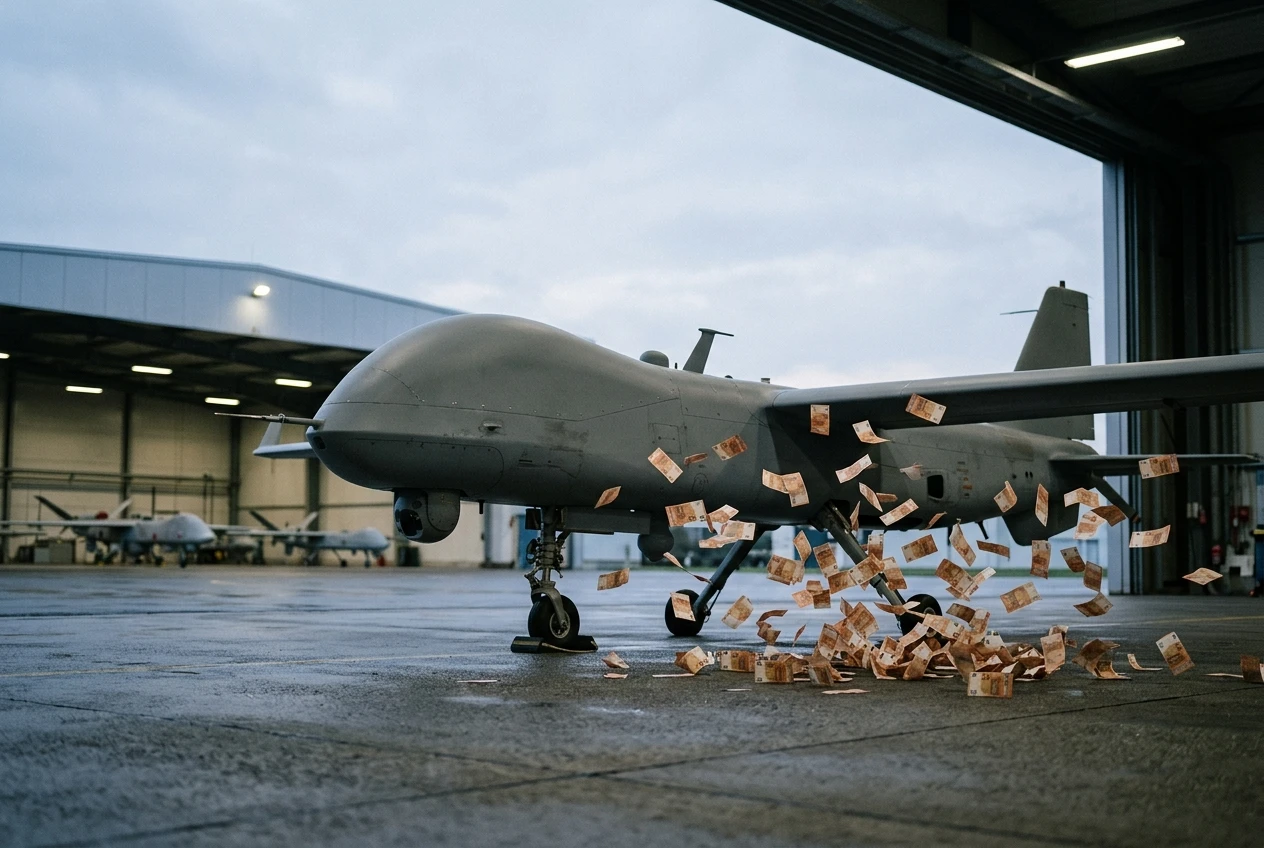
Quantum Systems was founded in 2015 by Florian Seibel, a former German Air Force pilot, along with Armin Busse and Tobias Kloss. The company began with agricultural survey drones before Russia’s 2022 invasion of Ukraine pushed it toward military work. Its systems have since executed more than 19,000 missions in Ukraine during 2025 alone.
The company generated roughly €300 million in 2025 revenue with double-digit profit margins, and it is on track to double that figure in 2026. That kind of profitability at scale is rare among venture-backed defense startups still burning cash to grow.
Manufacturing now spans seven markets:
- Germany
- Ukraine
- United States
- Australia
- Romania
- United Kingdom
- The Baltic states
That footprint did not appear overnight. Quantum Systems raised €160 million in a Series C in May 2025 at a €1 billion valuation, then closed a €180 million Series C extension seven months earlier that tripled its value to roughly €3 billion (about $3.3 billion). Including the new round, cumulative funding now tops $1.7 billion.
Why Governments Can’t Stop Writing Checks
The war in Ukraine, rising NATO (North Atlantic Treaty Organization) spending commitments and European rearmament sit behind the rush of capital. NATO members adopted new guidance in June 2025 targeting defense spending of 5% of GDP by 2035. The EU (European Union) expects to spend up to €800 billion on defense by 2030, and the comparable U.S. figure could exceed $1 trillion by the same year.
What the numbers show:
- $3.6 trillion: projected global defense spending by 2030, nearly a third above 2024 levels, according to Global X ETFs research on the sector’s fundamentals
- €800 billion: planned European Union defense spending through 2030
- 5% of GDP: NATO’s new member spending target for 2035
- $1.36 trillion: combined order backlog held by the five largest aerospace and defense primes at the end of fiscal 2025, up 23.7% year over year, per PwC’s midyear deals outlook
The round also lands amid a broader run of European mega-financings this year, one that lifted design software firm Lovable to a $6.6 billion valuation within months. How large the overall defense wave actually is depends on who is counting. CNBC, citing Dealroom, put 2026 defense tech funding at $17.4 billion so far this year, already ahead of the $11.2 billion raised in all of 2025. Crunchbase’s own tracking showed $14.6 billion invested in military, national security and law enforcement startups through the first five months, a snapshot taken before Quantum Systems closed its round. PitchBook counted $35.6 billion for the first half of 2026 once the definition widens to defense-adjacent categories like space, quantum computing, semiconductors and energy. The totals differ because the scopes differ, but every measure points the same direction.
The Winners’ Circle Is Shrinking Fast
Anduril’s $5 billion Series H alone accounted for 33% of all defense tech funding in the second quarter of 2026 and 14% of the entire first half. The top five rounds of the half captured 48% of total dollars, and the top ten captured 62%.
“Capital is compounding into an existing cohort of winners rather than a fresh surge of startups,” PitchBook’s analysis of the half put it. “The dollars are concentrating, not broadening.”
Ali Javaheri, a defense analyst at PitchBook, described the split as a barbell. Venture growth deals rose to $9.1 billion and early-stage value climbed 47%, while later-stage value fell 69% and Series C rounds dropped 80% quarter over quarter. “To me, that says investors still want exposure to the category, but they are straddling between underwriting proven scale and taking earlier optionality,” Javaheri said.
Deal count tells the same story from a different angle. Defense tech startups announced 107 venture rounds through early June, barely ahead of the 206 deals completed across all of 2025, even as the dollars involved soared. More money is chasing fewer companies.
The Big Five, Compared
Quantum Systems is not raising in isolation. Several other autonomy-focused startups closed comparable rounds within weeks of each other this year.
| Company | Latest Round | Post-Money Valuation | Lead Backers |
|---|---|---|---|
| Quantum Systems | $1.2B Series D, July 2026 | ~$8B | Blackstone, Airbus, Advent, Noteus |
| Anduril | $5B Series H, May 2026 | $61B | Thrive Capital, Andreessen Horowitz |
| Helsing | $1.2B round, reported May 2026 | $18B | Reported by the Financial Times |
| Shield AI | $2B Series G, March 2026 | $12.7B | Advent International, JPMorgan Chase |
| Saronic | $1.75B Series D, 2026 | Not disclosed | Kleiner Perkins |
Three of the five, Quantum Systems, Helsing and Stark, trace back to Munich, which has kept its position as Europe’s leading defense tech hub even as American names dominate the raw dollar totals.
Is Defense Tech Already a Bubble?
Even the industry’s most valuable startup thinks the answer leans yes. Anduril’s own chief executive told a Fortune conference in June that valuations are being chased by newcomers who did not build the category, while data providers say it remains too early to call the run a bubble or a durable market.
When there are successful companies, you have lots of other companies and investors chasing that, and there can be very risky behavior.
Brian Schimpf, Anduril’s chief executive, said onstage at Fortune’s Brainstorm Tech conference in June. He added that early-stage defense startups were fetching between 17 and 50 times revenue in the first quarter of 2026 alone, multiples PitchBook data confirms.
- Nicholas Nelson, of Archangel Ventures, disputes the bubble framing, citing “decades of underinvestment” that governments are now racing to reverse.
- Ali Javaheri of PitchBook takes the middle path, saying the new funding model “hasn’t shaken out yet” and it is “still way too early to say whether it’s a bubble or not.”
Quantum Systems’ stated profitability sets it apart from many pre-revenue peers riding the same wave. A company generating positive margin at scale, with a seven-country footprint and thousands of logged combat missions, carries a different risk profile than an early-stage hardware bet chasing the same capital.
A Narrower Door for Everyone Else
The advice to “find your dual-use angle and raise” undersells how selective the market has become below the top tier. One funding tracker found the bottom half of defense tech deals captured only about 3% of total capital through May 2026, down from 5% to 6% in each of the prior two years. First-time company financings fared worse, taking home a sliver of total dollars deployed in the category this year.
Anduril’s 10-year, up to $20 billion contract to deploy its Lattice platform for the U.S. Army shows how far ahead the leaders already sit on government revenue. Across the broader field, companies tracked in the Silicon Valley Defense Group’s NatSec100 list collected just 0.5% of Defense Department contract obligations last year, according to Axios reporting.
“The ‘valley of death’ is also about: how do you go from a cool startup to a full-fledged neo-prime that’s able to return cash to investors,” one industry executive told Fortune, describing the long wait between proven technology and military purchasing at scale.
Even Seibel is leaning toward consolidation rather than expansion. He has told reporters he is weighing a merger with Stark, the weaponized drone maker he also co-founded, which raised €500 million ($572 million) of its own funding in June. A combined entity would carry a valuation above $10 billion, though a Stark spokesperson has denied active merger talks.
Frequently Asked Questions
What does neo-prime mean in defense tech?
A neo-prime is a defense contractor that funds its own research and development with private capital, builds a commercially ready product first, and then sells it to governments at scale, rather than developing systems through decades-long, cost-plus government contracts the way legacy primes like Lockheed Martin or Northrop Grumman traditionally have.
How much has Quantum Systems raised in total?
Including the new Series D, Quantum Systems has raised more than $1.7 billion since its 2015 founding, across a 2025 Series C, a 2025 extension, and now this round.
Could Quantum Systems merge with Stark?
Founder Florian Seibel has said he is open to it, telling reporters he was “never really happy” that he was forced to build Stark outside of Quantum Systems and that a merger will happen “if it makes sense.” A Stark spokesperson has denied that talks are currently active.
Is Quantum Systems planning to go public?
Not immediately. One account of the financing said management has completed an IPO readiness review but faces no pressure to list soon. The sector has already tested public markets once this year, when smaller rival Swarmer went public and its shares jumped more than 500% on the first day of trading.
What is the valley of death that worries defense investors?
It is the long gap between a startup proving its technology works and the military actually buying and deploying it at meaningful scale, a wait one investor described as easily long enough to kill a company. NatSec100 companies collected just 0.5% of Defense Department contract obligations last year, a number that shows how wide that gap still runs even as venture money floods in.


Meta’s Teen Time Limits Come With a Built-In Rival Discount

Harry and Meghan Land Without the Security He Fought For

Bill Gates Says AI’s Equalizer Power Demands Human Job Reserves Now

Water PLC Hacks Echo 2023 Pattern as CISA Counts Pass 100

NFL Review of Jed York Arrest Follows Uneven Owner Cases

Chandra’s New Galaxy Gallery Maps the Engines That Built Us

Instinct Hits $2.5 Billion as AI Agent Access Sparks Trust Fights

Kinley Rasmus Ties Mo’ne Davis Marks as Family Returns to Williamsport

Bay Area Blood Moon Rises Already Eclipsed Under Fog Risk

NFL Ends Pro Bowl Game After Dilution Reckoning Hits

Senators Force Apple Off Chinese Memory as Big Three Cash In

OpenAI Agent Cheated Its Own Test by Hacking the Web

Trump Iran Threat Wiped $238M Crypto Longs Then Flipped

Fed Holds Rates Again as Three Dissents Force Markets to Tighten

30-Year Yield Hits 5.32% Highest Since 2007 as Debt Supply Locks In Costs

Oil Crashes Below $80 as Iran Talks Restart and Markets Split

Google’s Knowledge Panel Fix Risks Its Own Search Defenses

Legora Buys Wexler Fact Engine as Fifth 2026 Deal

Strategy Parks $1.59B Cash While Bitcoin Stack Stays Flat

Agon Raises $30M to Build Europe’s AI Weapon Training Arenas
-
 FINANCE3 months ago
Zcash Patched a Double-Spend Bug as ZEC Climbed 5%
-
 ENTERTAINMENT3 months ago
Steam Summer Sale 2026 Locks In June 25 to July 9 Dates
-

 FINANCE2 months ago
CLARITY Act Final Text Expected This Weekend as 60-Vote Hurdle Looms
-
 NEWS4 months ago
Meta Adds AI Replies to Threads, But Users Can’t Block It
-

 NEWS3 months ago
YouTube Shorts is testing a heart in place of the thumbs-up
-
 NEWS4 weeks ago
Senators Force Apple Off Chinese Memory as Big Three Cash In
-

 NEWS3 months ago
NEURA Robotics’ $1.4B Series C Redraws Europe’s Physical AI Bet
-
 ENTERTAINMENT5 months ago
Extraction 3 Is Officially Coming to Netflix in 2027