
NEWS
Perceptron $6.5M Round Cracks AI Data Gatekeeping
Perceptron closed $6.5 million to launch data questing on its 800,000-node mesh, letting AI teams source verified datasets in days instead of buying Big Tech access.

Perceptron closed a $6.5 million strategic round on 30 July 2026 to launch a data-questing platform on its live mesh of more than 800,000 nodes. The raise pulls in Web3 funds, trading desks and infrastructure partners so AI teams can commission verified datasets in days instead of renting access from centralized gatekeepers.
Peter Anthony, UK co-founder and CEO, said the network already proved organic demand. Now the capital turns passive bandwidth into ordered, high-value datasets that contributors own and can cash out freely.
That shift matters because the base already exists at scale. Capital does not have to buy the crowd. It has to tool the crowd so paying AI clients can place precise orders against it.
Who Wrote the Cheque
The round brought Sigma Capital, Selini Capital, QCP Capital, P2 Ventures, CoinDCX Ventures, Momentum6, DeFi Capital, the Walrus Foundation, Aethir, Colosseum, GuruDev Capital, Tempo Finance, NewTribe Capital, Digital Consensus Fund and CodeCraft Capital. No single lead was named. The money funds the questing launch, better contributor tools and the push toward five million nodes.
- Sigma Capital and Selini Capital among the early names listed
- Trading firm QCP Capital and CoinDCX Ventures add market depth
- Infrastructure partners Aethir and Walrus Foundation sit beside pure capital
- P2 Ventures framed the deal as a DeAI stack play
Nathan Gurr, investment analyst at P2 Ventures investment thesis, said the team had already mobilised a global workforce that can pull niche expertise, from doctors and lawyers to native speakers, on demand. Mark Rydon, co-founder of Aethir decentralized GPU network, added that centralized scraping is hitting diminishing returns on both cost and quality, and that Perceptron solved the distribution problem.
| Backer type | Examples named | Role in round |
|---|---|---|
| Venture / Web3 funds | Sigma, Selini, P2 Ventures, CoinDCX Ventures | Core capital |
| Trading / market firms | QCP Capital | Liquidity and networks |
| Infrastructure partners | Aethir, Walrus Foundation | Compute and storage adjacency |
| Specialist capital | Colosseum, NewTribe, Digital Consensus | Ecosystem reach |
The list reads like a DePIN and DeAI roll-call rather than a classic Silicon Valley Series A.
Mixing pure capital with compute and storage partners is deliberate. Questing will need adjacent capacity when image, voice and video tasks ramp. Having those names in the round shortens the path from a posted request to a delivered set.
How Idle Bandwidth Becomes Training Fuel
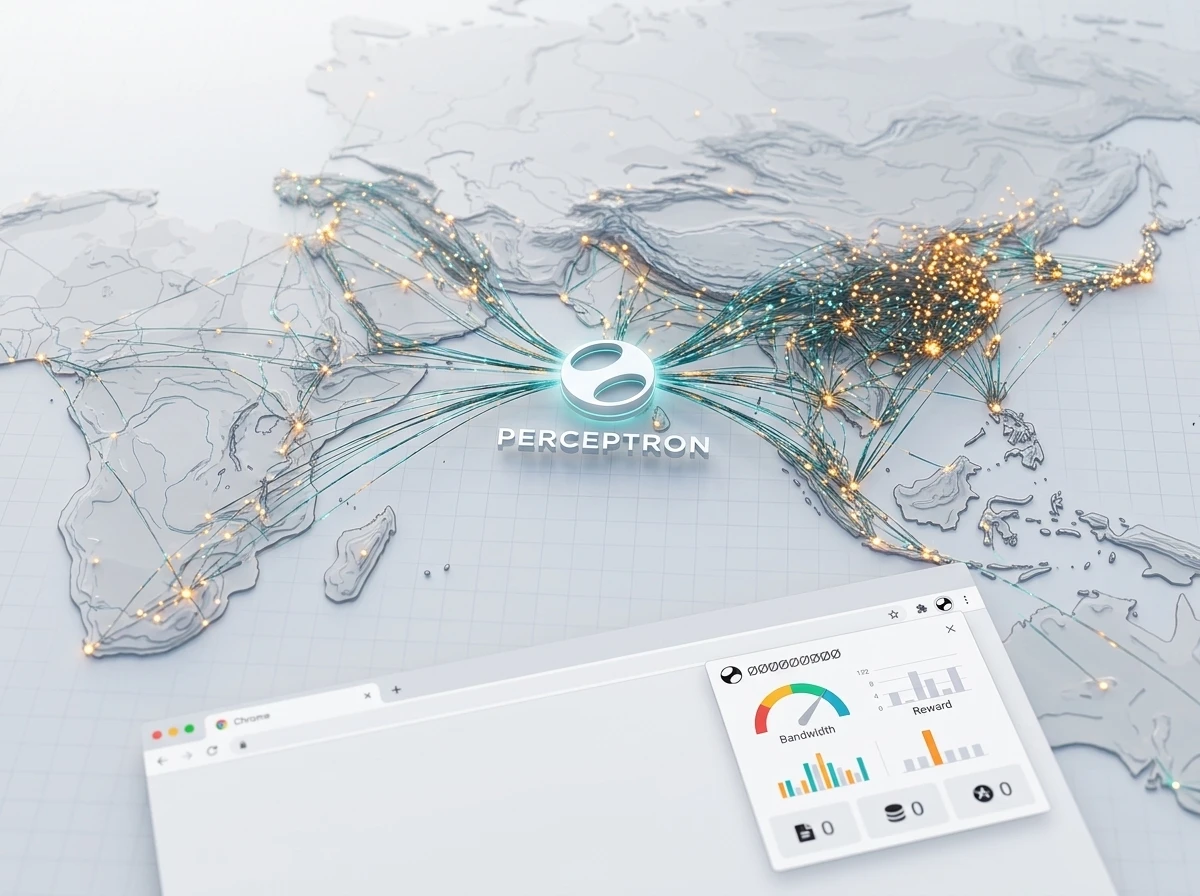
Users run a Chrome extension or Android app. The node shares unused bandwidth to pull publicly available web views from that device’s local vantage point. Packets return to the network for cleaning and verification. Contributors earn points that convert to PERC tokens and reputation that unlocks higher-value work. Personal files stay private; the system only sees what any browser would see on the open web.
The data-questing layer changes the model from pure passive collection to commissioned work. AI companies post specific requests. The mesh routes them to nodes that match location, language or domain skill. Peer verification and automated checks keep quality above simple scrapes. Contributors keep ownership of their data and earnings and can withdraw without a third-party gate.
- Node layer: idle bandwidth and geographic diversity
- Quest layer: structured tasks for annotation, images, voice or niche knowledge
- Ownership layer: users monetise or exit at will
- Verification: peer plus automated quality gates before payment
The official Perceptron network site positions this as a single mesh that collapses the gap between data demand and supply. Earlier interviews put the cost advantage near 90 percent versus legacy providers for certain public-web pipelines.
Passive collection still fills the pipe. Questing decides what travels first and at what price. Reputation then sorts who sees the specialist work, so the same node base can serve both bulk public-web pulls and narrower expertise tasks without building a second workforce.
The Numbers the Round Is Betting On
Press materials cite more than 807,000 nodes and over 300,000 daily active users after an earlier phase that hit 200,000 users across Telegram and Discord. The live live network dashboard metrics recently showed roughly 810,000 total nodes, with daily active nodes in the low six figures and weekly active users near 356,000. Regional weight is heavy in Vietnam, Indonesia, India, the Philippines and Nigeria.
Stats snapshot
- 807,000+ nodes cited at announce
- 300,000+ daily active users in company figures
- 150+ countries
- 5 million nodes as longer-term target
| Top regions (hub view) | Approx share |
|---|---|
| Vietnam | 37 % |
| Indonesia | 13 % |
| India | 12 % |
| Philippines | 9 % |
| Nigeria | 7 % |
Windows still dominates the client mix. The pattern matches other bandwidth DePIN projects that grow fastest where mobile and desktop data plans leave spare capacity and where dollar rewards matter more.
Concentration in a handful of regions is both a strength and a constraint. Language coverage, local web views and time-zone spread already look useful for many public-web and sentiment jobs. Clients that need heavier weight in other markets will test whether rewards and tooling can pull the map outward as the five-million-node target approaches.
Why the Data Layer Suddenly Matters
OpenAI has paid tens of millions a year just for API access to platforms such as Reddit and X. Anthony has used the $60 million to $100 million range as the clearest illustration that quality pipelines sit behind walls most startups cannot climb. Centralized scrapers face rate limits, legal risk and stale dumps. Closed partnerships stay out of reach.
We’ve already shown that mission can become a reality, as evidenced by our ability to scale to hundreds of thousands of nodes organically. Now, with this funding, we are launching our data-questing platform, which will allow AI companies to commission specific, high-value datasets directly from our community.
Peter Anthony said that in the announce materials. The second-order effect is simple: once a mesh can deliver verified, location-aware or expertise-tagged data in days, the advantage shifts from who can write the biggest check to who can post the cleanest request. Independent model builders gain a path that does not run through the same three or four data brokers.
AI training dataset markets are still measured in the low-to-mid single-digit billions for 2025-2026 across research houses, with forecasts that climb steeply. Even small share shifts matter when the alternative is a multi-year wait for better open sets or another expensive scrape cycle.
Cost is only part of the story. Speed and specificity decide whether a lab ships on schedule. A mesh that can route by location, language or domain skill in days compresses a procurement cycle that used to stretch across contracts, scrapes and clean-up passes.
Grass and the Wider Bandwidth Pack
Perceptron is not alone. Grass built a similar idle-bandwidth scraping network that passed hundreds of thousands of nodes and raised from Polychain and others. Honeygain and older consumer bandwidth apps proved people will share spare capacity for small rewards. What separates the current wave is the explicit AI client focus and the move from pure passive collection into commissioned quests that can capture specialist human input.
| Network pattern | What it proved | Limit for AI teams |
|---|---|---|
| Older consumer bandwidth apps | Users share spare capacity for small rewards | No structured AI commissioning path |
| Grass-style idle scrape meshes | Hundreds of thousands of nodes can form | Still weighted to passive collection |
| Perceptron questing layer | Organic base plus ordered tasks on one mesh | Must convert daily actives into repeat supply |
Crowd conversation on X after the announce mixed celebration of the 800k-node base with the usual DePIN questions about token timing and real revenue. The official post framing the data layer as the true bottleneck drew tens of thousands of views. The sharper takes noted that organic growth to this scale already answered the hardest question; capital now buys the tooling to turn that crowd into a reliable supply side for paying AI teams.
European AI funding has stayed active in narrower niches. The Agon 30 million AI defence arenas raise and the telli 15 million seed for AI agents show capital still finds product-market fit stories even when broader tech funding cooled. Perceptron’s round sits in the same current: infrastructure that removes a concrete bottleneck rather than another foundation model.
How Questing Turns a Crowd into Supply
Organic scale answered whether people would run nodes. Questing answers whether those nodes can fill paid, repeat orders with enough quality to matter to AI buyers.
The path is mechanical. A client posts a request. The mesh matches it to location, language or domain skill. Peer checks and automated gates clear the set before payment moves. Contributors keep ownership and can exit without a gatekeeper. Each completed quest also feeds reputation, which opens higher-value work on the same base.
- Bulk public-web pulls still run on idle bandwidth
- Commissioned tasks pull niche human input on demand
- Verification stands between delivery and payout
- Ownership stays with the contributor through cash-out
Live clients already hint at the mix. Image supply for text-to-video work such as Everlyn AI sits beside sentiment pipelines across social and crypto markets. Those are different shapes of demand on one mesh. The near-term test is whether the same routing and quality stack can absorb voice, richer content and, later, video without fracturing the contributor experience.
A separate $10 million AI Data Fund already offers selected teams free infrastructure time and up to 5 TB of data. That lowers the trial cost for early models and puts real workloads on the questing rails before wider marketplace entry.
What the Money Buys
Near-term priority is the data-questing platform launch, with further product news expected next quarter. The public roadmap on the company site runs through 2027:
- Q3 2026, Alpha loop and Data Questing v1; micro-quests with instant balance updates; node network feeding initial AI demand
- Q4 2026, Voice, image and content quests; refined datasets to clients; external marketplace entry
- Q1 2027, Video quests and Data Vault for dataset IP and reuse
- Q2 2027, Validator net, synthetic quests for model QA, enterprise Connect API
Beyond that sits a live evaluation suite. A separate $10 million AI Data Fund already offers selected teams free infrastructure time and up to 5 TB of data to accelerate early models. Live clients include image supply for text-to-video work such as Everlyn AI, plus sentiment pipelines across social and crypto markets.
The five-million-node target would put every common AI data need inside one mesh. That remains a stretch goal. The immediate test is whether questing converts the existing 300k-class daily audience into reliable, high-margin specialised supply that AI companies reorder.
Roadmap order is itself a bet. Micro-quests and instant balance updates come first so contributors feel the loop before heavier media types arrive. Marketplace entry in Q4 2026 then stresses external demand. Video, vaulting, validators and an enterprise API only land after that base works. Miss the early conversion step and the later surface area matters less.
Why Ownership Changes the Buyer Conversation
Centralized pipelines bundle access, cleaning and lock-in. Buyers rent a pipe. They rarely own the underlying contribution graph or the right to reorder the same people on new terms.
Perceptron’s ownership layer flips that default. Contributors monetise or exit at will. AI teams commission sets without climbing the same partnership walls that produce eight-figure API bills. Verification still sits in the middle, so quality is not left to hope.
For independent model builders, the practical change is procurement shape. Instead of a multi-year wait for better open sets or another scrape cycle, they post a clean request and pay against delivered, checked work. The $60 million to $100 million illustration Anthony has used stops being the only reference price in the room.
None of that removes the need to prove repeat orders. It does change who holds leverage when the order is placed.
Perceptron now has capital, a proven organic base and a clear product next step. The centralized data moat that forced startups into expensive side doors is no longer the only path.


UK AI Mega-Rounds Capture Europe’s H1 2026 Funding Rebound

Highland Europe’s €1.1B Fund VI Draws Public Backing for Scaleups

TÖNNJES Backs Bikekey to Scale Digital Bike IDs Beyond Theft

Intropy’s $11M Seed Cracks Manual Spare Parts Moat

Inforcer’s $50M Series C Turns MSP Control Planes Into SMB AI Shields

Meta AI Lifts Instagram Scroll Time as Lawsuits Mount

Redmi Note 17 Leak Puts Giant Si-C Batteries in Midrange

Police Chiefs Back CLARITY Act as Passage Odds Sink Below 30%

Perceptron $6.5M Round Cracks AI Data Gatekeeping

HONOR MagicOS 11 Sets August 6 Date and Forces the Glass Race

CLARITY Act Final Text Expected This Weekend as 60-Vote Hurdle Looms

Kalshi Loses Major NY Prediction Markets Ruling to Judge Torres

Fed Minutes Cite AI Demand as Inflation Risk, Put a 2026 Hike Back on the Map

Marker AI Writing Startup Lands $13M Seed Led by Index Ventures

Dota 2 Esports World Cup 2026: Spirit Defends $2M Title In Paris

Meta’s Muse Spark 1.1 Beats Rivals on Price, Trails on Coding

CS2 Premier Season 5 Lands With Cache and a C4 Damage Rework

ARC Intelligence Closes €4M Seed Round in Roughly a Week

Finto Picks Munich Over Silicon Valley After YC, Raises $3.4M

Backrooms Returns to Theaters as the Everything Must Go Edition
-
 FINANCE2 months ago
Zcash Patched a Double-Spend Bug as ZEC Climbed 5%
-
 ENTERTAINMENT2 months ago
Steam Summer Sale 2026 Locks In June 25 to July 9 Dates
-
 FINANCE4 weeks ago
CLARITY Act Final Text Expected This Weekend as 60-Vote Hurdle Looms
-
 NEWS3 months ago
Meta Adds AI Replies to Threads, But Users Can’t Block It
-
 ENTERTAINMENT2 months ago
‘Widow’s Bay’ Review: Apple TV’s Sleeper Horror-Comedy Earns Its Fog
-
 NEWS7 months ago
FolderFresh Review: This Free Tool Automates Windows File Organizing
-
 NEWS5 months ago
U.S. Navy Deploys Solar-Powered Lightfish Drone to Patrol Oceans
-
 FINANCE3 weeks ago
Kalshi Loses Major NY Prediction Markets Ruling to Judge Torres