
FINANCE
CLARITY Act Hits June Crunch as Senate Calendar Tightens

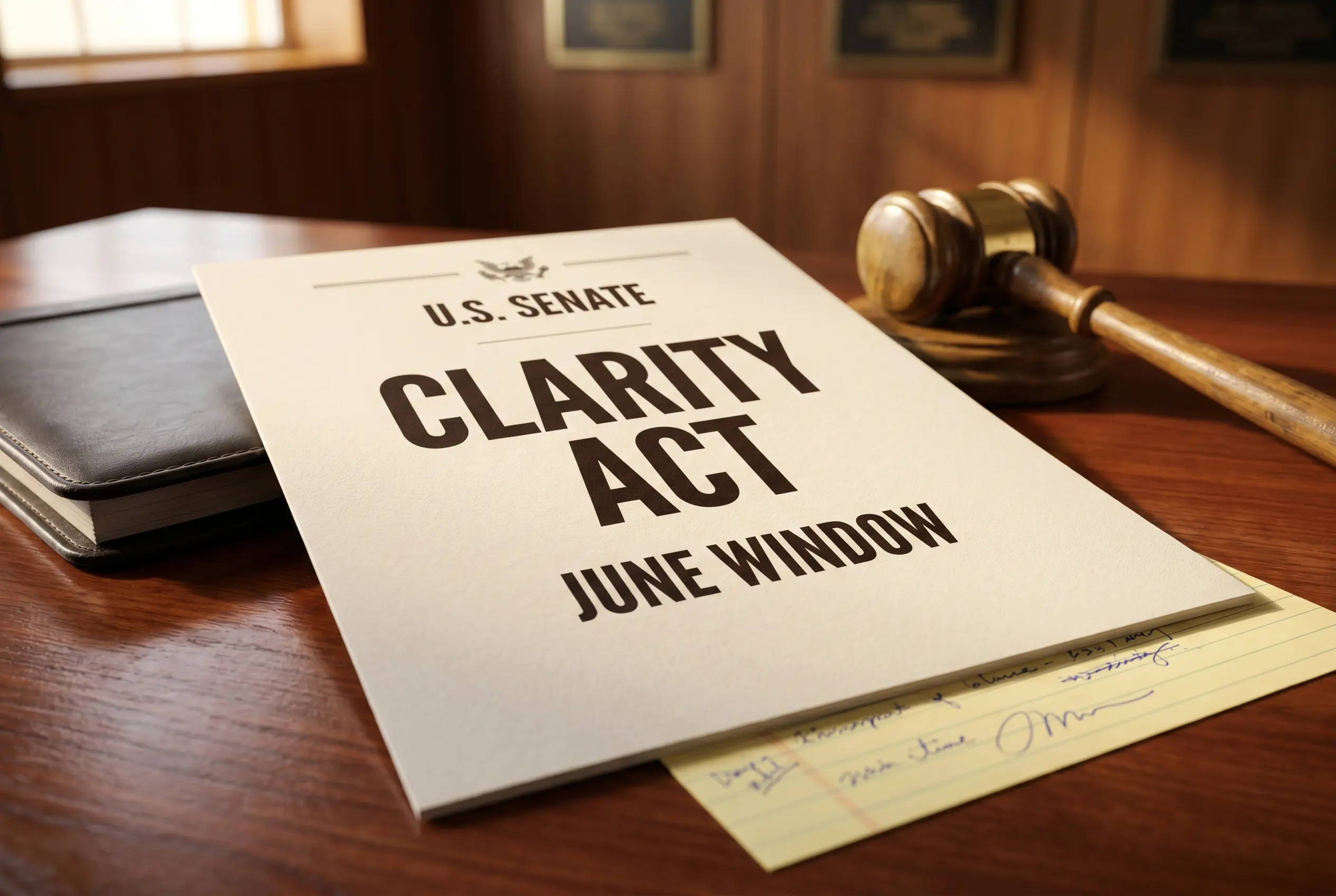
The CLARITY Act cleared the U.S. Senate Banking Committee on a 15-9 bipartisan vote on May 14, and its backers now argue the crypto market-structure bill has only a handful of working weeks to reach the Senate floor before lawmakers leave for the August recess. Galaxy Digital chief executive Mike Novogratz called June “now or never.” Prediction-market traders are a little more relaxed, pricing 2026 passage at 60% on Polymarket at the time of writing.
Committee approval was the easy part. What happens next depends less on policy than on whether Senate leaders can carve out floor time in a June already stacked with higher-priority bills.
Where the Bill Sits After the 15-9 Committee Vote
The CLARITY Act, formally the Digital Asset Market Clarity Act, passed the House last July and then spent months parked in the Senate. The committee vote was the first real forward motion of the year. All 13 Republicans on the panel backed it, joined by two Democrats: Ruben Gallego of Arizona and Angela Alsobrooks of Maryland.
At its core, the bill answers a question that has dogged the industry for years: who regulates what. It draws a line between digital assets that behave like securities and those that behave like commodities, then assigns each to a different agency. You can read the full text of H.R. 3633 for the statutory language, but the practical split is simple to summarize.
| Regulator | What it covers under the bill | Scope |
|---|---|---|
| SEC (Securities and Exchange Commission) | Investment-contract assets and fundraising that looks like a securities offering | Disclosure and securities-market oversight |
| CFTC (Commodity Futures Trading Commission, the derivatives and commodities regulator) | Digital commodities once a network is sufficiently decentralized | Exclusive jurisdiction over digital-commodity spot markets |
That handoff from the SEC to the CFTC is the piece the industry has wanted most. For years, firms complained that almost any token could be treated as a security depending on which enforcement lawyer was reading the file. The bill tries to replace that uncertainty with a test written into law.

Why Backers Say June Is the Only Window
The loudest case for speed is coming from Senator Cynthia Lummis, the Wyoming Republican who has championed digital-asset legislation longer than almost anyone in the chamber. Her argument is not subtle: pass it now, or wait years.
Lummis has said the next realistic opportunity for a market-structure bill is 2030, once this Congress is gone. In the meantime, she wrote, “developers remain exposed with no legal protections, and law enforcement remains without the tools to hold bad actors accountable.” That concern about builders facing legal jeopardy echoes warnings she has made before about the risk of reopened code prosecutions if the bill stalls.
Novogratz put it more bluntly on X.
June is ‘Clarity’ month. It’s literally now or never.
That line, from the Galaxy Digital chief, captures the industry mood. The window framing rests on a hard truth about Washington: bills that miss their moment rarely come back in the same form, and an election cycle tends to scramble whatever coalition was holding them together.
The Calendar Math Working Against It
Here is where the optimism meets the schedule. Senate Majority Leader John Thune told Republican lawmakers they would not finish their reconciliation package before leaving town, which means that fight rolls into June and keeps eating floor time. Punchbowl News reporter Jake Sherman noted the Senate “will go home until June, leaving the reconciliation bill unfinished.”
Crypto journalist Eleanor Terrett laid out the squeeze in plain numbers. The bill is now competing for attention against a stack of other must-pass items.
- The unfinished budget reconciliation package, the chamber’s top priority
- Renewal fights over FISA (the Foreign Intelligence Surveillance Act, which governs federal surveillance powers)
- A housing package already passed by the House
- The CLARITY Act itself, now waiting in line behind all of it
Terrett counted four working weeks in June and three in July before the August recess. “Clarity Act passage before August recess just got more challenging,” she wrote. Seven working weeks sounds like plenty until you remember the Senate moves one major bill at a time, and reconciliation alone can swallow whole weeks.
The China Pitch and the National-Security Frame
To break through the noise, supporters have reframed a financial-regulation bill as a national-security one. Lummis has been the sharpest on this point, tying the legislation directly to competition with Beijing. “If the United States doesn’t establish the global standard for digital asset regulation, someone else will,” she wrote on May 30. “China is not waiting.”
Treasury Secretary Scott Bessent has pressed the same case from the executive branch. In a Wall Street Journal opinion piece, he argued the country risks pushing crypto development offshore, naming Abu Dhabi and Singapore as jurisdictions already drawing builders away with clearer rules. His public lobbying coincided with a jump in the betting odds; coverage tracked the Polymarket odds climbing as Bessent pressed Congress, reaching roughly 60% from the mid-50s.
Whether the China framing moves undecided senators is an open question. It is, however, the kind of argument that travels well in a floor speech and gives reluctant members a reason to vote yes that has nothing to do with token prices.
The Stablecoin Yield Fight Still Unresolved
Strip away the geopolitics and one technical dispute is still doing most of the blocking. It concerns whether stablecoin holders can earn yield. An earlier law barred stablecoin issuers from paying interest to customers simply for holding the tokens, but a loophole lets third parties offer rewards instead.
The banking industry wants that loophole closed in the market-structure bill, worried that yield-bearing stablecoins could pull deposits out of traditional accounts. The crypto industry argues rewards are exactly what stablecoins need to compete in the payments market. JPMorgan boss Jamie Dimon has been among the loudest voices on the banking side, and the dispute has fueled a broader bank lobby push against the stablecoin provisions.
Alsobrooks, one of the two Democrats who crossed over in committee, said she spent more than nine months negotiating consumer protections and deposit-flight safeguards. She voted to advance the bill “in recognition of that good faith,” while making clear unresolved issues remained before she could support it on the floor. The detail matters because her committee yes is not yet a floor yes, and the same caveat likely applies to other Democrats. A section-by-section summary of the digital-asset bill lays out the customer-protection and stablecoin provisions still under negotiation.
The Floor Math: Sixty Votes, Seven Democrats
This is the arithmetic that decides everything. To clear the Senate, the bill needs to survive a filibuster, and that takes a supermajority, not a simple one.
- 60 votes are required on the Senate floor to overcome a filibuster.
- 53 Republican seats mean at least seven Democrats must cross the aisle.
- 2 Democrats, Gallego and Alsobrooks, backed it in committee.
- 4 working weeks in June and three in July stand between now and the recess.
So the gap between where the bill is and where it needs to be is roughly five more Democratic votes, found inside a shrinking calendar, with the stablecoin question still unsettled. None of that is impossible. Senate Banking Chairman Tim Scott steered the committee vote through more than 100 filed amendments, and the White House clearly wants a signing ceremony. The House and Senate negotiators still have to reconcile their two versions before any floor action begins.
If leadership clears a path and the yield dispute gets a fix Democrats can live with, the bill could reach the floor in June or July and hand the administration its market-structure win before the August break. If reconciliation drags and the stablecoin fight hardens, the next genuine opening may not arrive until well after this summer, which is precisely the outcome Lummis is warning about when she points to 2030.
Frequently Asked Questions
What Is the CLARITY Act?
The CLARITY Act, or Digital Asset Market Clarity Act, is U.S. legislation that defines when a digital asset is treated as a security versus a commodity and assigns regulatory authority accordingly. The SEC oversees investment-contract assets, while the CFTC gains exclusive jurisdiction over digital-commodity spot markets.
When Will the Senate Vote on the CLARITY Act?
No floor date is set. After the May 14 committee vote, supporters including Senator Cynthia Lummis expect a Senate floor vote sometime this summer, ideally before the August recess, though competing legislation could push the timeline later.
How Many Votes Does the CLARITY Act Need to Pass the Senate?
It needs 60 votes to overcome a filibuster. With 53 Republican seats, the bill requires at least seven Democrats to cross over. Two Democrats supported it at the committee stage, leaving a gap that backers must close on the floor.
What Is the Main Obstacle to the CLARITY Act?
Two things. A dispute over whether stablecoin holders can earn yield remains unresolved between the banking and crypto industries, and the Senate calendar is crowded with reconciliation, surveillance-law renewals, and a housing package, all competing for limited floor time.
What Happens if the CLARITY Act Fails in 2026?
Lummis has warned that the next realistic window for a market-structure bill would not come until around 2030. Until then, she argues, developers would lack clear legal protections and regulators would keep operating without statutory rules for digital-commodity markets.


Citigroup Says ETF Outflows Drove Bitcoin’s Crash, Not Strategy’s Sale

Samsung Galaxy Z Fold 8 Ultra Confirmed by Bluetooth SIG

Game of Thrones: Dragonfire Makes Season 3 Viewing Pay Off

YouTube Music Puts Search Where Your Thumb Already Lives

Amazon’s AI Image Generator Turns Shopper Imagination Into Search

Meta’s AI Support Bot Handed Hackers Instagram Accounts

Lummis Fires Back at Dimon as the CLARITY Act Hits the Senate Calendar

CLARITY Act Floor Vote Likely Shifts to August, Lummis Says

Valve’s Steam Machine Launch Signals Point to Weeks, Not Months

Motorola’s Moto Buds 2 Arrive in the US on July 2 at $99.99
Citigroup Says ETF Outflows Drove Bitcoin’s Crash, Not Strategy’s Sale
Amazon’s AI Image Generator Turns Shopper Imagination Into Search
Lummis Fires Back at Dimon as the CLARITY Act Hits the Senate Calendar
CLARITY Act Hits June Crunch as Senate Calendar Tightens

Trump Orders Fed Review of Crypto Banking Access on ETF Retreat Day
Valve’s Steam Machine Launch Signals Point to Weeks, Not Months

Remedy Self-Publishes Control Resonant at $59.99 for September 24

CLARITY Act Gains 160 Security Experts Before Senate Floor Vote

CLARITY Act Faces a 2030 Cliff If June Floor Vote Slips
Lummis Warns CLARITY Act Collapse Would Reopen Code Prosecutions
-
FINANCE13 hours ago
Citigroup Says ETF Outflows Drove Bitcoin’s Crash, Not Strategy’s Sale
-
NEWS13 hours ago
Amazon’s AI Image Generator Turns Shopper Imagination Into Search
-
FINANCE13 hours ago
Lummis Fires Back at Dimon as the CLARITY Act Hits the Senate Calendar
-
FINANCE2 weeks ago
Trump Orders Fed Review of Crypto Banking Access on ETF Retreat Day
-
NEWS14 hours ago
Valve’s Steam Machine Launch Signals Point to Weeks, Not Months
-
ENTERTAINMENT14 hours ago
Remedy Self-Publishes Control Resonant at $59.99 for September 24
-
FINANCE1 day ago
CLARITY Act Gains 160 Security Experts Before Senate Floor Vote
-
FINANCE4 days ago
CLARITY Act Faces a 2030 Cliff If June Floor Vote Slips