
HEALTH
Why Wearable TENS Massagers Are Quietly Outgrowing the Spa Trip

The home recovery aisle used to offer two unappealing choices: a reclining massage chair the size of a loveseat, or a clinical transcutaneous electrical nerve stimulation pad you stuck to your skin and wired to a battery box. Wearable TENS massagers have quietly rewritten that script. Devices like SKG’s G7 Pro Fold 3.0 neck massager fold down to the size of a phone, weigh less than a paperback, and slip under a sweater, putting clinical-style electrical pain tech on the body for the price of a mid-range smartwatch.
The convenience is real and the category is expanding fast. The clinical case for lasting relief is thinner than the marketing implies, which is worth knowing before anyone treats a wearable as a cure rather than a comfort.
From Clinic to Collarbone: Recovery Tech Goes Wearable
For most of the past decade, serious muscle recovery at home meant equipment. The chair dominated a room. The medical pad looked like physiotherapy gear and needed a wall socket nearby. Neither traveled well. The newest wave of recovery gadgets drops the cabinet and the cables, wrapping the same electrical-stimulation hardware into something you can wear through a workday, a commute, or a school run.
The money is following the form factor. The global electric massager market grew to roughly $6.49 billion in 2026 from about $5.81 billion a year earlier, and is forecast to keep climbing at a double-digit annual rate through 2032, according to a widely cited electric massager market forecast to 2032. Portability is one of the clearest drivers of that growth.
- $6.49 billion – the 2026 size of the global electric massager market, up from $5.81 billion in 2025.
- 12.7% – the projected compound annual growth rate through 2032.
- 46 million – SKG units shipped worldwide as of October 2025, per the company’s internal shipment data.
SKG Health, a wearable-wellness brand founded in 2007, sits near the front of that shift. It is part of a wider push to fold connected gadgets into everyday life, a trend visible across categories from kitchen tech to the kind of smart home devices built to reshape a daily routine.
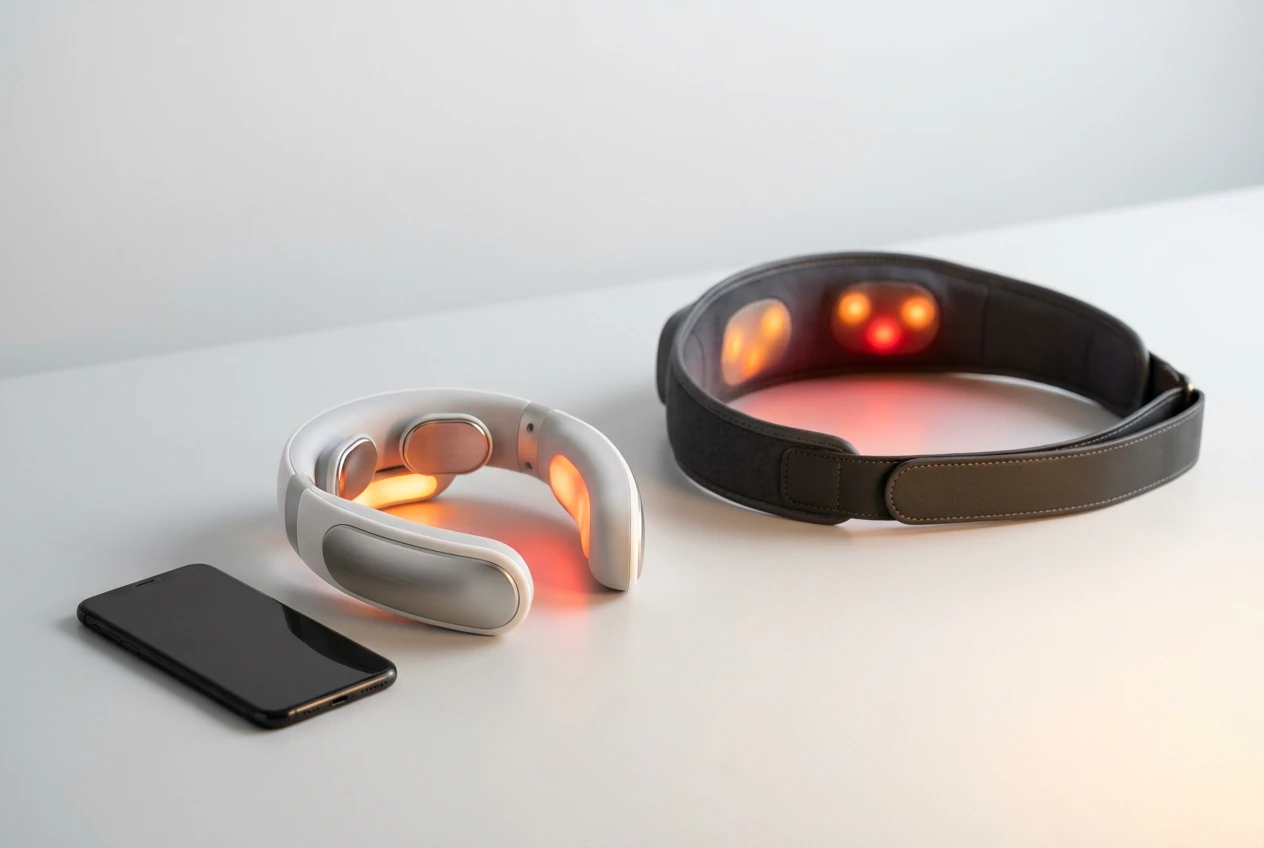
How TENS, EMS and Near-Infrared Heat Work Together
The marketing language around these devices can blur together, but three distinct technologies do the actual work. Most premium wearables, including SKG’s, stack all three.
- TENS (transcutaneous electrical nerve stimulation) sends low-voltage pulses through the skin to interrupt pain signals before they reach the brain, the same basic method used in physiotherapy clinics.
- EMS (electrical muscle stimulation) triggers small involuntary muscle contractions, which can boost local blood flow and loosen stiffness.
- Near-infrared heat uses 850nm LEDs, the wavelength found in some skincare masks, to warm the muscle and the fascia layer beneath it so the stimulation feels less harsh.
On the neck device, SKG runs what it calls Generation 3.0 dual mid-frequency pulses at around 7000Hz, delivered through nine titanium nodes that the company says create a gentle traction effect, lifting the neck and nudging posture upward. A 5,140 mm wide warming compress sits behind the nodes. The full specification list is available on the official G7 Pro Fold neck massager product page. The lower-back unit swaps the traction nodes for an eight-zone kneading system meant to imitate a therapist’s thumbs.
G7 Pro Fold 3.0 vs W9 Ultra: Neck and Lower Back Compared
SKG positions the two devices as a pair, one for the cervical spine and one for the lumbar region, the two areas that take the most punishment from desk work and lifting. They share the same electrical-stimulation core and the same 850nm heat, but the body targets and form factors differ. Both carry a regular list price of $199.99.
| Attribute | G7 Pro Fold 3.0 | W9 Ultra |
|---|---|---|
| Target area | Neck and shoulders | Lower back and waist |
| Weight | About 280g (0.6 lb), folds to phone size | 350g (420g with strap) |
| Core technology | TENS and EMS at 7000Hz, 9 titanium nodes, neck traction | TENS and EMS, 8-zone kneading nodes |
| Heat | 850nm near-infrared warming compress | 850nm near-infrared heat |
| Modes and battery | Multiple modes, foldable travel design | 14 modes, 9 intensities, 3100mAh, washable leather belt |
| List price | $199.99 | $199.99 |
The practical difference comes down to how you wear them. The neck unit is built to be seen and slipped on for short sessions; the back unit is built to disappear under a T-shirt while you cook, drive, or sit at a desk. A Mother’s Day promotion that ran from April 25 to May 8, 2026 briefly trimmed both close to $170, but that window has closed and the standard price applies again.
What the Research Shows About Electrical Pain Relief
Here is the part the product copy tends to skip. The evidence that TENS produces durable relief for everyday neck pain is weak. A Cochrane review of the question found very low-certainty evidence that TENS beats a sham device for chronic neck pain, and two of the seven trials it examined found the therapy was no better than placebo at all.
Where studies did record a benefit, it tended to be modest and short-lived. A broader umbrella review of TENS in cervical pain syndromes concluded that TENS can relieve pain in the short term, but ranks below therapeutic exercise, manual therapy, and ultrasound for cervical complaints. The fuller picture is laid out in Cochrane’s plain-language summary of the TENS evidence for chronic neck pain.
None of that makes the devices useless. Short-term comfort has genuine value when you are tense at 9 p.m. and a clinic is not an option, and the warming and kneading elements deliver a pleasant sensation regardless of what the electrical current does. The honest framing is that these are recovery and comfort tools, not treatments for an underlying problem. Persistent neck or back pain still warrants a clinician, not a gadget.
Why Tech Neck Turned Recovery Into a Growth Market
The demand is not imaginary. Neck pain ranks as the fourth-leading cause of disability worldwide, with an annual prevalence above 30%, and the rise of smartphones has given the problem a nickname. “Tech neck” describes the strain from hours spent hunched over a screen, and estimates of its lifetime prevalence among smartphone users run to roughly 55.8%. The mechanics are simple, as the Mayo Clinic explainer on tech neck sets out: the further forward the head tilts, the more load the cervical muscles carry.
That is a large, recurring, self-renewing customer base, and it skews toward exactly the people SKG markets to: hybrid workers, parents, commuters, anyone whose stiffness is a daily condition rather than an injury. The brand leans on celebrity endorsement to reach them, citing health advocate Maye Musk and retired NBA player Tracy McGrady as users who have posted about its recovery products.
The wider electronic massage equipment market is forecast to grow at about 11.2% a year through 2035, which tells you investors expect the screen-hunching to continue. Whether wearables stay filed under comfort or eventually earn stronger clinical backing depends on trials that have not yet been run. If the research catches up, the category graduates from gadget to therapy. If it does not, these stay what they are now: a convenient way to feel better for an hour, sold to a market that keeps getting bigger.
Frequently Asked Questions
Are Wearable TENS Massagers Safe to Use Every Day?
For most healthy adults, short daily sessions are considered low-risk, and manufacturers design consumer units with capped intensity for that reason. The main cautions are to avoid overusing high power levels, which can leave muscles sore, and to follow the device’s recommended session length rather than running it for hours.
Do TENS and EMS Massagers Relieve Neck Pain?
They can provide short-term relief for some people, but the evidence is weak and inconsistent. A Cochrane review found only very low-certainty evidence that TENS outperforms a sham device for chronic neck pain, and benefits, where present, tend to fade quickly. Treat them as comfort tools rather than cures.
What Is the Difference Between the SKG G7 Pro Fold 3.0 and the W9 Ultra?
The G7 Pro Fold 3.0 targets the neck and shoulders, folds to phone size, weighs about 280g, and uses nine titanium nodes with a traction effect. The W9 Ultra targets the lower back, weighs 350g, hides under clothing, and uses an eight-zone kneading system with 14 modes and a 3100mAh battery.
How Much Do the SKG G7 Pro Fold 3.0 and W9 Ultra Cost?
Both carry a standard list price of $199.99 each. SKG ran a Mother’s Day promotion from April 25 to May 8, 2026 that dropped them to roughly $170, but that offer has ended and the regular price now applies.
Who Should Avoid TENS and EMS Devices?
People with a pacemaker or other implanted electronic device, those who are pregnant, and anyone with epilepsy or a heart-rhythm condition are generally advised against using electrical-stimulation devices without medical clearance. Anyone unsure should check with a qualified clinician before first use.
Can You Wear the W9 Ultra Under Clothing?
Yes. The W9 Ultra has an ultra-thin profile and wraps around the waist with a leather belt, so it sits discreetly under a T-shirt or sweater. It is cordless, which lets you keep it on while cooking, working at a desk, or running errands.
Disclaimer: This article is for informational purposes only and does not constitute medical advice. Electrical-stimulation and massage devices are not substitutes for diagnosis or treatment of pain conditions, and individual results vary. Anyone with an implanted medical device, a heart condition, epilepsy, or a pregnancy, or anyone experiencing persistent pain, should consult a qualified healthcare professional before use. Prices and product specifications are accurate as of publication.


Veridue Raises $4 Million to Speed Energy Deal Diligence

Healey Adds a £150m Rung for Northern Scale-Ups

Ten Deals Took Most of Europe’s August Tech Money

Holmes Hired Fielder to Film Her Last Days

Molten Bets £100m of Plc Cash on Late-Stage Tech

Garlinghouse Cited Dutch Gold, and London Got the Bars

byFounders Bets $4.3 Million on Fluencify After $2M ARR

Alpha Gang Puts A-List Stars on a Zellner Wager

Angel Bets a Recut PG-13 Chase on Ritchson and Wilson

Flex IT and T1A Combine to Own Corporate Device Supply

Walter’s TWG Insists No Fraud as Insurer Probes Force Cleanup

30-Year Yield Hits 5.32% Highest Since 2007 as Debt Supply Locks In Costs

PCE Stays at 3.7% as Gas and Tariffs Outrun Coming Revisions

Evernorth S-4 Clears Path for Active XRP Treasury on Nasdaq

Astute’s $1.2M bet makes B2B creator deals feed AI discovery

Strategy Parks $1.59B Cash While Bitcoin Stack Stays Flat

Instinct Hits $2.5 Billion as AI Agent Access Sparks Trust Fights

CLARITY Act Cloture Opens a Door Ethics Still Blocks

Oracle’s 2.8 GW Bloom Deal Exposes the AI Power Bypass

Amber’s €7M locks Mittelstand knowledge inside Europe
-
 FINANCE3 months ago
Zcash Patched a Double-Spend Bug as ZEC Climbed 5%
-
 ENTERTAINMENT3 months ago
Steam Summer Sale 2026 Locks In June 25 to July 9 Dates
-

 FINANCE2 months ago
CLARITY Act Final Text Expected This Weekend as 60-Vote Hurdle Looms
-
 NEWS4 months ago
Meta Adds AI Replies to Threads, But Users Can’t Block It
-
 ENTERTAINMENT5 months ago
Extraction 3 Is Officially Coming to Netflix in 2027
-

 NEWS3 months ago
YouTube Shorts is testing a heart in place of the thumbs-up
-
 NEWS1 month ago
Senators Force Apple Off Chinese Memory as Big Three Cash In
-

 NEWS3 months ago
NEURA Robotics’ $1.4B Series C Redraws Europe’s Physical AI Bet