
BUSINESS
Brussels Bets €48 Million That Wooden Blades Can Beat Fibreglass
A mold-free wooden blade startup just landed EU cash in the Spanish region that built Europe’s fibreglass turbine industry, racing incumbents’ own fixes.

The European Union just put €48.18 million behind a bet that wood can out-engineer fibreglass. Voodin Blade Technology and three partners will use the grant to build Spain’s first automated factory for wind turbine blades made from engineered wood, in Navarre, a region that helped build Europe’s fibreglass turbine industry three decades ago.
The wager lands just as Europe’s wind industry runs out of places to put its old blades. A self-imposed landfill ban across the sector took effect this January, and the incumbents Voodin is chasing, Siemens Gamesa, Vestas and LM Wind Power, are already building their own fixes for the same problem. Roughly 78 percent of decommissioned blades still end up buried, and Europe’s wind sector pulled in €45 billion for new projects last year alone.
The VB1F Wager
The project has a name: Voodin Blade 1st Factory, or VB1F. The consortium behind it includes Lithuania’s VMG Wood Invest, the project coordinator, and VMG Technics, alongside Germany’s Voodin Blade Technology, which built the underlying manufacturing process, and Anker-Tec.
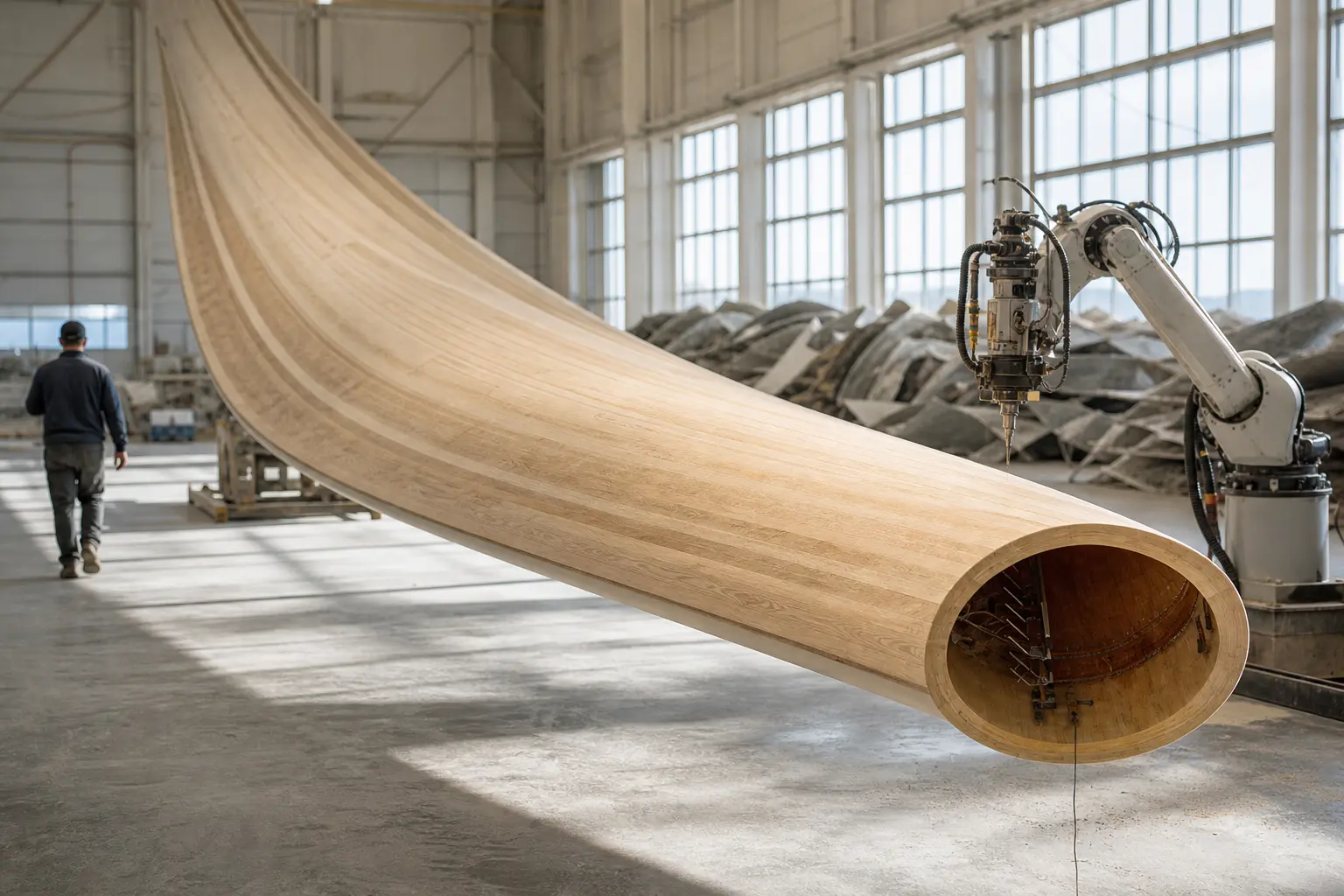
Voodin’s process mills blades from Laminated Veneer Lumber, thin sheets of wood bonded and pressed into a single uniform structural plank, without using a mold. That matters more than it sounds. Fibreglass blades are built in giant, custom-built molds that cost a fortune and only work for one blade design. Retool for a new blade, and the old mold gets scrapped.
Voodin’s pitch is that a mold-free, fully automated line can be dropped anywhere clean energy is needed, not just at a handful of centralized composite mega-factories.
Our manufacturing system is designed for fast-scale deployment. By enabling local blade production, we can help build stronger, more resilient European supply chains, reduce dependence on overseas manufacturing, and accelerate the deployment of wind energy where it is needed most. Our approach is designed for both scale and flexibility.
Tom Siekmann, co-founder and chief executive of Voodin Blade Technology, made that case when the grant was announced. It is also, functionally, the entire thesis the EU Innovation Fund is now underwriting.
Europe’s Blade Problem Runs Out of Road
The timing is not incidental. The European wind industry has committed to a landfill ban effective since January 2026, according to WindEurope, the sector’s trade association. Roughly 90 percent of a turbine’s mass, steel, concrete, cabling, already gets recycled through established channels. Blades are the holdout.
The scale of that holdout is growing fast. WindEurope projects Europe will generate over 50 kilotonnes of end-of-life blade waste by 2030, with around 14,000 blades due to be dismantled, adding up to somewhere between 40,000 and 60,000 tonnes of material. Globally, industry researchers cited by the American Chemical Society’s C&EN have projected as much as 43 million metric tons of blade waste by 2050.
The chemistry is the reason. Blades are built from glass or carbon fibers set in epoxy resins that are cured, not melted, into shape. Once cured, those thermoset bonds do not melt back down for reuse. They burn. That is why, as C&EN has reported, most of the roughly 12,000 blades decommissioned each year in Europe and the US still get cut up and buried.
Wood Is Quietly Colonizing the Wind Industry
Voodin is not the only startup betting public money can make wood the fix. Sweden’s Modvion signed its own Innovation Fund grant this spring, reported at €39.1 million, to build what would be the first dedicated factory for mass-producing wooden wind turbine towers rather than blades. The European Commission backed both projects in the same wind-manufacturing funding round late last year, alongside two others working on offshore components and floating foundations.
| Project | Material | EU Grant | Turbine Part | Status |
|---|---|---|---|---|
| VB1F (Voodin consortium) | Laminated Veneer Lumber | €48.18 million | Rotor blades | Grant runs April 2026 to December 2035; Navarre plant targeted for 2031 |
| Modvion | Laminated wood (spruce-based) | €39.1 million (reported) | Towers | Signed late April 2026; first dedicated wooden-tower factory |
The pattern is bigger than either company. Wood was the original material of wind power for centuries before steel and fibreglass took over the industry entirely, and both of these startups are effectively arguing that shift was never permanent, just unfinished.
Why Build a Wooden Blade Factory in Fibreglass’s Birthplace?
Navarre is not a neutral choice of location. It is the region where Gamesa, now Siemens Gamesa, built the turbine assembly plant in 1994 that helped turn Spain into a wind power exporter within a decade, and where its Aoiz factory later produced 62.5 meter fibreglass blades, among the longest ever built in the country at the time.
Siemens Gamesa, formed by the 2017 merger of Gamesa and Siemens’s wind unit, now ranks as Europe’s second-largest turbine maker behind Vestas, and one of the largest globally. Navarre’s wider renewable sector grew out of that same 1990s wind boom, and the region has since positioned itself around repowering and blade-material recovery projects of its own.
Placing a wooden, mold-free blade factory inside that same regional supply chain is either a tribute to what fibreglass built there or a direct challenge to it. Probably both.
Siemens Gamesa and Vestas Are Placing Their Own Bets
Voodin is not competing against a passive industry. The incumbents have their own answers to the same landfill problem, built around recyclable resin chemistry rather than swapping the material out entirely.
- Siemens Gamesa completed installation of its RecyclableBlade technology at a commercial offshore project in December 2024, aiming for full material recovery at end of life while keeping utility-scale performance.
- Vestas announced a chemical recycling process in February 2023 designed to break existing blades down into materials that can be reused in new ones.
- LM Wind Power, owned by GE Vernova, completed its ZEBRA project’s closed-loop recycling demonstration in October 2024, recovering more than 75 percent of the resin from a test blade.
- Market concentration still favors the old guard: LM Wind Power, TPI Composites and Siemens Gamesa together held over 35% of global blade deliveries in 2024, according to Mordor Intelligence.
Wood also faces a regulatory hurdle the resin fixes do not. Existing certification frameworks for turbine components were built around steel, concrete and fiber-reinforced composites, so wood does not fit neatly into them, forcing both Voodin and Modvion to develop new testing and validation protocols largely from scratch. Convincing regulators that timber can meet modern structural standards for a 60-meter blade spinning at height is slower work than tweaking a resin formula.
What Has to Go Right Before 2031
The Innovation Fund’s own grant paperwork lists a project window of 117 months, April 2026 through December 2035, under grant agreement 101252033. But the Navarre plant itself is not due to start producing commercial blades until 2031, meaning years of construction, certification and ramp-up sit between this announcement and the first blade leaving the line.
- Capacity: up to 160 blade sets per year at full operation
- Climate impact: turbines built from those blades could generate roughly 13.5 million MWh of electricity over a decade
- Jobs: about 450 local positions once the plant reaches full capacity
- Process: fully electric and mold-free, allowing new blade designs without retooling
- Company claims: Voodin’s own materials cite a 78 percent cut in blade CO2 emissions and a 20 percent lower blade cost versus fibreglass
That last set of figures comes from Voodin itself, not an independent audit, and it is worth separating from the landfill statistic entirely: one is a company’s efficiency claim, the other is an industry-wide waste problem the whole sector is scrambling to solve. Under EU waste rules, landfilling ranked the least preferred option long before this grant existed, which is part of why Brussels is willing to fund an unproven fix.
If Navarre works, Voodin says the design can be licensed and rebuilt anywhere in the world clean energy is needed. If it does not, the €48.18 million becomes one more line in the Innovation Fund’s ledger of bets that did not clear the mold.
Frequently Asked Questions
What Is Laminated Veneer Lumber Exactly?
Laminated Veneer Lumber bonds multiple thin layers of wood veneer together under pressure to create a single, highly uniform structural material. Unlike raw timber, which carries natural inconsistencies in grain and density, LVL is engineered specifically to behave predictably under the kind of structural load a turbine blade or building beam has to carry.
How Does the EU Innovation Fund Pay for Projects Like VB1F?
The Innovation Fund is financed by revenues from the EU Emissions Trading System rather than general tax revenue, with a budget of roughly €40 billion set aside for 2020 through 2030. Since 2020, trade reporting shows at least 14 wind-energy projects have received a combined total of at least €475 million from the fund.
Are Wooden Wind Turbine Blades Actually as Strong as Fibreglass?
Voodin markets LVL as a genuine structural substitute, arguing the material offers the strength, dimensional stability and load-bearing capacity a turbine blade needs from a renewable source rather than fossil-based fibreglass. Independent, long-term operational data at full utility scale is still limited since commercial wooden blades only began installation in Germany in 2024.
What Happens to the Fibreglass Blades Already Buried?
Some are being processed rather than left in the ground. Waste company Veolia built a program that, within about two years of starting, had converted roughly 2,000 decommissioned blades into feedstock for cement production, a use industry critics still call a downcycle rather than true recycling.
Is Voodin the Only Company Betting on Wood for Wind Power?
No. Sweden’s Modvion is pursuing the same material for turbine towers rather than blades. Wood was in fact the original material of wind power centuries before industrialization pushed the sector toward steel and fibreglass, so both companies are effectively reversing, not inventing, a materials shift.


Torvalds Blames AI for a Full-Fat Linux 7.3-rc2

Meta’s Muse Agent Can Spend Before the Privacy Lock

Ripple Treasury’s $13 Trillion Still Runs on Bank Rails

Play Store Pause Button Works After the 2024 Cache Try

Kalshi Loses Its Utah Stay as Felony Risk Goes Live

Intel’s October CPU Hike Puts Cheap Industrial Chips at Risk

Samsung Drops the First Wear OS Galaxy Watches

Instagram Copyright Strikes Now Carry a Crypto Ransom

Miami-Dade Wants Rockstar to Pay for a Vice City Makeover

Windows 11 Battery Widget Hinges on Accessory Makers

Walter’s TWG Insists No Fraud as Insurer Probes Force Cleanup

30-Year Yield Hits 5.32% Highest Since 2007 as Debt Supply Locks In Costs

PCE Stays at 3.7% as Gas and Tariffs Outrun Coming Revisions

Evernorth S-4 Clears Path for Active XRP Treasury on Nasdaq

Astute’s $1.2M bet makes B2B creator deals feed AI discovery

Strategy Parks $1.59B Cash While Bitcoin Stack Stays Flat

Instinct Hits $2.5 Billion as AI Agent Access Sparks Trust Fights

CLARITY Act Cloture Opens a Door Ethics Still Blocks

Oracle’s 2.8 GW Bloom Deal Exposes the AI Power Bypass

AI data centers win as RAM kits jump nearly 500 percent
-
 FINANCE3 months ago
Zcash Patched a Double-Spend Bug as ZEC Climbed 5%
-
 ENTERTAINMENT3 months ago
Steam Summer Sale 2026 Locks In June 25 to July 9 Dates
-

 FINANCE2 months ago
CLARITY Act Final Text Expected This Weekend as 60-Vote Hurdle Looms
-
 NEWS4 months ago
Meta Adds AI Replies to Threads, But Users Can’t Block It
-
 ENTERTAINMENT5 months ago
Extraction 3 Is Officially Coming to Netflix in 2027
-

 NEWS3 months ago
YouTube Shorts is testing a heart in place of the thumbs-up
-

 NEWS1 month ago
Senators Force Apple Off Chinese Memory as Big Three Cash In
-

 NEWS3 months ago
NEURA Robotics’ $1.4B Series C Redraws Europe’s Physical AI Bet