
BUSINESS
India-UK Trade Deal Kicks In, but Indian States Hold the Real Price Lever
The India-UK CETA took effect July 15, cutting tariffs on cars and whisky, but Indian state excise rules may decide who actually feels the savings.

The Comprehensive Economic and Trade Agreement between India and the United Kingdom took effect on July 15, 2026, eliminating or slashing duties across cars, whisky, textiles and dozens of other goods after more than four years of on and off talks. Within days, the gap between promise and delivery was already visible on price tags.
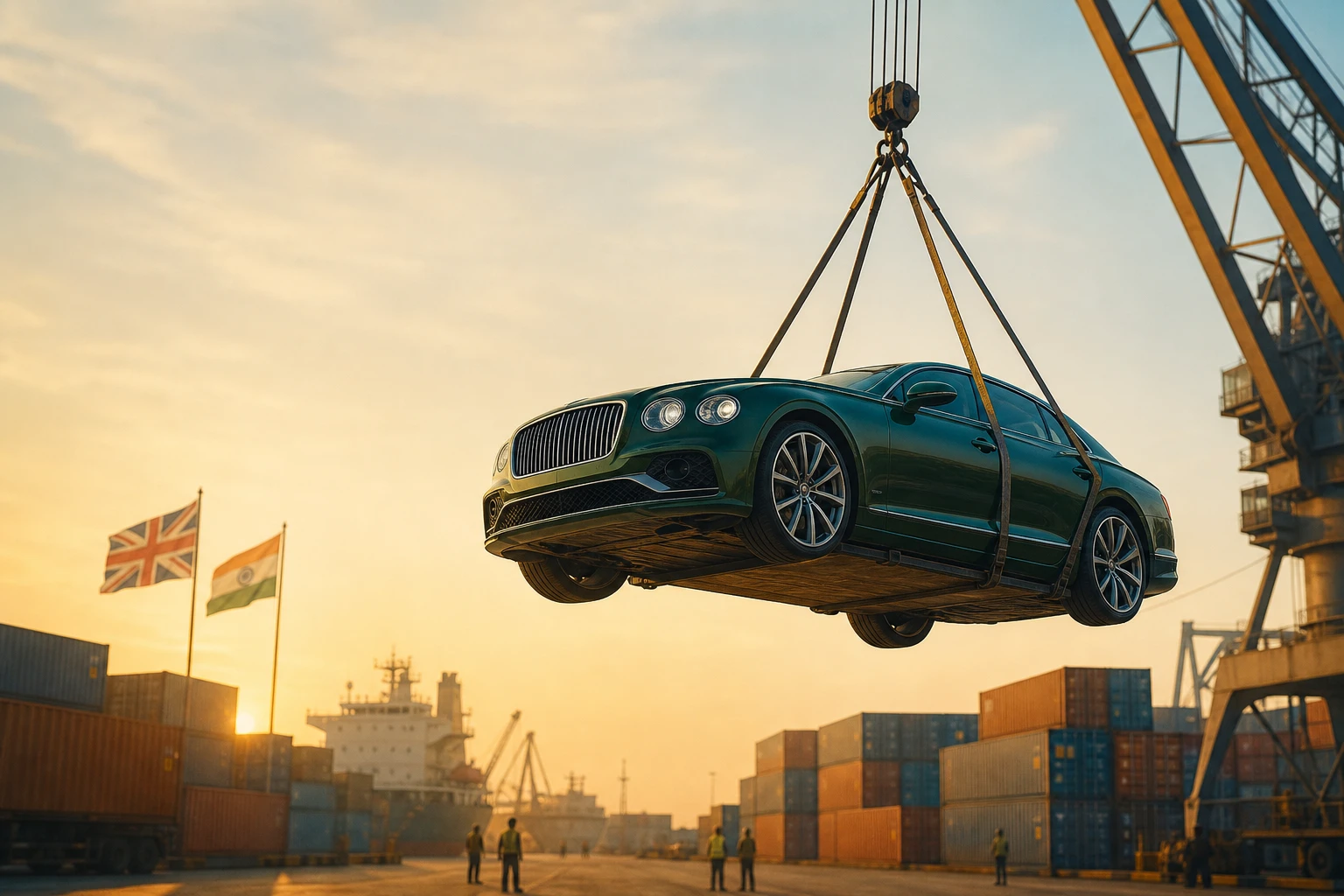
British carmakers moved almost overnight. Jaguar Land Rover and McLaren announced cuts on UK-built models sold in India within days of the tariff change, according to reporting by the Times of India. Scotch whisky and gin, the deal’s other headline win, are stuck. India’s federal tariff on spirits fell on schedule, but the shelf price still runs through 28-plus state excise departments that had no seat at the table and no obligation to pass anything on.
Cars Move First, Whisky Waits Its Turn
The mechanics explain the gap. Automobile tariffs sit almost entirely under central government control, so when New Delhi cut the rate, importers could reprice immediately. Alcohol taxation in India runs through the states, layered on top of the new customs duty in the form of excise levies, retail markups and licensing fees that CETA never touched.
Sanjit Padhi, chief executive of the International Spirits and Wine Association of India, told the Times of India that the full benefit of the deal depends on whether the tariff cut actually reaches consumers without being offset by state taxes or regulatory curbs. Anant S Iyer, director general of the Confederation of Indian Alcoholic Beverage Companies, made a similar point to the paper, noting that pricing decisions rest with individual companies because states control both supply and consumer pricing.
That leaves two industries running the same treaty at two different speeds. One passed savings to buyers before the ink dried. The other is waiting on 28 state governments that were never party to the negotiation.
What Changes on the Tariff Schedule
The headline numbers are steep. India’s average tariff on UK goods falls from 15% to 3% under the deal. The UK, in turn, removes duties on 99% of Indian tariff lines from day one, covering close to the full value of Indian exports into Britain.
| Sector | Tariff Before CETA | Tariff At Entry Into Force | Where It Lands Later |
|---|---|---|---|
| Scotch whisky and gin (into India) | 150% | 75% | 40% within a decade |
| Automobiles (into India, under quota) | Over 100% | 10% | Quota widens gradually |
| Aerospace parts (into India) | 11% | 0% | Immediate |
| Processed foods (into the UK) | Up to 70% | 0% | Immediate |
| Marine products (into the UK) | 21.5% | 0% | Immediate |
| Textiles and clothing (into the UK) | 12% | 0% | Immediate |
The UK government’s own estimate puts the near-term savings on UK exports to India at up to £400 million a year, rising to £900 million after a decade. Total UK-India trade was worth £48 billion in 2025 (roughly $62 billion), and officials project the deal adds a further £25.5 billion a year in bilateral trade once it is fully phased in, alongside a £4.8 billion annual lift to UK GDP and £5.1 billion to India’s.
A Ranking Flip Nobody Announced
The pact is routinely described as a deal between the world’s fifth and sixth largest economies, but which country holds which spot just changed. The IMF’s April 2026 World Economic Outlook put the UK fifth with a nominal GDP of $4.26 trillion and India sixth at $4.15 trillion, with Japan fourth at $4.38 trillion.
India had briefly overtaken the UK for fifth place. The reversal came from a weaker rupee, down roughly 11% against the dollar, combined with a revision to India’s GDP base year. India’s real growth rate still leads every major economy, at 6.5% projected for 2026, well ahead of the US, China and Germany.
The same currency weakness that cost India a rung on the GDP ladder cuts into the trade deal too. A softer rupee raises the rupee cost of everything the tariff cuts are supposed to make cheaper, since the duty rate falls but the underlying import price, converted from pounds, does not.
CETA is also the sixth free trade agreement India has completed under the Narendra Modi government, following pacts with Mauritius, the United Arab Emirates, Australia, the European Free Trade Association bloc, and Oman.
The Governments That Never Sat at the Table
India’s commerce minister, Piyush Goyal, called the agreement a new benchmark for equitable and ambitious trade between two large economies, one he said would benefit farmers, fishermen, workers, startups and innovators. Prime Minister Narendra Modi described the pact and its companion social security agreement as a way to deepen the Comprehensive Strategic Partnership and catalyse trade, investment, growth and job creation in both economies, in a post on X.
Those are the terms set in London and New Delhi. The terms that matter for a bottle of Scotch on an Indian shelf are set by state excise commissioners who answer to state legislatures, not to the treaty.
- Auto industry: Jaguar Land Rover and McLaren already cut prices on UK-built models, betting that a centrally administered tariff turns into a showroom discount within weeks.
- Spirits industry: ISWAI’s Sanjit Padhi and CIABC’s Anant S Iyer both caution that whisky and gin prices hinge on state excise regimes the treaty never touched.
- Indian officials: Commerce minister Piyush Goyal frames the deal as a broad-based win for farmers and exporters, betting the aggregate gains outweigh the sector-by-sector friction.
No dispute case has been filed over any of this. The disagreement is playing out in earnings calls and trade press quotes, not courtrooms, at least for now.
Farmers and Factories on Opposite Sides of the Ledger
Textile, leather, marine and engineering exporters on the Indian side are the deal’s cleanest winners, gaining duty-free entry into a UK market that previously charged tariffs as high as 70% on processed foods and 21.5% on marine products. Indian officials say the tariff elimination covers 99% of tariff lines and nearly the full value of trade.
India protected a narrower group of its own producers by carving them out entirely.
- Dairy stayed outside the deal, shielding India’s dairy farmers from competition.
- Apples were excluded to protect domestic orchards from British and European competition.
- Edible oils were held back, keeping India’s tariff tools intact for a politically sensitive import category.
On the UK side, Indian electric and hybrid vehicles gain access to the British market under a quota system, a reciprocal opening that mirrors the car quota India granted UK manufacturers.
Brussels Watches a Smaller Deal Cross the Line First
The European Union has its own India trade deal, and it is not yet in force. The EU and India concluded negotiations on 27 January 2026, a pact European Commission President Ursula von der Leyen (the EU’s chief executive) called the mother of all trade deals.
In this increasingly volatile world, Europe chooses cooperation and strategic partnerships.
Von der Leyen said that after the deal’s conclusion. Nearly six months later, it remains politically agreed but not legally binding, still moving through ratification while the UK’s smaller bilateral deal has already gone live.
The EU is India’s largest trading partner, with €120 billion in goods trade in 2024, more than double the UK-India total. The EU’s agreement would eliminate or reduce tariffs on over 96% of EU goods exports and could double EU exports to India by 2032, according to the European Commission’s own trade directorate. For now those numbers sit on paper while London and New Delhi are the ones testing the theory in practice.
The contrast lands at an awkward moment for India’s trade diplomacy more broadly. The same week CETA took effect, US lawmakers introduced a bill proposing tariffs of up to 100% on Indian goods over the country’s continued purchases of Russian oil, a reminder that India’s largest single trading partnerships are all under some form of political strain simultaneously.
The Reviews and Safeguards Waiting in Reserve
Both governments have built in checkpoints rather than leaving the deal to run untested for a decade. Midyear reviews are meant to catch early snags in customs processing and sector-specific schedules. Analysts tracking the rollout say the numbers worth watching are export and import growth in sectors with early tariff cuts, customs clearance times, consumer prices in covered categories, new investment announcements, and how often either side reaches for the dispute or safeguard clauses built into the text.
If trade accelerates the way both governments are promising, officials in both capitals have floated follow-on agreements covering clean energy, fintech and pharmaceuticals. If the early data disappoints, particularly on consumer prices, the pressure shifts to revising a deal that just took six years to finish. The whisky aisle, not the signing ceremony, is where that verdict gets written first.
Frequently Asked Questions
What does CETA stand for in the India-UK trade deal?
CETA stands for the Comprehensive Economic and Trade Agreement, the formal name for the pact that took effect on July 15, 2026. Trade analysts tracking the rollout describe it as the UK’s most significant bilateral trade agreement since it left the European Union.
How many Indian companies operate in the UK under the wider economic relationship?
Around 1,000 Indian companies were already operating in the UK before CETA took effect, employing about 100,000 people and holding roughly $20 billion in accumulated investment, according to Indian officials cited at the deal’s 2025 signing.
Does the deal change how long workers pay social security in each country?
Yes. A companion Double Contribution Convention lets workers posted between the UK and India pay social security in only one country at a time for up to five years, mirroring arrangements the UK already has with Japan, South Korea and the United States.
What happens if one country’s exports suddenly surge and hurt the other’s producers?
The agreement includes safeguard tools that can be triggered if a flood of a sensitive product from one side threatens producers on the other. Using them would test both the pact’s formal dispute process and the political will of two governments that spent years reaching this point.


Veridue Raises $4 Million to Speed Energy Deal Diligence

Healey Adds a £150m Rung for Northern Scale-Ups

Ten Deals Took Most of Europe’s August Tech Money

Holmes Hired Fielder to Film Her Last Days

Molten Bets £100m of Plc Cash on Late-Stage Tech

Garlinghouse Cited Dutch Gold, and London Got the Bars

byFounders Bets $4.3 Million on Fluencify After $2M ARR

Alpha Gang Puts A-List Stars on a Zellner Wager

Angel Bets a Recut PG-13 Chase on Ritchson and Wilson

Flex IT and T1A Combine to Own Corporate Device Supply

Walter’s TWG Insists No Fraud as Insurer Probes Force Cleanup

30-Year Yield Hits 5.32% Highest Since 2007 as Debt Supply Locks In Costs

PCE Stays at 3.7% as Gas and Tariffs Outrun Coming Revisions

Evernorth S-4 Clears Path for Active XRP Treasury on Nasdaq

Astute’s $1.2M bet makes B2B creator deals feed AI discovery

Strategy Parks $1.59B Cash While Bitcoin Stack Stays Flat

Instinct Hits $2.5 Billion as AI Agent Access Sparks Trust Fights

Oracle’s 2.8 GW Bloom Deal Exposes the AI Power Bypass

CLARITY Act Cloture Opens a Door Ethics Still Blocks

Amber’s €7M locks Mittelstand knowledge inside Europe
-
 FINANCE3 months ago
Zcash Patched a Double-Spend Bug as ZEC Climbed 5%
-
 ENTERTAINMENT3 months ago
Steam Summer Sale 2026 Locks In June 25 to July 9 Dates
-

 FINANCE2 months ago
CLARITY Act Final Text Expected This Weekend as 60-Vote Hurdle Looms
-
 NEWS4 months ago
Meta Adds AI Replies to Threads, But Users Can’t Block It
-
 ENTERTAINMENT5 months ago
Extraction 3 Is Officially Coming to Netflix in 2027
-

 NEWS3 months ago
YouTube Shorts is testing a heart in place of the thumbs-up
-

 NEWS1 month ago
Senators Force Apple Off Chinese Memory as Big Three Cash In
-

 NEWS3 months ago
NEURA Robotics’ $1.4B Series C Redraws Europe’s Physical AI Bet