
NEWS
Lummis Warns CLARITY Act Collapse Would Reopen Code Prosecutions

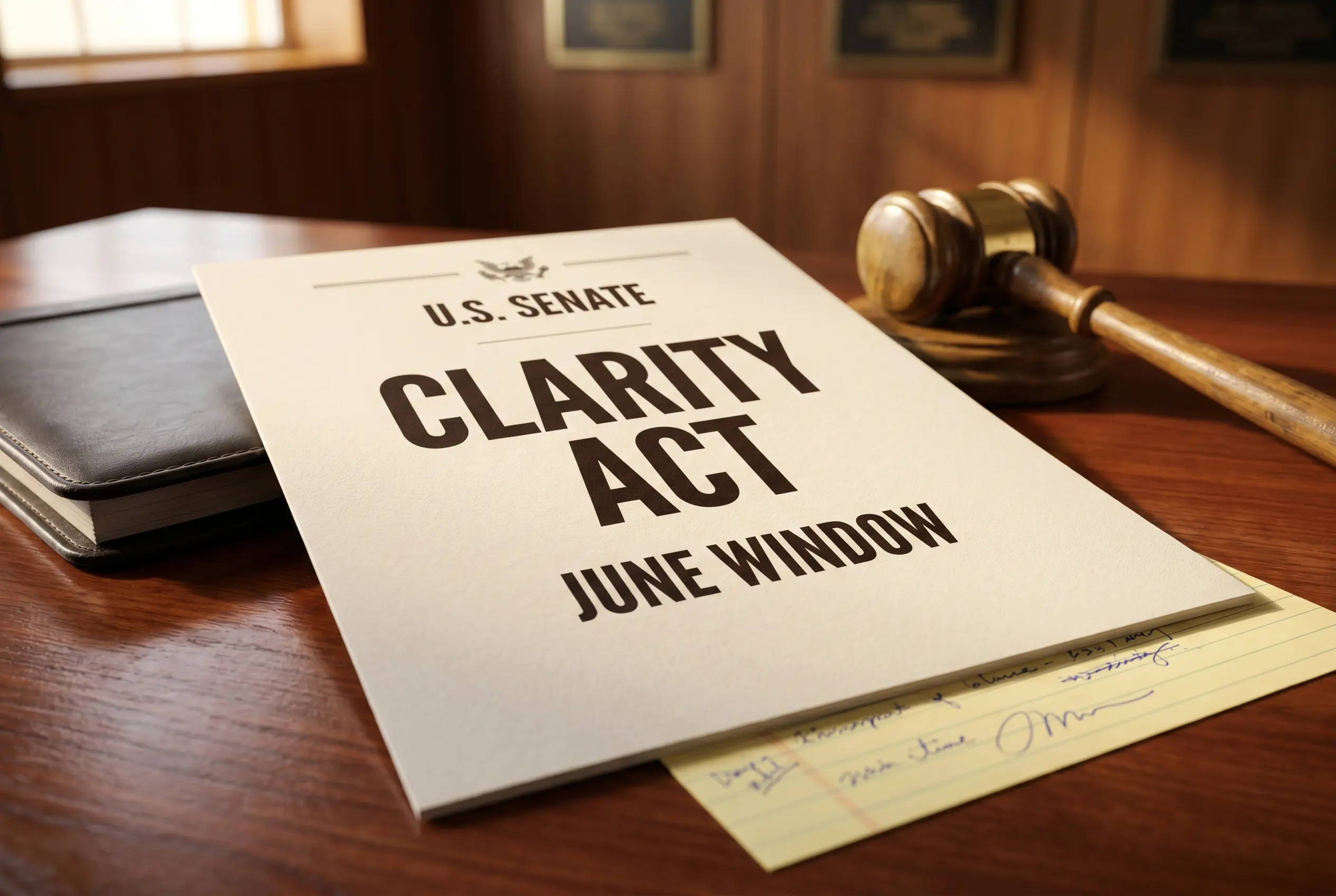
Last week, traders on the prediction market Kalshi priced the CLARITY Act at nearly 75% to pass before 2027. This week the same contract sits at 49%. Senator Cynthia Lummis spent the back half of May on X telling her followers what a missed Senate vote actually buys: a return of federal prosecutions of open-source coders for publishing software.
The warning lands on top of a packed Senate June, a 45-day Section 702 FISA extension that expires on June 12, and a 15-9 Banking Committee vote on May 14 whose two Democratic yeses are still five short of the seven the bill needs on the floor.
The Warning Behind the Tweet
If the Clarity Act doesn’t pass this Congress, American software developers will be targeted again for prosecution in the near future just for publishing code. These are the stakes.
That was Lummis, the Wyoming Republican who chairs the Senate Banking Subcommittee on Digital Assets, posting on X this month. She was not speaking in the abstract. Last August, a Manhattan jury convicted Tornado Cash co-founder Roman Storm of running an unlicensed money-transmitting business under 18 U.S. Code Section 1960 (the federal statute that bans operating a money-transmitting business without a state license, originally written for wire-transfer shops). The Department of Justice has since asked U.S. District Judge Katherine Polk Failla to retry Storm in October on the deadlocked money-laundering and sanctions-violation counts.
That prosecution is the case the senator and the wider crypto policy bloc have spent two years pointing to as the template for how the rest of decentralised finance gets criminalised if Congress does not redraw the line for the act of publishing code. She co-authored the Senate version of the bill with Banking Committee Chairman Tim Scott.
The market structure bill that passed the House 294-134 last July, and cleared Senate Banking 15-9 on May 14, carves out a safe harbor for non-custodial software developers. It amends the same statutory framework that produced the Storm conviction so that publishing code which others use to move funds does not, by itself, make the developer a money transmitter.
The current Senate text borrows the House framework: the Securities and Exchange Commission (the federal regulator that polices stocks and investment contracts) keeps authority over digital tokens classified as securities, while the Commodity Futures Trading Commission (the federal regulator that polices commodity futures and swaps) takes exclusive jurisdiction over digital commodity spot markets.
Four Working Weeks, Five Big Bills
The Senate returns from the Memorial Day recess on Monday, June 2. Reporter Eleanor Terrett, who covers crypto policy on X, counted four working weeks in June and three in July before the August recess. The bills competing for those slots:
- Section 702 FISA reauthorization, with the current 45-day extension expiring June 12.
- The farm bill, overdue since the last reauthorization expired.
- A housing package the House cleared earlier in May.
- Republican reconciliation talks tied to the broader tax package.
- The Digital Asset Market Clarity Act itself.
FISA is the hard one. Section 702 is the warrantless-surveillance authority the intelligence community treats as non-negotiable. Congress already punted once, sending President Donald Trump a 45-day bridge on April 30 rather than a long-term renewal, and Senate Majority Leader John Thune said publicly the extension was meant to find a permanent fix.
Every floor day spent on Section 702, the farm bill, and housing is a day the crypto bill does not get one. TD Cowen analyst Jaret Seiberg told clients last week that prospects for 2026 are fading, citing both calendar pressure and unresolved Democratic ethics demands. Our earlier coverage of the Wyoming senator’s push against the year-end deadline tracked the same fragility a fortnight ago.
Lummis told reporters earlier this month that internal negotiations are continuing behind closed doors. “We’re going to take the bill that we passed in the Senate Banking Committee last week,” she said, adding that her staff is reworking ethics provisions and writing technical revisions to the related stablecoin bill, the GENIUS Act (the Guiding and Establishing National Innovation for U.S. Stablecoins Act, signed into law in 2025).
The Ethics Fight That Won’t End
Democratic resistance focuses on what the bill leaves out: an explicit conflict-of-interest section barring the President, the Vice President, and members of Congress from active digital-asset trading. Multiple Democrats have signalled they will not deliver the seven Senate votes needed for cloture (the 60-vote threshold that ends a filibuster) without that language.
The flashpoint is Trump-affiliated crypto. World Liberty Financial, the decentralised-finance project the Trump family launched in 2024, is the most visible example, alongside American Bitcoin (the Trump-linked mining venture) and the TRUMP and MELANIA meme coins. The Trump family reportedly recorded $1.4 billion in crypto-related income across 2025.
Senator Elizabeth Warren of Massachusetts sent SEC Chairman Paul Atkins a letter on the day of the May 14 markup arguing that World Liberty’s activities “appear to have benefited the Trump family at the expense of investors,” and demanding regulatory enforcement regardless of political influence. Senator Kirsten Gillibrand of New York told colleagues the bill will not clear the chamber without ethics language.
The two Democrats who voted with Republicans in committee, Ruben Gallego of Arizona and Angela Alsobrooks of Maryland, were brought across by a behind-closed-doors deal that did not resolve the conflict-of-interest fight. Chairman Scott now needs five more Democratic floor votes than he had at markup. The Republican counter is that any amendment narrowly targeting Trump-linked entities is a poison pill the GOP will reject, leaving Seiberg’s note to flag the standoff as the bill’s single largest live risk.
The Kalshi Crash From 75% to 49%
Prediction-market pricing has moved harder than any single Senate procedural step would justify. The table below tracks the three live Kalshi crypto market structure contracts, alongside the Polymarket equivalent.
| Contract | Mid-May reading | Late-May reading | Move |
|---|---|---|---|
| Kalshi: passes before 2027 | ~75% | 49% | down 26 points |
| Kalshi: passes before August 2026 | ~50% | 37% | down 13 points |
| Kalshi: passes before July 2026 | ~30% | 14% | down 16 points |
| Polymarket: passes in 2026 | ~70% | 60% | down 10 points |
The committee vote was the easy step. A 15-9 result looks bipartisan but was mechanical, achieved by stacking concessions on developer protections and law-enforcement carve-outs. The harder step, the floor vote, requires solving an ethics problem that the committee carved around rather than through. Our earlier read on the 68% Kalshi reading on the yield-deal week showed how quickly that pricing reverses when a single negotiation breaks.
The pre-July reading of 14% says traders do not believe Banking and Senate Agriculture can move the bill through both committees, manage amendments, schedule floor time, and clear 60 votes inside four June working weeks. The pre-August reading of 37% says they think there is roughly a one-in-three chance the bill clears before the recess. The 49% structural contract is what traders give the entire 119th Congress to get something on the President’s desk.
What the Committee Vote Bought
A bipartisan committee vote is procedural. It moves a bill from one stage to the next, and it does not deliver the 60 floor votes needed to pass. Five points the May 14 result did not solve:
- The conflict-of-interest amendments Senate Democrats want are still unresolved and not in the substitute text that left committee.
- Senate Agriculture must produce and pass its own version of the bill before the two committee texts get reconciled.
- The yield-bearing stablecoin compromise that crypto industry advocates pushed for in early May was a Banking Committee fix, not a floor-coalition fix.
- Coinbase and other industry incumbents have publicly questioned parts of the substitute text, weakening pressure on undecided Democrats to move quickly.
- Majority Leader Thune has not committed to floor time before mid-June.
The senator’s public argument is that letting any of this slip past December 2026 sends the issue back to the legislative starting line. A new Congress takes office on January 3, 2027. Any unfinished bill from the 119th Congress dies, and the next Congress’s committee chairs decide whether to start over.
President Trump endorsed the bill in March, calling for a “future-proof” market structure framework, and Lummis cited that endorsement in a follow-up post: “Let’s get the bipartisan Clarity Act to his desk so he can make the U.S. the crypto capital of the world with a stroke of a pen.”
White House backing has been consistent through the spring. It does not solve the Senate math.
Why the Tornado Cash Verdict Sharpens the Stakes
The reason this warning lands harder than it did in March is that the federal courts have given the Wyoming senator a working example. In August 2025, the Storm jury convicted on the unlicensed-money-transmitting count and deadlocked on money-laundering and sanctions-violation charges. DOJ has now asked Judge Failla for an October 2026 retrial on the deadlocked counts, exposing the defendant to a maximum of forty more years on top of the five-year cap on the conviction already in hand.
The Manhattan verdict landed on a different theory than the FinCEN (Financial Crimes Enforcement Network) guidance from 2019, which had explicitly exempted developers of non-custodial anonymising software from money-transmitter status. The Southern District of New York applied 18 U.S.C. Section 1960(b)(1)(C), which sweeps in any business transmitting funds used for illicit purposes, regardless of whether the operator controls the funds.
The legal gap that produced the verdict is the same gap the Digital Asset Market Clarity Act safe harbor closes. If the bill dies in this Congress, the Manhattan precedent stands on its own. DOJ keeps the playbook it used in the Southern District. Future prosecutors are free to apply the statute to any open-source contributor whose code is later used by a bad actor. The phrase “targeted again” is precise: the case has already happened, the legal theory has already been tested, and there is no built-in expiration date on it.
If the bill passes, the safe harbor overrides that theory prospectively. Prior convictions do not get vacated, but the next round of code-publishing prosecutions never starts.
The Senate returns June 2. If the bill clears Senate Agriculture and lands on the floor before the August recess, the open-source code question gets a federal answer this year. If it slips past December, the next federal answer comes from whichever district court hosts the prosecution after Storm’s.


Dolly Parton’s $450 Million Fortune Keeps Working After Her Death

SpaceX’s $60B Cursor Buy Immediately Costs It OpenAI Models

Rays Forever Home Wins County Vote as College and Taxpayers Carry the Load

Apple TV Hits $14.99 as Sports and Hits Bill Comes Due

Swift Telescopes Restart as Orbit Drop Accelerates

Oracle’s 2.8 GW Bloom Deal Exposes the AI Power Bypass

Galaxy S26 Beta 7 Ports Fold 8 AI as Stable Nears

Walmart Pays $50 Million to Close Federal Opioid Pharmacy Case

Space Mirror Demo Revives 1993 Russian Night-Light Test

Measles Death Dispute Deepens Distrust in Pennsylvania Outbreak

Trump Iran Threat Wiped $238M Crypto Longs Then Flipped

30-Year Yield Hits 5.32% Highest Since 2007 as Debt Supply Locks In Costs

Oil Crashes Below $80 as Iran Talks Restart and Markets Split

Strategy Parks $1.59B Cash While Bitcoin Stack Stays Flat

Astute’s $1.2M bet makes B2B creator deals feed AI discovery

SpaceX Stock Rebound Tests Real Demand Before Huge Unlock

BlackRock Turns Cash Empire Into Stablecoin Reserve Rails

The 20% Savings Ideal Meets a 2.7% Reality Check

Walter’s TWG Insists No Fraud as Insurer Probes Force Cleanup

Amber’s €7M locks Mittelstand knowledge inside Europe
-
 FINANCE3 months ago
Zcash Patched a Double-Spend Bug as ZEC Climbed 5%
-
 ENTERTAINMENT3 months ago
Steam Summer Sale 2026 Locks In June 25 to July 9 Dates
-

 FINANCE2 months ago
CLARITY Act Final Text Expected This Weekend as 60-Vote Hurdle Looms
-
 NEWS4 months ago
Meta Adds AI Replies to Threads, But Users Can’t Block It
-

 NEWS3 months ago
YouTube Shorts is testing a heart in place of the thumbs-up
-

 NEWS1 month ago
Senators Force Apple Off Chinese Memory as Big Three Cash In
-

 NEWS3 months ago
NEURA Robotics’ $1.4B Series C Redraws Europe’s Physical AI Bet
-
 ENTERTAINMENT5 months ago
Extraction 3 Is Officially Coming to Netflix in 2027