
FINANCE
US Strikes Iran for a Third Time as Bitcoin Slips Below $64,000
CENTCOM struck Iran for a third time this week after Tehran shut the Strait of Hormuz again, and Bitcoin barely reacted, sliding just under $64,000.

U.S. Central Command struck Iran for a third time this week, hours after Tehran’s navy declared the Strait of Hormuz closed again. Bitcoin slipped under $64,000 and mostly just sat there.
The calm is the surprising part. Iran’s earlier closures each sent Bitcoin and oil lurching hard within hours. This one barely moved the needle, and the fuller verdict from oil, stocks and bonds does not land until those markets reopen this week for the first time since the latest closure claim.
CENTCOM Strikes Iran for a Third Time in a Week
U.S. Central Command, the military command overseeing American forces across the Middle East, said it hit roughly 140 Iranian military targets overnight Saturday into Sunday, the third round of strikes this week. Over three nights, CENTCOM said, U.S. forces have now struck more than 300 targets inside Iran.
The strikes used precision munitions fired from land and sea based fighter jets, drones and naval vessels. Targets included missile and drone sites, naval capabilities, ammunition storage facilities, communication networks and coastal surveillance locations, CENTCOM said.
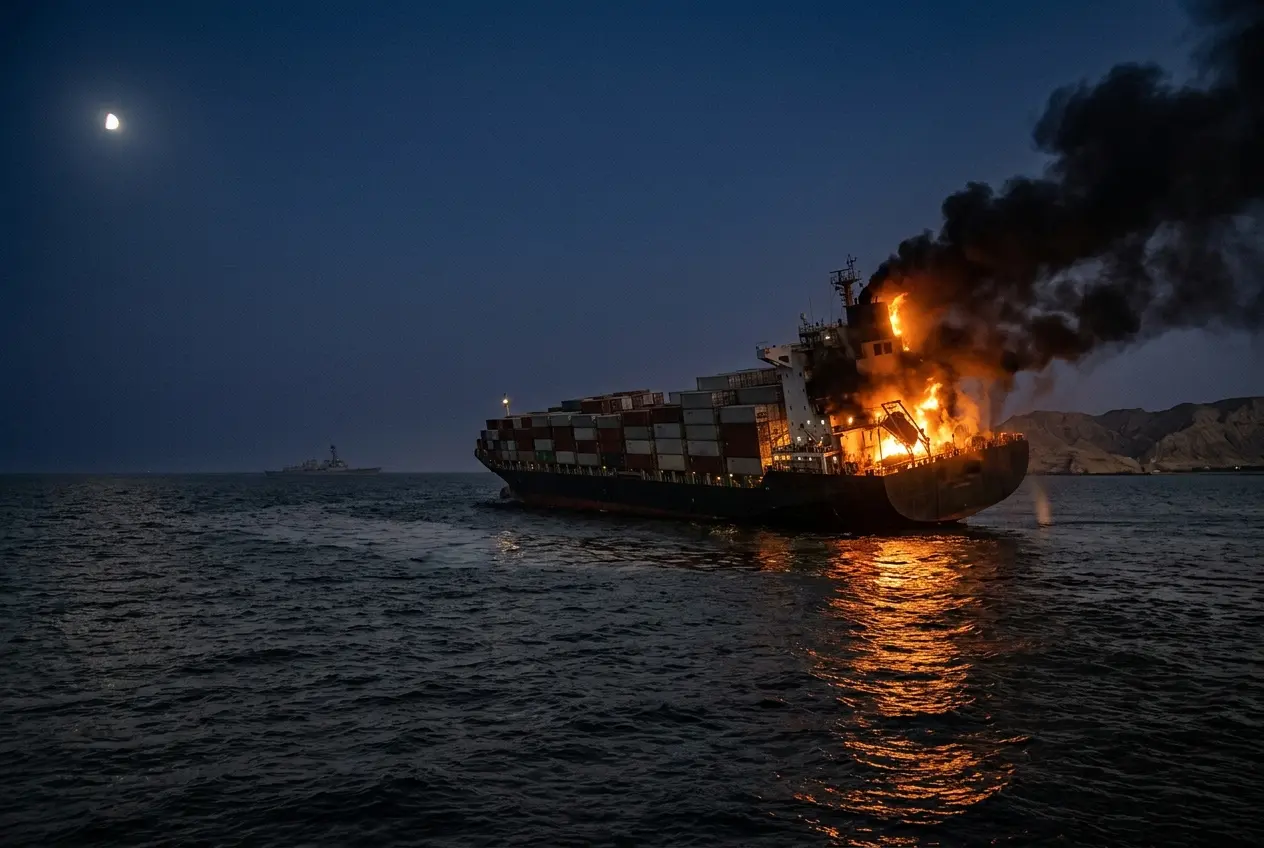
CENTCOM said the campaign answered an Iranian attack on a Cyprus flagged container ship transiting the strait. Islamic Revolutionary Guard Corps (IRGC) forces “blatantly attacked” the vessel, the command said, and one crew member is missing. “A civilian crew member is missing, and the vessel is unable to continue the journey due to an onboard fire and significant engine room damage,” CENTCOM wrote in a post on X, adding that the strikes were meant to hold Iranian forces accountable for its attack on commercial vessels moving through the strait.
The White House shows no sign of easing off. Indiana Republican Sen. Jim Banks said Sunday that President Trump will not end the war until Iran abandons its nuclear ambitions and stops threatening the strait. “President Trump has been very clear that he’s going to finish the job,” Banks told Fox News Sunday, adding that the administration’s “kid gloves” are off.
Is the Strait of Hormuz Actually Closed?
No single answer satisfies both sides. Iran’s Revolutionary Guard says it fired warning shots at a ship taking an unapproved route and has closed the waterway until further notice. CENTCOM says that’s false, insisting commercial traffic keeps moving and that Iran does not control the strait.
“The Strait of Hormuz is open to all vessels seeking to lawfully transit the international waterway,” CENTCOM wrote Sunday morning on X. “U.S. forces are positioned and prepared to ensure that freedom of navigation remains available despite unwarranted Iranian aggression, harassment, threats, and arbitrary declarations. Iran does not control the strait. Traffic is flowing.”
Tehran sees a broken promise instead. Iran says Washington’s push for ships to use a southern route hugging Oman’s coast violates the memorandum of understanding (MOU) the two countries signed last month. The U.S. counters that Iran is the one in breach, saying Tehran “was provided yet another opportunity to demonstrate adherence to the Memorandum of Understanding after being held accountable for earlier attacks on commercial vessels but has again failed.”
Iranian negotiator Mohammad Baqer Qalibaf was blunter. “The era of one sided deals is OVER,” he warned Sunday. “We told you: keep your word or pay the price.”
What We Know
- Iran’s account: The IRGC says it fired warning shots at a vessel and declared the strait closed until further notice.
- The U.S. account: CENTCOM says the strait remains open and commercial traffic is still moving through it.
- The dispute: Washington and Tehran each accuse the other of violating last month’s memorandum of understanding.
What’s Unconfirmed
- Whether shipping traffic is actually avoiding the strait or continuing to pass through despite Iran’s declaration.
- How much of the waterway remains mined from earlier fighting, a detail even marine insurers say they cannot verify.
- Whether the memorandum of understanding is formally void, as some Iranian statements suggest, or simply under strain.
A marine insurance broker put the uncertainty simply: whether or not mines are actually still in the water, shippers are pricing the risk as if they are, which by itself has slowed transit through the strait since the ceasefire began.
Bitcoin Barely Blinks Below $64,000
Bitcoin traded around $63,800 on Sunday, down just 0.3% over 24 hours despite the fresh airstrikes and Iran’s closure declaration. Ether, XRP and dogecoin all posted only fractional moves too, continuing a muted pattern in crypto’s reaction to Middle East escalation.
It was not always this calm. Bitcoin fell to around $61,688 on Wednesday as this week’s strikes began, a 2% drop in 24 hours that triggered a broader risk off move across financial markets. By Sunday it had clawed most of that back, still up 2% for the week even after a third round of strikes.
Timing explains part of the shrug. Oil, stocks and bonds sit closed for the weekend, leaving Bitcoin as the only major market pricing the strikes in real time, and it is treating them as close to a non event. The fuller reaction, especially in crude, will not show until trading resumes.
Compare that with March. When Iran first closed the strait, Brent crude jumped past $100 a barrel for the first time in four years and later peaked near $120, and Bitcoin sold off sharply on each escalation. A calmer oil open this week would suggest traders are reading this closure as a threat Tehran has made and walked back before.
- 16.90: the VIX volatility gauge’s level during this week’s earlier strikes, up nearly 5% yet still low for a market absorbing a third escalation this year.
- $120 a barrel: Brent crude’s peak after the strait’s first closure in March, a spike Bitcoin met with sharp sell offs.
- Largest on record: Bitcoin ETFs logged their biggest quarterly outflow ever last quarter, as institutional money rotated into AI stocks instead.
The pattern suggests traders increasingly treat Hormuz closures as rhetoric until oil actually stops moving. Whether that assumption survives will show up fast once trading resumes this week.
Four Closures and a Fading Reaction
This is not the first time Tehran has shut the waterway this year. Each closure has landed with less force than the last, at least in how Bitcoin has responded to it.
| Date | What Happened | Oil Market | Bitcoin |
|---|---|---|---|
| Feb. 28, 2026 | U.S. and Israel launch strikes on Iran, starting the war | Crude near prewar lows in the low to mid $60s a barrel | Trading near $63,000 amid a deep crypto slump |
| March 2026 | IRGC mines the strait and declares it closed | Brent tops $100 for the first time in four years, later peaks near $120 | Sells off sharply on each new escalation |
| June 17, 2026 | Trump and Iran sign a memorandum of understanding, reopening the strait toll free | WTI falls toward $81, Brent hits multi month lows | Rises about 2% to near $65,800 |
| July 9 to 12, 2026 | Third round of U.S. strikes this week; Iran declares the strait closed again | Markets shut for the weekend, awaiting this week’s reopen | Dips to $63,800, down just 0.3% on the day |
Each row tells the same story from a different angle. The initial shock forced a violent repricing. The threats that followed forced smaller ones, even though the underlying military escalation, judged by targets struck and ships damaged, has not eased at all. The strait remains, per the U.S. Energy Information Administration, the primary route for Middle East petroleum exports, with no quick substitute for its lost capacity.
Gulf Neighbors Absorb the Blows Markets Shrugged Off
The exchange of fire this weekend reached well beyond Iran and the strait itself. Qatar’s military said it intercepted incoming Iranian fire, with explosions heard in the neighboring United Arab Emirates. Qatar’s Interior Ministry said three people, including a child, were wounded by shrapnel from the interception.
Missile alerts sounded in Bahrain, home to the U.S. Navy’s Fifth Fleet. Kuwait’s Defense Ministry said three land border posts in the north and an offshore drilling platform belonging to the Kuwait Oil Company were damaged, with one worker hurt. Three Iranian missiles struck areas across Jordan, causing minor damage but no injuries, according to Jordan’s state news agency.
India said one of its nationals was missing after an attack on the commercial vessel GFS Galaxy this week, while 10 other Indian crew members were rescued.
Shipping traffic tells its own story. The number of vessels crossing the strait on Thursday fell to 34, the lowest daily count since June 28, according to S&P Global MINT and S&P Global Commodities at Sea data. Iran linked and sanctioned traffic made up roughly a third of that total, the research firm said.
American drivers are starting to feel it too. Regular gasoline averaged $2.98 a gallon just before the war began in late February. Gas prices are climbing again as the ceasefire’s future looks shakier by the day, according to a report from the auto group AAA.
Iran’s own leadership carries personal stakes now, not just strategic ones. The country’s new supreme leader, Ayatollah Mojtaba Khamenei, unseen since the war began, vowed Saturday in his first statement since burying his father that Iranians would avenge Ayatollah Ali Khamenei’s killing in the war’s opening strikes on Feb. 28.
The Toll Iran Wants and the Cost Washington Fears
Iran has strong financial reasons to keep contesting the strait rather than simply handing it back. Iranian officials believe monetizing passage through the waterway could generate up to $40 billion a year in toll revenue, close to what the country earns annually from oil exports, according to Council on Foreign Relations analyst Edward Fishman. Congressional researchers put the stakes in scale terms too, noting roughly 27% of the world’s maritime crude oil trade moves through the strait with few workable alternatives.
Money is tangled up in the broader negotiation too. Iran wants half of an estimated $25 billion in frozen assets released immediately, while the U.S. has resisted. A separate $300 billion reconstruction fund floated in the memorandum has already become a political flashpoint in Washington.
On the American side, economists warn the drag compounds the longer it runs.
Time is not the ally of the American economy.
Joseph Brusuelas, chief economist for RSM US, an accounting and consulting firm, made that assessment as gasoline costs climbed again this month. Fast rising gas prices have already eaten into paychecks and tax refunds, with the heaviest impact landing on households with the least cushion. President Trump, for his part, has shrugged off the political risk. “If they rise, they rise,” he said of gas prices earlier in the conflict.
The Week Bitcoin Meets the Fed
Oil, stocks and bonds reopen this week for the first time since Tehran’s latest closure declaration, giving markets outside crypto their first chance to price in three nights of strikes. A sharp gap higher in crude at the open would signal traders are finally taking this closure seriously, after weeks of shrugging off Iran’s threats.
The same week brings a heavy data calendar regardless of how oil trades. Inflation numbers and Federal Reserve testimony land within days of each other, both shaped in part by whatever crude does after this weekend’s escalation.
- July 14: The Consumer Price Index (CPI) for June is released, the first inflation reading since this week’s strikes.
- July 14 and 15: Federal Reserve Chairman Kevin Warsh testifies before Congress, with investors watching for hints on the path of monetary policy.
- July 15: The Producer Price Index (PPI) follows, testing whether higher energy costs are feeding into wholesale prices.
- Later in July: The Federal Open Market Committee (FOMC) holds its next policy meeting.
Economists have already modeled what a prolonged closure would do to that picture. A one quarter shutdown of the strait would raise U.S. headline inflation by 0.6 percentage points and core inflation by 0.2 points this year, according to a CEPR analysis built on a model of global oil markets.
Bitcoin has already made its call on this round of strikes, trading almost flat while missiles flew and a container ship burned. Oil, stocks and bonds get their turn this week.
Disclaimer: This article is for informational purposes only and does not constitute financial, investment or trading advice. Cryptocurrency and commodity markets are highly volatile and carry substantial risk. Consult a licensed financial professional before making investment decisions. Figures cited reflect market data available at the time of publication on July 13, 2026, and are subject to change.


Dolly Parton’s $450 Million Fortune Keeps Working After Her Death

SpaceX’s $60B Cursor Buy Immediately Costs It OpenAI Models

Rays Forever Home Wins County Vote as College and Taxpayers Carry the Load

Apple TV Hits $14.99 as Sports and Hits Bill Comes Due

Swift Telescopes Restart as Orbit Drop Accelerates

Oracle’s 2.8 GW Bloom Deal Exposes the AI Power Bypass

Galaxy S26 Beta 7 Ports Fold 8 AI as Stable Nears

Walmart Pays $50 Million to Close Federal Opioid Pharmacy Case

Space Mirror Demo Revives 1993 Russian Night-Light Test

Measles Death Dispute Deepens Distrust in Pennsylvania Outbreak

Trump Iran Threat Wiped $238M Crypto Longs Then Flipped

30-Year Yield Hits 5.32% Highest Since 2007 as Debt Supply Locks In Costs

Oil Crashes Below $80 as Iran Talks Restart and Markets Split

Strategy Parks $1.59B Cash While Bitcoin Stack Stays Flat

Astute’s $1.2M bet makes B2B creator deals feed AI discovery

SpaceX Stock Rebound Tests Real Demand Before Huge Unlock

BlackRock Turns Cash Empire Into Stablecoin Reserve Rails

The 20% Savings Ideal Meets a 2.7% Reality Check

Amber’s €7M locks Mittelstand knowledge inside Europe

Walter’s TWG Insists No Fraud as Insurer Probes Force Cleanup
-
 FINANCE3 months ago
Zcash Patched a Double-Spend Bug as ZEC Climbed 5%
-
 ENTERTAINMENT3 months ago
Steam Summer Sale 2026 Locks In June 25 to July 9 Dates
-

 FINANCE2 months ago
CLARITY Act Final Text Expected This Weekend as 60-Vote Hurdle Looms
-
 NEWS4 months ago
Meta Adds AI Replies to Threads, But Users Can’t Block It
-

 NEWS3 months ago
YouTube Shorts is testing a heart in place of the thumbs-up
-

 NEWS1 month ago
Senators Force Apple Off Chinese Memory as Big Three Cash In
-

 NEWS3 months ago
NEURA Robotics’ $1.4B Series C Redraws Europe’s Physical AI Bet
-
 ENTERTAINMENT5 months ago
Extraction 3 Is Officially Coming to Netflix in 2027