
NEWS
Musk Brands Altman a ‘Scammer’ as Apple Sues OpenAI Over Trade Secrets
Elon Musk called Sam Altman a scammer on X right after Apple sued OpenAI over alleged trade secret theft tied to a secret hardware device.

Elon Musk called Sam Altman a “scammer” on X this weekend, two days after Apple sued OpenAI in federal court accusing the ChatGPT maker of stealing its trade secrets to build a hardware device. The lawsuit, filed Friday in the U.S. District Court for the Northern District of California, names OpenAI, io Products and two individuals as defendants, and it landed just as Musk and Altman were already trading barbs over dueling AI model launches.
Behind the insults sits a far more specific document. Apple’s 40-page complaint lays out, allegation by allegation, how the company says OpenAI mined its hardware program using recruits pulled straight from the teams that built the iPhone. The insults will fade by next week. The filing is what OpenAI now has to answer in court.
What Did Apple Accuse OpenAI Of Doing?
Apple’s complaint accuses OpenAI of running a coordinated scheme to pull confidential hardware plans out of former Apple employees through job interviews, exit coaching and a network security gap, then use that material to accelerate its own device. The filing asks a court to stop OpenAI from using any of it and to force the return of Apple’s files.
The company did not mince words. “This much is clear, however: at every level, from members of its Technical Staff to its Chief Hardware Officer, and in coordination with business partners, OpenAI has been stealing Apple’s trade secrets and confidential information,” Apple said in the filing. It went further, calling its own view of the situation “the tip of the iceberg” and describing OpenAI’s device unit as resting on trade secrets it had no right to use.
OpenAI rejected the claims. “We have no interest in other companies’ trade secrets,” spokesperson Drew Pusateri said in a statement. “We remain focused on building innovative technology that empowers people everywhere.”
| Name Or Entity | Apple’s Description | Central Allegation |
|---|---|---|
| Tang Tan | Former Apple VP of product design for iPhone and Apple Watch; now OpenAI’s chief hardware officer | Directed job candidates to bring Apple hardware parts to interviews and used insider codenames to draw out more secrets |
| Chang Liu | Former senior systems electrical engineer at Apple; joined OpenAI in January 2026 | Exploited a network flaw to download confidential hardware files and kept an Apple-issued laptop |
| OpenAI (OpenAI Foundation, OpenAI Group PBC) | Former Apple partner on Siri integration, now a defendant | Accused of directing and normalizing the alleged scheme across its hardware organization |
| io Products | Hardware studio OpenAI bought for roughly $6.5 billion | Named as the vehicle through which the alleged trade secrets were put to use |
Apple says the pattern was not limited to its own staff. The filing claims OpenAI also approached one of Apple’s manufacturing partners and convinced it to demonstrate a proprietary metal-finishing process by falsely suggesting Apple had signed off on the request.
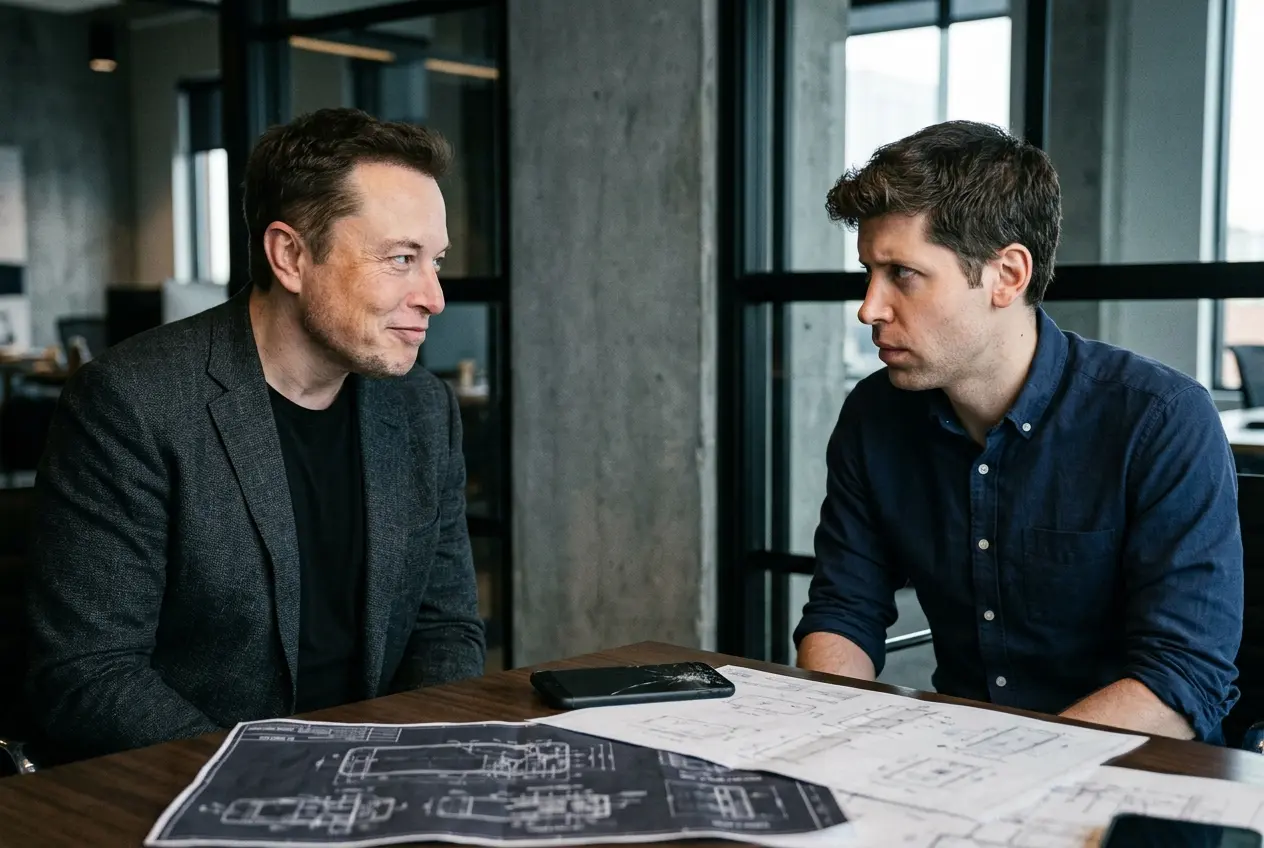
Scam Altman Strikes Again
Musk has used the “Scam Altman” label before, but this weekend he leaned on it harder. Responding to a post about the Apple lawsuit, he wrote, “Scam Altman strikes again …” then followed with a post he later reshared, in which he wrote that Altman takes scamming to a whole new level.
He didn’t stop there. “He might literally love scamming more than any human alive!” Musk posted. Altman answered on his own account, which drew more than 11 million views: “[H]omeboy you’re the one sellling public market investors on short-term space datacenters.” Musk fired back, referencing his orbital data center plans and his own courtroom history: “We start flying them next year. Maybe you can come see them if your parole officer approves.”
Altman framed the whole exchange around OpenAI’s newest model. “[T]here are a lot of benchmarks that suggest 5.6 sol is the best model in the world right now, but the most reliable way to tell is that elon is obsessed with me again,” he wrote. Asked separately whether he feared Apple, Altman posted, “[I] am not afraid of apple, but i have tremendous respect for them.” Even X’s own head of product joined in. Nikita Bier replied to one of Altman’s posts, “Incredible trade secrets as well, some of the best.”
The timing was not a coincidence. OpenAI released its GPT-5.6 Sol model this week, the same stretch in which Musk’s xAI, now folded into the SpaceX corporate family alongside Starlink and the X platform, put out Grok 4.5. The two men had spent days promoting their own releases before the rivalry turned personal again.
The Secret Device Sitting at the Center of the Case
OpenAI has never confirmed what its first hardware product actually is. Altman said in November that the company had finished its first prototypes, and people familiar with the project have described a device designed to be aware of its surroundings, something closer to a smart speaker than a phone. It is still expected to reach the public later this year.
That timeline sits alongside a separate, longer-range rumor. Supply chain analyst Ming-Chi Kuo has reported OpenAI is also developing a smartphone that could arrive as late as 2028, a device that would put it in even more direct competition with the company whose alumni built it.
The device traces back to OpenAI’s roughly $6.5 billion acquisition of io Products last year. The startup was founded by Jony Ive, Apple’s design chief until 2019, working alongside Tan and two other former Apple designers, Evans Hankey and Scott Cannon. Ive is not named as a defendant in Apple’s suit and is not accused of wrongdoing.
More Than 400 Apple Alumni Now Work at OpenAI
Apple’s complaint puts a number on the exodus: more than 400 former Apple employees are now working at OpenAI. Most of the hardware recruits came out of the same engineering division Tan once ran, according to Fortune’s reporting on the case.
Apple’s filing lists the specific behavior it says amounted to theft, not just hiring. Among the allegations:
- Job candidates were told to bring actual Apple parts, including batteries and logic boards, to interviews for “show and tell” sessions.
- Departing employees were coached on how to slip past Apple’s exit security checks.
- A former hardware executive forwarded Apple supplier contacts and internal summaries to a personal email account before leaving.
- A software bug in Apple’s network was used to download dozens of confidential hardware files after the employee had already joined OpenAI.
Everything on that list is an allegation Apple has made in a filing, not a finding a court has made. None of it has been tested at trial.
Tang Tan’s Falling Out With His Old Boss
Tan spent close to a quarter century at Apple, most recently as vice president of product design overseeing the iPhone and Apple Watch, before leaving in February 2024 to join Ive’s new venture. Fortune reported the lawsuit also exposes a strained relationship between Tan and John Ternus, his former boss at Apple, with some designers having backed Tan over Ternus for the top hardware job back in 2021.
A Laptop Bug and an ‘LOL’ Message
The most granular allegation in the case involves Chang Liu, the electrical engineer who left Apple for OpenAI in January 2026. According to Fortune’s account of the filing, Liu discovered he still had access to Apple’s internal file servers after he had already started his new job and messaged a former colleague, Alyssa Peng: “LOL, I found out I can access the [network storage], so funny.” Peng replied, “I’m ready,” and, Apple alleges, went on to help pull more files using her own laptop.
A Rivalry That Started With a Nonprofit’s Broken Promise
Musk and Altman built OpenAI together in 2015 as a nonprofit AI research lab. Musk left the board in 2018 after donating tens of millions of dollars, and he later accused Altman and co-founder Greg Brockman of turning the organization into what he called “an opaque web of for-profit OpenAI affiliates.”
That grievance became a lawsuit worth roughly $150 billion, in which Musk accused OpenAI of becoming a “de facto subsidiary” of Microsoft, one of its biggest investors. A jury sided with OpenAI in May, ruling that Musk had waited too long to bring his claims. He has said he plans to appeal. A separate trade secret case, brought by Musk’s own xAI over an employee accused of taking proprietary data to OpenAI, was also dismissed for lack of evidence.
Weeks after that verdict, SpaceX, which now controls X, xAI and Starlink under one roof, completed an initial public offering that CNBC reported raised $75 billion. OpenAI has since filed confidentially for its own IPO. Forbes estimated Musk’s net worth at $917.3 billion as of this weekend, about a month after he became, by the outlet’s estimate, the first trillionaire in history; it put Altman’s net worth at $3.4 billion.
Apple is not the only Big Tech name OpenAI is now colliding with. Futurum Group chief executive Daniel Newman, a technology industry analyst, wrote on X that “OpenAI burning it down with one Mag 7 after another. First $MSFT and now $AAPL,” pointing to separate reporting that Microsoft is swapping some OpenAI software for its own in-house MAI models inside Word and Excel to cut costs.
The Case Moves Toward an Injunction Fight
Apple says it tried to handle this quietly first. It sent OpenAI a letter in February raising its concerns and asking the company to investigate; Apple says it never got a response. That silence is now part of the record in a federal case.
Jon Markman, writing in Forbes, argued the lawsuit’s importance to investors has little to do with who eventually wins. “The case itself will grind through motions for a long time, and the verdict matters less to investors than the filing already does,” he wrote.
What we know:
- Apple filed suit Friday in the Northern District of California, naming OpenAI, io Products, Tang Tan and Chang Liu.
- OpenAI has denied the claims through spokesperson Drew Pusateri, saying it has no interest in rivals’ trade secrets.
- Apple raised concerns in February through a letter it says OpenAI never answered.
What’s unconfirmed:
- Whether Apple wins an injunction blocking OpenAI from using the disputed material before its device ships.
- The device’s exact form, name or release date beyond a general expectation of a launch later this year.
- Whether the case touches the existing ChatGPT integration inside Apple Intelligence; Apple has not commented on that question.
California does not enforce noncompete agreements, which is part of why this fight is happening in a courtroom rather than in a hiring dispute. Trade secrets law is the only real brake Apple has on where its own alumni choose to work next, and that is the tool it has now reached for. The nearest concrete marker will be a ruling on Apple’s request to block OpenAI from using the disputed material, a decision likely to land well before OpenAI’s device ever reaches a shelf.


Dolly Parton’s $450 Million Fortune Keeps Working After Her Death

SpaceX’s $60B Cursor Buy Immediately Costs It OpenAI Models

Rays Forever Home Wins County Vote as College and Taxpayers Carry the Load

Apple TV Hits $14.99 as Sports and Hits Bill Comes Due

Swift Telescopes Restart as Orbit Drop Accelerates

Oracle’s 2.8 GW Bloom Deal Exposes the AI Power Bypass

Galaxy S26 Beta 7 Ports Fold 8 AI as Stable Nears

Walmart Pays $50 Million to Close Federal Opioid Pharmacy Case

Space Mirror Demo Revives 1993 Russian Night-Light Test

Measles Death Dispute Deepens Distrust in Pennsylvania Outbreak

Trump Iran Threat Wiped $238M Crypto Longs Then Flipped

30-Year Yield Hits 5.32% Highest Since 2007 as Debt Supply Locks In Costs

Oil Crashes Below $80 as Iran Talks Restart and Markets Split

Strategy Parks $1.59B Cash While Bitcoin Stack Stays Flat

Astute’s $1.2M bet makes B2B creator deals feed AI discovery

SpaceX Stock Rebound Tests Real Demand Before Huge Unlock

BlackRock Turns Cash Empire Into Stablecoin Reserve Rails

The 20% Savings Ideal Meets a 2.7% Reality Check

Walter’s TWG Insists No Fraud as Insurer Probes Force Cleanup

Amber’s €7M locks Mittelstand knowledge inside Europe
-
 FINANCE3 months ago
Zcash Patched a Double-Spend Bug as ZEC Climbed 5%
-
 ENTERTAINMENT3 months ago
Steam Summer Sale 2026 Locks In June 25 to July 9 Dates
-

 FINANCE2 months ago
CLARITY Act Final Text Expected This Weekend as 60-Vote Hurdle Looms
-
 NEWS4 months ago
Meta Adds AI Replies to Threads, But Users Can’t Block It
-

 NEWS3 months ago
YouTube Shorts is testing a heart in place of the thumbs-up
-

 NEWS1 month ago
Senators Force Apple Off Chinese Memory as Big Three Cash In
-

 NEWS3 months ago
NEURA Robotics’ $1.4B Series C Redraws Europe’s Physical AI Bet
-
 ENTERTAINMENT5 months ago
Extraction 3 Is Officially Coming to Netflix in 2027