
FINANCE
Bessent’s No-CBDC Applause Line Can’t Save the CLARITY Act
Bessent’s viral no-CBDC clip resurfaces as the CLARITY Act’s Senate odds sink toward 41% amid a fight over Trump’s own crypto income.

Treasury Secretary Scott Bessent’s vow that the United States will never build a central bank digital currency (CBDC) is going viral again, seven weeks after he first said it. A clip of the May 28 remark resurfaced on X on July 11 and has been shared widely since. The renewed attention lines up with a real deadline: the Senate returned this week with roughly three weeks left to pass the bill Bessent demanded in the same breath, the CLARITY Act.
That bill’s odds have slid hard since Bessent’s briefing, from as high as 82% on prediction markets in February to the low 40s and 50s today. The drag traces to an ethics fight over the president’s own crypto fortune, laid bare in a financial disclosure released July 1 that put $1.4 billion as Trump’s 2025 crypto-linked income.
A Seven-Week-Old Line Finds a New Audience
Bessent delivered the line at a White House briefing on May 28 that also covered a proposed $250 bill design and the government’s child savings program. He used the same appearance to launch the federal app for managing Trump Accounts, the $1,000 child investment accounts, before reporters turned him toward crypto.
Asked about a government-issued digital dollar, Bessent did not hedge.
There will be no central bank digital currency, which I think would be the first step toward tracking. So we have taken that off the table.
Bessent told reporters, casting a CBDC as a surveillance risk rather than a payments upgrade. The clip sat mostly dormant until a repost declaring the CBDC ban official pulled in fresh shares starting July 11, six weeks after Bessent actually said it.
In that same answer, Bessent pivoted to Capitol Hill. He told lawmakers to move fast on the CLARITY Act, formally the Digital Asset Market Clarity Act, H.R. 3633, warning that “the wild, wild west offshore” would keep pulling crypto business away from U.S. shores unless Congress finished the job.
Twenty Working Days
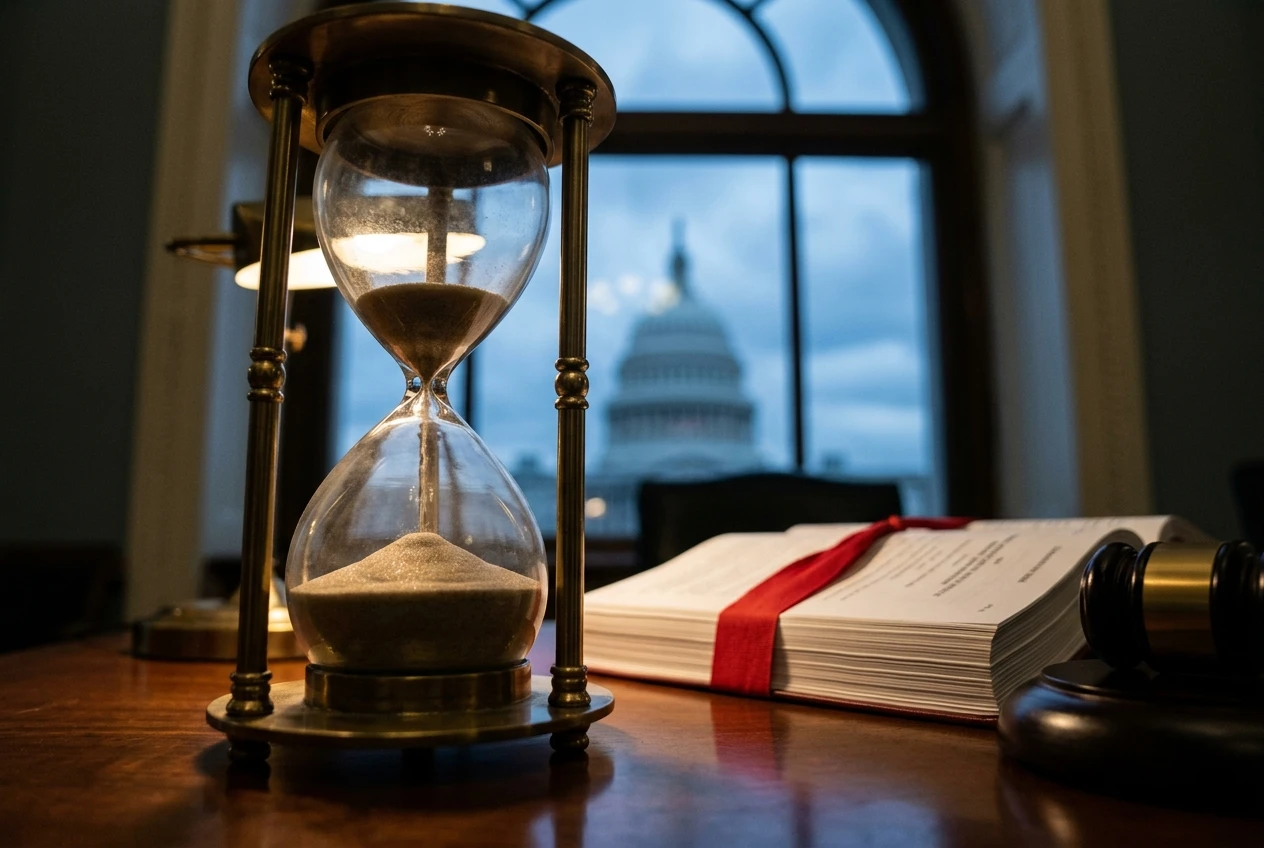
The Senate came back from its Fourth of July break on July 13 with 20 working days before lawmakers leave town again on August 7. Analysts on Wall Street and in Washington have called this stretch the last realistic window to pass crypto’s biggest bill this year.
The bill has never been closer procedurally. It passed the House on July 17, 2025, by a 294-134 margin, with more than 70 Democrats crossing over. The Senate Banking Committee advanced its own version 15-9 on May 14, 2026, and the measure was placed on the Senate Legislative Calendar as Calendar No. 423 on June 1, making it eligible for a floor vote without further committee action. Rep. Dusty Johnson, who chairs the House Agriculture Committee’s digital-assets subcommittee, said on June 18 that the House would move fast on a companion bill the moment the Senate acts, according to CryptoAmerica host Eleanor Terrett, who first reported the remarks.
Momentum on paper has not translated into votes.
- 82% was Polymarket’s price on 2026 passage back in February, before the ethics fight took hold.
- 41% to 50% is where Polymarket and Galaxy Research price it now, seven months later.
- 60 votes are needed to break a Senate filibuster, and Republicans hold only 53 seats.
- 20 working days remain before the chamber leaves for its August 7 recess.
Earlier this spring, before the slide began, this site tracked the bill sitting at 57% odds of passage as Bessent’s public campaign first picked up steam. That number has since been cut nearly in half.
The Math Hasn’t Moved Since May 14
Only two Democrats crossed over in the Banking Committee vote: Ruben Gallego of Arizona and Angela Alsobrooks of Maryland.
Both attached a warning to their yes votes. “My vote today is a vote to keep working in good faith,” Alsobrooks said at the May 14 markup. “It does not mean that I’ll be voting for the passage of the Clarity Act on the floor, because we still have so much work to do.”
Nine Democrats voted no, including Elizabeth Warren of Massachusetts, Mark Warner of Virginia and Catherine Cortez Masto of Nevada. Warren filed 44 amendments during the markup, and nearly all were rejected. She has called the bill a threat that will “blow up the economy.”
| Senator | May 14 Committee Vote | Where They Stand Now |
|---|---|---|
| Ruben Gallego (D-Ariz.) | Yes | Says he will keep pushing on ethics language before backing final passage |
| Angela Alsobrooks (D-Md.) | Yes | Says her committee vote does not guarantee a floor vote |
| Elizabeth Warren (D-Mass.) | No | Filed 44 amendments, calls the bill a threat to the economy |
| Mark Warner (D-Va.) | No | Wants law enforcement sign-off on Section 604 first |
| Catherine Cortez Masto (D-Nev.) | No | Same Section 604 condition, still unresolved |
Seven of those nine votes, or new ones entirely, have to flip before the bill reaches sixty. As of this week, none had publicly moved.
The disclosure that hardened Democratic resistance came on July 1, when the Office of Government Ethics released Trump’s 927-page financial statement showing about $1.4 billion in 2025 crypto income, including $635 million from $TRUMP memecoin licensing and more than $500 million from World Liberty Financial token sales. Advocacy group 5 Calls, which is urging constituents to lobby their senators against the bill, pegs the Trump family’s total crypto earnings even higher, near $2.3 billion.
Why Do Seven Democrats Still Say No?
Three unresolved fights are blocking the seven votes Republicans need, and none of them is really about whether crypto should be regulated at all. They are about ethics language covering Trump’s own holdings, a law enforcement carve-out for software developers, and how much revenue Coinbase and its rivals get to keep from stablecoin rewards.
- Ethics and conflict of interest. Senator Kirsten Gillibrand of New York, one of the chamber’s more crypto-friendly Democrats, said at the Consensus 2026 conference in Miami: “The Clarity Act will not get approved in the Senate without it,” referring to enforceable language covering officials’ crypto holdings.
- Section 604 and law enforcement. The provision would shield software developers who write non-custodial code from money-transmitter rules. The National District Attorneys’ Association has warned it would hinder criminal investigations, and Warner and Cortez Masto have tied their votes to a law enforcement sign-off that has not arrived.
- Stablecoin yield. Coinbase earns roughly $1.35 billion a year in USDC rewards revenue. The American Bankers Association argues the current language lets platforms pay interest-equivalent rewards the GENIUS Act was written to ban, and JPMorgan chief executive Jamie Dimon has publicly opposed letting the rewards continue at all.
Some resistance has already softened. The Major County Sheriffs of America shifted its stance from opposed to neutral last week, and the White House Crypto Council secured the first-ever CLARITY Act endorsement from the National Organization of Black Law Enforcement Executives earlier this month.
Banking groups have their own complaint about the same section. The Bank Policy Institute argues the current draft leaves gaps a stronger anti-money-laundering rule would close, saying Treasury already has authority it is not fully using.
The GENIUS Act Built This Runway
CLARITY is the second half of a two-bill plan the crypto industry has wanted since Trump’s first executive order on digital assets in January 2025. The first half, the GENIUS Act, became law on July 18, 2025, creating the country’s first federal framework for stablecoins, tokens pegged to the dollar.
That earlier law carries its own deadline. Its rulemaking window closes July 18, 2026, the same week the Senate is trying to move CLARITY, adding a second countdown regulators have to watch alongside the legislative one.
CBDC restrictions moved on a parallel track. The House had already folded anti-CBDC language into an unrelated bill this year, the 21st Century ROAD to Housing Act. Rep. Mike Flood said House Republicans rewrote the Senate’s version specifically to close a pathway that would have let CBDC restrictions lapse in 2030.
The jurisdictional split at the center of CLARITY is older still. For most of the past decade, the Securities and Exchange Commission (SEC) policed crypto through lawsuits, arguing token by token that assets qualified as securities under laws written in the 1930s. The Commodity Futures Trading Commission (CFTC) would take over spot markets for tokens ruled sufficiently decentralized. A 2025 legal analysis from law firm Arnold & Porter flagged the CFTC’s limited retail oversight experience as a readiness question Congress would still have to answer even after a bill passes.
August 7 Is the Hard Deadline
Sentiment has whipsawed all year. Ripple chief executive Brad Garlinghouse pegged passage odds at 80 to 90% back in early June. Six weeks later, Polymarket traders have the bill in the low 40s.
Senator Cynthia Lummis of Wyoming, the Banking Committee’s leading advocate for the bill, has said missing this window could push comprehensive crypto rules to 2030. She has also disclosed that the bill carries $150 million in dedicated funding to fight illicit crypto activity, a detail she uses to push back on claims the bill is soft on crime.
“I did not spend years on this issue to watch another country write the rules that govern the assets Americans invented,” Lummis said. “Let’s pass the Clarity Act.”
Stifel’s chief Washington policy strategist, Brian Gardner, has put a similar deadline in writing, saying the bill probably needs to clear the Senate by the end of July and that missing the August recess would make its prospects “deteriorate materially.” Galaxy Research’s head of firmwide research, Alex Thorn, struck the same note, writing that the runway for a 60-vote bill needing a merged committee text, floor debate and House action “is quickly declining into just a matter of weeks.”
If lawmakers leave town without a vote, the bill does not disappear, but the odds worsen. Fall floor time competes with a defense authorization bill and a FISA reauthorization, and by September the midterm campaign will be shaping every vote in the chamber. A new Congress next January would start the whole process over.
For now, the clip of Bessent ruling out a CBDC keeps racking up views. The bill he mentioned in the same breath still needs seven votes it did not have on May 14, and the Senate has until August 7 to find them.
Disclaimer: This article is for informational purposes only and does not constitute investment, legal or financial advice. Cryptocurrency markets and pending legislation carry significant uncertainty and risk. Figures on vote counts, prediction market odds and legislative timing are accurate as of publication and may change quickly. Consult a qualified financial or legal professional before making investment decisions.


Dolly Parton’s $450 Million Fortune Keeps Working After Her Death

SpaceX’s $60B Cursor Buy Immediately Costs It OpenAI Models

Rays Forever Home Wins County Vote as College and Taxpayers Carry the Load

Apple TV Hits $14.99 as Sports and Hits Bill Comes Due

Swift Telescopes Restart as Orbit Drop Accelerates

Oracle’s 2.8 GW Bloom Deal Exposes the AI Power Bypass

Galaxy S26 Beta 7 Ports Fold 8 AI as Stable Nears

Walmart Pays $50 Million to Close Federal Opioid Pharmacy Case

Space Mirror Demo Revives 1993 Russian Night-Light Test

Measles Death Dispute Deepens Distrust in Pennsylvania Outbreak

Trump Iran Threat Wiped $238M Crypto Longs Then Flipped

30-Year Yield Hits 5.32% Highest Since 2007 as Debt Supply Locks In Costs

Oil Crashes Below $80 as Iran Talks Restart and Markets Split

Strategy Parks $1.59B Cash While Bitcoin Stack Stays Flat

Astute’s $1.2M bet makes B2B creator deals feed AI discovery

SpaceX Stock Rebound Tests Real Demand Before Huge Unlock

BlackRock Turns Cash Empire Into Stablecoin Reserve Rails

The 20% Savings Ideal Meets a 2.7% Reality Check

Walter’s TWG Insists No Fraud as Insurer Probes Force Cleanup

Amber’s €7M locks Mittelstand knowledge inside Europe
-
 FINANCE3 months ago
Zcash Patched a Double-Spend Bug as ZEC Climbed 5%
-
 ENTERTAINMENT3 months ago
Steam Summer Sale 2026 Locks In June 25 to July 9 Dates
-

 FINANCE2 months ago
CLARITY Act Final Text Expected This Weekend as 60-Vote Hurdle Looms
-
 NEWS4 months ago
Meta Adds AI Replies to Threads, But Users Can’t Block It
-

 NEWS3 months ago
YouTube Shorts is testing a heart in place of the thumbs-up
-

 NEWS1 month ago
Senators Force Apple Off Chinese Memory as Big Three Cash In
-

 NEWS3 months ago
NEURA Robotics’ $1.4B Series C Redraws Europe’s Physical AI Bet
-
 ENTERTAINMENT5 months ago
Extraction 3 Is Officially Coming to Netflix in 2027