
NEWS
Tulsa’s Route 66 Capital Cruise Is Set to Smash a Guinness World Record

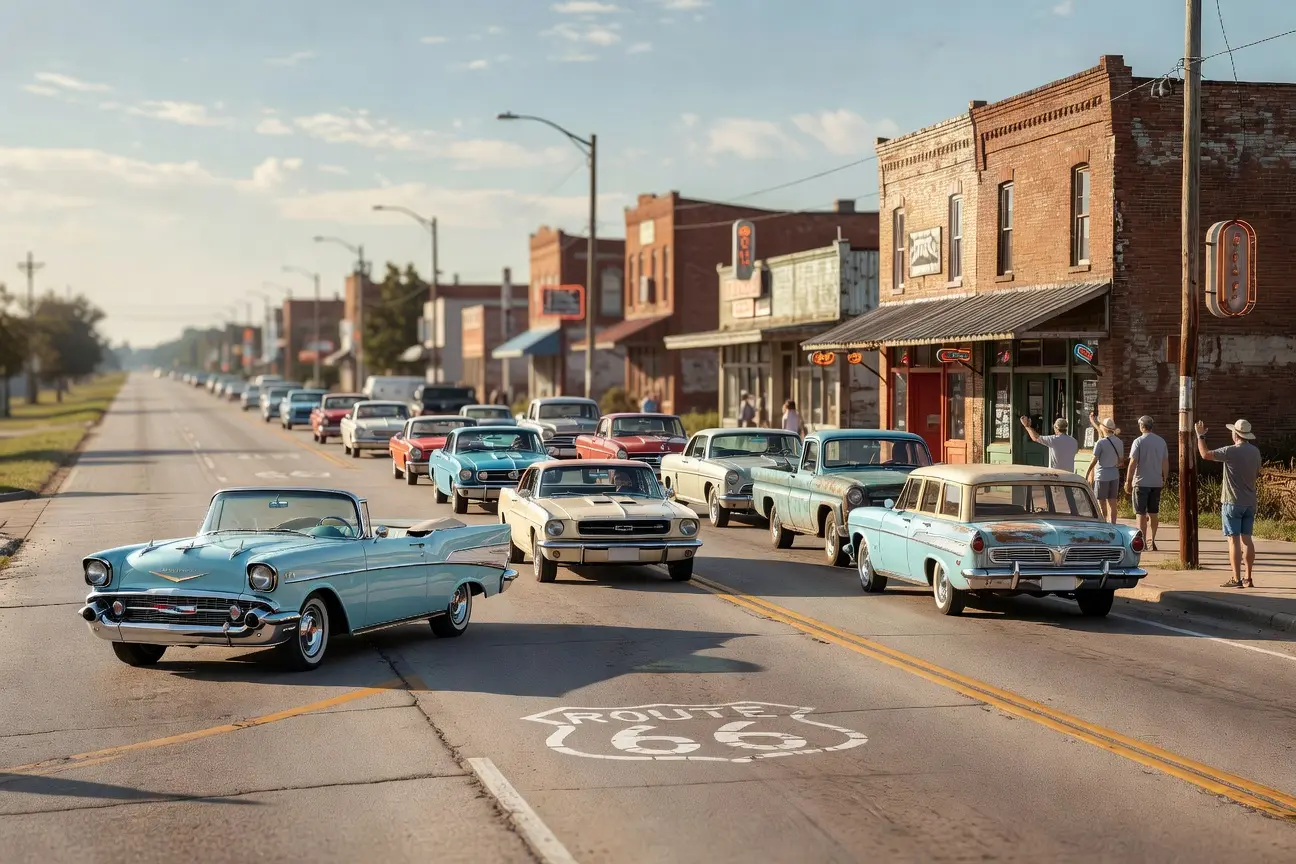
The Guinness World Record for the largest classic car parade has sat with Dorado, Puerto Rico, since April 2017 at 2,491 cars. Tulsa is at 3,895 registered, with more than two weeks of sign-ups still open. On Saturday, May 30, the city will roll all of them down 5.5 miles of original Route 66 asphalt and turn a single morning into a coronation of the Mother Road’s 100th birthday.
The Morning the Cars Roll Out of Expo Square
The cars start their engines at 8 a.m. Staging happens at Expo Square on the east edge of downtown Tulsa, where the column will line up before pushing west along 11th Street, the original 1926 alignment of Route 66 through the city. The route passes the Harvard, Lewis, and Peoria intersections before completing its 5.5-mile run. A Guinness World Records (GWR, the body that adjudicates record categories) adjudicator will be on site to count vehicles in real time. Tulsa’s Mother Road Market is the official adjudicator sponsor, a piece of symmetry given the food hall sits on the highway it is now helping to commemorate.
The lead-up is its own event. An expo runs at Expo Square on Thursday and Friday, May 28 and 29, with a public tailgate Friday from 4 to 8 p.m. Cars from 1996 model year or earlier qualify, meaning every vehicle in the column will be at least 30 years old when it rolls out of staging.
Christian Bengel, Tulsa Route 66 Commission chair and a city councilor, said the day represents “exactly how the Capital of Route 66 should honor the Mother Road.” Mayor Monroe Nichols offered a less ornamented read in the same announcement. “In Tulsa, we don’t do anything halfway,” he said. “This will be a true citywide celebration.”
The route was chosen because it has not changed in a century. The Tulsa real-estate man who fought for the Chicago-to-Los-Angeles routing in 1926 argued the highway should turn south through Oklahoma to avoid the Rockies. Drivers leaving Expo Square on the 30th will retrace the alignment his lobbying produced, with all of the original through-line still in place. Full event details sit on Tulsa’s official Route 66 Capital Cruise event page.
A Record Built to Be Broken
Puerto Rico’s town of Dorado set the standing Guinness mark in April 2017 with 2,491 classic cars. That number stood as the ceiling for nine years. Tulsa’s registration overtook it weeks ago.
On May 13, Bengel announced 3,895 cars were registered, with 17 days of sign-ups still on the books. “I thought that was insurmountable when we first started talking about this,” he told reporters, referring to the Dorado number. “But we’re on pace to bring 4,000 cars here to Tulsa.” The full official Guinness World Records attempt announcement went out earlier in the year.
| Parade | Date | Vehicles | Location |
|---|---|---|---|
| Standing Guinness record | April 2017 | 2,491 | Dorado, Puerto Rico |
| Tulsa Capital Cruise (registered, May 13) | May 30, 2026 | 3,895 | Tulsa, Oklahoma |
| Tulsa Capital Cruise (organizer projection) | May 30, 2026 | ~4,000 | Tulsa, Oklahoma |
A 4,000-car parade would land 60% above the prior record. Guinness rules require every vehicle to actually move past the adjudication point in sequence, so the count is a logistical exercise across the entire stretch, not a head count at the start. Organizers initially targeted just 3,000 vehicles when planning began in 2024.
What registered drivers get for showing up:
- Photo opportunities at staged backdrops along the route
- Commemorative items and event credentials
- Pre-event coverage by event-affiliated media
Early registration cost $15 with an April 30 deadline. Standard registration is $25 and stays open through mid-May. Factor 110, the agency producing the cruise in partnership with Visit Tulsa, kept the cap deliberately high to absorb late entries. If the current trajectory holds, the Capital Cruise will not just take the record. It will reset it by the largest margin any classic-car parade has cleared since Guinness began tracking the category.
Sixteen Party Zones Stitch the Parade Together
Driving the parade is one way to be part of May 30. Watching is the other, and the city has built 16 sponsored party zones along the route to capture spectators who do not own a 1996-or-earlier vehicle. Each zone is anchored by a local sponsor, drawn from both nonprofit and commercial sectors.
The sponsor categories include:
- Churches and faith-based organizations
- Universities and community colleges
- Convenience stores and supermarkets
- Cafés and independent restaurants
- Community foundations and civic groups
Walking the full set of 16 zones covers the entire parade route on foot. Each zone is built around live music, food vendors, and interactive activities, with sponsors handling their own programming inside their footprint.
Jonathan Huskey of Tulsa Regional Tourism framed the inclusion logic in plain terms.
This is a party for everyone, and just because you may not have a classic car 1996 or older, doesn’t mean you can’t be a part of this unprecedented Route 66 centennial celebration.
Bengel pitched the same idea in different language when announcing the cruise route, saying the celebration “will light up every corner of our city, from north to south, east to west.” The 11th Street corridor slices through neighborhoods that were on the original alignment, neighborhoods that have rebounded unevenly as commercial gravity in Tulsa has shifted north and south over the decades. Putting a zone at every cluster is a deliberate equity move, not an afterthought.
Cyrus Avery’s Grandson Rides the Mother Road
The parade has a designated lead car, and the people in it are part of the story. Two centenarians, Betty Lee Jones and Morris Neighbors, will ride in the front vehicle, both 100 years old in the same year Route 66 turns 100. Between five and ten participants overall are 100 or older, by the city’s count.
Behind them somewhere in the column will be Bob Berghell, grandson of Cyrus Avery, the Tulsa civic figure known as the “Father of Route 66.” Avery, an oil-boom-era real-estate man who moved to Tulsa in 1908, was appointed to the federal board that designed the U.S. Numbered Highway System in the mid-1920s. He pushed for the Chicago-to-Los-Angeles alignment, argued for the southern routing through Oklahoma, and is credited with naming the highway U.S. 66 itself. He also coined the road’s first nickname, “Main Street of America,” before John Steinbeck rechristened it the “Mother Road” in “The Grapes of Wrath” in 1939. The Oklahoma Historical Society keeps the long-form encyclopedia biography of Cyrus Avery in its archive.
The centenarian riders are the parade’s softest beat and possibly its strongest argument. The federal designation that created the highway went into effect on November 11, 1926. Anyone born within a few months of that date is, by definition, exactly the road’s age. Tulsa found a handful of them and put two in the front seat. That detail is going to do more work for the city’s tourism brand than any registration count.
Behind the Cruise, Oklahoma’s $6.6 Million Centennial Bet
Where the Grants Land
The Capital Cruise is the loudest single event of the centennial. The longer game is policy. Oklahoma’s state-level Route 66 Centennial Commission manages an annual allocation of $6.6 million for corridor revitalization, with grants flowing to towns and roadside attractions along the 400-mile Oklahoma stretch.
Tulsa received roughly $753,000 across four projects in the latest cycle. Oklahoma City got $417,500 for a neon sign and mural. Smaller communities like Arcadia, Stroud, and Chandler are absorbing the rest. The state has been distributing money in deliberately small, broadly spread grants, on the theory that a tourist economy rewards density and continuity more than a few large anchor sites. The Oklahoma Tourism and Recreation Department’s centennial roadmap lays out the corridor strategy in full.
Why the Parade Is Also a Budget Argument
The numbers behind the bet: Route 66 tourism contributes roughly $79 million in net in-state wealth to Oklahoma’s economy every year, per the state’s commerce department estimates. The math the commission is working from values the road at $250,000 to $450,000 per mile per year in tourism spending when invested in. Oklahoma’s 400-mile stretch makes the corridor a $100-million-plus annual tourism asset if the high end of that range holds.
That is why May 30 matters beyond the morning. The parade is the high-visibility moment that justifies the underlying capital plan to a state legislature that has to renew the funding. A Guinness ratification gives the commission a clean line for the next budget cycle. It also gives Tulsa, which staked its identity on “Capital of Route 66” branding, a documented win to cite when arguing for the next round of corridor investment.
By 8 a.m. Saturday, the cars start moving west out of Expo Square. Somewhere around mid-route the count will pass the old mark and the adjudicator will note it. The state will have made its case.
Frequently Asked Questions
Who can register a vehicle for the Route 66 Capital Cruise?
Anyone with a vehicle from model year 1996 or earlier, a valid license, and proof of insurance. The cutoff means any car in the parade will be at least 30 years old. Registration is handled through Visit Tulsa’s official portal.
How much does it cost to enter a classic car?
Early registration was $15 with an April 30 deadline. Standard registration is $25 and stays open through mid-May. There is no spectator fee at any point.
Do spectators need tickets to watch?
No. The parade is a free public event. The 16 sponsored party zones along the route offer live music, food vendors, and activities, all open to the public.
What route does the parade follow?
The cruise runs 5.5 miles along Tulsa’s 11th Street, the original 1926 alignment of Route 66 through the city. Staging begins at Expo Square, with cars rolling out at 8 a.m. on Saturday, May 30.
What is the current Guinness World Record being challenged?
Dorado, Puerto Rico, set the record for the largest parade of classic cars in April 2017 with 2,491 vehicles. Tulsa had 3,895 registered as of May 13 with sign-ups continuing.
Will a Guinness adjudicator be on site?
Yes. An official Guinness World Records adjudicator will verify the count and ratify the result at the event. Tulsa’s Mother Road Market is the official adjudicator sponsor.


Veridue Raises $4 Million to Speed Energy Deal Diligence

Healey Adds a £150m Rung for Northern Scale-Ups

Ten Deals Took Most of Europe’s August Tech Money

Holmes Hired Fielder to Film Her Last Days

Molten Bets £100m of Plc Cash on Late-Stage Tech

Garlinghouse Cited Dutch Gold, and London Got the Bars

byFounders Bets $4.3 Million on Fluencify After $2M ARR

Alpha Gang Puts A-List Stars on a Zellner Wager

Angel Bets a Recut PG-13 Chase on Ritchson and Wilson

Flex IT and T1A Combine to Own Corporate Device Supply

Walter’s TWG Insists No Fraud as Insurer Probes Force Cleanup

30-Year Yield Hits 5.32% Highest Since 2007 as Debt Supply Locks In Costs

PCE Stays at 3.7% as Gas and Tariffs Outrun Coming Revisions

Evernorth S-4 Clears Path for Active XRP Treasury on Nasdaq

Astute’s $1.2M bet makes B2B creator deals feed AI discovery

Strategy Parks $1.59B Cash While Bitcoin Stack Stays Flat

Instinct Hits $2.5 Billion as AI Agent Access Sparks Trust Fights

Oracle’s 2.8 GW Bloom Deal Exposes the AI Power Bypass

Amber’s €7M locks Mittelstand knowledge inside Europe

CLARITY Act Cloture Opens a Door Ethics Still Blocks
-
 FINANCE3 months ago
Zcash Patched a Double-Spend Bug as ZEC Climbed 5%
-
 ENTERTAINMENT3 months ago
Steam Summer Sale 2026 Locks In June 25 to July 9 Dates
-

 FINANCE2 months ago
CLARITY Act Final Text Expected This Weekend as 60-Vote Hurdle Looms
-
 NEWS4 months ago
Meta Adds AI Replies to Threads, But Users Can’t Block It
-
 ENTERTAINMENT5 months ago
Extraction 3 Is Officially Coming to Netflix in 2027
-

 NEWS3 months ago
YouTube Shorts is testing a heart in place of the thumbs-up
-

 NEWS1 month ago
Senators Force Apple Off Chinese Memory as Big Three Cash In
-

 NEWS3 months ago
NEURA Robotics’ $1.4B Series C Redraws Europe’s Physical AI Bet