
FINANCE
Trump Orders Fed Review of Crypto Banking Access on ETF Retreat Day

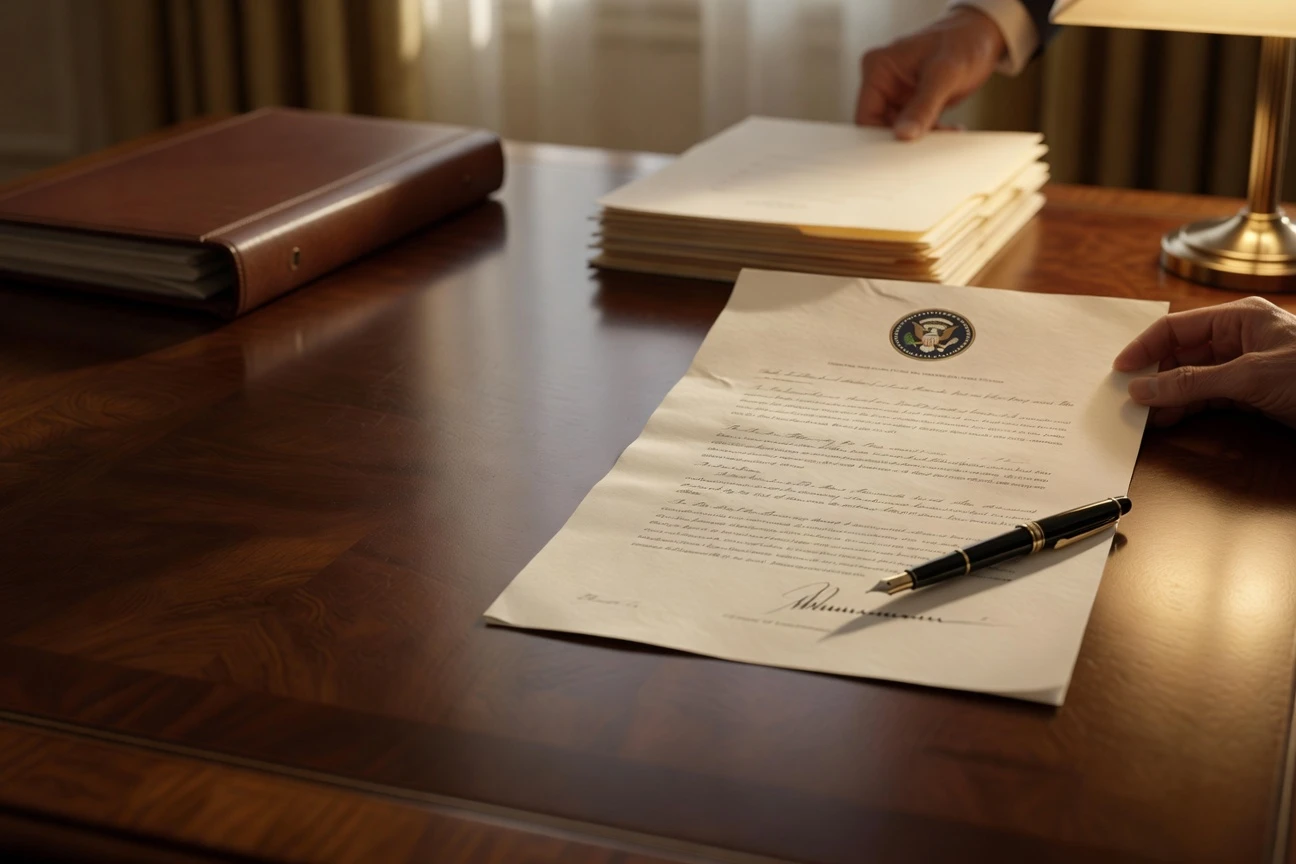
President Donald Trump signed an executive order on May 19 ordering six federal financial regulators to review and roll back rules that have kept fintech firms and digital asset companies out of the U.S. banking system. The order gives the Securities and Exchange Commission (SEC, the federal securities regulator), the Commodity Futures Trading Commission (CFTC, the federal derivatives regulator), the Office of the Comptroller of the Currency (OCC, the federal bank chartering agency), the Federal Deposit Insurance Corporation (FDIC), the Consumer Financial Protection Bureau, and the National Credit Union Administration 90 days to identify supervisory practices that block partnerships between banks and crypto firms.
The same day, Trump Media and Technology Group quietly pulled three crypto exchange-traded fund filings from the SEC, including the planned Truth Social Bitcoin ETF (exchange-traded fund, a listed product holding the asset directly). One side of the administration was opening the door to crypto’s banking ambitions while the other was walking out of the consumer fund business.
What the Order Tells Six Regulators to Do
The order, titled the May 19 fintech regulatory framework directive, sets three calendar markers. Within 90 days, the six named regulators must hand the White House a list of rules and policies that “unduly impede” fintech firms from partnering with federally regulated banks, credit unions, broker-dealers, investment advisers, and futures commission merchants. Within 120 days, the Federal Reserve Board has to report back on whether non-bank financial companies and uninsured depository institutions can be granted access to its payment infrastructure. Within 180 days, every named agency must take implementing steps based on the findings.
The fintech definition is unusually broad. It covers payment processing, lending, deposit-taking, derivatives, investment management, brokerage, underwriting, custodial and fiduciary services, digital banking, digital asset-related services, securities and commodities trading, and blockchain-based services. Any company touching one of those lines qualifies.
| Agency | Lead Deadline | Specific Brief |
|---|---|---|
| Federal Reserve | 120 days | Report on legal authority to extend payment access to non-banks and uninsured depositories |
| OCC | 90 days | Identify barriers to bank charters for fintech firms |
| FDIC | 90 days | Review deposit insurance application rules |
| SEC and CFTC | 90 days | Catalog rules blocking digital asset firm registration |
| CFPB and NCUA | 90 days | Surface guidance items that restrict bank-fintech partnerships |
| All named agencies | 180 days | Implement based on review findings |
The phrase that matters most for crypto sits inside the Fed’s brief. The president asked the central bank to study whether the 12 regional Federal Reserve banks have legal authority to independently grant or deny access to payment accounts and services, and whether decisions on completed applications should be made within a 90-day window. That clause aims at the institutional discretion that has defined Federal Reserve master account decisions since the early 1980s.
The Same-Day Withdrawal That Frames the Bet
Trump Media filed registration statement amendments with the SEC on May 19 to discontinue three planned funds: the Truth Social Bitcoin ETF, the Truth Social Bitcoin and Ethereum ETF, and the Truth Social Crypto Blue Chip ETF. The filings asked the agency to credit fees paid against future products, which keeps the door cracked open for a different format later.
The retreat tracks the math of the spot Bitcoin ETF market. Established issuers including BlackRock, Fidelity, and Ark Invest run their products at expense ratios between 0.19% and 0.25%, and they hold roughly 90% of the more than $130 billion in spot Bitcoin ETF assets. A late-arriving brand product would have entered at a higher fee against a market where the early movers already locked in institutional custody, market-making, and distribution.
Spot Bitcoin ETFs also bled $648 million in net outflows over the trading week ending May 16, the worst single-week run since February, on a softening crypto tape that has Bitcoin trading near $94,000 after touching $109,000 in January. The combination of saturation and a weaker price chart closed the window on a brand-led launch. For context on the political mood around the asset class through the spring, the Beijing summit week saw a separate Bitcoin rally tied to U.S.-China headlines.
What the same-day pairing exposes is a hierarchy inside the administration’s crypto thinking. Speculative consumer products are no longer the easy win. Banking plumbing is. The first piece is harder to deliver and harder to glamourize, but its beneficiaries sit in different chairs.
The Master-Account Question at the Center
A Federal Reserve master account is the operational key to the U.S. payment system. With one, an institution can settle Fedwire transfers, clear ACH (Automated Clearing House, the bank-to-bank payments network) payments, and hold reserves directly with the central bank. Without one, it has to route everything through a correspondent bank that does have one, paying fees and waiting on a third party to move funds.
Three categories of institutions are currently blocked or constrained from that access:
- Wyoming Special Purpose Depository Institutions chartered to serve crypto firms, most prominently Custodia Bank and Kraken Financial
- National trust banks chartered by the OCC for crypto companies, including Coinbase, Circle, Ripple, Paxos, BitGo, Fidelity Digital Assets, Crypto.com, Stripe, and Anchorage Digital
- Non-bank fintechs that handle large payment flows but do not hold a depository charter
The order does not, by itself, hand any of these firms an account. It directs the Fed to report within 120 days on whether they should be eligible, what the legal authority is to extend access, and what statutory or regulatory barriers stand in the way. What the order cannot do is force the Federal Reserve to actually grant any account. The Fed is independent. A 120-day report ends with policy recommendations, not an account number; whether the central bank acts on those recommendations is its own call.
Who Stands to Cash In First
Three groups read the order as a direct lift to their roadmap. Their wins are not symmetrical, and the order’s wording favors the firms already holding partial federal recognition.
- Nine OCC-chartered crypto trust banks are now positioned to seek deposit insurance and Federal Reserve access if the order’s framework holds. Coinbase, Circle, Ripple, Paxos, BitGo, Fidelity Digital Assets, Crypto.com, Stripe, and Anchorage make up that group.
- Two Wyoming SPDIs that have waited on Fed access for years, Custodia Bank and Kraken Financial, are the most direct beneficiaries of any move toward a defined approval timeline.
- Roughly $3.5 billion in stablecoin reserve volume currently parked at intermediary banks could move toward direct Fed accounts, removing a layer of cost and counterparty exposure for issuers.
Ripple has been the loudest in public about wanting a master account, with chief executive Brad Garlinghouse calling it the missing piece for institutional payment integration during a March industry panel. Ripple’s executive team has tied its long-term XRP strategy to that institutional pipeline, and a clearer Fed access path would harden the case.
Anchorage Digital, the only federally chartered crypto custodian in the country, has held an OCC trust charter since January 2021 and has publicly tied its institutional pipeline to Federal Reserve services. Coinbase, the largest U.S. crypto exchange, gains differently; the exchange does not run a depository entity but custodies coins for BlackRock’s spot Bitcoin ETF and the bulk of institutional flows. A faster path for its trust affiliate to bank-like services would let it shorten settlement times and price more aggressively against Wall Street incumbents.
For Kraken, the order arrives months after the exchange filed for an initial public offering. A clarified Fed access path improves the equity story by adding a credible operating moat to the IPO pitch.
Warren’s Counter Letter, Filed the Same Week
The week the order landed, Senator Elizabeth Warren, ranking member of the Senate Banking Committee, sent a letter to the OCC on national trust charters for crypto firms, demanding answers on the nine approvals the agency has issued since January.
These companies are effectively crypto banks that want to evade the fundamental safeguards and obligations that come with being a bank.
Warren wrote that the charters “appear to go far beyond the narrow set of activities permitted by law” and that the approvals “pose serious risks to consumers, the safety and soundness of the banking system, and the separation of banking and commerce.” Her objection has substance beyond the politics. National trust banks operate without FDIC insurance and outside the full prudential framework that applies to insured depository institutions. Extending central bank payment infrastructure to entities that do not face the same examination intensity as the banks they would settle alongside is the precise risk Warren is naming.
The Senate Banking Committee advanced the CLARITY Act 15-9 on May 14, over 44 Warren amendments. The CLARITY Act, the GENIUS Act on stablecoins, and the May 19 executive order form three pieces of the same architecture. Each lowers the regulatory floor for crypto-bank hybrids. Each names a different agency. None individually settles the question Warren is asking, but together they redraw the perimeter.
Custodia’s Two-Year Fight Sets the Template
The reason the Federal Reserve directive matters is a 2023 denial. Caitlin Long’s Custodia Bank, chartered as a Wyoming SPDI in 2020, applied for a master account in October 2020 and was rejected by the Kansas City Federal Reserve on January 27, 2023. The denial filings cited heightened risks tied to the bank’s crypto activities, including its ability to mitigate money laundering and terrorism financing risks.
A federal district court in Wyoming upheld the denial in March 2024. Judge Scott Skavdahl ruled that Federal Reserve banks have discretion to deny master accounts even when an applicant is statutorily eligible. The decision is on appeal at the Tenth Circuit.
The 90-day decision-window study asks the Fed to consider, at least, narrowing that discretion. The 120-day report on legal authorities is effectively a request for the central bank to tell the White House what statutory levers Congress would need to pull to override the Custodia outcome on future applications. Whether the Fed plays along is the test; its independence on monetary policy is well established, but its independence on payment access decisions is a thinner, more contested doctrine.
If the Fed’s 120-day report concedes broader payment access authority and the Tenth Circuit reverses on Custodia, the crypto banking architecture of 2027 looks structurally different from the one in place today. If the Fed pushes back on its own authority and the appellate court affirms the denial, the order’s bite shrinks to whichever regulators the president can lean on directly, with everything else waiting on Congress.


Dolly Parton’s $450 Million Fortune Keeps Working After Her Death

SpaceX’s $60B Cursor Buy Immediately Costs It OpenAI Models

Rays Forever Home Wins County Vote as College and Taxpayers Carry the Load

Apple TV Hits $14.99 as Sports and Hits Bill Comes Due

Swift Telescopes Restart as Orbit Drop Accelerates

Oracle’s 2.8 GW Bloom Deal Exposes the AI Power Bypass

Galaxy S26 Beta 7 Ports Fold 8 AI as Stable Nears

Walmart Pays $50 Million to Close Federal Opioid Pharmacy Case

Space Mirror Demo Revives 1993 Russian Night-Light Test

Measles Death Dispute Deepens Distrust in Pennsylvania Outbreak

Trump Iran Threat Wiped $238M Crypto Longs Then Flipped

30-Year Yield Hits 5.32% Highest Since 2007 as Debt Supply Locks In Costs

Oil Crashes Below $80 as Iran Talks Restart and Markets Split

Strategy Parks $1.59B Cash While Bitcoin Stack Stays Flat

Astute’s $1.2M bet makes B2B creator deals feed AI discovery

SpaceX Stock Rebound Tests Real Demand Before Huge Unlock

BlackRock Turns Cash Empire Into Stablecoin Reserve Rails

The 20% Savings Ideal Meets a 2.7% Reality Check

Amber’s €7M locks Mittelstand knowledge inside Europe

Walter’s TWG Insists No Fraud as Insurer Probes Force Cleanup
-
 FINANCE3 months ago
Zcash Patched a Double-Spend Bug as ZEC Climbed 5%
-
 ENTERTAINMENT3 months ago
Steam Summer Sale 2026 Locks In June 25 to July 9 Dates
-

 FINANCE2 months ago
CLARITY Act Final Text Expected This Weekend as 60-Vote Hurdle Looms
-
 NEWS4 months ago
Meta Adds AI Replies to Threads, But Users Can’t Block It
-

 NEWS3 months ago
YouTube Shorts is testing a heart in place of the thumbs-up
-

 NEWS1 month ago
Senators Force Apple Off Chinese Memory as Big Three Cash In
-

 NEWS3 months ago
NEURA Robotics’ $1.4B Series C Redraws Europe’s Physical AI Bet
-
 ENTERTAINMENT5 months ago
Extraction 3 Is Officially Coming to Netflix in 2027