
HEALTH
ReVision Implant’s €4M Round Tests Europe’s Bionic Eye Bet

ReVision Implant has secured €4 million to push its cortical visual prosthesis from research project toward clinical manufacturing, in-house cleanroom work and regulatory preparation. The Belgian neurotechnology company is trying to restore functional vision by bypassing damaged eyes and optic nerves and stimulating the brain’s visual cortex.
The round, backed by private investors and medtech operators, is small beside the promises usually attached to brain-computer interface work. Its timing is the useful part. The company now has to prove that a device built around lab-grade neural stimulation can become a regulated implantable medical product.
The Money Is a Manufacturing Signal
The oversubscribed €4 million round gives ReVision Implant a bridge between grant-funded science and the expensive discipline of medical device production. Existing investors joined new European business leaders and medtech operators, according to the company information supplied with the round.
Frederik Ceyssens, ReVision Implant’s co-founder and chief executive, has been clear about where that money goes first. The company has begun building its own cleanroom capacity, expanding its team, preparing regulatory compliance work and moving its clinical programme forward. That mix says more than a larger headline cheque would have said.
Cleanrooms are not glamorous. They are also where a neural implant company starts becoming accountable for repeatable fabrication, traceable quality controls and the hard question of whether every device can be made the same way twice. For a product that will sit in or near brain tissue, that change in operating model matters.
- €4 million in new private funding now supports clinical and operational scale-up.
- 2020 is the founding year listed by ReVision for the company started by Ceyssens and Prof. Peter Janssen.
- Thousands of electrodes are the company’s stated design aim for the visual cortex implant.
A Brain Route Widens the Patient Map
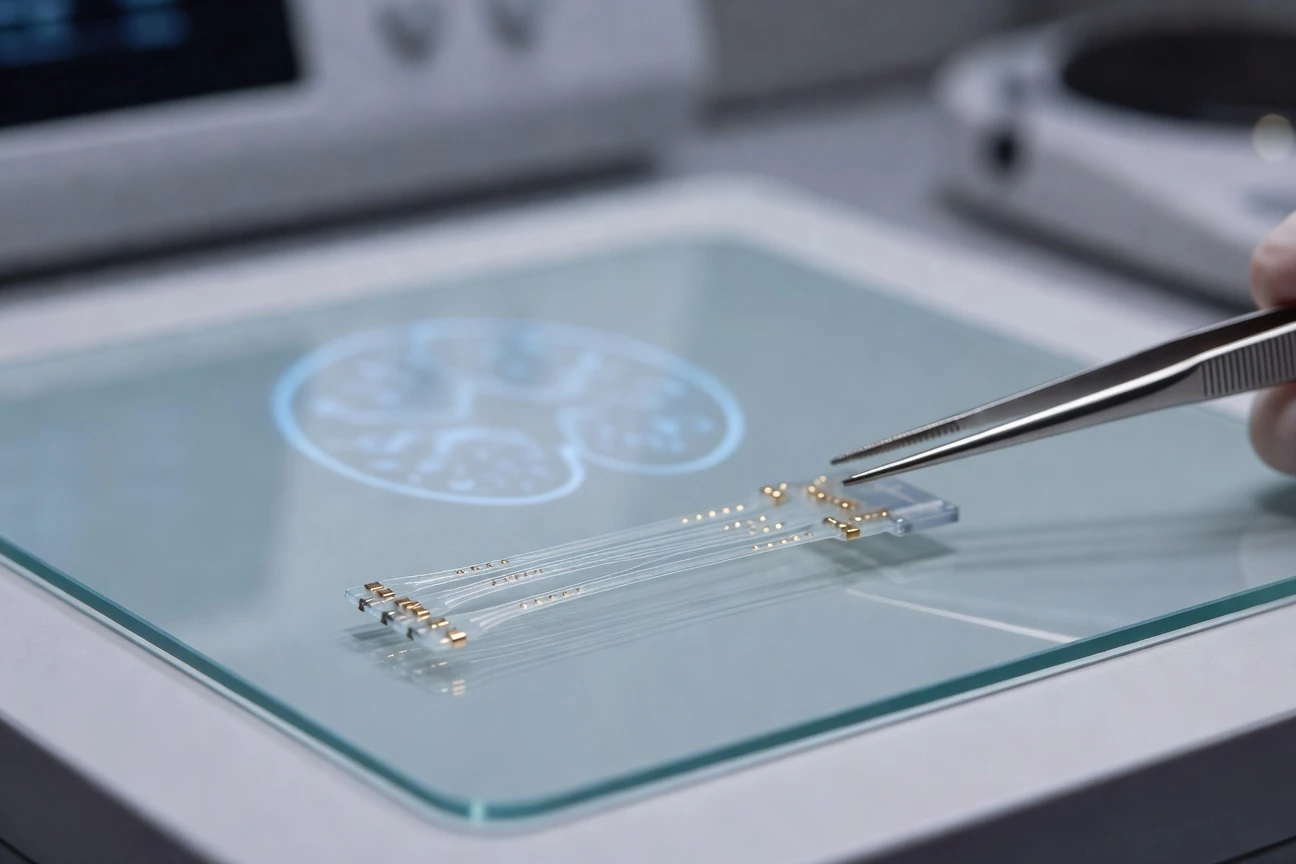
Most bionic-eye work has tried to stimulate the eye or the retina. ReVision is taking the cortical route. Its device, called Occular in the company’s public material, is designed to place microelectrode arrays in the visual cortex and connect them wirelessly with a headset that carries cameras and signal processing.
The scientific reason is simple enough for a patient to understand. If the eye, retina or optic nerve is too damaged to carry usable visual signals, those pathways may not be the best target. The company’s cortical prosthesis technology page says electrical stimulation in the primary visual cortex can create phosphenes, the small dots of perceived light that form the raw material for artificial vision.
That route also widens the addressable group. In its own FAQ, the company says 95% of cases could be suitable because the system bypasses the eye and optic nerve, with exceptions for damage to the visual cortex itself and for people blind from birth whose visual cortex did not develop normally. That is a company claim, not a clinical result, and it still needs human evidence.
- Camera – Captures visual information, usually from a headset or glasses-style frame.
- Implant – Delivers stimulation through microelectrodes placed in nervous tissue.
- Electronics and algorithms – Convert video into stimulation patterns the brain may learn to interpret.
- Training – Teaches the recipient to turn dots of light into useful cues for daily tasks.
The company says its arrays are ultra-flexible and as thin as a single brain cell. It also claims semiconductor fabrication can support lower cost in volume production. Both claims point back to the same issue investors are now funding: the device has to be manufacturable before it can become medicine.
Europe’s Grant Stack Filled the Risk Gap
Private capital is arriving after public money carried the early technical risk. The European Innovation Council (EIC, the European Union’s deep-tech funding arm) lists ReVision as a company partner in HyperStim and FlairVision, two projects tied to visual prosthesis work. The EIC impact profile for ReVision Implant says EU support helped the company move from proof-of-principle work toward medical device manufacturing.
The EIC Pathfinder and Transition grants have been invaluable to demonstrate our first proof-of-principle, to evolve from an early-stage technology company into a medical device manufacturer, and to get closer to the market.
Ceyssens made that comment in the EIC profile. The same page lists HyperStim as an EIC Pathfinder project and FlairVision as an EIC Transition project, a sequence that matters because it shows the company moving from scientific feasibility toward first human work.
The FlairVision project fact sheet on CORDIS, the European Commission’s research results service, shows a European Union contribution of €2.495 million, a start date of May 1, 2025, and an end date of April 30, 2028. It says the project will conduct an experiment with a blind patient. The older HyperStim project fact sheet shows €2.105 million in EU support and a goal of using stimulation protocols to gain more resolution from the available electrodes.
Put together, the two grant records show why this round is a hinge rather than a standalone event. Europe paid for a large part of the science risk. Private investors are now being asked to fund the clinical and industrial risk.
Rivals Show How Young the Category Remains
Cortical vision implants have enough history to avoid science fiction language, but not enough commercial success to look routine. The comparison set is narrow. Some systems sit on the brain surface. Others place electrodes inside cortex. Some have reached feasibility studies, while others remain in earlier development.
| Programme | Core Approach | Public Status | Why It Matters |
|---|---|---|---|
| ReVision Occular | Flexible microelectrode arrays in the visual cortex | Company says short-term human testing is the next step and longer blind-volunteer work is scheduled later | Aims for broad coverage of the visual cortex and higher practical resolution |
| Cortigent Orion | Surface stimulation of the visual cortex | Orion early feasibility study record lists six implanted subjects and active, not recruiting status | Shows that cortical visual prosthesis testing has already entered humans |
| Illinois Tech ICVP | Wireless stimulators with intracortical electrodes | Illinois Tech ICVP clinical testing update reported 25 stimulators and 400 electrodes in the first recipient | Offers a working example of wireless brain stimulation for artificial sight |
| Neuralink Blindsight | Visual cortex brain-computer interface (BCI, a device path that links electronics with neural signals) | Neuralink visual prosthesis trial page says it received Food and Drug Administration (FDA, the U.S. medical device regulator) Breakthrough Device Designation | Raises public attention, but has not made cortical vision a proven mass therapy |
Cortigent’s story is the cautionary backdrop. Its Argus II retinal prosthesis, inherited from Second Sight, helped hundreds of profoundly blind people see light and motion but was discontinued because the retinitis pigmentosa population was small, according to Cortigent’s own Argus II page. That history hangs over every new visual prosthesis startup.
ReVision’s bet is to move upstream from the eye to the brain, then solve for scale, lifetime and resolution. That is a harder surgical proposition, but it may reach patients who have no retinal route left.
Cleanrooms Decide More Than Prototypes
A research electrode can be impressive without being ready for a patient. A clinical implant needs documented materials, controlled manufacturing, sterilisation strategy, packaging, traceability, complaint handling and post-market plans. The cleanroom build is where those obligations start becoming daily work.
That shift fits the European regulatory path. The European Commission’s clinical investigations guidance for medical devices points sponsors toward requirements under the Medical Device Regulation (MDR, the European Union rulebook for device approval and clinical evidence). For an active implantable brain device, the evidence burden will be high.
There is also a strategic reason to bring important manufacturing steps in-house. A company can move faster when design changes, fabrication learning and quality documentation sit close together. It can also answer investor questions with more precision: what failed, what changed, and whether the next batch is better.
Europe has other brain-device companies trying to turn surgical ambition into repeatable products. Thunder Tiger Europe recently covered brain-surgery microrobots for cancer treatment, a separate field with the same investor lesson. For invasive neurotechnology, the lab win is only the opening ticket. Manufacturing discipline decides whether hospitals can ever use the device.
Useful Vision Sets the Bar
The broad need is not in doubt. The World Health Organization (WHO, the United Nations health agency) says at least 2.2 billion people have near or distance vision impairment worldwide, and at least 1 billion of those cases could have been prevented or remain unaddressed. The WHO vision impairment fact sheet also puts the global productivity cost at US$411 billion a year.
ReVision is not targeting that whole universe. Cataracts, refractive errors and many retinal diseases follow different treatment routes. The target group is narrower and harder: people with severe blindness who cannot benefit from therapies focused on the eye or optic nerve. For them, useful vision may mean recognising obstacles, finding doorways, reading large high-contrast shapes or using visual cues with a cane or other assistive tools.
That makes the next phase unforgiving. First human studies can prove safety and perception without proving daily independence. Longer studies have to show whether artificial dots become stable information, whether the implant lasts, whether surgery is acceptable, and whether patients judge the benefit worth the burden.
If the first human programme shows repeatable, safe perception, the €4 million round will look like the point where a Belgian lab project began turning into a device company. If the cleanroom and clinical work slip, the money will have bought time, not proof.
Disclaimer: This article is for informational purposes only and is not medical advice. Cortical visual prostheses and brain-computer interfaces involve surgical, neurological and regulatory risks. Patients should consult qualified medical professionals before considering any investigational device or clinical trial. Figures are accurate as of publication.


Replit Opens Its London Office Inside an AI Crowd

Straight Circle Trailer Lands Without a U.S. Date

Anemo Labs Bets £700,000 on an AI Sense of Smell

Nintendo Prices the Zelda 40th Switch 2 at $519

Copilot Capital Buys the Autopilot Already Running 90 GW

Ground A Raises €9.1 Million for a Pallet Laser

Gibney’s Musk Film Opens in Venice Without Its Subject

Torvalds Blames AI for a Full-Fat Linux 7.3-rc2

Dexter Returns Sharper, Older, and Stuck Between Killers

Meta’s Muse Agent Can Spend Before the Privacy Lock

Walter’s TWG Insists No Fraud as Insurer Probes Force Cleanup

30-Year Yield Hits 5.32% Highest Since 2007 as Debt Supply Locks In Costs

PCE Stays at 3.7% as Gas and Tariffs Outrun Coming Revisions

Evernorth S-4 Clears Path for Active XRP Treasury on Nasdaq

Astute’s $1.2M bet makes B2B creator deals feed AI discovery

Strategy Parks $1.59B Cash While Bitcoin Stack Stays Flat

CLARITY Act Cloture Opens a Door Ethics Still Blocks

Instinct Hits $2.5 Billion as AI Agent Access Sparks Trust Fights

Oracle’s 2.8 GW Bloom Deal Exposes the AI Power Bypass

AI data centers win as RAM kits jump nearly 500 percent
-
 FINANCE3 months ago
Zcash Patched a Double-Spend Bug as ZEC Climbed 5%
-
 ENTERTAINMENT3 months ago
Steam Summer Sale 2026 Locks In June 25 to July 9 Dates
-

 FINANCE2 months ago
CLARITY Act Final Text Expected This Weekend as 60-Vote Hurdle Looms
-
 NEWS4 months ago
Meta Adds AI Replies to Threads, But Users Can’t Block It
-
 ENTERTAINMENT5 months ago
Extraction 3 Is Officially Coming to Netflix in 2027
-

 NEWS3 months ago
YouTube Shorts is testing a heart in place of the thumbs-up
-

 NEWS1 month ago
Senators Force Apple Off Chinese Memory as Big Three Cash In
-

 NEWS3 months ago
NEURA Robotics’ $1.4B Series C Redraws Europe’s Physical AI Bet