
FINANCE
Elon Musk’s X Money Bet Echoes the Fight That Fired Him
X Money’s nationwide US rollout revives the payments bet that got Musk fired from PayPal in 2000, this time under his sole control.

Elon Musk’s X has switched on X Money nationwide for Premium and Premium+ subscribers, packing a bank account, peer-to-peer transfers and a metal Visa card into the same app people use to post. The rollout pairs deposit insurance up to $10 million through the Federal Deposit Insurance Corporation (FDIC) with an introductory 6% annual percentage yield (APY). Most fintech rivals cannot match either number.
Musk built X.com to be exactly this kind of bank twenty-six years ago. A boardroom coup cost him the company before he could prove the idea worked. This time, no board can vote him out.
Banking Features Inside the Feed
X Money lets subscribers send, receive and request money on X with no transaction fees and no transfer limits. Users can link outside bank accounts, set up direct deposit that arrives up to two days early, pay bills, mail physical checks and send wire transfers, all inside the app.
Deposits sit with partner institution Cross River Bank, carrying the standard $250,000 FDIC guarantee. A cash sweep program then spreads balances across several partner banks, pushing total coverage up to $10 million per account, well beyond what non-FDIC fintech tools like PayPal or Venmo offer. Premium+ subscribers get the 6% APY the moment they sign up; standard Premium subscribers unlock it once they meet direct-deposit requirements.
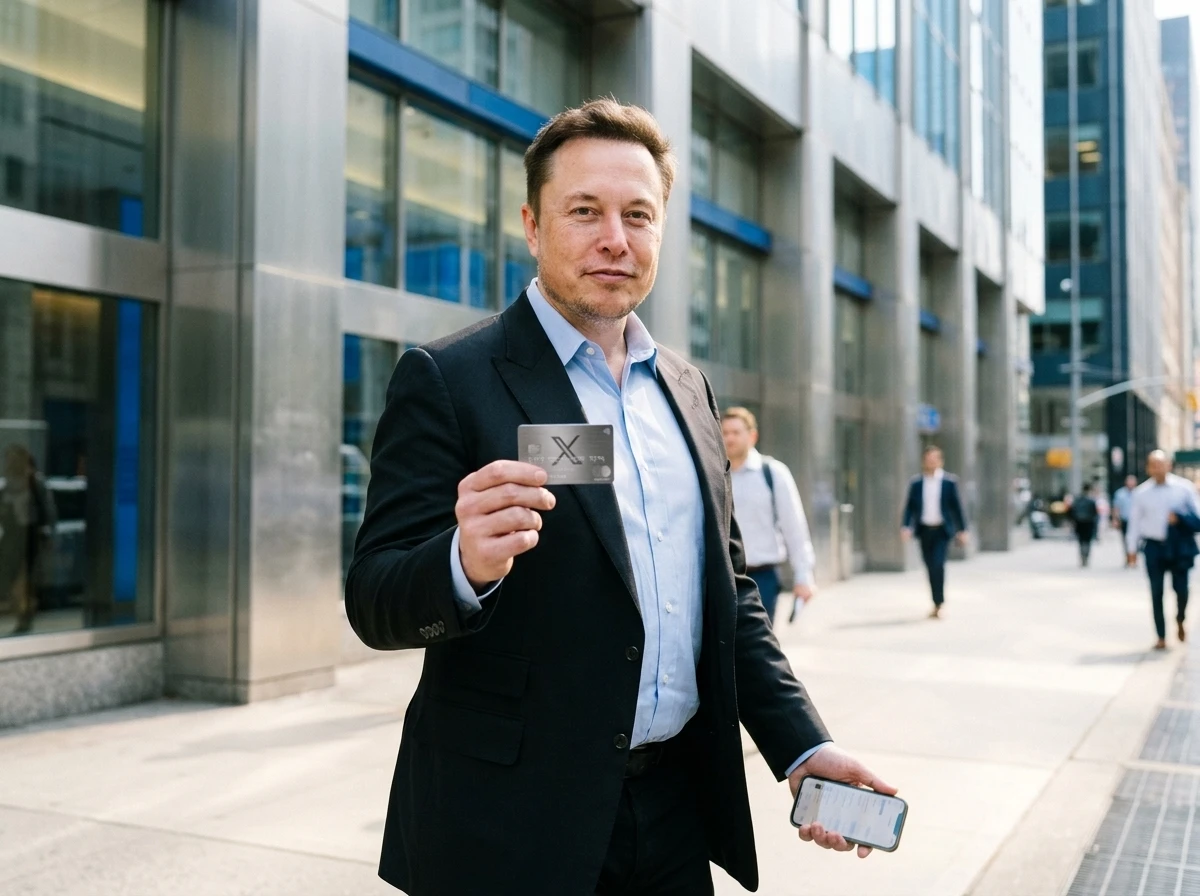
The physical piece is a virtual or metal Visa debit card, branded the X Card, built to work with Apple Wallet and Google Pay. Its perks are meant to read as a real upgrade over a typical debit card:
- 3% cash back on eligible purchases made with the card
- Fee-free withdrawals at ATMs anywhere in the world
- Support for adding the card straight into Apple Wallet or Google Pay
- A customizable metal design that can display the holder’s X handle
X Money confirmed the terms directly to users, including the sweep structure behind that $10 million in combined FDIC coverage, in a post on the platform itself.
The Coup That Cost Musk His First Bank
The loop closed fast once the app went live. A user sent Musk $25 on the new platform, earmarked to buy him a coffee, and Musk acknowledged the payment within hours, treating it as a live proof of concept.
That moment closes a loop that started in 1999, when Musk co-founded X.com as an online financial services startup. The company merged with Confinity, the startup behind PayPal, and Musk ran the combined business. He wanted the merged company to keep building under the X.com name. Colleagues worried the single letter read as an adult-content address, and they clashed with Musk over how aggressively to fight payment fraud.
The dispute ended with a boardroom coup. Peter Thiel and allies inside the company pushed Musk out as chief executive in the summer of 2000, while he was away on his honeymoon, according to Walter Isaacson’s biography of Musk. Thiel took over, and the company dropped the X.com name for good in 2001, becoming PayPal. When eBay bought PayPal in 2002, Musk collected $165 million for his stake, walking away richer but without the company or the name.
He didn’t let go of the domain’s memory. In July 2017, Musk bought X.com back from PayPal, telling followers on Twitter it held great sentimental value. The price was never disclosed. Six years later, he renamed Twitter itself to X.
- 1999: Musk co-founds X.com as an online financial services and banking startup.
- 2000: X.com merges with Confinity, the startup behind PayPal.
- Summer 2000: The board ousts Musk as chief executive while he is on his honeymoon and installs Peter Thiel in his place.
- 2001: The merged company drops the X.com name and rebrands entirely as PayPal.
- 2002: eBay buys PayPal, and Musk collects $165 million for his stake.
- July 2017: Musk buys the X.com domain back from PayPal, calling it a purchase of great sentimental value.
- 2023: Musk renames Twitter to X.
- 2026: X Money goes live nationwide for Premium and Premium+ subscribers.
Why Can’t X’s Board Stop Him Now?
Short answer: there isn’t one that can. Musk holds the titles of owner, chairman and chief technology officer at X Corp, a company he controls outright, unlike the venture-backed board that fired him from X.com in 2000.
That difference is the whole bet. Thiel and the other early PayPal investors had seats, votes and a different theory of the product, and they used all three. X Corp today answers to Musk in a way X.com’s board never did. If X Money stumbles on execution or regulation, the person deciding how to respond is the same person who built it.
Cross River Bank’s Regulatory Baggage
The bank actually holding the deposits is not a household name. Cross River Bank, a New Jersey-chartered lender, has built its business as one of the biggest players in banking-as-a-service, supplying the regulatory and technical plumbing that lets tech companies offer FDIC-backed accounts without becoming banks themselves.
That business model has already drawn regulatory scrutiny once. The FDIC issued a consent order against Cross River Bank in 2023 over failures to properly oversee its fintech lending partners, citing gaps tied to the Equal Credit Opportunity Act. The order requires the bank to build out due-diligence policies and get FDIC sign-off before entering any new fintech partnership. A legal analysis of the order published in December 2025 noted Cross River must still submit lists of its current credit products and third-party partners for ongoing FDIC review.
X Money is precisely the kind of third-party fintech relationship that order was written to police, just running through deposits and payments instead of lending.
Warren’s Warning Arrived Three Months Early
Senator Elizabeth Warren, the Massachusetts Democrat who serves as ranking member of the Senate Banking, Housing and Urban Affairs Committee, sent Musk a letter in April 2026, months ahead of this week’s full launch, raising concerns about consumer protection, national security and financial stability.
Since acquiring Twitter and re-branding it “X,” you have made clear that you intend to build an “everything app” that “will add comprehensive communications and the ability to conduct your entire financial world.”
Warren wrote that Musk had repeatedly identified financial services as central to his plan for X. Her letter also tied the launch to Musk’s own role a year earlier working with the Consumer Financial Protection Bureau (CFPB), the federal agency that polices products exactly like X Money, as it was scaled back under the Trump administration. Musk has not publicly responded to the letter.
America’s Graveyard of Everything Apps
Musk isn’t the first person to try building a WeChat-style everything app on American soil. He’s the latest in a line of attempts that mostly ended in retreat.
| Company | Payments Ambition | Outcome |
|---|---|---|
| Meta (Novi) | Stablecoin-linked digital wallet tied to the Diem project | Shut down in 2022 before reaching a public launch |
| Meta (Meta Pay) | Wallet-style balance and checkout across Facebook, Instagram and Messenger | Narrowed to a checkout and payment-credentials tool with no stored balance |
| Google (Google Pay) | Standalone peer-to-peer payments app separate from Google Wallet | US version discontinued, users redirected to Google Wallet |
| Bolt | WeChat-style super app built on its checkout network | Launched in 2025 after more than a decade in development |
Meta’s own description of what Meta Pay does today makes the retreat plain: log in through Facebook, Instagram or Messenger to shop, donate or send money to friends, nothing like the stored-balance wallet Novi was built to be. Bolt’s chief executive has openly pointed to WeChat as the model worth chasing, calling the buildout a goal more than a decade in the making. None of them combined a social feed, a bank account and a metal card the way X Money now claims to.
The States X Money Still Can’t Reach
X already holds money transmitter licenses in more than 40 states and has previously driven $1 billion in trading volume through its Cashtags feature. It is still waiting on approval in the states that remain.
X has said it plans to expand X Money to a wider US audience over the coming months, state by state, as licensing clears. No date has been set for full national coverage, twenty-six years after the first version of this bet cost Musk the company entirely.
Frequently Asked Questions
Who can actually sign up for X Money right now?
Only paying Premium and Premium+ subscribers in the United States can open an account. Free X users don’t qualify, and because the rollout depends on state-by-state money transmitter licensing, subscribers in some states still can’t access it even if they pay for Premium.
How does X Money’s FDIC coverage compare with apps like Venmo or Cash App?
Most rival payment apps don’t sweep balances across multiple partner banks, so coverage tied to a single bank typically caps at the standard $250,000. X Money’s sweep program spreads deposits across several FDIC-member banks, raising total coverage to $10 million per account.
Does X Money involve a stablecoin or cryptocurrency?
Warren’s letter specifically pressed Musk on whether X Money would issue its own stablecoin under the GENIUS Act, the federal framework that lets private companies mint dollar-pegged tokens. Musk had not publicly answered that question as of the letter.
What exactly did regulators require of Cross River Bank?
The FDIC’s 2023 consent order requires Cross River to build out due-diligence policies, perform fair lending risk assessments and get FDIC approval before signing any new fintech partnership, on top of the standard oversight banks already carry.
Will the 6% interest rate stick around?
X has not said whether the rate is permanent or an introductory offer. Companies that lead with a headline rate like this one typically adjust it over time as they lock in new users.
Disclaimer: This article is for informational purposes only; banking and interest-rate terms carry regulatory and institutional risk, and readers should confirm current rates, fees and coverage directly with X Money or Cross River Bank before making financial decisions.


Beelzebub’s €3 Million Raise Rides a Wave of EU Cyber Deadlines

Multiverse Computing’s $570 Million Bet on Smaller AI

GTA 6 Japan Code Expiration Traces to a Six-Month Payment Law

Windows 11 Finally Reverses the Taskbar Cut It Made in 2021

Elon Musk’s X Money Bet Echoes the Fight That Fired Him

Claude Chats That Leaked to Google Still Live On GitHub

DFINITY Bets Its Crashed Crypto Project on Sovereign Cloud

Facebook Verified Brings Back the Facial Recognition Meta Deleted

A Chinese Open Model Just Saved Hugging Face From OpenAI

Samsung’s Galaxy Glasses Run on Meta’s Own Chip Too

CLARITY Act Final Text Expected This Weekend as 60-Vote Hurdle Looms

Kalshi Loses Major NY Prediction Markets Ruling to Judge Torres

Fed Minutes Cite AI Demand as Inflation Risk, Put a 2026 Hike Back on the Map

Marker AI Writing Startup Lands $13M Seed Led by Index Ventures

Dota 2 Esports World Cup 2026: Spirit Defends $2M Title In Paris

Meta’s Muse Spark 1.1 Beats Rivals on Price, Trails on Coding

ARC Intelligence Closes €4M Seed Round in Roughly a Week

CS2 Premier Season 5 Lands With Cache and a C4 Damage Rework

Trump Calls Iran ‘Islamic Republic of Japan’ as Ceasefire Ends

Finto Picks Munich Over Silicon Valley After YC, Raises $3.4M
-
 FINANCE2 months ago
Zcash Patched a Double-Spend Bug as ZEC Climbed 5%
-
 ENTERTAINMENT2 months ago
Steam Summer Sale 2026 Locks In June 25 to July 9 Dates
-
 NEWS3 months ago
Meta Adds AI Replies to Threads, But Users Can’t Block It
-
 FINANCE3 weeks ago
CLARITY Act Final Text Expected This Weekend as 60-Vote Hurdle Looms
-
 ENTERTAINMENT2 months ago
‘Widow’s Bay’ Review: Apple TV’s Sleeper Horror-Comedy Earns Its Fog
-
 NEWS7 months ago
FolderFresh Review: This Free Tool Automates Windows File Organizing
-
 NEWS4 months ago
U.S. Navy Deploys Solar-Powered Lightfish Drone to Patrol Oceans
-
 FINANCE3 weeks ago
Kalshi Loses Major NY Prediction Markets Ruling to Judge Torres