
NEWS
Samsung’s Galaxy Glasses Run on Meta’s Own Chip Too
Samsung’s first Android XR glasses lean on Galaxy phones and the same Qualcomm chip already powering Meta’s dominant Ray-Ban lineup.

Samsung says its first Android XR smart glasses will launch later this year in the premium range, at what the company only calls a reasonable price. Choi Jae-in, head of Samsung’s extended reality research and development team, laid out the pitch at a press briefing after this month’s Galaxy Unpacked event in London.
The pitch has a catch nobody at that briefing mentioned. Leaked footage of the glasses’ companion app shows a control scheme that matches Meta’s market leading Ray-Ban line gesture for gesture, and the reason traces back to a chip both companies buy from the same supplier.
Samsung’s Pitch Skips the Headset Fight
Samsung is not trying to build a face computer. Choi told Korea Times the glasses are “an extension of the experience centered on the smartphone, rather than being a post-smartphone device.” That is a direct shot at bulkier standalone headsets, and an indirect one at how much processing Samsung expects the glasses to handle on their own.
The answer is: not much. Samsung calls the approach split computing. Simple tasks run on the glasses themselves. Anything heavier, like image processing, live translation, or AI powered navigation, gets routed to a paired Galaxy phone instead.
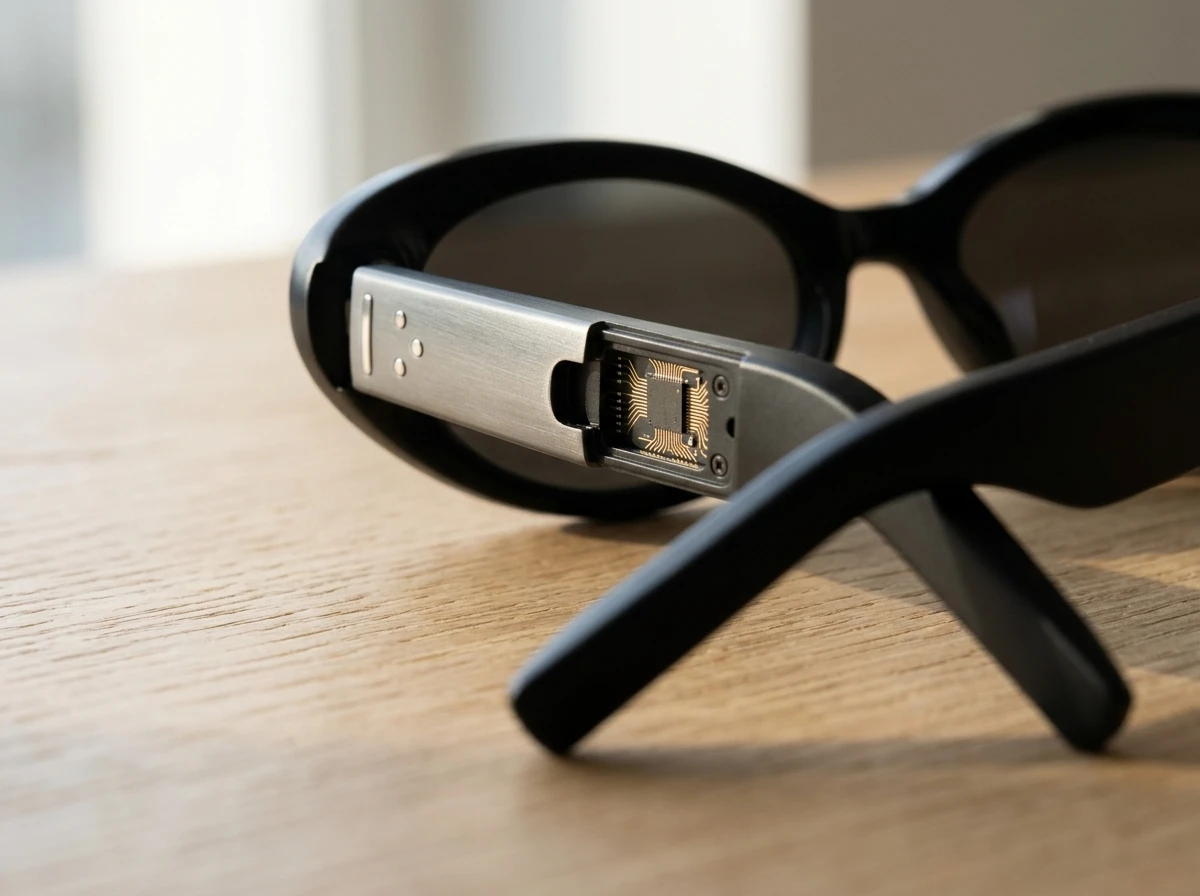
That tradeoff is why the glasses can stay light. Samsung says it borrowed hinge durability testing built for its foldable phones, then added drop and chemical resistance testing on top, aiming for mobile grade toughness without the weight of a full headset. A Qualcomm wearable chipset gets the glasses up to nine hours of battery life on a charge, and they carry no display at all. Voice handles the rest.
The Chip Both Rivals Depend On
Meta and other competitors already have glasses on the market, but Samsung is taking a different approach.
Choi said that to the Korea Herald at the same briefing. It is true that Samsung is arriving two years after Meta’s Ray-Ban glasses turned into a hit. It is less true that the hardware underneath is different.
Leaked tutorial clips from the Galaxy Glasses companion app, first posted by leaker SammyGuru on June 30 and reported by TechTimes on July 3, show physical controls that line up with Meta’s Ray-Ban almost exactly. TechTimes traced the overlap to the Qualcomm Snapdragon AR1 chip that both products share, along with a design ceiling of roughly 50 grams and under $500 that neither company has officially confirmed.
Qualcomm’s own product page describes the Snapdragon AR1 Gen 1 as its first Snapdragon platform built for smart glasses, with dual image processors and support for simple notification displays. That same chip has powered Ray-Ban Meta since 2023. Qualcomm followed it with a smaller AR1+ Gen 1 in June 2025, cutting the package size by 26% and trimming power use by 7%, exactly the kind of gain that lets both Samsung and Meta keep shrinking their frames without switching suppliers.
Samsung frames split computing as the thing that sets it apart from Meta. Research firm VDC Research says that framing understates how similar the two already are: Meta’s Ray-Ban glasses pushes its own heavy processing to the paired phone as well. Samsung’s separate Galaxy XR headset actually works the other way, computing locally on Qualcomm silicon while leaning on Google’s Gemini, closer to how Apple’s Vision Pro leans on its own chip and Siri.
| Feature | Samsung Galaxy Glasses | Ray-Ban Meta |
|---|---|---|
| Core chipset | Qualcomm wearable chip, reported to be the same Snapdragon AR1 family | Qualcomm Snapdragon AR1 Gen 1, confirmed since 2023 |
| Compute approach | Split computing, heavy AI tasks sent to a paired Galaxy phone | Heavy processing also pushed to the paired phone, per VDC Research |
| Design partner | Gentle Monster and Warby Parker, four styles shown so far | EssilorLuxottica, maker of Ray-Ban and Oakley |
| Units on the market | Not yet launched | More than 7 million sold in 2025 alone |
The Watch, Buds and Notes Do the Rest
Where Samsung’s pitch does hold up is inside its own ecosystem. None of these tricks need the cloud. They just need another piece of Galaxy hardware already in your pocket or on your wrist.
- Galaxy Watch gestures – a double pinch snaps a photo, controls music playback, or answers a call without touching the glasses
- Galaxy Buds handoff – audio switches to paired Buds automatically the moment the glasses go on
- Built in app links – the glasses connect directly to Samsung Notes, Gmail, and Google Maps
- Voice control – with no touchpad or display, voice commands carry most hands free functions
That is real convenience if you already own a Galaxy phone, watch and earbuds. It is also a quiet argument for buying three more Samsung products instead of one.
Roughly 10% of the Patents Guard Privacy
Camera glasses invite an obvious complaint: people nearby have no idea when they are being filmed. Samsung says it built the defense into hardware rather than a settings toggle. Roughly 10% of the company’s smart glasses patents cover anti misuse features, addressing what Samsung describes as widespread privacy concern around the category.
The camera shuts off automatically the moment someone covers the LED indicator light, and again if the wearer takes the glasses off their face. Neither action requires opening an app.
Gentle Monster and Warby Parker Get a Cut
Samsung is not designing frames alone. It showed four design variations built with Gentle Monster and Warby Parker, two fashion eyewear brands with no real history in consumer electronics until now.
Meta ran the same play first. EssilorLuxottica, the French Italian eyewear group that owns Ray-Ban and Oakley, has built and sold Meta’s smart glasses since the original Ray-Ban Stories in 2021. That arrangement sold more than 7 million pairs in 2025 alone, according to the company’s own quarterly results, up from roughly 2 million units combined across 2023 and 2024. Whether Samsung or Meta ends up ahead, Gentle Monster and Warby Parker just landed the same kind of deal that turned EssilorLuxottica into a wearables company almost by accident.
Meta Already Sold Seven Million Pairs
Samsung is not entering an empty market. Meta’s head start is measured in millions of units, and in years of chip supply that predate this rivalry entirely.
Google introduced Android XR in December 2024, naming Samsung and Qualcomm as launch partners from the start. It was Google’s third run at wearable computing after Google Glass and the phone tethered Daydream VR platform, both of which the company shelved by around 2019. Qualcomm, for its part, was already deep in this business before either rival’s current glasses existed. Analysts at Futurum Group counted Qualcomm powering more than 80 XR devices by late 2023, before Ray-Ban Meta’s later generations or Samsung’s glasses ever shipped.
How Much Will Samsung’s Glasses Cost?
Samsung has not named a price. Executives call it premium range but reasonable, aiming above budget audio glasses and well below a mixed reality headset. A leaked companion app comparison reported by TechTimes ties the hardware to a shared ceiling near $500, the same territory analysts associate with Ray-Ban Meta, though Samsung has confirmed no figure of its own.
What we know:
- Samsung says the glasses launch in the premium range at a reasonable price later this year
- Four styles already exist, co designed with Gentle Monster and Warby Parker
- Battery life runs up to nine hours, and the glasses carry no display
What is still unconfirmed:
- The exact retail price, beyond the leaked hint of a sub $500 ceiling
- The specific launch date within later this year
- Whether the deepest Galaxy features work at all on non Samsung Android phones
Samsung and Meta will keep fighting over whose logo ends up on your face. Qualcomm just needs both companies to keep making glasses.
Frequently Asked Questions
Will Samsung’s Galaxy smart glasses work with an iPhone?
Android XR is built on Android, and split computing needs a paired smartphone to handle the heavy lifting, so the glasses are designed around Galaxy and Android phones. Samsung has not detailed any iPhone support, and the deepest features, like Watch gestures and Buds handoff, are Galaxy exclusive by design.
Has Google tried smart glasses before Android XR?
Yes. Google built Google Glass and later the phone tethered Daydream VR platform, and shelved both efforts by around 2019 before returning to the category with Android XR alongside Samsung and Qualcomm in December 2024.
What other companies are building Android XR hardware?
Beyond Samsung, Qualcomm has said Android XR opens a path for its other partners, including Lynx, Sony, and XREAL, to build their own headsets and glasses on the same underlying platform.


A Chinese Open Model Just Saved Hugging Face From OpenAI

Samsung’s Galaxy Glasses Run on Meta’s Own Chip Too

Letitia James Warns the Clarity Act Would Gut State Fraud Fights

Tether Gold Wins Shariah Approval as Scholars Split on Crypto

Tether Gold Earns Shariah Certification to Chase Institutional Billions

Judge Blocks Minnesota’s Prediction Market Ban, Tribes Brace

Google’s Phone to Watch Unlock Fix Cuts Both Ways

Ondo Network Goes Live and Sidelines Its Blue-Chip Chain

Tom Lee’s BitMine Doubles Down on Its Ethereum Bet

Fed Rate Hike Odds Climb as Washington Faces the Biggest Bill

CLARITY Act Final Text Expected This Weekend as 60-Vote Hurdle Looms

Kalshi Loses Major NY Prediction Markets Ruling to Judge Torres

Fed Minutes Cite AI Demand as Inflation Risk, Put a 2026 Hike Back on the Map

Marker AI Writing Startup Lands $13M Seed Led by Index Ventures

Dota 2 Esports World Cup 2026: Spirit Defends $2M Title In Paris

Meta’s Muse Spark 1.1 Beats Rivals on Price, Trails on Coding

ARC Intelligence Closes €4M Seed Round in Roughly a Week

CS2 Premier Season 5 Lands With Cache and a C4 Damage Rework

Trump Calls Iran ‘Islamic Republic of Japan’ as Ceasefire Ends

Finto Picks Munich Over Silicon Valley After YC, Raises $3.4M
-
 FINANCE2 months ago
Zcash Patched a Double-Spend Bug as ZEC Climbed 5%
-
 ENTERTAINMENT2 months ago
Steam Summer Sale 2026 Locks In June 25 to July 9 Dates
-
 NEWS3 months ago
Meta Adds AI Replies to Threads, But Users Can’t Block It
-
 FINANCE3 weeks ago
CLARITY Act Final Text Expected This Weekend as 60-Vote Hurdle Looms
-
 ENTERTAINMENT2 months ago
‘Widow’s Bay’ Review: Apple TV’s Sleeper Horror-Comedy Earns Its Fog
-
 NEWS7 months ago
FolderFresh Review: This Free Tool Automates Windows File Organizing
-
 NEWS4 months ago
U.S. Navy Deploys Solar-Powered Lightfish Drone to Patrol Oceans
-
 FINANCE3 weeks ago
Kalshi Loses Major NY Prediction Markets Ruling to Judge Torres