
NEWS
Multiverse Computing’s $570 Million Bet on Smaller AI
Multiverse Computing is raising up to $570 million to shrink AI models for edge devices, wagering against hyperscalers’ $600 billion 2026 data center spending.

Multiverse Computing has opened a funding round targeting up to $570 million (€500 million) at a $1.7 billion (€1.5 billion) pre-money valuation, a number the Spanish startup says is five times what it was worth just over a year ago. The Series C is co-led by Forgepoint Capital International, BNPP SIVF and Bullhound Capital, and the round is still open to more money. The pitch behind the cash: shrink the large language models the rest of the industry keeps building bigger.
That is a wager with real money on the other side of the table. Five of the biggest cloud companies on earth plan to spend somewhere between $660 billion and $690 billion this year alone on the kind of giant data centers Multiverse says enterprises will not always need.
A $570 Million Bet Against Bigger AI
Multiverse Computing is based in San Sebastián (Donostia), in Spain’s Basque Country, and builds a compression tool called CompactifAI. The technology strips large language models down by 80 to 95 percent in size, the company says, with accuracy loss it puts at just 2 to 3 percent.
The Series C is co-led by Forgepoint Capital International, BNPP SIVF (BNP Paribas’ Solar Impulse Venture Fund) and Bullhound Capital. Commitments so far also include Santander Alternative Investments, Tikehau Capital, HP Inc., Orange Ventures, Scania Invest, Qatar Development Bank and NAventures, the corporate venture arm of Canada’s National Bank, among others. JPMorgan and Santander CIB are advising the deal, a level of banking firepower unusual for a startup at this stage.
Here is how the last two rounds compare on paper:
| Metric | Series B (closed June 2025) | Series C (announced July 27, 2026, still open) |
|---|---|---|
| Amount | $215 million (€189 million) | Up to $570 million (€500 million) |
| Lead investor(s) | Bullhound Capital | Forgepoint Capital International, BNPP SIVF, Bullhound Capital |
| Valuation | Just over $500 million, per PitchBook | $1.7 billion pre-money |
| Cumulative funding to date | Not disclosed at the time | About $800 million once closed |
PitchBook estimated the Series B valuation at just over $500 million at the time, a figure that puts the new round’s multiple closer to threefold than fivefold. Multiverse has not detailed how it arrives at its own five times number.
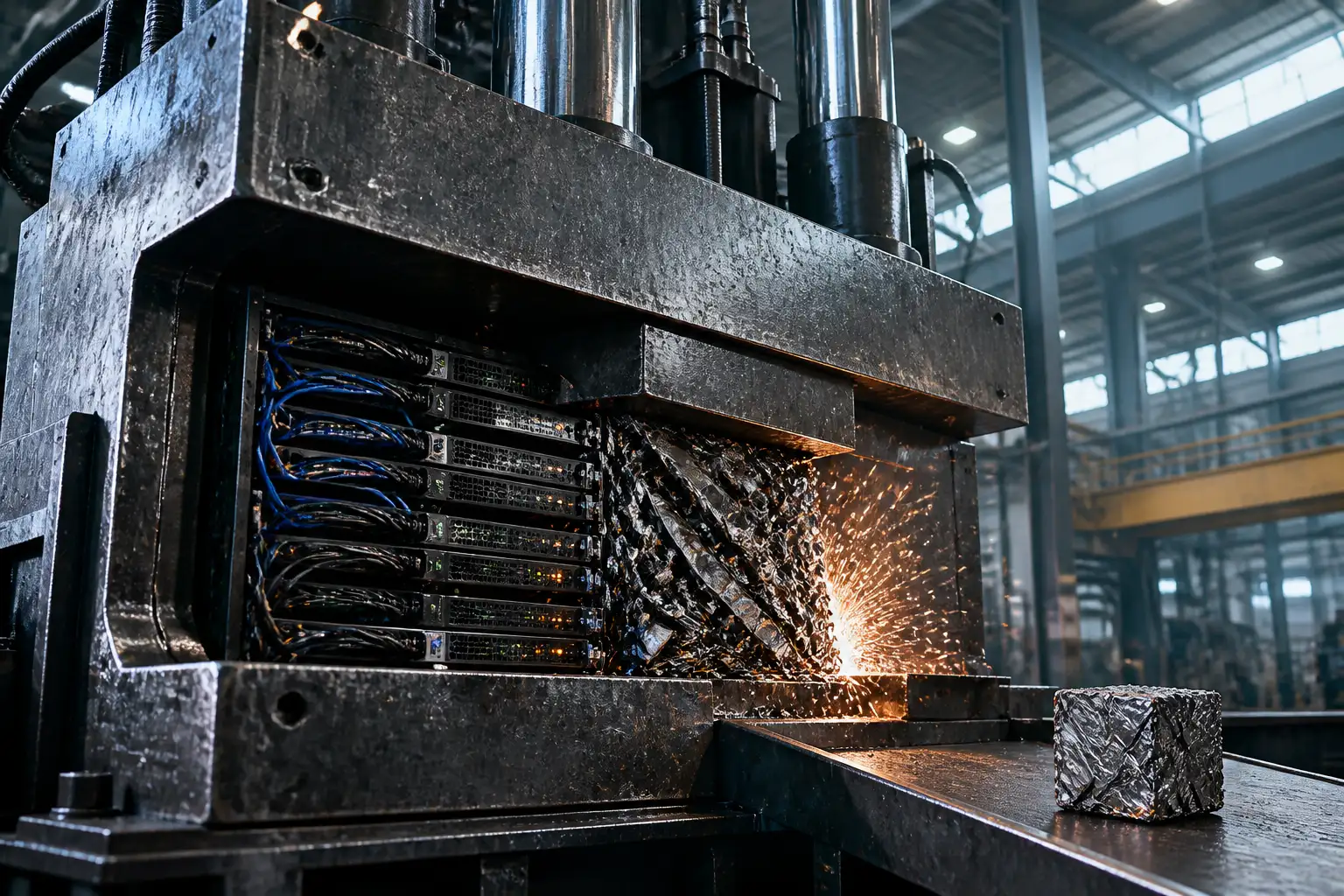
Physics Does the Shrinking, Not Quantum Chips
CompactifAI was developed by cofounder and chief scientific officer Román Orús, a physicist. It leans on tensor networks, a mathematical tool with roots in quantum physics research, to strip redundant parameters out of an already trained model.
- Tensor network – a mathematical framework born in quantum physics research, used to describe how enormous numbers of variables interact efficiently; Multiverse borrows the math to compress a neural network, not to run its software on an actual quantum computer.
Multiverse does not need a quantum computer to run CompactifAI at all. The compressed models it produces run on ordinary phones, cameras, cars and industrial sensors, the company says. Compressed models also process four to twelve times faster and cut inference costs by 50 to 80 percent, according to Multiverse’s own account of the technology.
$600 Billion Says Bigger Still Wins
Multiverse’s argument only matters because of what everyone else is doing. Microsoft, Amazon, Alphabet, Meta and Oracle are on pace to spend $660 billion to $690 billion in 2026 on data centers and AI infrastructure, according to research firm Futurum Group, nearly double what the same five companies spent in 2025.
Set that against the market Multiverse is chasing. The global edge AI market, every vendor and device combined, was worth an estimated $24.9 billion in 2025, and forecasters see the edge AI market growing toward $118.7 billion by 2033, per Grand View Research.
Those are not directly comparable pools of money. One counts infrastructure spending by five companies; the other estimates an entire product category’s revenue. But the gap in scale is exactly the bet: Multiverse is staking a still small, fast growing market against an industry pouring hundreds of billions of dollars into the opposite approach.
Who Is Already Buying Into the Bet?
Multiverse says it already serves more than 100 customers across manufacturing, finance, energy, aerospace, cybersecurity, defense and health and life sciences, with CompactifAI running on drones, cameras, satellites, vehicles and telecom infrastructure. That gives the technology a track record beyond pilot projects before this round even closed.
- Finance and insurance – Allianz, Bank of Canada and PwC are named users of compressed models
- Energy and industry – Iberdrola and Bosch have deployed CompactifAI in field and grid systems
- Telecom, aerospace and defense – Telefónica and Indra round out the customer roster named publicly
The appeal, in one lead investor’s telling, is how far the company has moved beyond its original niche.
Multiverse sits at the intersection of the infrastructure and the application layers and has evolved from being the leading downstream LLM compression technology to becoming a complete AI foundry and Operating System. It is the only company we’ve seen that has both the technical foundation and the commercial traction to be that critical platform.
Damien Henault, managing director and partner at Forgepoint Capital International, said that in explaining why his firm chose to co-lead the round.
A Round That Has Not Closed
The headline number is a target, not a final tally. Multiverse has not said when it expects to finish raising, nor what terms the lead investors receive for their stakes. A round announced while still open can also close below what it set out to raise.
The valuation itself is no surprise to anyone tracking the deal closely. Bloomberg reported in February 2026 that Multiverse was already in talks around a €1.5 billion valuation, the same figure now attached to the round five months later.
Once the Series C closes, Multiverse expects total funding raised since 2019 to reach about $800 million, folding in earlier grants and GPU credits alongside cash equity.
Spain’s Basque Country Doubles Down on Its Own Bet
Among the round’s backers sit two distinctly regional names: the Basque Government’s Hazten Scale-Up Fund and Kutxa Fundazioa, a Basque savings bank foundation. Both were investors before this round and both are back for the Series C, tying a slice of Basque public and semi-public money to one company’s read on where AI computing goes next.
Quobly, a French firm building physical qubits rather than compression software, closed a €115 million bet on silicon quantum computing earlier this year, and in Italy, Algorithmiq’s move to Milan came with a raise big enough to break the country’s quantum computing funding record. Basque public money is following the same regional logic.
“Multiverse’s CompactifAI introduces material changes to AI processing that address the global need for greater efficiency in AI, and their ingenuity is accelerating European sovereignty,” said Per Roman, cofounder and managing partner at Bullhound Capital.
Qatar Development Bank and the EIC Fund, the European Innovation Council’s investment arm, both joined a round built partly around keeping AI processing off American hyperscaler infrastructure entirely, not simply cheaper to run there. For now, both regional and sovereign money are tied to the same unclosed number: a $1.7 billion valuation nobody has fully paid for yet.
Frequently Asked Questions
Is Multiverse Computing a quantum computing company?
Multiverse builds no quantum hardware. It was founded in 2019 to apply quantum-inspired software to optimization problems in finance and energy, and CompactifAI still leans on tensor networks, a framework borrowed from quantum physics, but runs entirely on classical chips.
How much money has Multiverse Computing raised in total?
Once the Series C closes, total funding since 2019 is expected to reach about $800 million. That figure blends cash equity with non-cash support; the Series B alone included $35 million in grant funding and GPU resources on top of $180 million in equity, per the company’s own account of that round.
How much faster or cheaper does CompactifAI make AI models run?
Beyond the headline size reduction, Multiverse says compressed models run four to twelve times faster and cut inference costs by 50 to 80 percent compared with the uncompressed originals.
Are the Series C investors new backers or returning ones?
Both. Bullhound Capital led the Series B and co-leads the Series C, and Forgepoint Capital International moved from a supporting investor last time to a co-lead this time. Qatar Development Bank, HP Inc. and NAventures are newer names on the cap table.
What market is Multiverse Computing chasing with this technology?
The company has pointed to the AI inference market, the ongoing cost of running trained models rather than building them, which it previously sized at $106 billion globally.


Beelzebub’s €3 Million Raise Rides a Wave of EU Cyber Deadlines

Multiverse Computing’s $570 Million Bet on Smaller AI

GTA 6 Japan Code Expiration Traces to a Six-Month Payment Law

Windows 11 Finally Reverses the Taskbar Cut It Made in 2021

Elon Musk’s X Money Bet Echoes the Fight That Fired Him

Claude Chats That Leaked to Google Still Live On GitHub

DFINITY Bets Its Crashed Crypto Project on Sovereign Cloud

Facebook Verified Brings Back the Facial Recognition Meta Deleted

A Chinese Open Model Just Saved Hugging Face From OpenAI

Samsung’s Galaxy Glasses Run on Meta’s Own Chip Too

CLARITY Act Final Text Expected This Weekend as 60-Vote Hurdle Looms

Kalshi Loses Major NY Prediction Markets Ruling to Judge Torres

Fed Minutes Cite AI Demand as Inflation Risk, Put a 2026 Hike Back on the Map

Marker AI Writing Startup Lands $13M Seed Led by Index Ventures

Dota 2 Esports World Cup 2026: Spirit Defends $2M Title In Paris

Meta’s Muse Spark 1.1 Beats Rivals on Price, Trails on Coding

ARC Intelligence Closes €4M Seed Round in Roughly a Week

CS2 Premier Season 5 Lands With Cache and a C4 Damage Rework

Trump Calls Iran ‘Islamic Republic of Japan’ as Ceasefire Ends

Finto Picks Munich Over Silicon Valley After YC, Raises $3.4M
-
 FINANCE2 months ago
Zcash Patched a Double-Spend Bug as ZEC Climbed 5%
-
 ENTERTAINMENT2 months ago
Steam Summer Sale 2026 Locks In June 25 to July 9 Dates
-
 NEWS3 months ago
Meta Adds AI Replies to Threads, But Users Can’t Block It
-
 FINANCE3 weeks ago
CLARITY Act Final Text Expected This Weekend as 60-Vote Hurdle Looms
-
 ENTERTAINMENT2 months ago
‘Widow’s Bay’ Review: Apple TV’s Sleeper Horror-Comedy Earns Its Fog
-
 NEWS7 months ago
FolderFresh Review: This Free Tool Automates Windows File Organizing
-
 NEWS4 months ago
U.S. Navy Deploys Solar-Powered Lightfish Drone to Patrol Oceans
-
 FINANCE3 weeks ago
Kalshi Loses Major NY Prediction Markets Ruling to Judge Torres