
BUSINESS
Alphabet’s AI Spend Delivers Growth and Its First Cash Crunch
Alphabet’s record AI infrastructure outlay produced 82% cloud growth and the company’s first negative free cash flow.

Alphabet just printed its first negative free cash flow quarter as a public company after capital spending hit $44.9 billion in the three months ended June 30. Revenue still climbed 24 percent to $119.8 billion and Google Cloud accelerated to 82 percent growth. The growth and the bill arrived in the same release.
On Fox Business shortly after the numbers, Motley Fool Asset Management portfolio manager Shelby McFaddin framed the tradeoff that now sits in front of every hyperscaler: lead on AI infrastructure or protect the cash engine that pays for it. Apple’s parallel path, heavy on services and lighter on absolute capex intensity, offers the cleanest contrast.
The First Negative Free Cash Flow Print
Operating cash flow reached $39.1 billion. Capex ran $44.9 billion. Free cash flow therefore came in at roughly negative $5.9 billion. Trailing-twelve-month free cash flow stayed positive at $53.3 billion, yet the quarterly crossover is historic.
CFO Anat Ashkenazi told analysts the vast majority of the spend went into technical infrastructure for AI. Roughly 60 percent landed in servers and 40 percent in data centers and networking. Full-year 2026 capex guidance moved to $195 billion to $205 billion, up from the prior $180 billion to $190 billion range.
| Metric | Q2 2026 | Change |
|---|---|---|
| Total revenue | $119.8 billion | +24% |
| Google Cloud | $24.8 billion | +82% |
| Operating margin | 34% | +2 pts |
| Capex | $44.9 billion | +100% YoY |
| Free cash flow | -$5.9 billion | First negative |
The second-quarter 2026 earnings release also showed operating income up 30 percent. Diluted EPS jumped to $9.11, lifted in part by large unrealized gains on equity securities. The operating business itself expanded. The cash conversion simply did not keep pace with the buildout.
The arithmetic is straightforward. Capex exceeded operating cash flow by about $5.8 billion in the quarter, and that gap is what produced the first negative free cash flow print. Trailing-twelve-month free cash flow of $53.3 billion still shows a multi-quarter cushion, but one quarter of heavy server and data-center outlays was enough to flip the sign.
Guidance reinforces the point. The new full-year range of $195 billion to $205 billion lifts the prior band by $15 billion at both ends. Management is signaling that the pace set in this quarter is not a one-time spike.
- Servers absorbed roughly 60 percent of technical infrastructure spend.
- Data centers and networking took the remaining 40 percent.
- Operating margin still expanded two points to 34 percent even as cash conversion lagged.
Investors sold the stock hard in the immediate reaction. The number that mattered was not the revenue beat. It was the cash-flow line that had never before gone red.
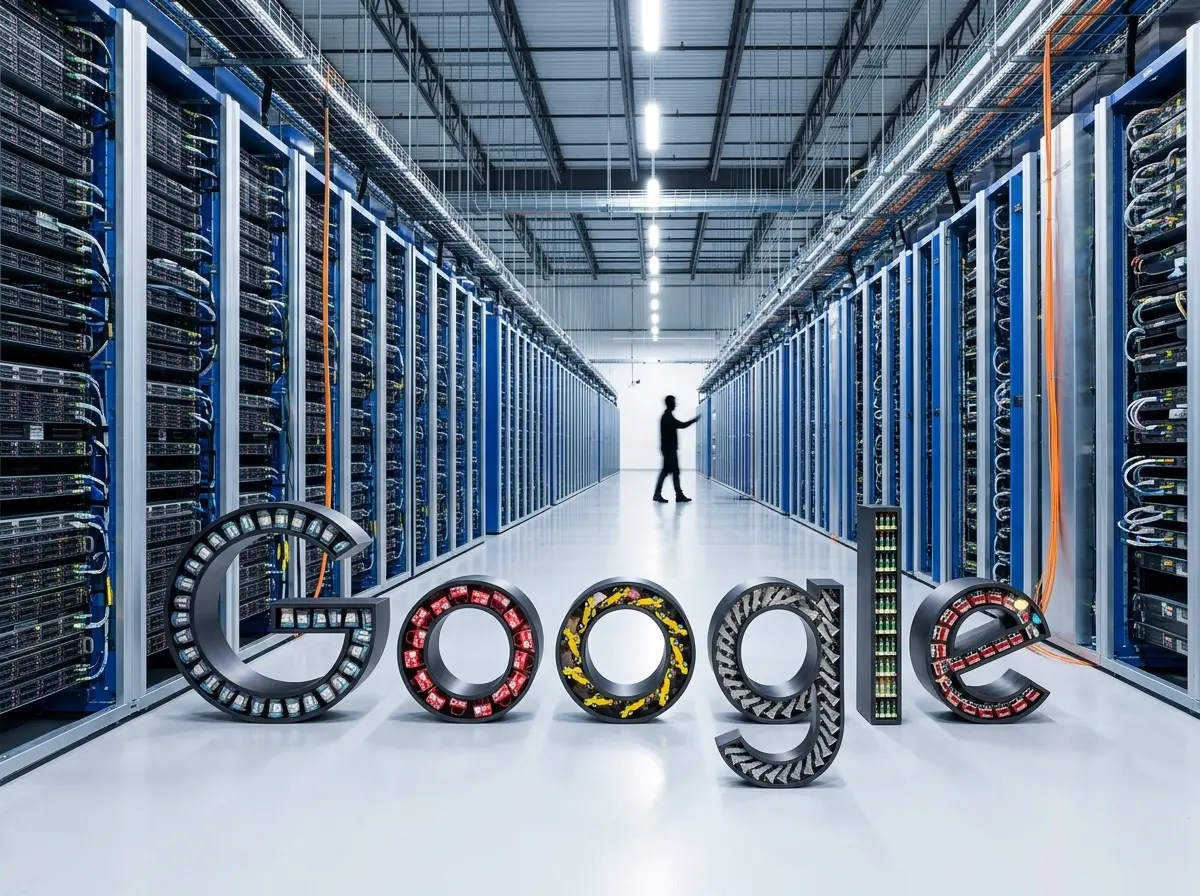
Cloud Growth Hit 82 Percent
Google Cloud revenue reached $24.8 billion. Backlog climbed to $514 billion. That backlog is larger than several years of prior total company capex. Demand is not theoretical.
- Gemini App hit 950 million monthly active users; daily actives tripled year over year.
- Model APIs process roughly 22 billion tokens per minute, up from 16 billion the prior quarter.
- Nearly 90 percent of the Fortune 100 now use Gemini Enterprise.
- Agent Development Kit downloads approached 70 million.
- More than 2,000 enterprises each consumed over 100 billion tokens in the last twelve months.
CEO Sundar Pichai wrote on X that the quarter showed AI investments “redefining what’s possible across every part of our business.” He pointed to the same cloud acceleration, the token ramp, and Search query growth from AI features. The full earnings call transcript details add that AI Mode now exceeds one billion monthly active users and that the company continues to cut the cost of those responses even as capabilities rise.
The token figures alone sketch a steep utilization curve. Throughput moved from 16 billion tokens per minute to 22 billion in a single quarter. That rise sits alongside the Gemini App’s 950 million monthly active users and the tripling of daily actives. Usage is scaling on both the consumer and enterprise sides at once.
Cloud operating income also improved sharply. Scale is starting to show. The open question is whether inference pricing and utilization will keep climbing fast enough to justify the next wave of servers already on order.
Backlog of $514 billion gives the company multi-year visibility into contracted demand. That figure does not remove the near-term cash strain, but it does explain why management is willing to keep raising the capex guide. Customers have already committed work that must run on the capacity now being built.
Search Still Carries the Cash Load
Google Services revenue rose 15 percent to $94.5 billion. Search & other grew 17 percent. YouTube ads added 13 percent. Advertising remains the primary cash generator that funds everything else.
AI Overviews and AI Mode are now folded into one seamless experience. Management says the features drive incremental queries and still send billions of clicks to the open web each week. Ad yield has held so far. That stability is the quiet pillar under the entire spend plan.
Services revenue of $94.5 billion still dwarfs Cloud’s $24.8 billion. The advertising engine inside Search and YouTube is what makes a $44.9 billion quarterly capex bill even conceivable. Without double-digit growth in those lines, the infrastructure build would pressure the balance sheet far sooner.
If generative answers ever meaningfully reduce high-intent commercial clicks without a matching rise in new ad formats or higher pricing, the math changes. McFaddin highlighted exactly this tension: smarter answers must still support strong ad yield. So far the data has not broken. The test continues every quarter.
Apple Sticks to Services Stickiness
Apple reported its own June quarter one week later. Revenue reached $109.4 billion, up 16 percent. Services hit a June-quarter record at $30.74 billion, up 12 percent, even if the print slightly missed some estimates. Company gross margin landed at 50.1 percent, helped by tariff refunds.
Apple’s June-quarter revenue and margins underscore a different capital intensity. The company leans on an installed base of active devices that keeps buying high-margin services: App Store, iCloud, Apple Music, AppleCare, advertising, and payments. On-device AI and privacy framing fit that model. Hardware cycles still matter, yet services smooth the volatility.
| Company | Quarterly revenue | Growth | Notable margin or mix |
|---|---|---|---|
| Alphabet | $119.8 billion | +24% | Operating margin 34% |
| Apple | $109.4 billion | +16% | Gross margin 50.1% |
| Alphabet Cloud | $24.8 billion | +82% | Backlog $514 billion |
| Apple Services | $30.74 billion | +12% | June-quarter record |
Tim Cook called it the strongest June quarter ever, with double-digit growth across iPhone, Mac, and Services in every geographic segment. The next iPhone cycle will show whether new AI features move upgrade rates. Until then, Apple’s cash generation faces far less absolute pressure from data-center construction.
The contrast in capital intensity is structural. Alphabet is funding servers, data centers, and networking at a run rate that now exceeds operating cash flow in a single quarter. Apple’s services layer rides an installed base and avoids that absolute infrastructure bill. Both companies are growing revenue at double digits. Only one is printing negative free cash flow to stay in the AI capacity race.
Relative stock performance this year has reflected the difference. Apple’s lower need for multi-hundred-billion-dollar annual infrastructure builds has looked like a feature while hyperscalers race.
How the Equity Raise Fits the Picture
In June Alphabet issued a mix of Class A, Class C, and mandatory convertible preferred stock for net proceeds of $49.6 billion. The company also set up a $40 billion at-the-market equity program. Proceeds are earmarked for general corporate purposes, including AI infrastructure and global compute. The company has also tapped the bond market.
That financing sits beside the recent multi-billion equity raise for AI compute narrative already familiar to readers. Cash from operations no longer fully covers the build. External capital fills the gap. The same pattern is visible across Amazon, Microsoft, and Meta. Bond investors have started demanding higher spreads. Funding costs are no longer free.
Crowd reaction on X after the print focused less on the cloud beat and more on the funding wall. When even the most profitable technology companies must borrow or dilute to keep building, the cycle has entered a new phase. Absorption capacity now matters as much as raw growth.
Stack the pieces and the sequence is clear. Operating cash flow of $39.1 billion could not cover $44.9 billion of capex. The $49.6 billion equity raise and the $40 billion at-the-market program exist to close that kind of gap. Full-year guidance of $195 billion to $205 billion implies the gap may recur until cloud and AI revenue conversion accelerates further.
The Backlog Gives Demand a Multi Year Floor
Cloud backlog at $514 billion is larger than several years of prior total company capital spending. That single figure reframes the negative free cash flow quarter as a timing mismatch rather than a demand problem.
Enterprise adoption metrics support the same reading. Nearly 90 percent of the Fortune 100 now use Gemini Enterprise. More than 2,000 enterprises each consumed over 100 billion tokens in the last twelve months. Agent Development Kit downloads approached 70 million. These are contracted or recurring usage signals, not pilot experiments.
Management still has to turn backlog into billed revenue and billed revenue into free cash flow. The $514 billion figure does not automatically repay the servers already ordered. It does, however, give investors a lower bound on the work those servers are meant to run. Capex guidance in the $195 billion to $205 billion range is easier to defend when contracted demand already stretches that far.
The risk shifts from “will customers show up” to “will pricing and utilization convert this backlog fast enough to restore positive free cash flow.” That is a different question, and it is the one the next several quarters will answer.
What Shared Funding Pressure Means Across Peers
Alphabet is not alone in reaching for external capital. The same pattern is visible across Amazon, Microsoft, and Meta. Bond investors have started demanding higher spreads. Funding costs are no longer free for any of the large builders.
When the most profitable technology companies must borrow or dilute to keep building, absorption capacity becomes a shared constraint. Each firm is racing to secure servers and power at the same moment. That simultaneous demand is what lifts spreads and what makes equity programs like Alphabet’s $40 billion at-the-market facility look prudent rather than optional.
McFaddin’s framing applies industry-wide: lead on AI infrastructure or protect the cash engine. Alphabet chose to lead and accepted a first negative free cash flow quarter as the visible cost. Peers face the same menu. The companies that convert capacity into high-utilization, positively priced inference first will justify the dilution and the debt. The others will carry the funding cost longer.
The Metrics That Will Decide the Next Quarter
Unit economics of inference sit at the center. Management already reports lower costs per AI Mode response. Hardware utilization and model efficiency gains can turn a pure cost story into operating leverage. Clearer breakouts of AI-related revenue would help the market price progress instead of promise.
What we know
- 2026 capex guided to $195-205 billion.
- Cloud backlog $514 billion and still growing.
- First quarterly FCF deficit of roughly $5.9 billion.
- Search and YouTube ad growth still double-digit.
What remains unconfirmed
- Exact timeline for free-cash-flow recovery.
- Pricing power on consumer-facing AI features.
- How much of the 2027 spend will be locked in before ROI appears.
- Whether ad yield holds as AI answers become default.
The same test faces every large spender. The broader corporate AI spending ROI gap shows most firms still struggle to convert outlays into measurable returns. Alphabet’s full-stack position and cloud momentum put it nearer the front of the pack, yet the cash-flow print shows the cost of staying there.
McFaddin called it a balance between ambition and discipline that investors must now score quarter by quarter. Product launches, the next capex update, and any fresh disclosure on AI pricing will set the tone into year-end. Execution can still make today’s outlays look wise. Margin slippage and prolonged negative free cash flow will speak louder than any roadmap.
The race continues. Patience now has a visible price tag.


UK AI Mega-Rounds Capture Europe’s H1 2026 Funding Rebound

Highland Europe’s €1.1B Fund VI Draws Public Backing for Scaleups

TÖNNJES Backs Bikekey to Scale Digital Bike IDs Beyond Theft

Intropy’s $11M Seed Cracks Manual Spare Parts Moat

Inforcer’s $50M Series C Turns MSP Control Planes Into SMB AI Shields

Meta AI Lifts Instagram Scroll Time as Lawsuits Mount

Redmi Note 17 Leak Puts Giant Si-C Batteries in Midrange

Police Chiefs Back CLARITY Act as Passage Odds Sink Below 30%

Perceptron $6.5M Round Cracks AI Data Gatekeeping

HONOR MagicOS 11 Sets August 6 Date and Forces the Glass Race

CLARITY Act Final Text Expected This Weekend as 60-Vote Hurdle Looms

Kalshi Loses Major NY Prediction Markets Ruling to Judge Torres

Fed Minutes Cite AI Demand as Inflation Risk, Put a 2026 Hike Back on the Map

Marker AI Writing Startup Lands $13M Seed Led by Index Ventures

Dota 2 Esports World Cup 2026: Spirit Defends $2M Title In Paris

Meta’s Muse Spark 1.1 Beats Rivals on Price, Trails on Coding

CS2 Premier Season 5 Lands With Cache and a C4 Damage Rework

ARC Intelligence Closes €4M Seed Round in Roughly a Week

Finto Picks Munich Over Silicon Valley After YC, Raises $3.4M

Backrooms Returns to Theaters as the Everything Must Go Edition
-
 FINANCE2 months ago
Zcash Patched a Double-Spend Bug as ZEC Climbed 5%
-
 ENTERTAINMENT2 months ago
Steam Summer Sale 2026 Locks In June 25 to July 9 Dates
-
 FINANCE4 weeks ago
CLARITY Act Final Text Expected This Weekend as 60-Vote Hurdle Looms
-
 NEWS3 months ago
Meta Adds AI Replies to Threads, But Users Can’t Block It
-
 ENTERTAINMENT2 months ago
‘Widow’s Bay’ Review: Apple TV’s Sleeper Horror-Comedy Earns Its Fog
-
 NEWS8 months ago
FolderFresh Review: This Free Tool Automates Windows File Organizing
-
 NEWS5 months ago
U.S. Navy Deploys Solar-Powered Lightfish Drone to Patrol Oceans
-
 FINANCE3 weeks ago
Kalshi Loses Major NY Prediction Markets Ruling to Judge Torres