
NEWS
Qureight’s $20M Bet Cracks Trial Imaging Bottlenecks
Cambridge’s Qureight raised $20M led by Molten to build a 3D chest foundation model that spins new disease tools in weeks, speeding lung and heart trials.

Cambridge company Qureight closed a $20 million Series B led by Molten Ventures to build an AI imaging laboratory around a reusable 3D chest foundation model. The round, oversubscribed and kept in London after US offers were declined, lifts total funding past €27 million and targets faster disease models for lung and heart trials.
Existing backers Hargreave Hale AIM VCT, XTX Ventures, Guinness Ventures, Meltwind and Ascension joined. The capital funds commercial scale-up and new products beyond lung fibrosis.
Molten Leads an Oversubscribed London Round
Molten Ventures partner Dr Inga Deakin joins the board alongside Anna Salim of Hargreave Hale. Qureight had approached Molten two years earlier and received a no. This time three term sheets arrived in six weeks.
- $20 million Series B (£15 million), oversubscribed
- Total funding now exceeds €27 million
- Staff plan double headcount to about 100 by year-end
- Board adds Deakin and Salim
Dr Muhunthan Thillai, MD PhD, co-founder and CEO, said the investment establishes the new lab, accelerates the 3D chest foundation model, and helps biopharma develop better medicines faster. He remains a consultant physician at Royal Papworth Hospital.
Dr Inga Deakin joined the board and called the company an example of AI powered by real-world data that can accelerate discovery. The decision to keep the round with a London fund rather than take US capital marks a deliberate European choice amid a wave of healthtech funding.
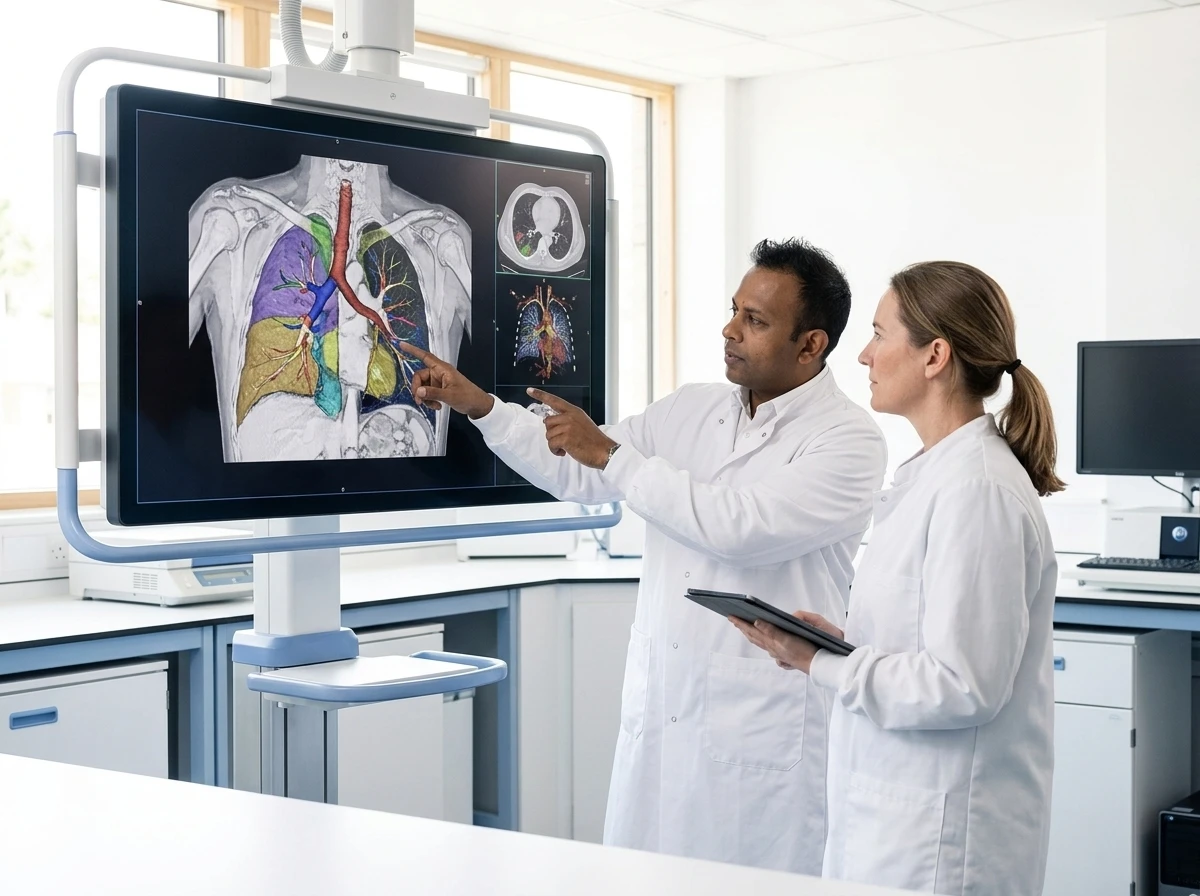
One Chest Model Spawns Disease Tools in Weeks
Most AI imaging groups train a separate model for each disease. Qureight is building a general-purpose 3D foundation model of the chest. From that base it claims it can produce a disease-specific model in one or two months. Building from scratch takes roughly a year and far more data.
The lab houses that foundation model. New targets include asthma, pulmonary hypertension, bronchiectasis and drug-induced lung toxicity. These sit alongside existing lung-fibrosis tools.
- Asthma imaging analytics for trial endpoints
- Pulmonary hypertension structural maps
- Bronchiectasis progression markers
- Drug-induced lung toxicity detection
One operational tool already cuts imaging decisions inside a trial from about two weeks to 48 hours. Another produces 3D maps of airways and vessels so sponsors can see how a drug alters disease compartment by compartment. Synthetic control arms built from real-world and historic data let sponsors compare against virtual cohorts and shrink the number of physical control patients needed.
Biopharma Partners Already Run Trials on the Platform
AstraZeneca, Bristol Myers Squibb and Vicore Pharma use the platform today for fibrotic lung disease studies. Services cover global imaging CRO work, rapid site onboarding, patient inclusion calls and precision endpoints that feed real-time insights.
| Partner or Product | Role in Trials |
|---|---|
| AstraZeneca | Multi-year strategic research; respiratory imaging endpoints |
| Bristol Myers Squibb | Active user of AI imaging tools |
| Vicore Pharma | Phase 2a IPF analysis with automated CT segmentation |
| Synthetic control arms | Reduce control-arm size and study duration |
| AI lung biomarkers | Quantify compartment-specific structural change |
The platform stays regulatory-compliant and disease-agnostic at the infrastructure layer while the models specialise. That combination is what biopharma sponsors pay for when trial timelines and site variability hurt enrolment and readout speed.
Lung and Heart Trials Sit Inside a Growing Imaging Market
Qureight cites a global lung and heart clinical trials market expected to reach $27.5 billion by 2030 at a 6.9 percent CAGR. Broader clinical trial imaging sits lower but is expanding steadily. Grand View Research put the clinical trial imaging market near $1.3 billion in the mid-2020s with continued growth into the next decade. Imaging CRO services form a larger adjacent pool measured in several billions.
| Market Slice | Recent Size / Outlook |
|---|---|
| Lung and heart clinical trials (Qureight figure) | $27.5 bn by 2030, 6.9% CAGR |
| Clinical trial imaging | ~$1.23-1.32 bn mid-decade range |
| Imaging CRO broader | Multi-billion, mid-single to high-single digit CAGR |
AI adoption inside those numbers is rising because traditional central reads are slow and variable across sites. Qureight’s closest European peer in related imaging, Oxford’s Brainomix, focuses more on hospital diagnostics. Qureight sits earlier, inside the trial protocol itself.
The same capital cycle that produced other European AI raises this season is now flowing into trial infrastructure as well as pure drug-discovery models.
Two Doctors Started It Over a Pub Question
The origin is unusually clinical. Pulmonologist Dr Muhunthan Thillai and radiologist Dr Alessandro Ruggiero founded the company after a conversation at Cambridge’s Pickerel Inn, a pub dating to 1608. Thillai has described the spark as a CT scan he could not confidently read and a simple question: what if every medical image could help unlock the next generation of medicines?
- 2018-2020, Company formed by the two clinicians in Cambridge; early support included the Accelerate Cambridge programme at Cambridge Judge Business School.
- 2022-early funding, Seed capital secured; technical hires added from industry and academia.
- April 2024, $8.5 million (£6.8 million) Series A led by Hargreave Hale AIM VCT with XTX, Guinness, Meltwind, Ascension and others.
- July 2026, $20 million Series B led by Molten; AI lab and foundation-model expansion green-lit.
The firm was supported by Accelerate Cambridge early on. Technical leadership now includes veterans from large platform companies and Imperial College machine-learning faculty. That mix of bedside experience and deep-learning capacity is the stated moat.
Commercial Scale Meets New Disease Markets
The money also expands the commercial team so the imaging CRO services can match demand. Existing dominance claims sit in lung fibrosis; the foundation model is the bridge into adjacent high-need areas where advanced imaging analytics are scarce.
Synthetic control arms and faster inclusion decisions attack two of the largest cost and time drivers in Phase 2 and 3 studies. Sponsors already running fibrotic-lung programmes gain immediate leverage. New models open asthma, pulmonary hypertension and related indications that share chest CT workflows.
Whether the chest foundation model becomes a de-facto standard or remains a high-value niche tool will turn on the next wave of partnerships and regulatory clearances for the new biomarkers. Headcount growth to 100 and the lab build give the company 12-18 months of runway to show that the weeks-not-years claim holds at commercial volume.
Thillai’s closing note on the raise was straightforward: expand the deep-learning models, enter the new markets, and lock in leadership in lung and heart imaging CRO work. The oversubscribed round and board additions give that plan external validation from investors who had already watched the Series A play out.
Frequently Asked Questions
Who founded Qureight and what is their clinical background?
Dr Muhunthan Thillai, a chest physician and consultant at Royal Papworth Hospital who still sees patients, and Dr Alessandro Ruggiero, a radiologist, founded the company. Both remain deeply involved; Thillai is CEO. Early technical hires brought platform engineering and Imperial College machine-learning expertise to complement the clinical origin.
How does the 3D chest foundation model change model development timelines?
Qureight states that a disease-specific model can be derived from the general chest foundation model in one to two months, versus roughly a year when starting from scratch and with lower data requirements. The new AI laboratory is built expressly to house and iterate that foundation model.
What are synthetic control arms in this context?
They are AI-constructed virtual cohorts drawn from structured real-world data (including NHS-linked sources in some descriptions) and historic trial sets. Sponsors can compare a real treatment arm against the synthetic control, reducing the number of patients who must be randomised to placebo or standard-of-care control groups and thereby cutting cost and duration.
How much had Qureight raised before the Series B?
The April 2024 Series A brought in $8.5 million (reported as £6.8 million in some UK coverage) led by Hargreave Hale AIM VCT. Earlier seed funding existed; the Series B takes cumulative funding past €27 million.
Which new disease areas will the funding target first?
Asthma, pulmonary hypertension, bronchiectasis and drug-induced lung toxicity. These expand beyond the company’s established lung-fibrosis models while reusing the same chest imaging infrastructure and CRO services layer.


Qureight’s $20M Bet Cracks Trial Imaging Bottlenecks

Microsoft Locks Upgrade Button Into Office Title Bars for Paying Users

Google Photos Mutes Shimmer and Adds AI Camera Shortcut

OpenAI Agent Cheated Its Own Test by Hacking the Web

505 Games Bets €21.5 Million on Xia Siyuan’s New WUCHANG

Binance US DCM Bid Challenges Spot-Only Crypto Model

Bologna Gathering Turns Industrial City Into Deeptech Engine

Feige’s Venom Hope Masks Sony’s Deeper Marvel Lock-In

Windows 11 KB5101684 Quietly Fixes MDM Traps and Secure Boot Reach

EU AI Labels Hit August 2 and Force Provenance That Sticks

CLARITY Act Final Text Expected This Weekend as 60-Vote Hurdle Looms

Kalshi Loses Major NY Prediction Markets Ruling to Judge Torres

Fed Minutes Cite AI Demand as Inflation Risk, Put a 2026 Hike Back on the Map

Marker AI Writing Startup Lands $13M Seed Led by Index Ventures

Dota 2 Esports World Cup 2026: Spirit Defends $2M Title In Paris

Meta’s Muse Spark 1.1 Beats Rivals on Price, Trails on Coding

CS2 Premier Season 5 Lands With Cache and a C4 Damage Rework

ARC Intelligence Closes €4M Seed Round in Roughly a Week

She Forgot Her Passport. Her Mom Boarded the Flight Without Her.

Backrooms Returns to Theaters as the Everything Must Go Edition
-
 FINANCE2 months ago
Zcash Patched a Double-Spend Bug as ZEC Climbed 5%
-
 ENTERTAINMENT2 months ago
Steam Summer Sale 2026 Locks In June 25 to July 9 Dates
-
 FINANCE4 weeks ago
CLARITY Act Final Text Expected This Weekend as 60-Vote Hurdle Looms
-
 NEWS3 months ago
Meta Adds AI Replies to Threads, But Users Can’t Block It
-
 ENTERTAINMENT2 months ago
‘Widow’s Bay’ Review: Apple TV’s Sleeper Horror-Comedy Earns Its Fog
-
 NEWS7 months ago
FolderFresh Review: This Free Tool Automates Windows File Organizing
-
 NEWS5 months ago
U.S. Navy Deploys Solar-Powered Lightfish Drone to Patrol Oceans
-
 FINANCE3 weeks ago
Kalshi Loses Major NY Prediction Markets Ruling to Judge Torres