
NEWS
Bologna Gathering Turns Industrial City Into Deeptech Engine
Cubbit founders’ invite-only event plus free GPUs at Italy’s AI Factory convert Motor Valley density into startup partnerships and capital velocity.

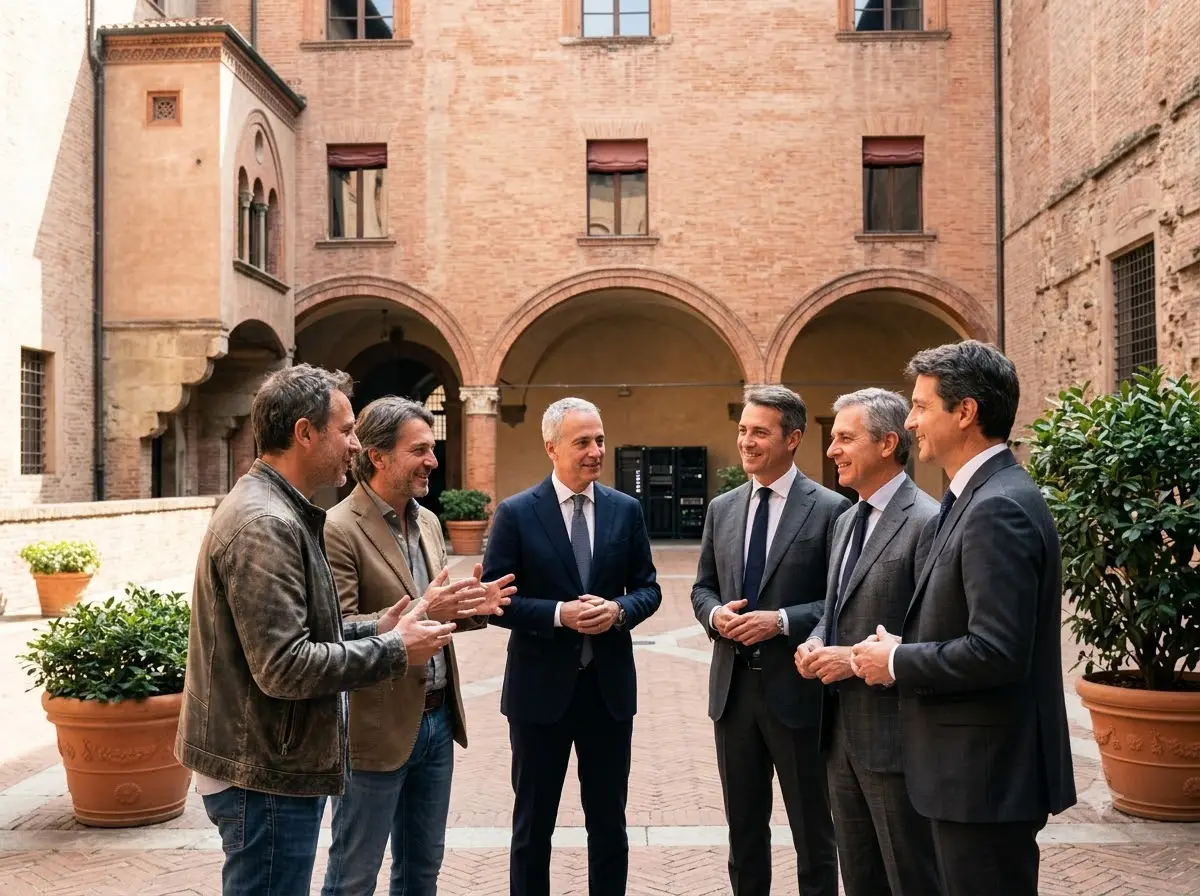
Alessandro Cillario and Stefano Onofri, co-CEOs of Bologna-based Cubbit, pulled more than 500 founders, investors and corporate leaders to their fourth Bologna Gathering in May 2026. Attending funds managed over €50 billion. Participating startups had already raised more than €1.2 billion.
The pair still run one of Europe’s leading sovereign cloud companies. They treat the invitation-only gathering as core work, not charity.
The Gathering That Skips the Noise
Cillario and Onofri co-founded The Bologna Gathering after Web Summit left them wanting deeper conversations. Large events deliver scale. They rarely deliver the quiet intensity early-stage teams need with actual buyers and serious capital.
The invite-only event format and past line-ups keep the room tight: selected VCs, scale-up founders and senior executives from Europe, the Americas and Asia. The 2025 edition logged more than 1,000 one-to-one meetings in under eight hours at Bologna Business School. Investor AUM in the room rose from €39 billion that year to more than €50 billion in 2026.
- 500+ carefully chosen leaders in 2026
- €50bn+ assets under management among attending investors
- €1.2bn+ already raised by the startups and scale-ups present
- 16+ major corporates now active, up from under ten in year one
Cubbit produces the event with StartYouUp and a web of public partners including ART-ER, the Emilia-Romagna Region and the Metropolitan City of Bologna. Venues range from historic libraries to business-school campuses and gala dinners. The goal stays practical: turn introductions into pilots and cheques.
Corporates Sit at the Table
Most big tech conferences treat industry as sponsors in the hallway. TBG puts them in the room as customers. Cillario notes that Europe’s loudest successes often began as consumer products. Enterprise sales move slower and demand proof.
“That’s why bringing corporates into the event is so important,” he said. “In the first year we had fewer than ten corporate participants. Today we have more than sixteen major companies involved because they’ve realised there’s real value here.”
| Participant type | Early editions | Recent editions | Examples present |
|---|---|---|---|
| Major corporates | Under 10 | 16+ | Ferrari, Ducati, Generali, Intesa Sanpaolo, CNH Industrial, Chiesi, Dallara, Menarini Silicon Biosystems, JP Morgan, Unipol |
| Investor AUM | €39bn (2025) | €50bn+ (2026) | LocalGlobe, BlackRock, Eurazeo, CDP Venture Capital, ETF Partners, Hitachi Ventures |
| 1:1 meetings | – | 1,000+ in 8 hours (2025) | Founders with buyers and capital in same sessions |
Early-stage teams can ask a Ducati or Ferrari engineer a direct question: would this solve your problem? That feedback loop shortens the path from prototype to purchase order. Local industry density makes the conversations real rather than theatrical.
Bologna’s Industrial Base Meets Free GPUs
Bologna already exports roughly one-third of its goods as industrial machinery for packaging, automation, robotics and precision engineering. It sits at the heart of Italy’s Motor Valley. Ducati’s headquarters are in the city; Lamborghini sits nearby in Sant’Agata Bolognese. Automotive suppliers and motorsport engineering fill the surrounding region. Ducati’s Bologna headquarters and Motor Valley roots give deeptech teams ready access to sophisticated buyers who already understand complex hardware and software integration.
That base now sits next to one of Europe’s densest AI and supercomputing clusters. The Bologna Technopole, developed by the Emilia-Romagna Region and Italy’s Ministry of University and Research, hosts CINECA, the European Centre for Medium-Range Weather Forecasts and the National Institute for Nuclear Physics. At its core sits IT4LIA AI Factory.
Eligible startups, SMEs, researchers and public bodies receive free access to high-performance computing and technical support. The factory already draws on Leonardo, the AI-optimised LISA partition, the cloud-native GAIA platform and MEGARIDE. Together they deliver over 20,000 GPUs across Leonardo LISA GAIA and related systems, forming one of the continent’s strongest AI platforms.
In April 2026 EuroHPC JU signed the April 2026 procurement contract for the new system with E4 Computer Engineering and Dell Technologies. The incoming IT4LIA supercomputer, budgeted at €290 million and based on liquid-cooled NVIDIA GB200 NVL4 architecture with European components from SiPearl and Axelera AI, targets more than 160 exaflops of peak AI inference performance. Installation is planned at the DAMA Tecnopole data centre managed by CINECA. The wider infrastructure programme around the Technopole runs to roughly €1 billion.
Infrastructure alone does not create companies. Cillario put it plainly: “Building infrastructure alone isn’t enough. You also need to build an ecosystem.”
Returning Founders and Quiet Capital
Italy still loses talent. It also gains it back. “Brain circulation” now describes founders who leave for London, Silicon Valley or Australia, then return with networks, capital and operating scars.
Simone Mancini came back from Australia to co-found fintech unicorn Scalapay. Luca Ferrari returned to Milan and built Bending Spoons into one of Europe’s largest software companies. Danila De Stefano developed Unobravo while living in London. Simone Di Somma sold his Y Combinator-backed Innaas to SAP and launched cybersecurity firm Cyberwave. Iris Skrami moved Renoon, her digital product passport startup, from the Netherlands to Italy because fashion regulation would hit Italian brands first and family-owned houses still decide quickly.
Skrami noted that many early customers already want multi-year contracts ahead of full regulation, fearing later price rises. Decision cycles inside those traditional brands often run faster than inside large multinationals.
Cillario describes Emilia-Romagna as an incredibly wealthy region with a strong industrial base and significant private capital. Unlocking even a tiny fraction of that money would transform Italian venture volume. Milan sits about an hour away by train; Turin and Rome are reachable. More companies now choose to start or relocate here.
I’ve never really believed in the idea of “giving back” only after you’ve already become successful. Waiting twenty or thirty years, building a fortune and then deciding to help the ecosystem doesn’t make much sense to me. During those decades you could have been supporting Europe, your city or your local startup community.
Cillario made the point while explaining why Cubbit keeps investing energy in the Gathering while scaling internationally. Some founders who attended early editions have already launched companies and raised millions. A few may outgrow Cubbit. That outcome is the target.
Test Lines and University Spinouts
Research stays useless until someone can try it without buying a factory. BI-REX, the Big Data Innovation & Research Excellence competence centre, runs a flagship Test Before Invest pilot line access programme. Startups build proofs of concept, run products on a smart-factory line, and tap robotics, AI platforms, additive manufacturing, digital twins, IoT, 5G and HPC without owning the kit. The centre also offers technology assessments, collaborative R&D, finance access, market validation, acceleration and Industry 4.0 training.
Supporting organisations around Bologna include:
- COBO Accelerator for digital and industrial technologies
- G-Factor for life sciences, digital health, AI and emerging tech
- Almacube, the University of Bologna’s innovation hub
- CTE COBO, the local House of Emerging Technologies with multi-million-euro support already deployed to dozens of firms
Italy’s wider numbers have firmed. The country now hosts 17 unicorns valued at a combined $44.6 billion. Prima and Namirial crossed the threshold in 2025. Early 2026 deals stretched from D-Orbit’s $62 million Series D in space logistics and Subbyx’s $35 million Series A to Dronus’ $17 million drone round and Niulinx’s $38 million autonomous-driving seed, Europe’s largest of its kind. PitchBook recorded 225 Italian VC rounds in the first quarter of 2026, up 80 percent year on year and the highest quarterly total in a decade.
Cillario sees maturity: startups chase international capital, and international investors now see high-quality university and research-derived technology.
The Mindset Still Needs Work
Hardware, compute and capital still meet a cultural brake. Skrami said Italy can feel closed compared with other ecosystems. Founders often prefer to build quietly. Talking about success can feel as if it diminishes the work. One exhibitor at an Italian event once asked not to receive international press coverage.
Cillario and Onofri treat that mindset as part of the mission. Building Cubbit and building Bologna’s startup layer were never separate projects. They were two sides of the same ambition. Public celebration of exits, open customer conversations and founder-to-founder help remain deliberate goals of the Gathering.
Public conversation around the 2026 edition framed it as a signal of technological sovereignty and a possible turning point for Italian tech. The quieter cultural habits still limit how loudly the story travels. That tension is real and unfinished.
Companies Already Shipping
Several teams illustrate the deeptech and industrial edge now visible around the city.
Daidalos designs and licenses semiconductor accelerator IP for HPC, automotive, IoT, defence and space. Customers keep control of their own silicon while cutting development time and risk.
GeneSys Bio builds portable molecular diagnostics that deliver lab-quality PCR results for infectious disease in under an hour at the point of care, starting with urinary tract infections and expanding across human, veterinary and environmental use.
Magnetic Future, spun out of the University of Bologna and Mercatorum University, develops compact flux pumps that keep current circulating in superconducting magnets without bulky high-current connections. In one Italian fusion experiment the company estimates annual energy costs could fall from more than €1 million to under €5,000.
Trailslight mounts AI-driven sound analysis on existing streetlights to sense traffic, vehicle types, weather and noise, then dims or brightens lighting automatically. The company claims 40 to 60 percent cuts in public lighting energy use.
O-Damp, another University of Bologna spinout, embeds a dual-layer insert of EPS foam and non-Newtonian pads into helmets. The design dissipates rotational energy from oblique impacts, the leading cause of serious head injury, with an initial focus on motorcycle use and later adaptation for cycling, skiing and industrial safety.
These companies sit inside the same network of free compute, test beds, industrial buyers and founder-run matchmaking. Cubbit’s co-CEOs keep showing that the people building the next European cloud layer can also build the room where the next deals happen. The second-order result is a commercialization engine that industrial density alone never delivered and pure capital programmes rarely sustain.
Frequently Asked Questions
What is The Bologna Gathering and who organises it?
The Bologna Gathering is an invitation-only, roughly 30-hour networking event that brings selected European and international VCs, corporate executives and Italian scale-up founders together in Bologna. It is produced by Cubbit and StartYouUp with founding institutions that include ART-ER, the Emilia-Romagna Region and the Metropolitan City of Bologna, plus partners such as BI-REX and IT4LIA AI Factory.
How does IT4LIA AI Factory help startups?
IT4LIA provides eligible startups, SMEs, researchers and public organisations free access to high-performance computing resources and technical support at the Bologna Technopole. The current stack already exceeds 20,000 GPUs; a new dedicated AI supercomputer under a 2026 EuroHPC contract will add more than 160 exaflops of peak inference performance once installed.
What does Cubbit actually build?
Cubbit is a geo-distributed cloud storage platform founded in Bologna in 2016. It offers sovereign, S3-compatible object storage that spreads data across nodes rather than concentrating it in a few hyperscale data centres, targeting European organisations that need data independence, lower cost and stronger resilience.
Why does Bologna attract deeptech companies?
The city combines a dense advanced-manufacturing and Motor Valley base (machinery is about one-third of exports), the University of Bologna, the Technopole supercomputing campus, competence centres such as BI-REX that offer Test Before Invest facilities, and growing local private capital. Milan is only about an hour away by train.


Qureight’s $20M Bet Cracks Trial Imaging Bottlenecks

Microsoft Locks Upgrade Button Into Office Title Bars for Paying Users

Google Photos Mutes Shimmer and Adds AI Camera Shortcut

OpenAI Agent Cheated Its Own Test by Hacking the Web

505 Games Bets €21.5 Million on Xia Siyuan’s New WUCHANG

Binance US DCM Bid Challenges Spot-Only Crypto Model

Bologna Gathering Turns Industrial City Into Deeptech Engine

Feige’s Venom Hope Masks Sony’s Deeper Marvel Lock-In

Windows 11 KB5101684 Quietly Fixes MDM Traps and Secure Boot Reach

EU AI Labels Hit August 2 and Force Provenance That Sticks

CLARITY Act Final Text Expected This Weekend as 60-Vote Hurdle Looms

Kalshi Loses Major NY Prediction Markets Ruling to Judge Torres

Fed Minutes Cite AI Demand as Inflation Risk, Put a 2026 Hike Back on the Map

Marker AI Writing Startup Lands $13M Seed Led by Index Ventures

Dota 2 Esports World Cup 2026: Spirit Defends $2M Title In Paris

Meta’s Muse Spark 1.1 Beats Rivals on Price, Trails on Coding

CS2 Premier Season 5 Lands With Cache and a C4 Damage Rework

ARC Intelligence Closes €4M Seed Round in Roughly a Week

She Forgot Her Passport. Her Mom Boarded the Flight Without Her.

Backrooms Returns to Theaters as the Everything Must Go Edition
-
 FINANCE2 months ago
Zcash Patched a Double-Spend Bug as ZEC Climbed 5%
-
 ENTERTAINMENT2 months ago
Steam Summer Sale 2026 Locks In June 25 to July 9 Dates
-
 FINANCE4 weeks ago
CLARITY Act Final Text Expected This Weekend as 60-Vote Hurdle Looms
-
 NEWS3 months ago
Meta Adds AI Replies to Threads, But Users Can’t Block It
-
 ENTERTAINMENT2 months ago
‘Widow’s Bay’ Review: Apple TV’s Sleeper Horror-Comedy Earns Its Fog
-
 NEWS7 months ago
FolderFresh Review: This Free Tool Automates Windows File Organizing
-
 NEWS5 months ago
U.S. Navy Deploys Solar-Powered Lightfish Drone to Patrol Oceans
-
 FINANCE3 weeks ago
Kalshi Loses Major NY Prediction Markets Ruling to Judge Torres