
BUSINESS
Alphabet AI Capex Turns Cash Flow Negative While Cloud Soars
Alphabet raised 2026 capex to $195-205 billion and posted first-ever negative free cash flow.

Alphabet posted its first negative free cash flow as a public company in the second quarter of 2026 after $44.9 billion in capital spending, then raised full-year guidance to $195-205 billion. Google Cloud still accelerated to 82 percent growth and a $514 billion backlog, forcing investors to weigh near-term cash pressure against enterprise lock-in.
The numbers landed on the same day Motley Fool Asset Management portfolio manager Shelby McFaddin discussed the profit trade-offs on Fox Business. Apple, by contrast, continues to lean on high-margin services and partnerships rather than building the same scale of data centers.
Q2 Numbers That Moved the Stock
Consolidated revenue reached $119.8 billion, up 24 percent year over year. Operating income climbed 30 percent and the operating margin expanded two points to 34 percent. Diluted EPS hit $9.11, though a large share reflected unrealized gains on equity securities.
Google Services rose 15 percent to $94.5 billion. Search & other grew 17 percent. YouTube ads advanced 13 percent. The standout was Google Cloud: revenue jumped 82 percent to $24.8 billion. Backlog stood at $514 billion.
| Metric | Q2 2026 | Change |
|---|---|---|
| Total revenue | $119.8 billion | +24% |
| Google Cloud revenue | $24.8 billion | +82% |
| Operating margin | 34% | +2 pts |
| Capex | $44.9 billion | +101% |
| Free cash flow | about -$5.9 billion | first negative |
The Alphabet Q2 2026 earnings release confirmed the scale. Capex of $44.9 billion exceeded operating cash flow near $39 billion, producing the first cash crunch from AI spend since the 2004 IPO. Roughly 60 percent of technical infrastructure outlays went to servers and 40 percent to data centers and networking.
That split matters for the pace of relief. Servers can be deployed and depreciated on a faster cycle than buildings and fiber. The margin expansion to 34 percent shows the core ad and cloud engines still throw off cash even while infrastructure absorbs it. Investors who fixated only on the free-cash-flow line missed the simultaneous strength in operating income, which rose 30 percent.
Capex Guidance Keeps Climbing
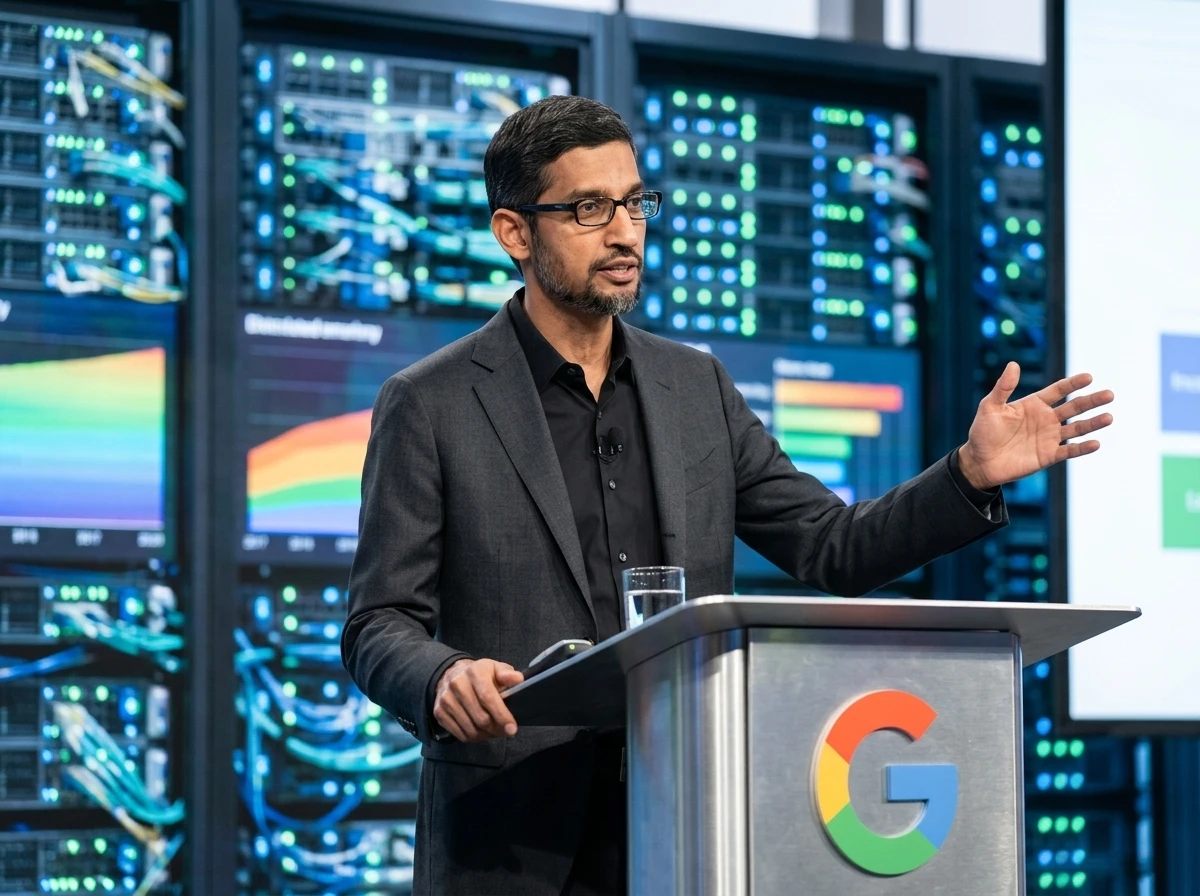
Management lifted 2026 capital expenditure guidance to $195-205 billion from the prior $180-190 billion range. That follows an earlier step-up from the February outlook of $175-185 billion. 2025 spending finished near $91 billion. Executives said 2027 will increase significantly again.
CFO Anat Ashkenazi and CEO Sundar Pichai tied the acceleration to demand for AI compute that still exceeds available capacity. The company remains supply-constrained on frontier models. Gemini models process about 22 billion API tokens per minute. The Gemini App reached 950 million monthly active users.
- $44.9 billion Q2 capex, more than double the year-earlier level
- $195-205 billion full-year 2026 guidance midpoint near double 2025
- $514 billion Cloud backlog providing multi-year visibility
- Nearly 90 percent of the Fortune 100 using Gemini Enterprise
In June Alphabet completed a large equity issuance that brought net proceeds of $49.6 billion and kept an at-the-market program of up to $40 billion available. The earlier proposed $80 billion equity capital raise had already signaled the funding shift from pure internal cash generation. Debt also rose. Buybacks slowed sharply.
The guidance path itself tells the story of how fast the build accelerated. February’s range already sat well above the prior year’s finish. The mid-year lift added another roughly $15 billion at the midpoint. Each step-up arrived with the same message: capacity, not demand, is the binding constraint.
Cloud Backlog Changes the Math
The second-order effect sits in utilization and customer lock-in. Cloud growth accelerated because enterprises want AI infrastructure and solutions together. Customers are exceeding commitments by more than 50 percent. Marketplace transactions grew over seven times. Agent Development Kit downloads reached nearly 70 million.
Pichai said on the call that AI investments are redefining every part of the business and that the full-stack approach is delivering measurable value. Nearly 500 Cloud customers each processed more than one trillion tokens in the prior year. More than 2,000 enterprises consumed over 100 billion tokens.
Search is adding generative features without collapsing the ads engine so far. AI Mode passed one billion monthly active users. The company says it is still sending billions of clicks to the open web each week and has driven the cost of AI Mode responses to its lowest level since launch through hardware and software efficiencies. That combination is the bet: higher compute intensity today for higher engagement and higher-value enterprise contracts tomorrow.
Backlog conversion is the bridge between those two stories. A $514 billion book of contracted work gives multi-year visibility that pure advertising businesses rarely enjoy. When customers already run above commitment by more than half, the risk shifts from filling capacity to delivering it on time and at acceptable unit cost.
Apple Plays a Different Game
Apple spends far less on data-center capex. Recent quarters show only a few billion dollars of capital outlays, with full-year 2026 projections in the low teens of billions according to analyst tallies. R&D has climbed above 10 percent of sales as the company invests in on-device models and features. It has partnered with Google so Gemini powers parts of Apple Intelligence and the next Siri generation.
The installed base does the heavy lifting. Services (App Store, iCloud, Music, AppleCare) deliver high-margin recurring revenue that smooths hardware cycles. Morgan Stanley estimates that roughly 1.3 billion of Apple’s 1.4 billion active iPhones cannot support the coming AI-powered Siri, setting up a potential multi-year upgrade wave. Privacy framing and tight hardware-software integration support premium pricing without matching hyperscaler infrastructure bills.
| Dimension | Alphabet | Apple |
|---|---|---|
| 2026 capex path | $195-205 billion guided | Low teens of billions |
| AI delivery model | Full-stack cloud and data centers | On-device plus partner models |
| Cash-flow stance | Accepts negative FCF to secure supply | Protects margin via asset-light approach |
| Primary monetization | Ads plus Cloud contracts | Services and device upgrades |
McFaddin framed the contrast as ambition versus discipline. Alphabet is funding the capacity race. Apple is monetizing stickiness and waiting for its cycle. Both approaches aim to protect investor trust, yet they price risk differently. Alphabet accepts negative free cash flow to secure supply. Apple accepts less control over the model layer.
The partnership line between them is easy to miss. Gemini already powers parts of Apple Intelligence. That arrangement lets Apple ship AI features without matching Alphabet’s infrastructure bill, while Alphabet gains distribution inside a premium installed base. Each side keeps the piece of the stack it values most.
How Investors Are Scoring the Trade-Off
The stock sold off after the print even though operating results beat. Markets zeroed in on free cash flow turning negative and the higher capex path. Some voices on X treated the first negative FCF quarter as a red flag that debt is rising while buybacks vanish. Others argued the opposite.
Cloud grew 82% and I’ll give them credit for that. But the company spent $44.9 billion in capex during a quarter where cloud brought in $24.8 billion. Alphabet raised $49.6 billion in equity and $20.3 billion in bonds in Q2 alone.
That summary from market commentator Hedgie captured the skeptical read circulating widely after the call. On the other side, investors such as Chamath Palihapitiya described the print as an entry into owning the infrastructure layer while models commoditize. The full earnings call transcript details show management repeating that demand still outruns capacity and that 2027 spending will rise again.
Year-to-date performance has favored Apple among the Mag 7 in some tallies precisely because it avoided the biggest capex spikes. Alphabet’s share price has absorbed multiple guidance hikes and the equity raise. The market is no longer paying solely for revenue beats; it wants unit economics of inference and clear AI-related revenue disclosures.
The gap between the two camps is less about whether AI demand is real and more about who captures the durable cash flow once the build wave crests. Bulls point to the backlog and the Fortune 100 penetration. Bears point to the single-quarter cash burn and the open-ended 2027 spend signal.
Where the Funding Mix Is Heading
Internal cash generation alone no longer covers the build. The June equity issuance delivered $49.6 billion in net proceeds and left an at-the-market program of up to $40 billion still available. That followed the earlier proposed $80 billion equity capital raise, which had already telegraphed the shift.
Debt rose in the same quarter. Buybacks slowed sharply. Together those moves rewrite the capital-return story that long-time shareholders had come to expect. The company is choosing balance-sheet flexibility and capacity over near-term per-share return of capital.
- Equity proceeds of $49.6 billion closed in June
- At-the-market capacity of up to $40 billion kept in reserve
- Bond issuance of $20.3 billion in the quarter alone
- Buyback pace cut as cash was redirected to infrastructure
The mix is deliberate. Equity and debt fund the servers and data centers that Cloud backlog already implies will be used. Dilution and higher interest costs are the price of arriving early with supply while competitors remain constrained. Whether that trade looks cheap or expensive depends entirely on how fast the backlog turns into high-margin recurring revenue.
What Token Demand Reveals About Lock-In
Usage metrics give a clearer picture of why management keeps lifting the spend. Gemini models process about 22 billion API tokens per minute. The Gemini App has reached 950 million monthly active users. AI Mode in Search has passed one billion monthly active users.
On the enterprise side the concentration is striking. Nearly 500 Cloud customers each processed more than one trillion tokens in the prior year. More than 2,000 enterprises crossed the 100 billion token mark. Nearly 90 percent of the Fortune 100 now use Gemini Enterprise.
Those figures explain the willingness to run negative free cash flow. Once a customer’s workflows, agents, and data pipelines sit on a given stack, switching costs rise. Marketplace transactions growing over seven times and Agent Development Kit downloads near 70 million reinforce the same pattern: tools and transactions compound on top of raw compute.
Efficiency gains are already visible on the consumer side. The company has driven the cost of AI Mode responses to its lowest level since launch through hardware and software work. That progress must continue if inference economics are to support both free consumer features and paid enterprise contracts without eroding Search yield.
What the Next Quarters Must Prove
Three practical tests now sit in front of Alphabet. First, can model efficiency and custom silicon (TPUs plus partner GPUs) bend the cost curve fast enough that free cash flow turns positive again before 2027 spending peaks? Second, can pricing for enterprise AI and any consumer AI features keep pace with inference costs without damaging Search ad yield? Third, will the $514 billion backlog convert into high-retention revenue at expanding Cloud margins?
- July 22, 2026, Q2 results and guidance raise to $195-205 billion; first negative FCF reported.
- June 2026, Equity capital raise closes with $49.6 billion net proceeds plus ATM capacity.
- February 2026, Initial 2026 capex outlook set at $175-185 billion, already far above 2025.
- 2025 full year, Capex finished near $91 billion as the AI build began its steep climb.
Apple faces its own test: whether AI features and the next iPhone cycle drive upgrades without heavy discounting, and whether services growth continues to offset any hardware softness. Geographic mix and supply-chain costs remain live variables.
Across the sector the same question appears in different clothing. Hyperscalers are collectively guiding toward roughly $700 billion-plus of 2026 capex. That scale creates broader AI spending ROI gaps across firms that lack Alphabet’s advertising engine or Apple’s services base. The firms that convert capacity into durable cash flow will set the next valuation floor. Those that only raise the spending bar will face repeated margin and cash-flow scrutiny.
For Alphabet the near-term scorecard is narrow: Cloud margin trend, Search engagement with AI Mode at scale, and any sign that free cash flow is stabilizing even as absolute capex stays elevated. Misses on those points will keep the equity and debt markets sensitive to every guidance update.
Patience Has a Price for Both
Alphabet is buying capacity and customer commitment at the cost of temporary free-cash-flow pain and equity dilution. The Alphabet’s $80 billion funding path makes the strategy explicit. Apple is buying time and margin protection by staying asset-light on AI infrastructure and riding its installed base. Both paths can work. The scorecard now runs quarter by quarter on Cloud utilization, Search engagement economics, iPhone replacement rates, and services attachment.
For now the race is defined by the bill Alphabet is willing to pay and the patience Apple is willing to keep. Execution on the backlog will decide which approach looks wiser in hindsight.


UK AI Mega-Rounds Capture Europe’s H1 2026 Funding Rebound

Highland Europe’s €1.1B Fund VI Draws Public Backing for Scaleups

TÖNNJES Backs Bikekey to Scale Digital Bike IDs Beyond Theft

Intropy’s $11M Seed Cracks Manual Spare Parts Moat

Inforcer’s $50M Series C Turns MSP Control Planes Into SMB AI Shields

Meta AI Lifts Instagram Scroll Time as Lawsuits Mount

Redmi Note 17 Leak Puts Giant Si-C Batteries in Midrange

Police Chiefs Back CLARITY Act as Passage Odds Sink Below 30%

Perceptron $6.5M Round Cracks AI Data Gatekeeping

HONOR MagicOS 11 Sets August 6 Date and Forces the Glass Race

CLARITY Act Final Text Expected This Weekend as 60-Vote Hurdle Looms

Kalshi Loses Major NY Prediction Markets Ruling to Judge Torres

Fed Minutes Cite AI Demand as Inflation Risk, Put a 2026 Hike Back on the Map

Marker AI Writing Startup Lands $13M Seed Led by Index Ventures

Dota 2 Esports World Cup 2026: Spirit Defends $2M Title In Paris

Meta’s Muse Spark 1.1 Beats Rivals on Price, Trails on Coding

CS2 Premier Season 5 Lands With Cache and a C4 Damage Rework

ARC Intelligence Closes €4M Seed Round in Roughly a Week

Finto Picks Munich Over Silicon Valley After YC, Raises $3.4M

Backrooms Returns to Theaters as the Everything Must Go Edition
-
 FINANCE2 months ago
Zcash Patched a Double-Spend Bug as ZEC Climbed 5%
-
 ENTERTAINMENT2 months ago
Steam Summer Sale 2026 Locks In June 25 to July 9 Dates
-
 FINANCE4 weeks ago
CLARITY Act Final Text Expected This Weekend as 60-Vote Hurdle Looms
-
 NEWS3 months ago
Meta Adds AI Replies to Threads, But Users Can’t Block It
-
 ENTERTAINMENT2 months ago
‘Widow’s Bay’ Review: Apple TV’s Sleeper Horror-Comedy Earns Its Fog
-
 NEWS8 months ago
FolderFresh Review: This Free Tool Automates Windows File Organizing
-
 NEWS5 months ago
U.S. Navy Deploys Solar-Powered Lightfish Drone to Patrol Oceans
-
 FINANCE3 weeks ago
Kalshi Loses Major NY Prediction Markets Ruling to Judge Torres