
GAMING
GameSir’s Swift Drive Remains a $199 Sim-Racing Bet
GameSir’s Swift Drive put a direct-drive thumb wheel on a pad at CES 2026. Eight months later the $199 bet still has no ship date.

GameSir’s Swift Drive still is not on sale, eight months after CES 2026 put a direct-drive thumb wheel on a gamepad. Trak Racer lists a $199 version as the TR640. Staff at the GameSir booth at Tokyo Game Show on September 19, 2026 said they want a 2027 release.
The pad is CEO Betta Core’s answer to a dorm that could not hold a rig, and a louder motor than Namco’s 1998 Jogcon ever got from a PlayStation port. The bet is whether a couch pad can steal the job of a desk wheel before the date slips again.
A Mini Wheel Where the Analog Sticks Sit
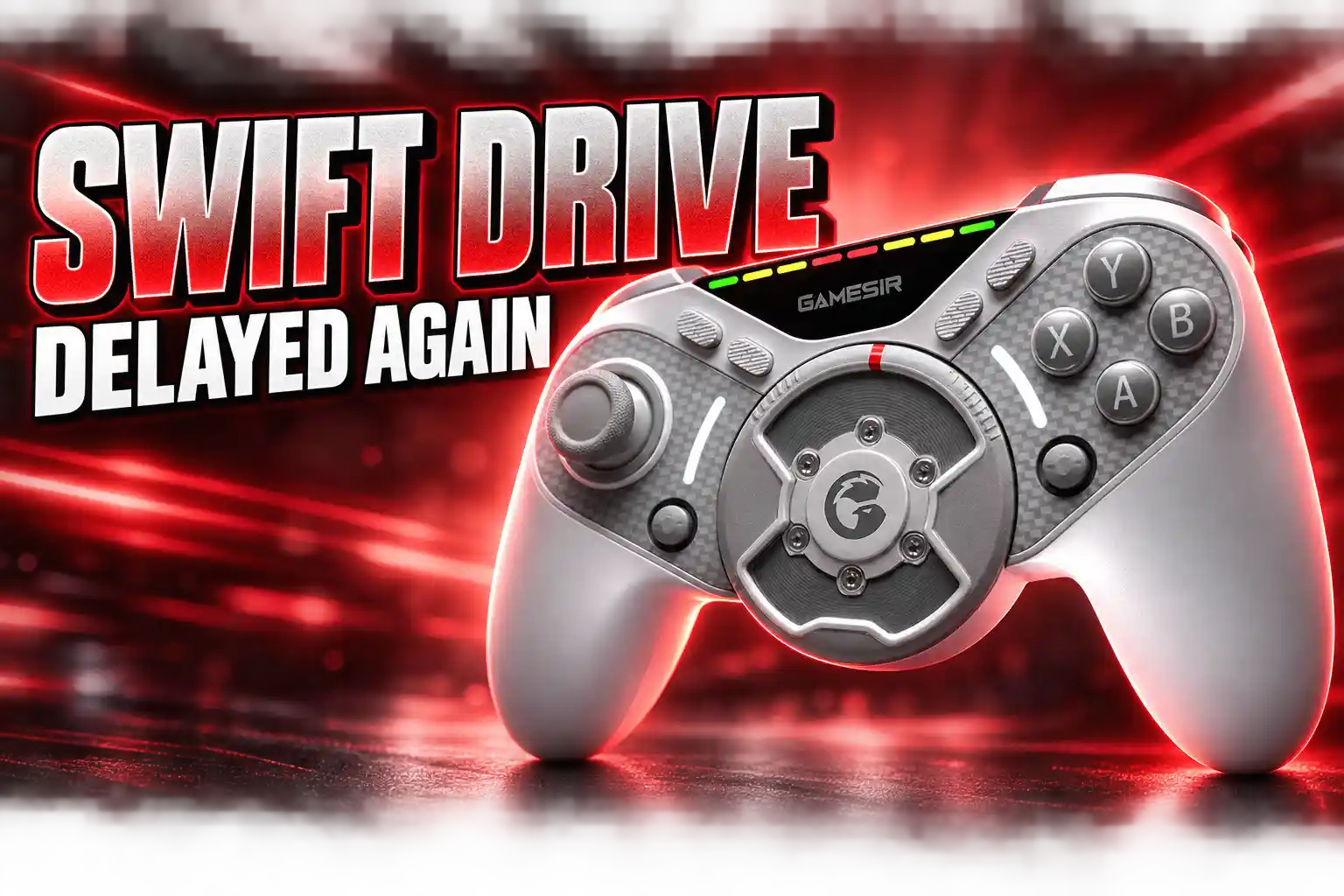
Swift Drive looks like a normal pad until the center disc. GameSir calls that disc the world’s smallest direct-drive motor, bolted where analog sticks usually live, so both thumbs steer a real wheel instead of a stick. The company used the line “zero latency, maximum immersion” when it posted the CES teaser on January 4, 2026.
Simracing will never be the same.
Codename: Swift Drive is coming, World’s 1st Direct-Drive FFB Controller. Zero latency, maximum immersion.
Follow our stream on GameSir YouTube channel, Jan 6-7. Experience the revolution at #CES2026.#GameSir #GamingGear #Controller pic.twitter.com/ejezFlw4tT
— GameSir (@mygamesir) January 4, 2026
The rest of the shell is still a controller. Face buttons, bumpers, and rear paddles stay in reach, Hall-effect sensors sit under the sticks and buttons, and each trigger has its own haptic motor for ABS pulse and wheel slip. The right stick is cut down to a nub for a look-behind camera, which is the main concession the racing layout makes.
THE SWIFT DRIVE HARDWARE
- The disc: A removable, rubberized mini wheel with a Hall-effect encoder GameSir rates at up to 65,000 levels.
- The travel: Steering range adjusts from 30 degrees to 1080 degrees, which is three full turns.
- The radio: A 2.4GHz wireless link, with a battery claim of 20-30 hours even with RGB shift lights running.
- The extras: Swappable wheel plates, per-trigger haptics, and a slightly heavier shell than a typical Xbox pad.
GameSir also teased a separate Turbo Drive piece in the same CES window. Swift Drive is the pad. The Charlotte prototype in May 2026 was PC-only, with Xbox/PC and PS5/PC versions described as the plan, not the unit on the table.
Betta Core Spent Half a Decade on a Dorm Problem
Early write-ups called this a high-schooler’s 3D-printed idea that GameSir later picked up. The person on the booth is more specific. Betta Core is GameSir’s CEO and the lead designer, and he has said the concept started as a high-school project because a full wheel would not fit his life.
GameSir’s July clip of Core describing the dorm-room origin puts the start in that cramped room. Friends wanted iRacing on the weekend. Setup took about 20 minutes, packing it away took about 30, and school work sat on the same desk. He wanted the wheel in a drawer, plug and play, then gone.
He told a CES interviewer the team only finished the prototype shortly before the Las Vegas show. That is a long build for a pad, and it shows in the brief: force feedback without a cockpit, a clamp, or a spare bedroom. The same brief is why a player who cannot use a wheel and pedals is not a side case. They are the customer the shape is for.
Cause of my disability I cannot use a wheel and pedals, I’ve waited all my life for something like this
A racing player, reply to GameSir, January 2026
Core has been clear the feel comes first, which is why the right stick shrank. The pad still has a full left stick and the usual buttons, so it can survive a menu or a replay. It is still a racing tool that happens to share a gamepad’s footprint.
The Jogcon’s Weak Motor and a Short Game List
Namco shipped the Jogcon in Japan on December 3, 1998, and in North America the same year, often bundled with Ridge Racer Type 4. It kept the size of a PlayStation pad and put a dial about 3 inches across in the middle, the first force-feedback steering device on that console. The name comes from a jog wheel, the kind used on video decks.
Power came from the controller port, so the motor stayed mild. Reviewers who still own one talk about gear slack, a loose dial, and feedback that fades when you want a shove. Ridge Racer’s arcade physics also fight a realistic wheel, which made centering the car feel like work even when a drift landed.
THE PATH FROM 1998 TO CES
- December 3, 1998: Namco launches the Jogcon in Japan with Ridge Racer Type 4, then sells it on its own.
- 1998-2000: Full Jogcon support lands in a short list that includes Ridge Racer Type 4, V-Rally 2, and PlayStation 2’s Ridge Racer V, plus a handful of other titles such as Breakout.
- December 12, 2025: GameSir posts the Codename Swift Drive teaser and points at CES 2026, booth 14457 in Central Hall.
- January 6-9, 2026: The prototype is shown at CES with a direct-drive disc, Hall-effect parts, and no price on the sheet.
- May 21-23, 2026: GameSir runs a Forza Horizon 6 clip, and a still-prototype unit appears at Sim Racing Expo in Charlotte as the Trak Racer TR640.
- September 19, 2026: A development sample sits at Tokyo Game Show, and booth staff say they want a 2027 release.
Twenty-eight years sit between those two discs. The old one died on weak torque and almost no game code. Swift Drive spent CES proving the motor. It still has to prove the other half, a store page you can check out and titles that speak the wheel’s language on day one.
How Strong Is a Thumb-Sized Direct-Drive Motor?
Hands-on time in January and May described the same surprise. The disc is not a clicky spinner. Over gravel or rocks the wheel pushes and pulls under the thumbs. Rumble strips have texture. Grass off the tarmac reads as a change in the rim. A barrier hit is strong enough that testers said to take your thumbs off.
That last point is the thumb-safety joke that followed the CES tape, where a driver threads a Schumacher-era Ferrari around the Nurburgring without dropping the car. Direct-drive bases in the 5 Nm class can bruise a wrist on a spike. A disc you pinch with two thumbs cannot throw that much mass, and GameSir has not published a newton-metre figure. The Charlotte unit still kicked hard enough, even with force feedback turned down, that the testers stopped treating it as a gimmick.
The steering is not 1:1 with a 900-degree rim, and it should not be. You hold this in your hands. A May tester said the prototype’s range split the difference between accuracy and comfort, and that Assetto Corsa was pick-up-and-play in a way a first wheel-and-pedal night is not. Shift lights on the pad look the part and sit where your eyes are not, which is a small tell that some of the theater is still theater.
A $199 Pad Versus a $379 Wheel Bundle
Price is the other half of Core’s dorm math. A January CES chat had GameSir aiming at a figure that would have made this its dearest pad. By May the working number in coverage was $199, and that is what Trak Racer puts on the TR640 page. It is a lot for a controller. It is a different conversation next to an entry direct-drive kit that needs a desk.
MOZA’s US shop has the 5.5 Nm bundle listed at $379, with the wheel, pedals, and a clamp in the box. That kit is the floor of proper force feedback for a lot of PC racers, and it still asks for furniture. A Fanatec-style base in the same class is the other common first buy, then a rim, then pedals, then somewhere to bolt them.
WHAT $199 IS ACTUALLY NEXT TO
| Setup | What you hold | Feedback | Listed price | Needs a desk |
|---|---|---|---|---|
| GameSir Swift Drive / TR640 | Gamepad with mini DD wheel | Direct-drive disc, trigger haptics | $199 list | No |
| Namco Jogcon (1998) | PlayStation pad with ~3-inch dial | Port-powered motor | Sold with R4, then solo | No |
| MOZA R5 Bundle | Wheelbase, rim, and pedals | 5.5 Nm direct drive | $379 on the US shop | Yes |
The $199 ask is why some racers will shrug and tell you to buy a wheel. They are pricing a pad against a pad. Core is pricing a drawer against a room. Wireless batteries sit where rumble motors usually go, so the pitch is a sofa, not a cockpit, which is also why the Charlotte hands-on kept returning to Forza Horizon 6 as much as Assetto Corsa.
At Tokyo Game Show the Sample Was Still a Sample
In May, a GameSir representative talked about a late-2026 target, while the Trak Racer version sat on pre-order with a tentative January 2027 date. The same write-up also floated a Q1 2027 projection. September clarified the mood more than any of those slides. A development sample appeared at Tokyo Game Show, and staff said they want to sell it next year, meaning 2027.
One showgoer said the Swift Drive unit on the stand looked unfinished, while other GameSir pads on the same booth, including a first wheel they labelled Turbo Drive, got more of the demo time. That is not a teardown. It is a show-floor read that the racing pad is still a lab object. Trak Racer has listed the TR640 for $199 and sells the same story, force feedback on a couch, no rig required, built on the Swift Drive platform.
WHAT WE KNOW
- The hardware: CES, Charlotte, and TGS units all use a mini direct-drive wheel in a gamepad shell with Hall-effect parts and trigger haptics.
- The money: Trak Racer’s public list price is $199, with a tentative January 2027 window on that SKU.
- The people: Betta Core is CEO and lead designer, and the idea started as a high-school and dorm project that ran about half a decade.
WHAT IS UNCONFIRMED
- A locked ship date: Late 2026 was a spring hope; September booth talk moved to 2027.
- Day-one game list: Demos used Assetto Corsa and Forza Horizon 6; full platform support is still a plan.
- Peak torque: Testers felt crashes hard; GameSir has not posted a newton-metre rating for the disc.
Software is the quiet risk, the same one that left the Jogcon talking to a handful of discs. A Hall-effect encoder and a 2.4GHz radio do not matter if a sim treats the wheel as a stick. Xbox and PlayStation builds were hoped for in May and were not the prototype on the table. Until those SKUs exist, Swift Drive is a PC conversation with a store listing ahead of the box.
Core built the pad so a wheel would fit in a drawer. The drawer is still empty. The $199 tag is on a page, the sample is on a stand, and the year attached to a sale is 2027.

Triumph Bonneville 400 Puts Its Badge on a 349cc Tax Cut

Verstappen Takes First 2026 Pole at a Relocated Bahrain GP

Anthropic Warns a Pentagon Fight Can Hit Private Clients

FDA Closes Taylor Farms Lettuce Probe Without a Cause

Galaxy Z Fold 8 Ultra Gets a 5,298MB October Security Update

The Orchard Bug Forced Zcash to Open an Empty Pool

The $5.99 Game That Won Steam’s 2026 Summer Sale

Don Lee Joins Hemsworth as Extraction 3 Starts Shooting

YouTube Shorts Retires Dislikes and Swaps Likes for Hearts

NEURA Robotics Is Spending Its $1.4B on a Machine Stack
-
 NEWS4 months ago
The Orchard Bug Forced Zcash to Open an Empty Pool
-
 GAMING4 months ago
The $5.99 Game That Won Steam’s 2026 Summer Sale
-
 ENTERTAINMENT6 months ago
Don Lee Joins Hemsworth as Extraction 3 Starts Shooting
-
 NEWS4 months ago
YouTube Shorts Retires Dislikes and Swaps Likes for Hearts
-
 NEWS4 months ago
NEURA Robotics Is Spending Its $1.4B on a Machine Stack
-
 AUTO6 months ago
Kawasaki Bets the New Z1100 Against Its Own Supercharger
-

 BUSINESS5 months ago
Norway’s Export Bank Backs Nscale’s $790 Million Narvik Loan
-

 GAMING4 months ago
Game of Thrones Dragonfire Follows Boston’s Conquest Playbook