
NEWS
Google’s Orbital TPUs Can Run Only in Short Bursts
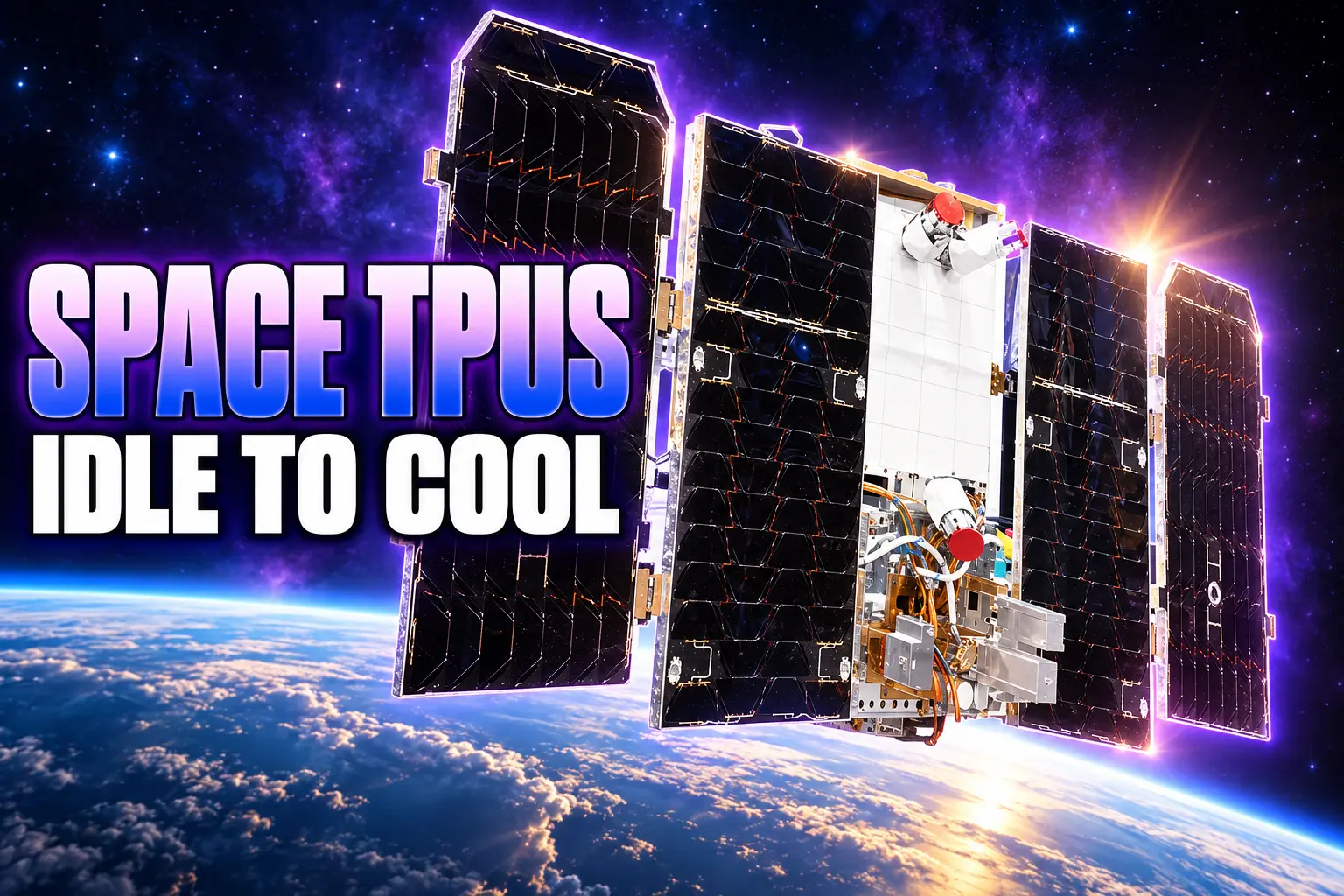
Google’s Project Suncatcher prototype reached orbit with four TPUs, then faces the vacuum heat limit that caps each run at about 15 minutes.

Google put four TPUs into low Earth orbit on October 1, 2026, aboard SpaceX’s Transporter-18 rideshare from Vandenberg Space Force Base. The Project Suncatcher prototype, built with Planet, is in contact and operating as expected.
The chips that made the trip still have to stop about every 15 minutes so a radiator can throw their heat into empty space.
The Chips Run, Then They Have to Stop
Project Suncatcher is Google’s long research bet that solar-powered satellites could one day host machine-learning work at scale. The first craft is not that scale. It is a compact Planet bus carrying four Tensor Processing Units, the custom accelerators Google uses in its own data-center halls, flown as a survival test.
Travis Beals, senior director of Paradigms of Intelligence at Google, has described the thermal limit in plain terms. Fans do not work in a vacuum. Heat has to move through a putty-like interface, then aluminum and copper pipes, then a radiator panel that can only dump so much energy at a time.
The chips can operate for about 15 minutes in space before needing to be shut down so they can cool off.
Travis Beals, Senior Director, Paradigms of Intelligence, Google
Google’s own facts page calls cooling a crucial research challenge for that reason. TPUs pack a lot of heat into a small board, and in orbit the only way out is radiation. The team has already run the stack in a thermal vacuum chamber. Beals wrote after liftoff that some things can only be tested in space, and that the next weeks of telemetry will show how the chips take launch stress, radiation, and those heat swings.
James Manyika, Google’s senior vice president for research, has been just as blunt about the calendar. He said the company does not expect anything usefully operational in the next few years. The public language is orbital data centers. The hardware on this flight is a four-chip board that must idle while a plate sheds heat.
Up, up, and away. 🚀
Today, in partnership with @planet, we launched a prototype satellite carrying four TPUs into orbit on @SpaceX's Transporter-18 rideshare mission. This launch is the first step of Project Suncatcher, our long-term research moonshot to see whether we can one… pic.twitter.com/6WakAX8q7N
— Google (@Google) October 1, 2026
Why Google Wants Compute in a Dawn-Dusk Orbit
The case for going up is power, not poetry. Google’s November 4, 2025 research note says a solar panel in the right orbit can be up to 8 times more productive than the same panel on the ground, and can generate power almost without night, which cuts the battery mass a spacecraft has to haul.
The target is a dawn-dusk sun-synchronous path, where the satellite rides the terminator and sees near-constant sun. That orbit also raises latency to some ground sites. Google is willing to take the delay in exchange for the extra light.
The same vacuum that keeps the panels in the sun is what breaks ordinary cooling. There is no air to carry heat off a chip. Extra sunlight does not, by itself, mean extra usable compute, because the radiators, pipes, and shielding have to be launched with the processors. That is the trap inside the pitch. The energy argument is real. The first duty cycle is still a stopwatch.
Google also argues that putting the work in orbit would ease pressure on land and water used by terrestrial halls. That is a future claim. This satellite will spend its early weeks answering a narrower question: whether commercial TPU silicon can run at all once the rocket stops shaking it.
Planet Flew the Bus Google Could Not Wait For
SpaceX supplied the ride. Planet supplied the spacecraft. Google’s October 1 note says the prototype was built in partnership with the Earth-imaging company, and that the team has confirmed contact with the satellite.
Planet’s own release is broader than one Google payload. The company said it launched 20 satellites on the same Falcon 9: the Suncatcher demo, Tanager-2, its latest hyperspectral craft with Carbon Mapper, and 18 SuperDoves for the PlanetScope fleet. It had first contact with Tanager-2, the Suncatcher prototype, and two SuperDoves, and expected the remaining 16 SuperDoves to come off a D-Orbit ION transfer vehicle on schedule.
That flight was Planet’s 40th successful launch and brought the firm to 718 satellites built and delivered on orbit. Google did not wait for a clean-sheet pair. Pre-launch accounts of the program say two custom satellites had been aimed at 2027, and that Google instead fitted its chips into a bus Planet already had in work so the first TPUs could fly this year.
Planet’s job now is commissioning: power, pointing, and the radio path that lets Google’s team see how the board behaves. Google’s job is the experiment on that board. The division of labor is easy to miss in a headline that names only SpaceX and Alphabet.
Transporter-18 Put 130 Payloads Into Sun-Synchronous Orbit
Falcon 9 lifted off at 11:32 a.m. PT on October 1 from Space Launch Complex 4E at Vandenberg, which is 2:32 p.m. ET and 18:32 UTC. SpaceX said the booster was on its 25th flight and landed at Landing Zone 4. The company listed 130 payloads on this flight, including cubesats, microsats, hosted payloads, two reentry vehicles, and four orbital transfer vehicles holding 41 of those payloads for later drop-off. First-stage landing came at 7 minutes 32 seconds.
TRANSPORTER-18 AT A GLANCE
| Item | Detail |
|---|---|
| Liftoff | October 1, 2026, 11:32 a.m. PT, SLC-4E |
| Vehicle | Falcon 9, booster on its 25th flight, LZ-4 landing |
| Manifest | 130 payloads to sun-synchronous low Earth orbit |
| Suncatcher payload | Four Google TPUs on a Planet-built prototype |
| Planet’s other craft | Tanager-2 plus 18 SuperDoves |
| Status | Contact confirmed, satellite operating as expected |
The rideshare is the point, not a footnote. A research satellite that cannot yet earn its keep does not buy a dedicated rocket. It shares a fairing with imaging birds, transfer tugs, and reentry testbeds, which is how a four-chip prototype reaches a dawn-dusk orbit without waiting for Google’s 2027 pair.
The Proton Beam Was the Easy Test
Before anyone agreed to fly the chips, Google ran Trillium, its v6e Cloud TPU, through a 67 MeV proton beam to measure total ionizing dose and single-event effects. High-bandwidth memory was the weak spot. It began showing irregularities after a cumulative 2 krad(Si), nearly three times the 750 rad(Si) Google cites as a shielded five-year mission dose. No hard failure was tied to that dose up to 15 krad(Si) on a single chip.
Those numbers are ground results. They do not replace on-orbit bit flips, temperature cycling, or the vibration of a Falcon 9 ride. Google said a launch can put components under forces in the 50 to 100 g range, and that the team shook the satellite on all three axes before flight.
THE SUNCATCHER CALENDAR
- November 4, 2025: Google publishes the Project Suncatcher research note and preprint on solar-powered TPU constellations.
- 2025 to 2026: Trillium TPUs take a 67 MeV proton beam; heat-pipe and radiator hardware sit in a thermal vacuum chamber.
- September 24, 2026: Google says the first TPUs will fly the following week on Transporter-18 with Planet.
- October 1, 2026: Falcon 9 launches from Vandenberg; Google and Planet confirm contact and start commissioning.
A peer-reviewed version of the research is now out in the journal Joule. Beals pointed to it the day of launch as the write-up behind the mission. The paper still treats thermal control, ground links, and on-orbit reliability as open engineering problems, not solved ones.
An 81-Satellite Cluster Still Lives on Paper
The design Google wants, if the prototype behaves, is not one large station. It is a tight flock. The preprint walks through an 81-satellite cluster of 1 km radius at a mean altitude of 650 km, with next-nearest neighbors oscillating between about 100 and 200 meters. That spacing is how the team thinks it can get data-center-class bandwidth from free-space lasers without inventing a new optical physics.
Commercially flown optical crosslinks today sit in a much lower bitrate band. Google’s analysis calls for on the order of 10 Tbps per link, using dense wavelength-division gear flown close enough that the received power holds up. A bench rig already moved 800 Gbps each way, 1.6 Tbps in total, on a single transceiver pair. Two satellites meant to try that in orbit are still described as a 2027 step. This flight does not test the lasers.
WHAT THE FIRST SATELLITE CANNOT PROVE
- Continuous compute: The radiators on this craft force a shutdown after about 15 minutes, so the run is a burst, not a shift.
- Chip-to-chip fabric: High-rate laser links between neighbors are a later flight, not part of Transporter-18.
- Formation keeping: An 81-satellite, 1 km cluster is a model. One bus cannot show collision margins at 100 to 200 meters.
- Launch math: Google’s cost case needs LEO prices near $200/kg by the mid-2030s before space energy looks comparable to terrestrial energy on a per-kilowatt-year basis.
Beals has said the radiators are among the heaviest pieces on the current mission, which hurts because every extra kilogram is launch cost. The team is looking for lighter ways to move heat. Until that mass comes down, the 8-times sunlight advantage is paying for a cooling problem it also creates.
WHERE THE COST MODELS DIVERGE
- Google’s paper: A learning-curve case puts launch below $200/kg by the mid-2030s, at which point launching and running a space plant could look comparable to the reported energy bill of a similar hall on Earth, chips excluded.
- Slava G. Turyshev, Jet Propulsion Laboratory: A 2026 analysis of orbital plants finds that a representative 1 MW node, after photovoltaic, storage, radiator, and bus mass, leaves only about $250 to $1,000 per kilogram for launch and spacecraft build, a band he places below current dedicated Falcon 9 prices before communications, operations, and replacement are added.
Those are different ledgers, not two readings of one bill. Google is comparing future launch to terrestrial energy. Turyshev is asking whether today’s mass fractions can even buy a ticket. The prototype will not settle either spreadsheet. It will only show whether four chips can compute between cooling pauses.
Earth’s Grid Queues Are Why This Flight Exists
Google is not leaving Earth. Bain’s 2026 technology report notes the company is funding 1.6 GW of mostly wind power and 300 MW of storage next to a new Minnesota campus. Tom Garvens, speaking for Google on campus design, has described battery buffers, load shaping, and work with utilities as the way to grow halls that now run as grid partners, not just loads. The orbital test sits beside that buildout, not in place of it.
The ground path is slow. TD Economics has put interconnection waits at three to four years in major U.S. markets and at seven years in Northern Virginia. Goldman Sachs has said only 50% to 60% of planned data-center capacity is likely to come online on time over two years. Those figures are why a research group would even bother shaking TPUs on a rideshare.
A pair of satellites to test laser links is still slated for 2027. Until those craft fly, the only job for these four chips is to run a short job, shut down, and dump heat while Planet finishes bringing a very small satellite online.

Triumph Bonneville 400 Puts Its Badge on a 349cc Tax Cut

Verstappen Takes First 2026 Pole at a Relocated Bahrain GP

Anthropic Warns a Pentagon Fight Can Hit Private Clients

FDA Closes Taylor Farms Lettuce Probe Without a Cause

Galaxy Z Fold 8 Ultra Gets a 5,298MB October Security Update

The Orchard Bug Forced Zcash to Open an Empty Pool

The $5.99 Game That Won Steam’s 2026 Summer Sale

Don Lee Joins Hemsworth as Extraction 3 Starts Shooting

YouTube Shorts Retires Dislikes and Swaps Likes for Hearts

NEURA Robotics Is Spending Its $1.4B on a Machine Stack
-
 NEWS4 months ago
The Orchard Bug Forced Zcash to Open an Empty Pool
-
 GAMING4 months ago
The $5.99 Game That Won Steam’s 2026 Summer Sale
-
 ENTERTAINMENT6 months ago
Don Lee Joins Hemsworth as Extraction 3 Starts Shooting
-
 NEWS4 months ago
YouTube Shorts Retires Dislikes and Swaps Likes for Hearts
-
 NEWS4 months ago
NEURA Robotics Is Spending Its $1.4B on a Machine Stack
-
 AUTO6 months ago
Kawasaki Bets the New Z1100 Against Its Own Supercharger
-
 BUSINESS5 months ago
Norway’s Export Bank Backs Nscale’s $790 Million Narvik Loan
-

 GAMING4 months ago
Game of Thrones Dragonfire Follows Boston’s Conquest Playbook