
NEWS
Hadrian Raises $40 Million to Turn Pentests Into Software
Hadrian raised $40 million to productize external pentesting, a smaller bet than US platforms that already run autonomous tests inside live networks.

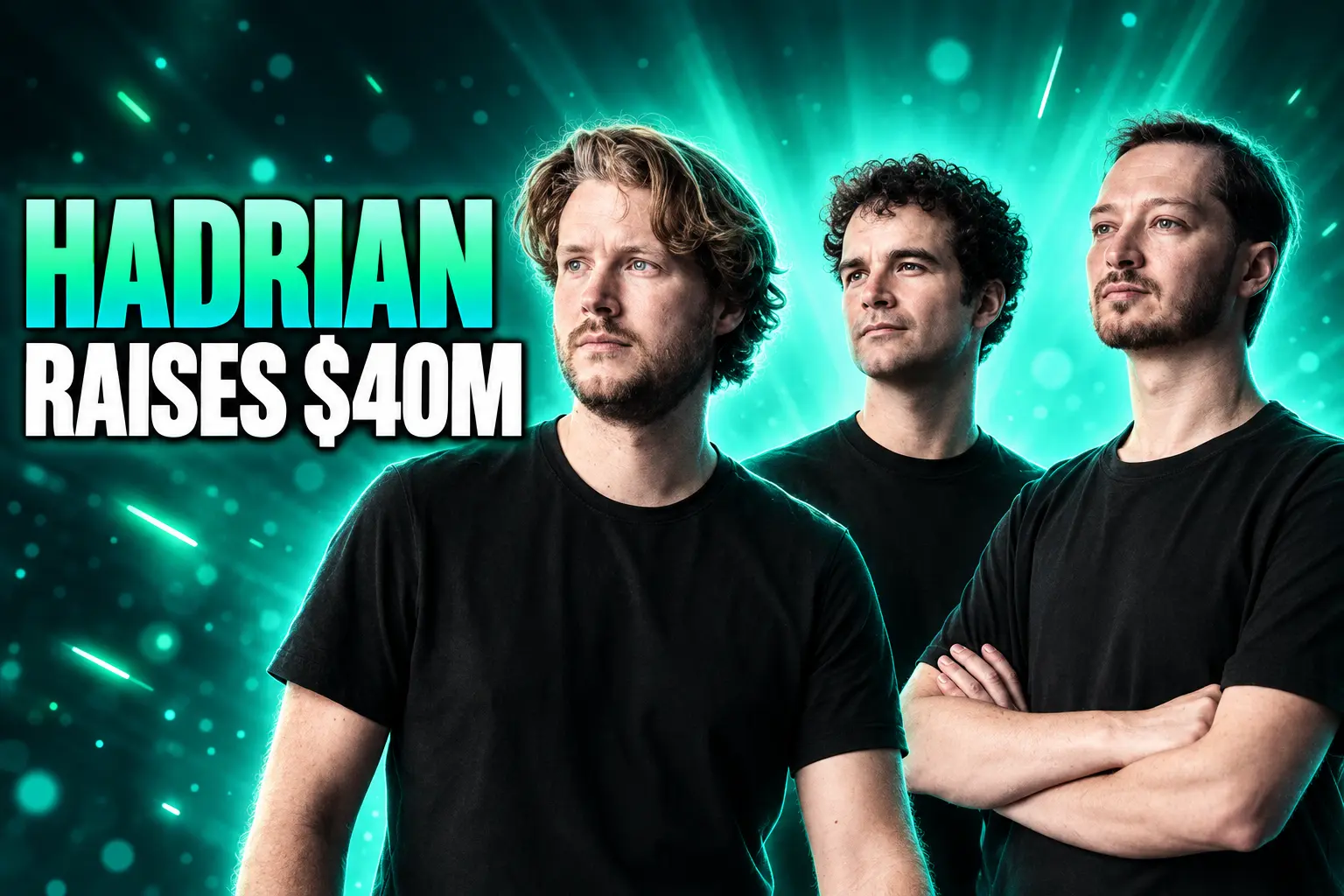
Hadrian has raised $40 million to run AI pentests around the clock, taking the Amsterdam firm’s total funding to $65 million. Forgepoint Capital International and SmartFin co-led the round announced on October 6, 2026, with HV Capital, Motive Partners, Picus Capital, and Oetker Ventures joining.
The pitch is a reply to machine-speed attackers. The product is more specific than that: it turns the annual human pentest into a software loop that never clocks out, while people still set the mission and decide what to fix.
Hadrian Closes a $40 Million Offensive Security Round
Hadrian will spend the new money on engineering and research, and on a wider push across EMEA and the United States. Chief executive Rogier Fischer said most of it will go to research and development, with a large share reserved for the US. The firm did not disclose a valuation or revenue.
Fischer said Hadrian now has about 90 people and offices in Amsterdam, London, and New York. Existing names on the cap table stayed in. Forgepoint, which manages over $1.2 billion and lists more than 40 companies, is the specialist cyber cheque. SmartFin, a Brussels firm founded in 2014 with over €600 million in commitments, is the European growth cheque.
Saumitra Dubey, a partner at SmartFin, said Hadrian’s enterprise contracts, retention, and customer list show it can win against much larger security vendors, and that the firm is backing a path to nine-figure revenue. That is the real use of this round: buy time to turn a 90-person shop into a global pentest subscription before the category hardens around a few US names.
THE ROUND IN BRIEF
- New capital: $40 million, co-led by Forgepoint Capital International and SmartFin.
- Total raised: $65 million, after a €2.5 million pre-seed in 2021 and a €10.5 million seed in June 2022 that took the total to $13.7 million.
- Headcount and offices: about 90 people in Amsterdam, London, and New York.
- Stated aim: more research staff, a wider EMEA footprint, and a deeper US sales push.
Customers named in the announcement include McKesson, NBC Universal, Francisco Partners, Total Energies, Amadeus, Leroy Merlin, and Damen Shipyards. Hadrian says those teams have seen 10 times greater visibility into critical exposures, an 80% faster path to a fix, and five times the return of a manual pentest. Those figures are the company’s own.
Only 0.47% of Scanner Hits Need a Fix
Hadrian’s own only 0.47% of scanner findings proved exploitable in a year of platform data. That is the labour problem this round is priced against. Security teams are not short of alerts. They are short of proof that an alert is an attack path.
The same study says 87% of organisations still run manual pentests, and that more than 70% of teams cannot tell which exposures an attacker could actually use. Seventy percent of intrusion chains in that dataset start at the edge, against exposed services, APIs, VPNs, and gateways. DNS accounted for 23% of verified exposures. Sixty-seven percent of the leaders surveyed flagged AI-driven threats as a concern, and 95% said they were unhappy with how they rank risk on a working day.
WHAT HADRIAN’S 2026 BENCHMARK FOUND
- True hits: 0.47% of vulnerability-scanner results needed action.
- Old method: 87% of organisations still commission manual pentests.
- Edge attacks: 70% of intrusion chains began on internet-facing systems.
- New CVEs: Hadrian counted 195 published a day in the first half of 2026.
When a finding is verified as critical, Hadrian puts the median time to a fix at four days. The drag sits earlier, in the hours spent sorting noise. The company’s announcement also points to recent cases of AI agents escaping test environments, and to Anthropic’s finding that criminals and state-linked groups had used its models to automate attack chains and write exploits. Attackers can now chain reconnaissance, exploitation, and follow-on work at machine speed. A once-a-year test still photographs a single day.
Atlas Watches the Edge, and Nova Goes Deeper
Hadrian sells that gap as two products that share a map. Atlas is the always-on watch: it charts internet-facing assets and sends purpose-built AI agents to test which exposures can be used. Nova is the on-demand pentest, launched on March 24, 2026, for a scoped web app or API. Because both tools keep the same context, a team can move from a live map into a deeper test without rebuilding the inventory from scratch.
Fischer said the platform runs more than 100 million attack simulations each day. Klaas Meinke, Hadrian’s head of AI, said the agents are guided by the firm’s ethical hackers, who prompt and shape their behaviour, and that this human-in-the-loop setup is how the agents keep learning. The company also uses a second agent to review each action, a check added after months of public incidents in which unsupervised agents ran past their brief.
People still set the objective and still make the call on what to patch. The software does the repetition no red team can staff overnight. That is a different wager from fully autonomous pentesting, and it is the one European buyers who need a kill switch can live with.
HOW THE TWO PRODUCTS SPLIT THE WORK
- Atlas: continuous map of external assets, with agents that chain techniques the way a human attacker would.
- Nova: scoped agentic pentest of web apps and APIs, with a report written for a fix ticket and an auditor.
- Shared context: the live attack-surface map feeds the deeper test, so the second job does not start from zero.
- Human gate: staff set the mission, rank the output, and a second agent reviews each step before it counts.
Hadrian tests from the outside. It does not sit on the internal network, and it does not ask for source code. For a CISO who needs to know what a stranger on the internet can see, that is the point. For a CISO who needs to know how far an attacker can walk once inside, it is a blank.
Everyone can see that AI is changing the threat landscape. It might also hold the answer, but most people are focused on automating the wrong bits. We have been working with LLMs since before they went mainstream, and we know that AI can work much faster than any human offensive security team. So we built a platform that emulates hackers’ attack paths, helping our customers to understand their key risks and prioritise their security resources appropriately.
Rogier Fischer, CEO, Hadrian
Fischer has also said the market is consolidating fast, with pentesting, vulnerability management, and attack simulation collapsing into one platform. Nova is how Hadrian tries to own the compliance-shaped piece of that stack, the PDF an auditor will actually accept, without sending a human team on site for two weeks.
Horizon3 Already Banked a $250 Million Round
The capital table around “AI hackers” is already lopsided. On August 3, 2026, San Francisco-based Horizon3 announced a $250 million Series E at a valuation of more than $2 billion, up from $650 million at its Series D, and said it now covers over 7,000 organisations with 120% year-over-year growth in annual recurring revenue. Co-founder Snehal Antani said NodeZero had earned the right to autonomously pentest production networks “with no humans in the loop,” on the back of 310,000 tests run in production.
That is a different machine from Hadrian’s. Horizon3 attacks the customer’s own live environment and chains misconfigurations, weak credentials, and identity gaps on the inside. Hadrian stays on the public edge. Both sell the death of the annual test. They are not selling the same test.
HADRIAN AND HORIZON3 AT A GLANCE
| Firm | Latest round | Scale stated | Where it tests | Human role |
|---|---|---|---|---|
| Hadrian | $40 million (Oct 2026) | $65 million total raised; about 90 staff | External attack surface, web apps, APIs | People set objectives and a second agent reviews actions |
| Horizon3 | $250 million Series E (Aug 2026) | More than $2 billion valuation; over 7,000 organisations | Production networks, identity, cloud, Kubernetes | Antani says tests run with no humans in the loop |
Gartner now treats this work as adversarial exposure validation, a category that replaces breach-and-attack simulation and automated pentesting. Hadrian was named a representative vendor in that market guide, published March 24, 2026, the same day Nova launched. Gartner’s line, as Hadrian quotes it, is that 60% of organisations will have adopted structured exposure validation by 2029, with AEV tools and managed firms as the usual enablers.
If that forecast holds, the annual boutique engagement becomes a side order. The budget moves to software that can re-test after every change. Hadrian is trying to take that budget from the outside in, with a human still on the kill switch. Horizon3 is trying to take it from the inside out, with no one on the switch. The $40 million does not close that gap. It funds a European answer to it.
Why Forgepoint and SmartFin Wrote the Checks
Damien Henault, managing director and partner at Forgepoint Capital International, said teams are buried in vulnerabilities and noise and need tools that think the way AI-armed hackers think. He said Hadrian’s always-on design gives both depth and breadth, and that the customer list and the team made the firm a natural company to back. Henault’s recent cyber bets have included Hackuity and Qevlar AI, so this cheque sits in a pattern, not a one-off AI tour.
Rogier and his team have built an agentic hacking platform that truly stands apart in the offensive cybersecurity space. Hadrian’s growing enterprise contract values, global customer base and exceptional enterprise retention rates demonstrate both the strength of its product and the team’s ability to execute and win against the largest cybersecurity incumbents. This funding comes at a pivotal moment, accelerating Hadrian’s next phase of growth as we support its ambition to become a global cybersecurity leader and build a nine-figure revenue business.
Saumitra Dubey, Partner, SmartFin
Nine-figure revenue is a long walk from an undisclosed book and 90 people. Dubey is underwriting enterprise retention and larger contracts, not a consumer download spike. The public conversation around this raise was thin, mostly copies of the announcement, which is typical for a European B2B security round on the same morning. The argument that matters is in those contract values, and in whether a CISO will retire a human pentest firm after two clean Nova reports.
From Teenage Hacking to Offices in Three Cities
Fischer and Olivier Beg met as teenagers on an online forum. Fischer has said he started hacking at 12 and has never carried out any criminal activity. They founded Hadrian in 2021 with Maurice Clin, after Fischer had already launched one of Europe’s early crypto exchanges. Fischer’s line on the origin is blunt: they wanted to automate the work they did as teenagers.
HADRIAN’S PATH TO THIS ROUND
- 2021: Fischer, Beg, and Clin found the company in Amsterdam and raise a €2.5 million pre-seed.
- June 2022: HV Capital leads a €10.5 million seed, with Picus Capital and others, taking total funds to $13.7 million.
- March 24, 2026: Hadrian launches Nova and is named a representative vendor in Gartner’s AEV market guide.
- October 6, 2026: Forgepoint and SmartFin co-lead a $40 million round that takes total funding to $65 million.
ABN AMRO Ventures had already put money in, arguing that a bank with tens of thousands of digital endpoints could not keep mapping them by hand. Tiago Teles, then security lead at ABN AMRO, described the labour shift in plain numbers.
What’s exciting about what Hadrian is doing is they solved a seemingly impossible puzzle: finding weaknesses in a complex network with human-like detail, at scale, from the outside and continuously. What usually takes a dedicated team of security engineers a few weeks to figure out for one system, they can do in minutes for thousands of systems.
Tiago Teles, Security Lead, ABN AMRO
Weeks for one system, minutes for thousands, is the second-order effect the new investors are buying. Boutique pentest firms bill those weeks. Hadrian is selling the minutes, then asking a person to decide which minute mattered.
The Customers Already Paying for Proof
Hans Quivooij, CISO at Damen Shipyards, said Hadrian changed how the shipbuilder looks at its external surface: instead of a known inventory and a periodic test, the team now sees what an attacker can actually see. Alessio Setaro, digital solutions leader at Leroy Merlin, said each new shop-floor system adds something to protect, and that Hadrian found assets that had drifted out of the company’s control and tested them the way an attacker would, which gave his team a ranked list rather than another scan dump.
Those are buyers who still need a report they can hand to an auditor, and who cannot wait for the next scheduled engagement. They are also buyers whose crown jewels sit behind the perimeter Hadrian does not enter. The $40 million will not buy Horizon3’s internal coverage. It will buy more agents, more researchers, and more people in New York to sell the outside-in version of the same idea.
Fischer’s consolidation line is the close of the bet. If pentesting, scanning, and attack simulation do become one platform, the firm that owns the live external map and can spit out a pentest-grade report in a couple of days takes budget from three old vendors at once. If CISOs keep paying humans for the inside, and software only for the edge, Hadrian remains a specialised watch, well funded by European standards and small beside the US autonomous pentest stack.
Frequently Asked Questions
How much does a Hadrian Nova pentest cost?
Hadrian lists each Nova test from €3,000, with bundles for teams that want several runs, and says most tests finish in 24 to 48 hours. The report includes proof of exploitability, reproduction steps, risk context, and fix advice, mapped to SOC 2, ISO 27001, and NIS2, and Hadrian’s offensive team checks every finding before it ships.
Does Hadrian test internal networks and applications?
No. Atlas and Nova test the external attack surface only: internet-facing assets, web apps, and APIs, including the OWASP Top 10 from the outside. There are no agents or sensors to install, and jobs that need source code or internal infrastructure sit outside the product. Hadrian completed its own SOC 2 Type II audit, announced in February 2025.
What is adversarial exposure validation in Gartner’s market guide?
Gartner’s Market Guide for Adversarial Exposure Validation, published March 24, 2026, defines AEV as a standalone technology market that replaces breach-and-attack simulation and automated pentesting and red-teaming tools. AEV platforms run attack scenarios to prove a theoretical exposure is real, to test controls often, and to improve detection. Hadrian is listed as a representative vendor for its platform.
How many organisations does Hadrian say it works with?
Hadrian’s 2026 Offensive Security Benchmark Report draws on 12 months of platform data from 300+ organisations worldwide and a survey of 34 enterprise security leaders. The company’s German and French product FAQs also describe the platform as used by security teams at more than 300 companies.

Procuros Raises €20 Million to Own the Trade Data Layer

Ace Combat 8’s Steam Peak Harvests a Seven-Year PC Bet

Finches Raises €2 Million to Spot Tight Harvests Early

Mercedes Built One AMG Cabriolet to Replace Two Cars

Hadrian Raises $40 Million to Turn Pentests Into Software

The Orchard Bug Forced Zcash to Open an Empty Pool

The $5.99 Game That Won Steam’s 2026 Summer Sale

Don Lee Joins Hemsworth as Extraction 3 Starts Shooting

YouTube Shorts Retires Dislikes and Swaps Likes for Hearts

NEURA Robotics Is Spending Its $1.4B on a Machine Stack
-
 NEWS4 months ago
The Orchard Bug Forced Zcash to Open an Empty Pool
-
 GAMING4 months ago
The $5.99 Game That Won Steam’s 2026 Summer Sale
-
 ENTERTAINMENT6 months ago
Don Lee Joins Hemsworth as Extraction 3 Starts Shooting
-
 NEWS4 months ago
YouTube Shorts Retires Dislikes and Swaps Likes for Hearts
-
 NEWS4 months ago
NEURA Robotics Is Spending Its $1.4B on a Machine Stack
-

 AUTO6 months ago
Kawasaki Bets the New Z1100 Against Its Own Supercharger
-

 BUSINESS5 months ago
Norway’s Export Bank Backs Nscale’s $790 Million Narvik Loan
-

 GAMING4 months ago
Game of Thrones Dragonfire Follows Boston’s Conquest Playbook