
NEWS
Buntar Aerospace Raises $16 Million to Stretch Drone Crews
Buntar Aerospace closed $16 million to scale Buntar-3 and Copilot, software that lets thinly trained crews fly more sorties and that the firm now wants to sell.

Buntar Aerospace closed a $16 million funding round on October 5, 2026, lifting the Kyiv company’s total capital to $30 million. Freedom Fund and an unnamed international growth equity investor led the deal, with Gardar, Iron Wolf Capital and Autonomy Capital joining.
The company will pour the money into more Buntar-3 aircraft, more factory space and more engineers, because the Armed Forces of Ukraine keep asking for airframes. The software sitting on those airframes is built for a different shortage: trained crews.
One Crew, Dozens of Aircraft
Buntar Copilot is the combat assistant that plans the sortie before the rotors spin. On the company’s own product pages it is sold as software that cuts the chance of losing an aircraft while the mission is still on paper, then keeps the flight inside battery, weather, altitude and radio limits once it is airborne.
The blunt line on the site is the one that explains the round. Automation and stored setups, the company says, let users run missions effectively even with limited training. Fleet command is pitched as one crew, dozens of autonomous units, and a live picture of the ground they cover.
That is operator substitution with a product name. Ukraine can build small aircraft faster than it can graduate people who will not stall, fly into a jammer, or leave a gap over a target. Copilot’s job is to take the parts of the sortie that punish inexperience and leave the human with the decision.
WHAT COPILOT TAKES OFF THE CREW
- Pre-flight risk: It folds in Ukraine’s DELTA situational picture, weather feeds and elevation maps so a bad plan dies on the ground.
- In-flight limits: It builds the route around battery life, wind, height and how solid the radio link still is.
- Handover timing: It flags when a board must turn for home and when the next one should launch, so watch over a point does not break.
- Multi-aircraft control: One station is meant to run more than one drone, with several camera feeds pulled into a single picture.
- Remote Control: In July 2026 the company added internet flying from hundreds of kilometres away, so a small team can launch the aircraft and leave the pad.
Remote Control is the cleanest statement of the thesis. The people in range of artillery do the physical launch. The skilled operator sits far enough back that losing the pad does not lose the crew. Co-founder Bohdan Sas put the same idea in the funding note: every Buntar system is built to fly, sense and adapt on its own, so skilled people can focus on decisions.
Every Buntar system is built to fly, sense, and adapt on its own, so skilled people can focus on decisions. We’re targeting the missions that depend most on highly trained operators: reconnaissance, counter-drone defence and precision strike assistance. That’s what Ukraine needs today, and what Europe must be ready for tomorrow.
Bohdan Sas, co-founder, Buntar Aerospace, October 5, 2026 statement
The missions he named are the ones that still eat experienced people. Recon, counter-drone work and strike support are where a tired crew makes a costly mistake. Copilot is the attempt to make that mistake rarer while the factory turns out more boards.
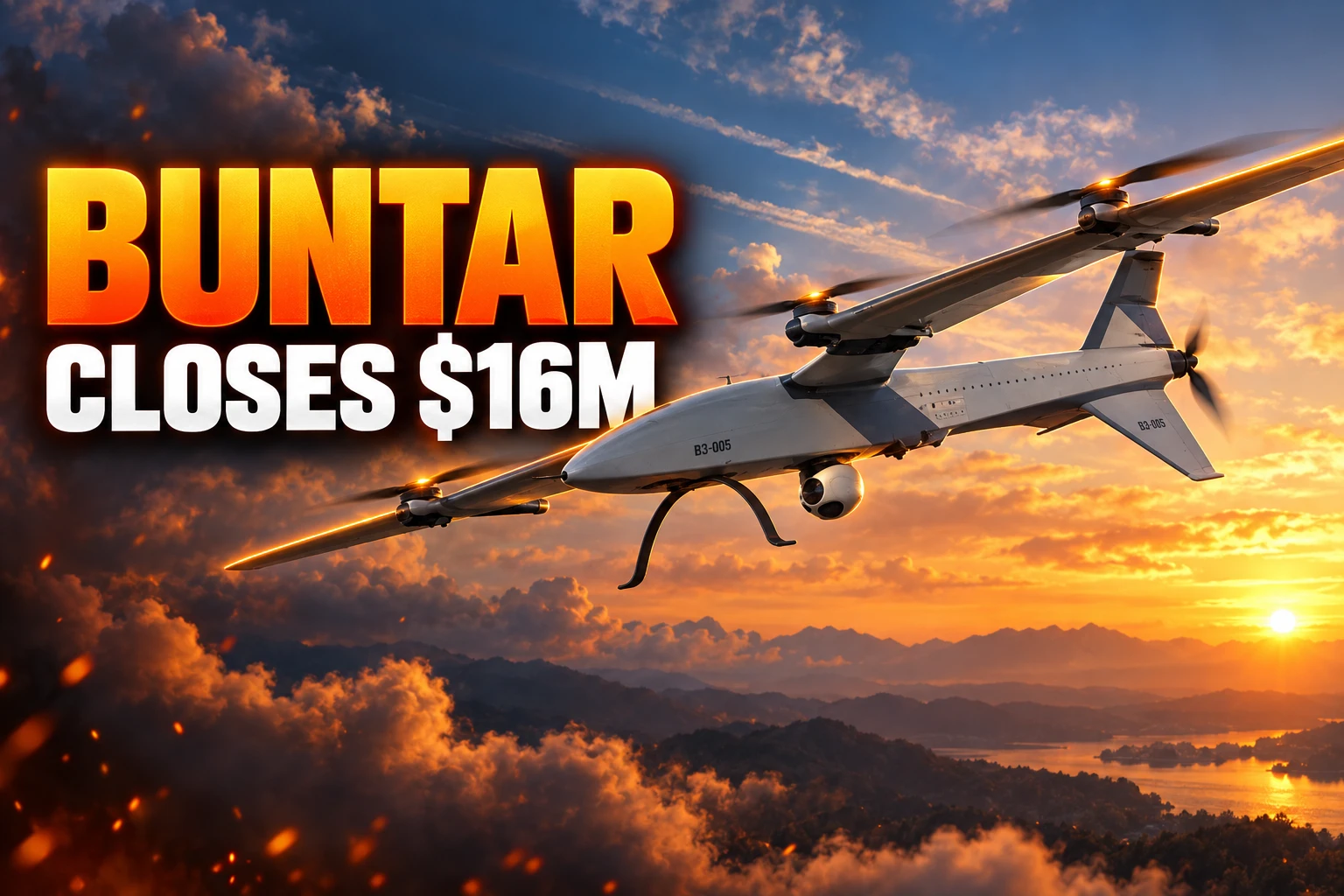
Buntar-3 Flies Four Hours Without GPS
The airframe underneath that software is an electric vertical take-off aircraft, sold as an EW-resistant tactical reconnaissance UAV with a tactical range of up to 100 km. It needs no runway and no catapult, which matters when the launch strip is a farm track that may be mined. Company listings put endurance of up to four hours on the same aircraft, with target detection out to 15 km and a live video link.
Navigation is the other reason units keep it. Buntar-3 is built to hold position and heading when satellite signals are gone, which on this front is the normal condition rather than a special case. The public spec sheet is short because the useful details live in the jammer belt, but the company is explicit about the problem it designed around: electronic attack that turns other links into a slideshow.
BUNTAR-3 ON THE COMPANY SHEET
| Item | Company figure |
|---|---|
| Take-off | Electric VTOL, no runway |
| Endurance | Up to 4 hours |
| Tactical range | Up to 100 km |
| Target detection | Up to 15 km |
| Navigation | Flies without GPS |
| Public unveiling | May 2025 |
Hardware of that class is no longer rare in Ukraine. What Buntar sells as a pair is the board plus the planner that is supposed to stop a four-hour aircraft from being wasted on a one-hour mistake. The company says both products already sit with front-line units and throw off steady revenue, which is why this round reads as scale capital rather than a science project.
How Madyar’s Birds Used It at Donetsk Airport
The combat claim that follows the aircraft around is not a brochure video. In March 2026, operators from the 414th Separate Unmanned Strike Aircraft Brigade, known as Madyar’s Birds, used a Buntar-3 for reconnaissance and fire correction on a Russian Shahed storage and launch site at Donetsk Airport. The strike mix was SCALP cruise missiles and ATACMS ballistic missiles.
That is a recon aircraft doing the work that used to belong to a manned spotter or a much more expensive drone. A Shahed depot is a target that moves, hides and is wrapped in jamming. If the Buntar-3 held a picture long enough for cruise and ballistic weapons to land, Copilot’s promise about gap-free watch is not theoretical.
The same month, the company was raising money on the back of that kind of use. Sas said the March cash would help scale systems that give operators information as early as possible and help save lives at the most critical moments. The October round is the next step on the same path: more boards in the air, more of the planning load on software, and a sales story that now points past Ukraine.
Freedom Fund Led, an Unnamed Fund Paid Up
Freedom Fund is the name on the term sheet that Ukrainian defence founders already know. Oleg Rohynskyy, the People.ai founder, set it up in 2022 as the first venture fund dedicated to Ukrainian defence tech. By August 2026 he put the book at more than 30 startups, with a typical cheque between $100,000 and $200,000 and a fund measured in tens of millions of dollars, not hundreds.
A fund that usually writes those cheques does not, on its own, fill a $16 million round. The other co-lead is the international growth equity investor the company declined to name. Gardar, Iron Wolf Capital and Autonomy Capital came in alongside. Gardar is the €80 million Norwegian defence fund that opened in June 2026 to back Ukrainian kit already in use at the front, and it sits in a circle that already knew Buntar: Munkene, one of Gardar’s Norwegian partners, joined the March Axon round.
WHAT WE KNOW
- The cheque: $16 million closed on October 5, 2026, taking stated total capital to $30 million.
- The named lead: Freedom Fund, the 2022 Ukrainian defence-tech fund, is a co-lead.
- The other names: Gardar, Iron Wolf Capital and Autonomy Capital participated.
- The spend: Product work, factory capacity for Armed Forces demand, hiring, and more Copilot development.
WHAT IS UNCONFIRMED
- The silent co-lead: The international growth equity fund has not been identified.
- The split: No figure has been given for how much each backer put in.
- The stage: The company attached no Series label to the round.
- The valuation: None has been published.
On the company’s English site the news line for the same day is sharper than the dual-use paragraph in the release. It reads as a raise “to weaponise and scale.” Sas, in the quoted statement, talks about civil uses that follow from front-line design. Both can be true. Investors writing growth-equity cheques into a wartime factory are buying the weaponised present first.
From a $200,000 Cheque to $30 Million
Ivan Kaunov, Kateryna Bezsudna and Bohdan Sas founded the company in August 2023. Kaunov had co-founded the Ukrainian fintech Finmap, then joined the army in April 2022 as an infantryman. Bezsudna had worked at Brave1, the state defence-tech cluster. They met while testing drones there and chose to build both the aircraft and the software rather than wrap someone else’s airframe.
Brave1 put in a $25,000 grant. In 2024 the co-founders of the ride-hailing firm Uklon wrote a $200,000 cheque. By March 19, 2026 the American public-safety company Axon Enterprise, the Taser maker, led a $10.4 million round with the Norwegian consortium Munkene AS. Axon and Buntar also sketched a commercial partnership around intelligence, surveillance and reconnaissance tools for Axon’s customers.
BUNTAR’S PATH TO $30 MILLION
- August 2023: Kaunov, Bezsudna and Sas found Buntar Aerospace in Kyiv.
- 2024: Uklon co-founders invest $200,000; Brave1’s $25,000 grant sits among the early backers.
- May 2025: The company unveils the Buntar-3 in public.
- March 2026: A Buntar-3 supports the Donetsk Airport strike; on March 19 Axon leads a $10.4 million round with Munkene AS.
- July 2026: Copilot gains Remote Control, internet flying from hundreds of kilometres.
- October 5, 2026: The company closes $16 million and states total capital of $30 million.
Kaunov, who is chief executive as well as co-founder, said the Axon work would combine Ukrainian combat experience with global security and software know-how. Rick Smith, Axon’s founder and chief executive, framed ISR as a way to protect people and said Buntar was building tools that help operators see earlier and decide faster in high-risk settings. That language is law-enforcement Axon talking. It is also the civilian door Buntar now says it wants to walk through.
Counter-Drone Work and Civilian Dual-Use
The October release is explicit about leaving a single-product recon shop. Copilot keeps getting development time. New lines are supposed to move into counter-drone defence and precision-strike support, then into dual-use products sold outside Ukraine, including civilian work where, the company says, demand for autonomous kit is rising fastest.
Export is the hard part of that sentence. A GPS-denied VTOL that already talks to DELTA is a Ukrainian military product. Turning the same planner into a tool a European border agency, energy inspector or police air unit can certify, insure and fly in peacetime airspace is a different company. The round funds that attempt. It does not prove the attempt.
What the company can show now is combat use, factory demand from the Armed Forces, and a software layer that assumes the operator is scarce. Dual-use is the story European growth funds need in order to sit in a syndicate with Freedom Fund. The unnamed co-lead’s silence is consistent with that: a large cheque into lethal kit often prefers the dual-use slide in the deck and a blank space on the press list.
Europe Inherits the Pilot Shortage
Sas’s line about Europe being ready tomorrow is not a slogan unique to this firm. Ukrainian software houses have been selling the same constraint for a year. Swarmer, which raised $15 million in a September 2025 Series A, built its pitch around one operator running many aircraft because NATO countries, its founder has said, should be able to field as many drones as they can build without running out of trained pilots.
Buntar is not a swarm company. It sells a four-hour recon board and a planner that tries to make a thin crew look thicker. The $16 million does not change that product. It buys more of it, plus a hiring spree for engineers and managers, including whole teams the company wants to fold into the platform, while Copilot grows from recon assistant toward counter-drone and strike support.
The factory spend will be visible first, because Ukraine still needs the aircraft. The software spend is the part that travels. A European buyer that cannot staff a wartime-sized drone school is shopping for the same thing Madyar’s Birds already needed at Donetsk Airport: a crew that can launch, leave, and still hold a picture. Buntar now has $16 million to argue it can sell that crew as a product.
Disclaimer: This article is news reporting and analysis of a completed private funding round and related product claims. It is informational only and is not investment advice, a solicitation to buy or sell securities, or a recommendation of any fund, company or dual-use product. Readers considering any financial position in defence-tech or unlisted shares should consult a qualified investment adviser or licensed broker who can review the actual offering documents. Figures, investor names and product statuses reflect company statements and other sources available on October 5 and 6, 2026, and may change as further details of the round are released.

Procuros Raises €20 Million to Own the Trade Data Layer

Ace Combat 8’s Steam Peak Harvests a Seven-Year PC Bet

Finches Raises €2 Million to Spot Tight Harvests Early

Mercedes Built One AMG Cabriolet to Replace Two Cars

Hadrian Raises $40 Million to Turn Pentests Into Software

The Orchard Bug Forced Zcash to Open an Empty Pool

The $5.99 Game That Won Steam’s 2026 Summer Sale

Don Lee Joins Hemsworth as Extraction 3 Starts Shooting

YouTube Shorts Retires Dislikes and Swaps Likes for Hearts

NEURA Robotics Is Spending Its $1.4B on a Machine Stack
-
 NEWS4 months ago
The Orchard Bug Forced Zcash to Open an Empty Pool
-
 GAMING4 months ago
The $5.99 Game That Won Steam’s 2026 Summer Sale
-
 ENTERTAINMENT6 months ago
Don Lee Joins Hemsworth as Extraction 3 Starts Shooting
-
 NEWS4 months ago
YouTube Shorts Retires Dislikes and Swaps Likes for Hearts
-
 NEWS4 months ago
NEURA Robotics Is Spending Its $1.4B on a Machine Stack
-

 AUTO6 months ago
Kawasaki Bets the New Z1100 Against Its Own Supercharger
-

 BUSINESS5 months ago
Norway’s Export Bank Backs Nscale’s $790 Million Narvik Loan
-

 GAMING4 months ago
Game of Thrones Dragonfire Follows Boston’s Conquest Playbook