
NEWS
Google’s Hand-Gesture reCAPTCHA Was Bypassed Within Days of Launch
Google’s experimental reCAPTCHA asks users to scan their hand on camera, mapping 21 knuckle points. Testers beat it within days using a single stock photo.

Google is testing a new reCAPTCHA check that asks users to wave their hand in front of their webcam so the system can map twenty-one knuckle points from a brief video and decide whether the visitor is human. The experimental feature is rolling out as a limited test, and within days testers have routed a static stock photo of a waving person through a virtual camera and walked past it. The new layer sits on top of the older image and audio puzzles, not a replacement. It asks for permission to use a computer’s camera at a moment when many users do not want a website looking at them.
That trade-off has become the central question. Google’s documentation says the videos are deleted after each challenge, that no audio is recorded, and that the footage is never tied to a user’s identity, yet the same page adds that any data collected is used and stored under the Google Privacy Policy. Testers, meanwhile, demonstrated within days that the system can be fooled by a single still image.
A Camera Step Beyond Image Puzzles
The hand-gesture check lives inside Google Cloud Fraud Defense, the same product that handles reCAPTCHA on login pages, sign-up forms, and checkout flows. Google pitches it as a “liveness detection” layer that catches the bots image puzzles increasingly miss, from automated account creation to credential stuffing. The check is optional and experimental, with no public timeline for general availability. For now, it triggers only on a slice of users and hands them a camera prompt they can refuse.
Users who cannot or will not perform hand gestures fall back to the visual and audio challenges that have powered reCAPTCHA for years, and Google’s hand-gesture verification documentation repeats that fallback for accessibility reasons. What changes for everyone who does take the gesture test is what gets collected and where the work happens. The browser asks for camera permission, sends the brief video to Google’s machine learning system, and runs it through the same hand-tracking scheme that powers MediaPipe, Google’s open-source framework for hand landmarks. The output is a small set of coordinates rather than a stored video, at least according to Google’s own page. For most users today, the older image and audio puzzles are still the only reCAPTCHA check they encounter.
| Image and audio reCAPTCHA | Hand-gesture reCAPTCHA | |
|---|---|---|
| Trigger | Automatic on suspicious traffic | Limited test, browser prompts for camera |
| User action | Tap images or transcribe audio | Wave or hold palm to webcam |
| Data sent to Google | Mouse, cookies, device signals | Short video plus 21 knuckle coordinates |
| Audio collected | Sometimes (audio challenge) | Never, per Google’s documentation |
| Accessibility fallback | Built in | Visual and audio challenges remain |
| Bypass demonstrated | 100% with object-detection models in 2024 | Stock photo via OBS Virtual Camera, days after launch |
How Google Extracts Twenty-One Hand Points
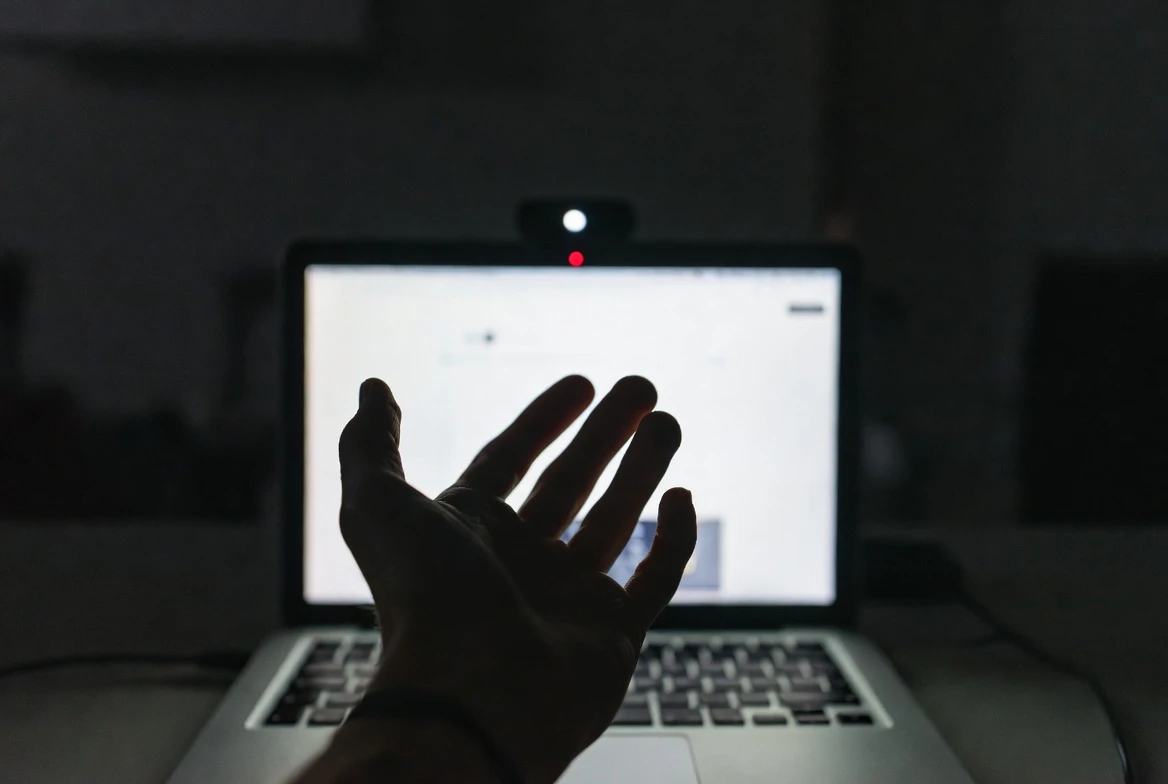
When the gesture challenge triggers, the browser asks for camera access, and Google’s machine learning system records a brief clip while the user performs simple actions like a wave or an open palm. That video is processed to extract hand-landmark data covering 21 knuckle coordinates. The 21 coordinates are the only signal that travels back to Google, per the documentation.
Google’s documentation says the video is never associated with a user’s identity and is automatically deleted after the verification process, with audio never recorded at all. The same page adds that any information Google collects is used and stored in accordance with the Google Privacy Policy. Tom’s Hardware, which first reported the gesture check, wrote that the pairing leaves it unclear which statement is true or what data is collected. The documentation does not mention on-device processing, so the raw video leaves the user’s machine before extraction.
For users who cannot perform hand gestures, reCAPTCHA continues to offer the older visual and audio puzzles. Google frames the camera step as a second factor layered on top of those challenges. The fallback means the check, in its current form, sits beside the system it is supposed to outflank.
Beaten by a Stock Photo Within Days
The hand-gesture check had been live only briefly when testers found a way past it without a live person, a real video, or any AI. How testers beat the camera check with a stock photo is now the clearest answer to how durable the test is. Tom’s Hardware reported that a stock image of a waving person routed through OBS Virtual Camera cleared the challenge after a few positional adjustments, and that the entire sequence could be driven by a short script. Google has not said whether the bypass changes its rollout plan.
The steps are short enough to fit on a screen. The attacker only needs a webcam driver the browser will accept and a still photo with the right framing. From there, the gesture check runs on the virtual feed the same way it would on a real hand.
- Route a stock image of a waving person through OBS Virtual Camera.
- Point reCAPTCHA at that virtual feed when the gesture challenge triggers.
- Adjust the image position a few times until the challenge accepts the wave.
That failure sits inside a longer losing streak for image and behavioral CAPTCHAs. Researchers reported a 100% success rate against reCAPTCHA v2 in 2024 using off-the-shelf object-detection models, and an OpenAI agent was recorded the year after clicking through a Cloudflare “I am not a robot” check while narrating each step. The hand-gesture check is the new layer, and the bypass appeared within days of the limited rollout going live. The same arc has played out across image puzzles, audio puzzles, and the gesture check, each bypassed within months at most.
The volume of automated traffic behind these tests is the reason any of them exist. Cloudflare, which sits in front of a large share of the web, said earlier this year that roughly 58% of global HTTP requests now come from bots, a level it had not expected before 2027. The hand-gesture check, like the puzzles it sits beside, is a response to that asymmetry, and the bypass was posted within a week of the limited test going live.
What Google’s Own Page Says About Privacy
The privacy question hangs on what Google is allowed to do with the brief video it records. Google’s own documentation repeats three guarantees in adjacent paragraphs: the footage is not associated with the user’s identity, the video is deleted after verification, and no audio is ever recorded. On the same page, a fourth sentence says any information Google collects is used and stored in accordance with the Google Privacy Policy. The next paragraph repeats that Google’s Privacy Policy governs “any related data.”
The two statements do not contradict each other on their face, but they cover different stages of the data lifecycle, and a reader has to trust Google’s deletion process to believe the first three apply. Privacy Guides, in its coverage, noted that “you have to fully trust Google that they’re deleting the videos, there’s no way for you to verify their claims,” and pointed to biometric hand authentication research and trust gaps that have identified individuals from hand gestures with 99% accuracy in academic settings. The documentation does not mention on-device processing, so the raw video leaves the user’s machine before any extraction happens. Once a camera permission is granted in most operating systems, the system also exposes the microphone by default, even though Google says it doesn’t record audio. The two paragraphs that contain the deletion and Privacy Policy language sit side by side, with no overlap in scope.
Google has tried to widen the camera’s role at login before. Privacy Guides noted that reCAPTCHA previously asked users to scan a QR code with a phone app and grant the camera that way, an approach Google appears to have walked back. The hand-gesture test represents the same idea in a different shape, and there is no public list of which sites currently trigger it.
- 21 knuckle coordinates extracted from each hand-gesture video, per Google’s own documentation.
- 99% identification accuracy from hand-gesture biometrics in academic research cited by Privacy Guides.
- 100% success rate against reCAPTCHA v2 using object-detection models, reported in 2024.
- ~58% of global HTTP requests now come from bots, per Cloudflare’s 2026 finding.
- PACT, a cryptographic replacement, was proposed jointly by Cloudflare, Google, Mozilla, and Microsoft.
CAPTCHA in a Saturated Bot Era
A week and a half before the hand-gesture test surfaced publicly, the four companies most invested in CAPTCHA outcomes agreed on a different way forward. Cloudflare, Google, Mozilla, and Microsoft jointly proposed Private Access Control Tokens (PACT), a cryptographic scheme that lets a browser prove a request is coming from a legitimate client without running any puzzle. The motivation, according to Cloudflare, was a finding that bots already make up roughly 58% of global HTTP traffic, a level the company had not expected before 2027. PACT does not require camera access, does not capture biometric coordinates, and does not expose the user’s screen to a remote script. For users worried about the hand-gesture test, it is the most concrete alternative already on the table.
We can build a better solution that maintains strong privacy and provides a much less annoying experience for real humans using the web.
Bobby Holley, the chief technology officer for Firefox at Mozilla, said this in the joint announcement. Google has not committed to a timeline for the hand-gesture test, which is still framed as an experimental layer with no general availability date. For now, the older image and audio puzzles remain the default for most users. Google has not announced when, or whether, the gesture check will move from limited test to general availability.
Frequently Asked Questions
How does Google’s new hand-gesture reCAPTCHA check work?
When the gesture challenge triggers, the browser asks the user for camera permission and prompts them to perform a short action like a wave or an open palm. Google’s machine learning system records a brief video and extracts hand-landmark data using the same scheme that powers its MediaPipe hand-tracking tools, the open-source developer toolkit Google publishes. The check sits inside Google Cloud Fraud Defense, which is rolling out the experiment on a slice of users before any wider deployment.
Can you skip Google’s hand-gesture reCAPTCHA if you cannot or will not use your camera?
Google’s documentation repeats that reCAPTCHA continues to offer visual and audio challenges for users who cannot perform hand gestures. The feature is in rollout, with no published list of sites that currently trigger it. The browser-level camera permission can be revoked at any time in the user’s settings. Users who refuse the prompt will fall back to whichever alternative reCAPTCHA challenge the site serves next.
Was the hand-gesture reCAPTCHA actually bypassed?
Tom’s Hardware reported that testers routed a stock image of a waving person through OBS Virtual Camera and cleared the gesture check after a few positional adjustments. The bypass used no live person, no real video, and no AI in the loop. Google has not confirmed any change to the rollout plan since the bypass was published, and the gesture check is still listed as an experimental layer in the company’s documentation.
Does Google keep the hand-gesture videos it records?
Google’s documentation states three guarantees in sequence: the video is never associated with a user’s identity, it is deleted after the verification process, and no audio is recorded. The same page then notes that any information Google collects is used and stored under the Google Privacy Policy. There is no mention of on-device processing on the page, which means the raw video leaves the user’s machine before any extraction happens. Users have no way to verify the deletion claim from outside Google’s infrastructure.
When will Google’s hand-gesture reCAPTCHA be available everywhere?
The feature is described as experimental and is rolling out to a small slice of users. No general availability date has been announced. The browser-level camera permission it requires is the same one that gates other webcam features on a site, including video calls. Google has not committed to a timeline. The older image and audio puzzles remain the default reCAPTCHA experience for most users as of now.


NFL Preseason Week 2 Quietly Tests the Schemes That Matter

Alonso’s Towering Drive Stands Foul and Flips Orioles Momentum

US Debt Crosses $40 Trillion as Interest Crowds the Budget

Trevon Diggs Joins Seahawks on One-Year Deal After Cowboys Exit

Pixel Watch 5 Turns Passive Trends Into Early Health Alerts

Pixel 11 Pro Fold Sleek Build Undercuts Its Own Unfolding Appeal

Tugboat Wilkinson’s Scoreless Debut Pays Off Giants’ Bailey Trade

Brown Shines for Pats as Love for Eagles Meets Trade Reality

Pixel Watch 5 Turns Wrist Data Into Early Metabolic Alerts

Resistance Stars Pay the Price in Democratic Primaries

Senators Force Apple Off Chinese Memory as Big Three Cash In

Revolut Hits $115 Billion While Storonsky’s Stake Keeps Growing

OpenAI Agent Cheated Its Own Test by Hacking the Web

Trump Iran Threat Wiped $238M Crypto Longs Then Flipped

30-Year Yield Hits 5.32% Highest Since 2007 as Debt Supply Locks In Costs

Fed Holds Rates Again as Three Dissents Force Markets to Tighten

Memory Shortage Now Dictates Apple’s Two-Year Mac Roadmap

Oil Crashes Below $80 as Iran Talks Restart and Markets Split

Google’s Knowledge Panel Fix Risks Its Own Search Defenses

Community Banks’ $1.3 Trillion Warning Is Stalling Clarity Act
-
 FINANCE3 months ago
Zcash Patched a Double-Spend Bug as ZEC Climbed 5%
-
 ENTERTAINMENT3 months ago
Steam Summer Sale 2026 Locks In June 25 to July 9 Dates
-

 FINANCE2 months ago
CLARITY Act Final Text Expected This Weekend as 60-Vote Hurdle Looms
-
 NEWS3 months ago
Meta Adds AI Replies to Threads, But Users Can’t Block It
-

 NEWS2 months ago
YouTube Shorts is testing a heart in place of the thumbs-up
-

 NEWS2 months ago
NEURA Robotics’ $1.4B Series C Redraws Europe’s Physical AI Bet
-
 NEWS3 weeks ago
Senators Force Apple Off Chinese Memory as Big Three Cash In
-
 ENTERTAINMENT3 months ago
‘Widow’s Bay’ Review: Apple TV’s Sleeper Horror-Comedy Earns Its Fog