
BUSINESS
Scaling for Sovereignty: How EU Policy Is Reshaping Europe’s Deeptech
As Brussels pushes strategic autonomy, deeptech scale-ups from CorPower Ocean to Multiverse Computing are scaling to fit the EU’s policy stack.

Europe’s deeptech companies are increasingly being shaped by the same hands that fund them. As Brussels pushes strategic autonomy, clean-tech manufacturing, and AI sovereignty, a generation of European scale-ups is being built to fit the policy: wave energy converters off Portugal, wooden wind-turbine towers in Sweden, satellite factories in Sofia, and AI-compression tools in San Sebastián. The common thread is the European Innovation Council (EIC) and the wider funding stack that sits behind it.
In 2025 and into 2026, the EIC’s Scaling Club, a curated community of more than 120+ deeptech scale-ups, has become the testbed for that alignment. The pattern is visible in the year-end milestones of four of its members: CorPower Ocean, Modvion, EnduroSat, and Multiverse Computing. Their 2025 funding rounds, EU grants, and capacity build-outs are not separate stories. They are a single industrial bet, structured around EU policy priorities on energy security, supply-chain resilience, and technological independence.
The Policy Stack Behind the Money
The capital flowing into these companies is layered. At the base sits the EU Innovation Fund, financed by auctioning allowances under the EU Emissions Trading System and estimated to provide approximately €40 billion between 2020 and 2030. Modvion’s own grant agreement describes it as “one of the world’s largest funding programmes for the deployment of innovative net-zero and low-carbon technologies.”
Stacked above that is the European Innovation Council (EIC), which blends grants and equity. CorPower Ocean was awarded up to €17.5 million by the EIC Accelerator in February 2025, including €2.5 million in grant funding and a €15 million equity pre-commitment. EnduroSat’s October 2025 round of $104 million was co-led by the EIC Fund alongside Riot Ventures, Google Ventures, Lux Capital, and Shrug Capital.
Above the EIC sits the EIC Scaling Club itself: a curated community where 120 European deep-tech scale-ups come together with 100 investors, 100 corporations, 100 mentors, 50 government agencies, and 50 media and cluster partners, all coordinated by Tech Tour, Bpifrance’s EuroQuity platform, Hello Tomorrow, Tech.eu, EurA, and IESE Business School. Adjacent to it is the Strategic Technologies for Europe Platform (STEP), which pooled the resources of 11 EU programmes and mobilised more than €15 billion in its first year, and the Net-Zero Industry Act, which targets at least 40% of the EU’s manufacturing capacity for strategic net-zero technologies to be sourced domestically. Other EIC Scaling Club members, including Germany’s Kraftblock, a deeptech scale-up working on industrial thermal energy storage, are scaling around the same policy alignment.
The practical effect: a deeptech company in Europe today can increasingly assemble its capital from a single policy direction. Wave energy, biomaterial wind towers, small-satellite production, and AI compression all sit on the same strategic-autonomy axis.
- €40 billion: estimated EU Innovation Fund size, 2020-2030
- 120: deep-tech scale-ups in the EIC Scaling Club
- 400+: partner organisations across the Scaling Club network
- 40%: NZIA target for domestic clean-tech manufacturing
- €15 billion: STEP mobilisation in its first year
How CorPower Ocean Is Scaling Wave Energy off Portugal
Stockholm-based CorPower Ocean closed 2025 as the most active member of the cohort. In February, the EIC Accelerator awarded the company up to €17.5 million to commercialise its wave-energy converters. By year end, CorPower had secured a €40 million grant from the EU Innovation Fund to support VianaWave, a 10 MW wave farm planned off the coast of northern Portugal.
The company is now the lead partner on POWER-Farm EU, a €30 million project partly funded by a €19 million Horizon Europe grant and aimed at validating wave farms for large-scale deployment in UK waters. Two new strategic investors, Acario (a Tokyo Gas subsidiary) and GTT Group, joined the cap table in 2025 to strengthen industrial capabilities and global reach.
The pitch is built on a specific stress case. CorPower’s 2025 annual review notes that “data centres alone could consume over 3% of global electricity by 2030, up from 1% in 2020, according to the IEA.” The company’s converters are designed to deliver predictable, 24/7 clean power to pair with intermittent wind and solar, and to feed the data-centre buildout the IEA is forecasting.
The white paper published in March, “Quest for 24/7 Carbon-Free Energy,” lays out the economic case. CorPower argues that a standardised design and proven hardware reduce investor risk and improve project-cost predictability, a fit with the EU’s bankability agenda for clean-tech infrastructure. CorPower’s 2025 funding and project roundup also notes a berth agreement at the European Marine Energy Centre in Orkney for a 5 MW array, set to become the UK’s largest wave-energy installation.
Modvion Builds Tall Towers from European Forests
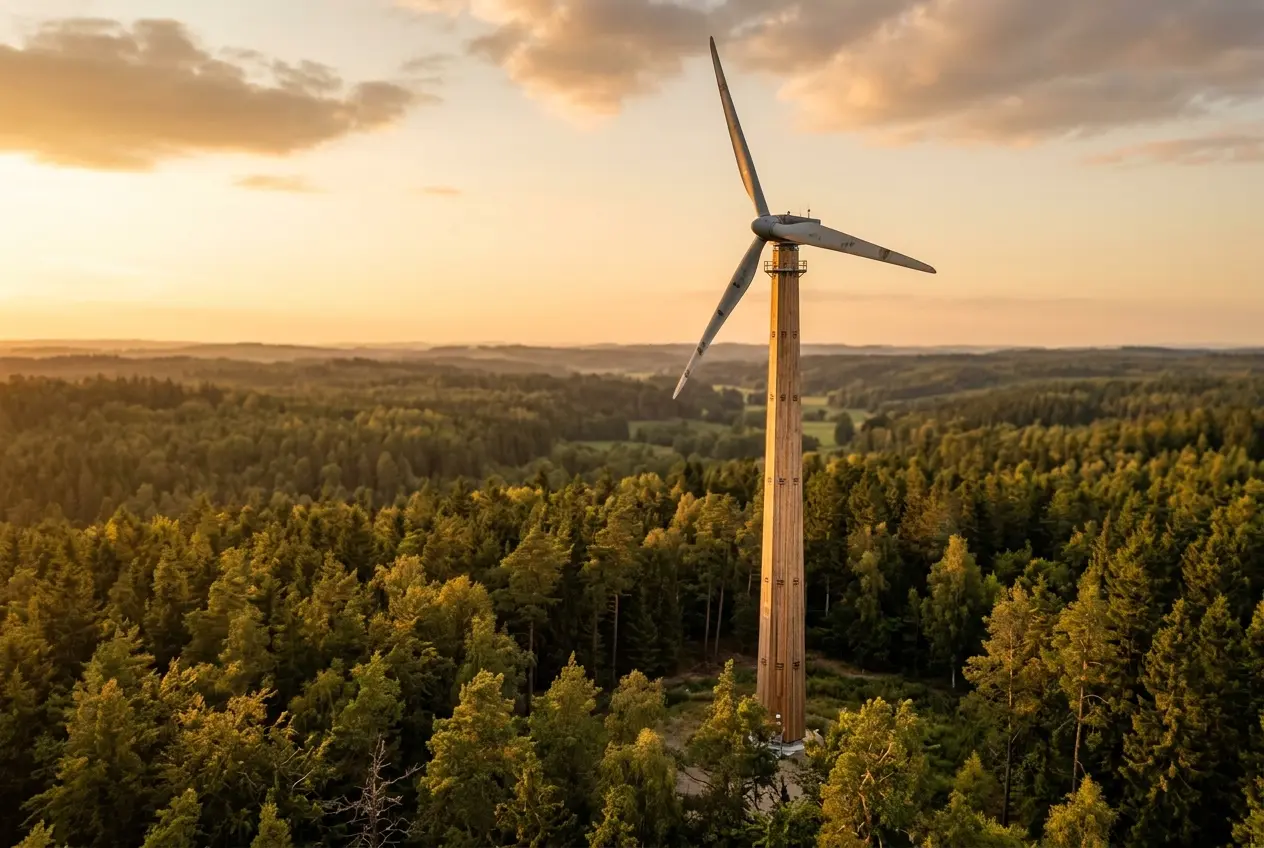
Modvion’s stack is different from CorPower’s, but aligned to the same supply-chain logic. The Gothenburg-based company builds wind-turbine towers from laminated veneer lumber (LVL), an engineered wood product sourced from European forests. Its modular design lets towers be transported on standard trucks and assembled on site, sidestepping the road-transport limits that increasingly constrain very tall steel towers.
In 2026, the European Commission signed a grant agreement with Modvion under the EU Innovation Fund for up to €39.1 million. The funding supports a volume-manufacturing facility in Trollhättan, Sweden, expected to reach full production capacity by 2031. The facility, described by Modvion as “the first serial production facility for wooden wind turbine towers in the world,” is projected to manufacture approximately 1,500 towers over ten years, avoid around 18 million tonnes of CO₂-equivalent, and generate roughly 29,000 GWh of renewable electricity per year, “enough to power approximately 7.3 million average EU households.”
The technology is already running. In 2024, Modvion erected its first commercial wooden tower, the Wind of Change, for Varberg Energi, equipped with a refurbished Vestas V90-2.0 MW turbine. A year on, Varberg Energi’s CEO Björn Sjöström called the turbine’s availability “excellent” with “no operational issues,” and Modvion reports more than 15,000 hours of successful operation. The company has now completed a tower design for a 6 MW turbine, among the largest onshore.
This agreement with the European Commission is a landmark moment for Modvion and for the wider wind energy industry. It validates both the commercial potential and the strategic importance of what we are building.
Maria-Lina Hedlund, CEO of Modvion, said the funding is “key for us to move from demonstration to scale and begin delivering wooden towers to the market at the volume the energy transition demands.” The €39.1M EU grant for wooden towers covers the build of a Trollhättan plant that would otherwise need traditional project finance.
| Modvion’s EU-Backed Buildout: By the Numbers | |
|---|---|
| EU Innovation Fund grant | up to €39.1 million |
| Facility location | Trollhättan, Sweden |
| Target full production | 2031 |
| Towers over 10 years | approximately 1,500 |
| CO₂-equivalent avoided | around 18 million tonnes |
| Annual renewable output | approximately 29,000 GWh |
| EU households powered | approximately 7.3 million |
| First commercial tower | Wind of Change, 2024 (Vestas V90-2.0 MW) |
EnduroSat’s 188,000-Square-Foot Bet on European Space
Space is the third leg of the cohort. Sofia-based EnduroSat raised $104 million in October 2025 in a round co-led by Riot Ventures, Google Ventures, Lux Capital, the EIC Fund, and Shrug Capital. The same week, the company opened a 188,340-square-foot Space Centre in Sofia, designed to manufacture up to two ESPA-class satellites per day.
The EIC Scaling Club’s own write-up of the round described the Sofia facility as “designed to scale production of its Frame ESPA-class satellites to up to two per day.” The building features advanced RF labs, hardware and mechanical labs, ISO-classified clean rooms, and full space qualification capabilities. EnduroSat’s new generation of Frame satellites uses a cableless design that the company says enables assembly and testing within hours.
The strategic framing comes from the investors. Riot Ventures co-founder Stephen Marcus: “EnduroSat is redefining how space infrastructure is built and deployed. Their production capabilities are aligned with the evolving demands of a new generation of satellite operators.” Roni Hiranand, a partner at GV: “Scalable, modular satellite platforms… uniquely position them to set a new standard for satellite constellations.”
This latest investment, combined with the launch of our new Space Center, marks a pivotal moment. It not only validates our strong market traction but significantly accelerates our ability to deliver highly capable, cost-effective satellite constellations at an unprecedented scale.
Raycho Raychev, founder and CEO of EnduroSat, said the company’s mission is to “simplify and streamline access to space, making space data a powerful tool for innovation across all industries.” The $104M round and Sofia Space Center was the company’s second funding round in 2025 and reflects demand for small and medium satellite constellations serving secure communications and earth observation.
Multiverse Computing Reframes Compression as Sovereignty
The fourth case sits at the silicon layer. San Sebastián-based Multiverse Computing raised €189 million ($215 million) in a Series B in 2025, led by Bullhound Capital, with HP Tech Ventures, SETT, Forgepoint Capital International, CDP Venture Capital, Santander Climate VC, Quantonation, Toshiba, and Capital Riesgo de Euskadi (Grupo SPRI) joining. The company is part of the EIC Scaling Club’s Next-Gen Computing market group.
Multiverse’s product, CompactifAI, uses quantum-inspired tensor networks to compress large language models by up to 95%, with only 2-3% precision loss. The compressed models are 4x to 12x faster and cut inference costs by 50% to 80%, according to the company’s own technical documentation. The pitch for European buyers is that compressed models can run on local data centres or even directly on devices such as PCs, phones, cars, and drones, a hedge against dependence on US hyperscale cloud providers.
The company’s framing for the round is unambiguous. Founder and CEO Enrique Lizaso Olmos: “What started as a breakthrough in model compression quickly proved transformative, unlocking new efficiencies in AI deployment and earning rapid adoption for its ability to radically reduce the hardware requirements for running AI models.” The €189M Series B and CompactifAI specs are now the largest single round in the EIC Scaling Club’s history at the time of reporting.
What Industrial Policy Picks
The pattern across the four companies is the same. EU policy defines a strategic need, EU funding mechanisms capitalise the suppliers, and a curated community, the 120-company curated deeptech community, connects them to follow-on capital. For the companies, the upside is concrete. CorPower’s €40 million VianaWave grant is not a market-rate loan; it is a sovereign-demand signal that de-risks the entire project. Modvion’s €39.1 million covers the build of a facility that would otherwise need traditional project finance.
The trade-off is the dependency it creates. A deeptech company whose roadmap is tied to NZIA targets, Innovation Fund cycles, and EIC milestones has to plan around grant-application timelines, EU state-aid rules, and the political durability of the Green Deal. STEP’s first-year numbers, more than €15 billion mobilised across 11 EU programmes, are impressive; they are also a reminder that the cohort’s success is partly downstream of a policy choice that can be revised. The EU plan to triple data-centre capacity sits on the same strategic-autonomy logic, with the same dependency profile.
Three things are worth watching:
- Innovation Fund size at the next EU ETS revision: The €40 billion 2020-2030 estimate depends on carbon prices holding up. A weaker ETS means less money, regardless of how many strong deeptech projects are in the pipeline.
- STEP rollout beyond the priority sectors: STEP currently names digital and deep-tech, clean and resource-efficient technologies, and biotechnologies as priority areas. Expansion to space and quantum is under discussion, but the policy text has not yet locked it in.
- Bankability of EU-funded projects: CorPower’s VianaWave still needs offtake contracts, Modvion’s Trollhättan plant still needs buyers, and EnduroSat’s Space Centre still needs constellation customers. EU capital can de-risk the supply side; demand-side bankability is a separate problem.
| Company | EU grant or EIC role | Headline 2025-26 milestone | HQ country |
|---|---|---|---|
| CorPower Ocean | €40M EU Innovation Fund; €17.5M EIC Accelerator | 10 MW VianaWave wave farm (Portugal) | Sweden (Stockholm) |
| Modvion | €39.1M EU Innovation Fund | Trollhättan wooden-tower plant signed | Sweden (Gothenburg) |
| EnduroSat | EIC Fund co-investor in $104M round | Sofia Space Centre, 188,340 sq ft, 2 sats/day | Bulgaria (Sofia) |
| Multiverse | EIC Scaling Club member (Next-Gen Computing) | €189M Series B, CompactifAI at 95% compression | Spain (San Sebastián) |
Frequently Asked Questions
What is the EIC Scaling Club?
The EIC Scaling Club is the European Innovation Council’s curated community of 120+ European deep-tech scale-ups, designed to connect founders with a 400+ partner network of investors, corporates, mentors, and government agencies. The programme is run in partnership with Tech Tour, Bpifrance (EuroQuity), Hello Tomorrow, Tech.eu, EurA, and IESE Business School, and its stated goal is to convert 20 of its members into unicorns.
What is the EU Innovation Fund?
The EU Innovation Fund is one of the world’s largest funding programmes for net-zero and low-carbon technologies, financed by EU ETS allowance auctions. It is estimated to provide approximately €40 billion between 2020 and 2030, and it is the same fund that awarded Modvion €39.1 million for its Trollhättan wooden-tower plant and CorPower Ocean €40 million for VianaWave.
How is EU policy reshaping European deeptech?
EU policy is reshaping European deeptech by tying public capital to strategic-autonomy outcomes. The Net-Zero Industry Act sets a 40% target for domestic manufacturing of strategic net-zero technologies, and STEP has mobilised more than €15 billion in its first year across 11 EU programmes. The EIC Scaling Club then channels this capital to 120+ scale-ups whose products are explicitly designed around European sovereignty goals, from clean-energy independence to AI sovereignty.
What is the Net-Zero Industry Act?
The Net-Zero Industry Act is an EU regulation that establishes a framework to strengthen Europe’s net-zero technology manufacturing ecosystem. It targets at least 40% of the EU’s annual deployment needs for strategic net-zero technologies to be met by domestic manufacturing capacity, making it a key policy anchor for the capital flowing into deeptech scale-ups in this article.
Why does AI compression matter for European sovereignty?
Multiverse Computing’s CompactifAI compresses large language models by up to 95% with only 2-3% precision loss, allowing compressed models to run on local infrastructure or directly on devices. The strategic argument is that compression gives European organisations a way to deploy powerful AI without depending on US hyperscale cloud providers, a deliberate hedge against the capital and energy intensity of the foundation-model race.


Maggie Gyllenhaal Tapped to Direct Rachel Kushner’s Creation Lake

NEURA Robotics’ $1.4B Tops a Defining Week for European Tech

The Bear Season 5 Trailer: Carmy Quits, Sydney Runs the Final Service

Instagram’s Your Algorithm Now Reaches the Main Feed

Xbox Layoffs 2026: Microsoft to Cut Jobs as Helix Storage Costs Surge

Netflix’s Hit Man Series Drops Glen Powell From the Lead

A New Revolutionary War Novel Lands as America Prepares to Turn 250

Peter Sarsgaard Cast as Seraphite Leader in The Last of Us Season 3

Microsoft Brings Phi Silica to Nvidia GPUs Outside Copilot+

Jerry Seinfeld’s ‘It Doesn’t Exist’ Reply Sparks CAIR Condemnation

Zcash Patched a Double-Spend Bug as ZEC Climbed 5%

Steam Summer Sale 2026 Locks In June 25 to July 9 Dates

‘Widow’s Bay’ Review: Apple TV’s Sleeper Horror-Comedy Earns Its Fog

Citigroup Says ETF Outflows Drove Bitcoin’s Crash, Not Strategy’s Sale

Amazon Scraps Its Stargate Revival After a 20-Week Writers Room

Coinbase Invests in Ethena, ENA Jumps 10% on Open-Market Buy

CLARITY Act Floor Vote Likely Shifts to August, Lummis Says

Gigaton Lands $26M to Replace Heavy Industry’s Control Stack
London AI Lab Inherent Raises $50m to Reinvent Science
Quobly’s €115M Bet to Scale Silicon Quantum Computing
-
FINANCE1 week ago
Zcash Patched a Double-Spend Bug as ZEC Climbed 5%
-
ENTERTAINMENT1 week ago
Steam Summer Sale 2026 Locks In June 25 to July 9 Dates
-
 NEWS1 month ago
Meta Adds AI Replies to Threads, But Users Can’t Block It
-
ENTERTAINMENT3 weeks ago
‘Widow’s Bay’ Review: Apple TV’s Sleeper Horror-Comedy Earns Its Fog
-
FINANCE1 week ago
Citigroup Says ETF Outflows Drove Bitcoin’s Crash, Not Strategy’s Sale
-
ENTERTAINMENT1 week ago
Amazon Scraps Its Stargate Revival After a 20-Week Writers Room
-
FINANCE1 week ago
Coinbase Invests in Ethena, ENA Jumps 10% on Open-Market Buy
-
FINANCE1 week ago
CLARITY Act Floor Vote Likely Shifts to August, Lummis Says