
BUSINESS
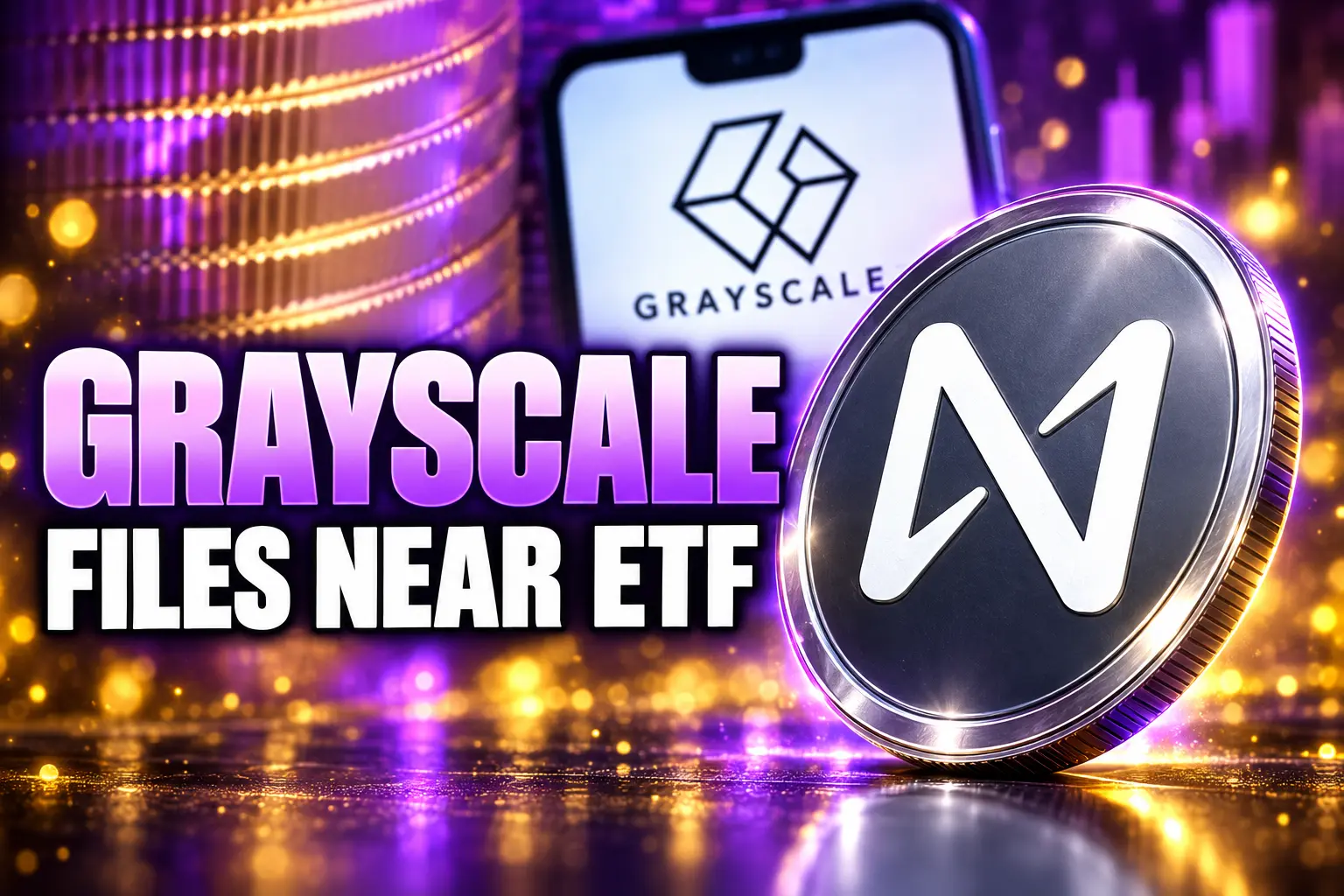
Grayscale Files a NEAR ETF Around a $1.5 Million Trust
Grayscale’s June 12 NEAR ETF amendment names BitGo, freezes staking, and still wraps a $1,536,432 OTC trust that trades at an 81% premium.

Grayscale filed Amendment No. 1 to its spot NEAR ETF on June 12, naming BitGo Bank & Trust N.A. as primary custodian of a vehicle that still holds $1,536,432.
SpaceX began trading that same Friday after pricing 555.56 million shares at $135 and raising $75 billion at a $1.77 trillion value. The amendment does not mention that listing. It swaps custody, freezes staking, and keeps the path to list Grayscale Near Trust on NYSE Arca under GSNR.
BitGo Replaces Coinbase as Primary Custodian
The original January 20 registration statement sought to convert the closed-end trust into Grayscale Near Trust ETF and list the same GSNR ticker on NYSE Arca. That filing, SEC file 333-292834, still treated Coinbase Custody Trust Company, LLC as the sole custodian.
The June 12 amendment, logged on EDGAR under accession 0001193125-26-269337, rewrites the back office. BitGo Bank & Trust N.A. is now the custodian. Coinbase, Inc. stays as prime broker. Coinbase Custody stays as an additional custodian. Coinbase is not out. It is no longer first in line on this product.
That split matches a pattern already visible on other Grayscale wrappers. The firm’s Hyperliquid staking ETF uses Anchorage Digital Bank N.A. The Sui staking ETF still uses Coinbase Custody. NEAR gets BitGo as the name on the vault, with Coinbase kept as a second key.
WHAT THE JUNE 12 AMENDMENT CHANGED
- Primary custodian: BitGo Bank & Trust N.A. replaces Coinbase Custody as the firm that holds the trust’s NEAR.
- Remaining Coinbase role: Coinbase, Inc. is prime broker and Coinbase Custody is an additional custodian, not the lead vault.
- Staking line: The prospectus now states that nobody tied to the trust may stake its NEAR until a stated legal condition is met.
- Token snapshot: Circulating supply is listed at 1.3 billion NEAR as of March 31, 2026, with a $1.5 billion market cap and a rank of 43, down from 39.
CSC Delaware Trust Company remains trustee. The Bank of New York Mellon remains transfer agent and administrator. The sponsor is still Grayscale Investments Sponsors, LLC at 290 Harbor Drive in Stamford. The product on the street is still the old trust, not a live ETF.
The Trust Still Holds $1,536,432
The Delaware statutory trust was formed on November 3, 2021. The share class Grayscale now quotes has an inception date of May 22, 2024 and a public inception of September 29, 2025. Eligible shares are GSNR shares quoted on OTCQB, not NYSE Arca.
As of September 10, 2026, Grayscale’s product page listed 438,900 shares, a net asset value of $3.50, and a market price of $6.35. Each share was backed by 1.41609365 NEAR. The total expense ratio is 2.50%. There is no distribution.
The same page states, in plain language, that the product has not met its investment objective. Shares quoted on OTC have traded at both premiums and discounts to the value of NEAR held, less expenses, “with variations that have at times been substantial.”
GSNR AS OF SEPTEMBER 10, 2026
- Assets: $1,536,432, non-GAAP, as published by Grayscale.
- NAV versus market: $3.50 net asset value against a $6.35 market price, an 81% premium (2.85 divided by 3.50).
- Fee: 2.50% total expense ratio, with no income distribution.
- Holdings unit: 1.41609365 NEAR per share across 438,900 shares outstanding.
An 81% premium is the closed-end problem this S-1 is built to solve. Until creations and redemptions open on an exchange, the share price is a separate market from the token. On September 10 that separate market asked $6.35 for a claim on $3.50 of NEAR.
Shareholders approved a Third Amended and Restated Trust Agreement on February 24, 2026, which is the legal shell the conversion would use. The amendment does not enlarge the bag. It prepares a small bag for an ETF ticker.
The Staking Condition Has Not Been Met
NEAR is a proof-of-stake token. Independent network stats on September 11, 2026 put the staking yield near 4.5% APY, with 1,306,023,743 NEAR in circulation. A brokerage product that cannot stake forgoes that carry, then charges 2.50% on top.
The amended prospectus is explicit. Staking is allowed only if a defined Staking Condition is satisfied. As of the prospectus date, it was not.
At this time, none of the Trust, the Sponsor, the Custodian, nor any other person associated with the Trust may, directly or indirectly, engage in Staking of the Trust’s NEAR on behalf of the Trust, meaning no action will be taken pursuant to which any portion of the Trust’s NEAR becomes used in any staking protocol or is used to earn additional digital assets and there can be no assurance that the Trust, the Sponsor, the Custodian or any other person associated with the Trust will ever be permitted to engage in Staking of the Trust’s NEAR.
Grayscale Near Trust, Amendment No. 1 to Form S-1, June 12, 2026
If the condition is later met, the sponsor may stake a portion of holdings through the Near Network’s proof-of-stake mechanism and take additional NEAR as staking consideration. BitGo’s own staking terms say NEAR unstaking takes four epochs, each about 12 hours, before funds can be claimed. That lag is one reason ETF issuers write staking rules so tightly: a redemption basket cannot wait two days for tokens to thaw unless the documents allow it.
The freeze is not a NEAR-specific ban across Grayscale. The firm already runs staking ETFs. This wrapper is the one that still says no.
A Staking Version Is Already in the SEC Queue
Bitwise filed for a spot NEAR product in May 2025, months before Grayscale’s January S-1. It has kept amending. A July 2, 2026 update added staking as a second objective, alongside tracking the token. Amendment No. 3 on July 31 named NYSE Arca and the ticker NRR. Amendment No. 5, dated August 28, 2026, was still a live S-1/A as of that filing.
Bitwise named Coinbase Custody to hold the tokens and BNY Mellon as cash custodian, administrator, and transfer agent. Seed capital in that package was $200, paid for 8 shares at $25. The management fee was still blank. The product cannot trade until the SEC declares the statement effective, the same gate Grayscale faces.
Two issuers, two designs. Grayscale is converting an existing OTC trust with staking parked and BitGo on the vault. Bitwise is building a new ETP that wants the yield and keeps Coinbase as custodian. If both clear, U.S. brokerage accounts would be able to buy NEAR two ways: GSNR without carry at a 2.50% fee unless Grayscale later cuts it, and NRR with a staking mandate whose fee has not been disclosed.
Nothing in either file says the Commission is close to a yes. Amendments of this kind are how issuers answer staff comments. They are not a listing date.
Live Grayscale Staking Funds Dwarf This Wrapper
Nine days before the NEAR amendment, Grayscale listed Hyperliquid Staking ETF on Nasdaq under HYPG. As of September 10, 2026 that fund held $172,683,863, or about 112 times GSNR’s assets, at a 0.29% management fee. It had 6,090,000 shares, 2,153,165.3786 HYPE, and 91.34 percent of HYPE staked. Gross staking rewards were 2.26%. Net was 1.69%. Anchorage Digital Bank N.A. is custodian. The fund paid $0.029079 a share in early August and $0.033713 in early September.
Sui Staking ETF, ticker GSUI, is the closer cousin by size. Grayscale’s Sui page for the same September 10 date showed $25,580,746 in assets, a 0.35% fee, Coinbase Custody, and 100% of the SUI staked. That product began trading on NYSE Arca on February 18, 2026.
GRAYSCALE’S NEAR WRAPPER VERSUS FUNDS THAT ALREADY STAKE
| Product | Ticker | Status | Assets | Fee | Staking | Lead custodian |
|---|---|---|---|---|---|---|
| Grayscale Near Trust | GSNR | OTCQB, S-1 pending | $1,536,432 | 2.50% | Off | BitGo Bank & Trust N.A. (as amended) |
| Hyperliquid Staking ETF | HYPG | Nasdaq, listed June 3, 2026 | $172,683,863 | 0.29% | 91.34% | Anchorage Digital Bank N.A. |
| Sui Staking ETF | GSUI | NYSE Arca, listed Feb. 18, 2026 | $25,580,746 | 0.35% | 100% | Coinbase Custody |
| Bitwise NEAR ETF | NRR | S-1/A pending | $200 seed | Undisclosed | Proposed on | Coinbase Custody |
HYPG is the product Grayscale actually scaled in June. GSNR is the product it papered. A 2.50% fee on $1,536,432 is about $38,411 a year before other costs, which is why a conversion, and a lower ETF fee, would have to arrive before this wrapper looks like HYPG rather than a leftover private-placement trust.
On August 7, 2026, Grayscale filed Form RW withdrawals for its Cardano, Polkadot, and Hedera ETF registrations. No shares had been issued under those three. NEAR was not on that list. It remains in the queue, unstaked, with BitGo named and Coinbase still in the room.
SpaceX Listed That Same Friday
SpaceX priced on June 11, 2026 at $135 a share. Trading started June 12. Shares rose 19% on the open, taking the company to a $2.1 trillion value. Elon Musk’s rocket, satellite, and orbital data-center story pulled a lot of AI language into that week’s market notes. NEAR has spent years pitching itself as a chain for agents and applications. The two stories sat on the same date. The S-1/A does not connect them.
NEAR’s own numbers have moved since the amendment’s March 31 snapshot. That filing put circulating supply at 1.3 billion tokens, market cap at $1.5 billion, and rank at 43, down from 39 in the January S-1. NearStats on September 11, 2026 listed NEAR at $2.45, a $3.18 billion market cap, rank 32, and the same 1.3 billion circulating supply. That is a 112% rise in market cap from the $1.5 billion figure in the amendment, (3.18 minus 1.5) divided by 1.5. The token is larger than the filing’s table. The trust is not.
GSNR’s $1,536,432 of assets is still a rounding error next to that $3.18 billion. A converted ETF would let authorized participants add NEAR in size. Until the SEC says yes, the only public share is the OTC line, thin volume, 2.50% fee, 81% premium.
What a Conversion Would Do to the Premium
An ETF listing would let authorized participants create and redeem shares against NEAR, which is how a closed-end vehicle that now prints an 81% premium is supposed to snap back toward NAV. The June 12 amendment keeps that conversion path. It does not turn the yield on, and it does not change the 2.50% expense ratio printed on the product page.
Creations would also test BitGo’s primary role in public. Coinbase would still sit as prime broker and extra custodian, so a listing would not be a clean custody handoff. It would be a dual setup around a token BitGo has already supported in the NEAR Foundation’s own treasury work since 2022.
If the Staking Condition is later met, the trust could start taking NEAR as staking consideration and look more like HYPG and GSUI. The prospectus refuses to promise that day. Bitwise’s NRR file is the one that already writes yield into the objective. Grayscale’s GSNR file is the one that writes the freeze.
As of September 11, 2026, GSNR still trades on OTCQB, HYPG still holds $172,683,863, and both NEAR ETF registrations remain pending. The amendment that landed on SpaceX’s listing day did one concrete thing: it put BitGo on the vault and left the stake switched off.
Disclaimer: This article is news reporting and analysis of SEC filings and product pages. It is informational only and is not investment advice, a solicitation, or a recommendation to buy, sell, or hold GSNR, HYPG, GSUI, NRR, NEAR, or any other security or digital asset. Readers should consult a licensed financial adviser and, where tax or brokerage rules apply, a qualified tax professional or broker before acting on any figure or product status in this piece. Assets, fees, premiums, rankings, and filing statuses reflect the cited issuer pages and registration statements as of the dates given in the article and can change without notice.

Copilot Capital Buys the Autopilot Already Running 90 GW

Walmart Puts Dunkin on the App to Sell More Groceries

Molten Bets £100m of Plc Cash on Late-Stage Tech

Ascentiz Recruits Developers Around Its Modular Exoskeleton at IFA

BIS Puts a Public Timestamp Under Official Statistics on XRPL

The Orchard Bug Forced Zcash to Open an Empty Pool

The $5.99 Game That Won Steam’s 2026 Summer Sale

Don Lee Joins Hemsworth as Extraction 3 Starts Shooting

YouTube Shorts Retires Dislikes and Swaps Likes for Hearts

NEURA Robotics Is Spending Its $1.4B on a Machine Stack
-
 NEWS4 months ago
The Orchard Bug Forced Zcash to Open an Empty Pool
-
 GAMING4 months ago
The $5.99 Game That Won Steam’s 2026 Summer Sale
-
 ENTERTAINMENT5 months ago
Don Lee Joins Hemsworth as Extraction 3 Starts Shooting
-
 NEWS3 months ago
YouTube Shorts Retires Dislikes and Swaps Likes for Hearts
-
 NEWS3 months ago
NEURA Robotics Is Spending Its $1.4B on a Machine Stack
-
 AUTO5 months ago
Kawasaki Bets the New Z1100 Against Its Own Supercharger
-
 BUSINESS4 months ago
Norway’s Export Bank Backs Nscale’s $790 Million Narvik Loan
-
 AUTO5 months ago
The Kawasaki Z1100 Awakens Sugomi With Less Peak Power