
NEWS
Gigaton’s $26 Million Round Bets on Waste-Fuel Kilns
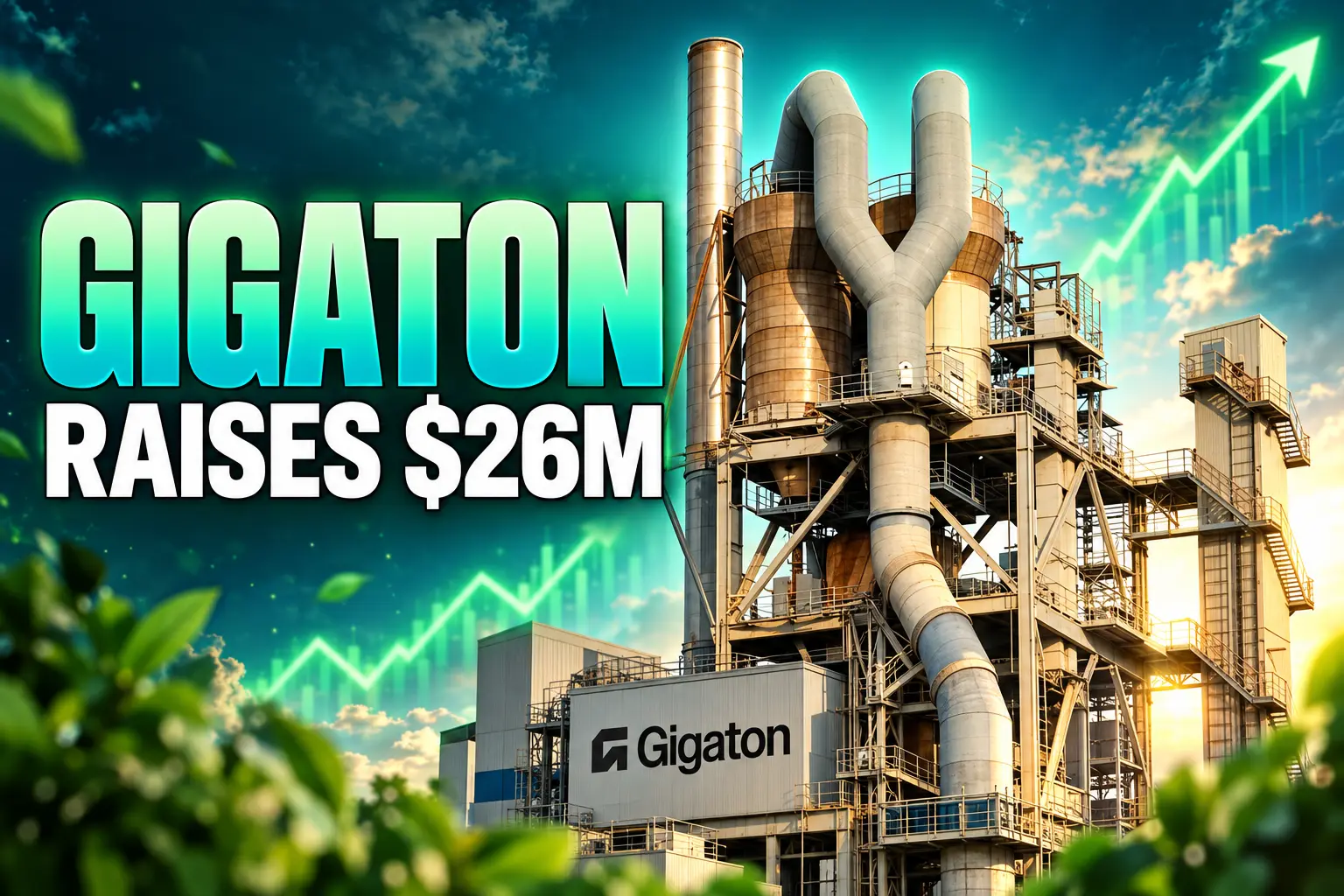
Gigaton’s $26 million Series A follows waste-fuel kiln control on plants that already run ABB software, while most cement CO2 still comes from limestone.

Gigaton closed a $26 million Series A on 3 June 2026 to put self-learning software on cement kilns that already burn waste instead of coal. Plural led the round. 2150, Semapa Next, Planet A Ventures, Cambridge Enterprise Ventures, the UCL Technology Fund (AlbionVC with UCL Business), and Clean Growth Fund joined, taking total funding past $35 million.
The London company, formerly Carbon Re, sells that cheque as the start of a fully autonomous plant. Named cement producers are already paying for something narrower: a control layer that holds a kiln steady when the fuel is refuse, not coal.
Plural Backs a $26 Million Bet on Kiln Control
Gigaton raised $26 million in Series A funding after a late-May 2026 rename. The sterling figure on the same round was £19.3 million. Josh Vernon, who joined as chief executive in early 2024 after co-founding the Australian fintech Earnd, is the public face of the raise.
The business started in 2020 as the first joint spinout from University College London and the University of Cambridge. Dr Daniel Summerbell, Buffy Price, Sherif Elsayed-Ali, and Dr Aidan O’Sullivan founded it. Summerbell is now chief solutions officer. The office is the Metal Box Factory at 30 Great Guildford Street in London.
Vernon put the pitch in cost, carbon, and old plants in the same breath.
Every cement executive I speak to is facing the same challenges: costs they struggle to control, carbon they struggle to reduce, and plants that weren’t built for the world they’re operating in today.
Josh Vernon, CEO, Gigaton
He added that the software most plants run “was never built to manage the complexity plants are forced to deal with today,” and that Gigaton was built to deliver cost and carbon savings now “while building the AI infrastructure these industries need in a fully autonomous future.”
Carina Namih, a Plural partner who sits on the board, said cement, glass, and steel consume about a quarter of global energy, and that Adani, Heidelberg, and Holcim are already saving millions of dollars a year on a single facility. The company says deployments deliver $1 million to $3 million in annual operational savings and 30,000 tonnes of CO2 per plant, a figure it equates to 11,000 UK households, with savings scaling toward $100 million across large multi-site customers. Those readings are company figures, not an independent audit.
The money is meant to fund a fivefold increase in headcount and a move from cement into steel, glass, and chemicals. Dealroom put the team at about 30 people at the raise. The LinkedIn company page listed 42 employees on 10 September 2026.
FROM SPINOUT TO SERIES A
- 2020: Carbon Re spins out of UCL and the University of Cambridge.
- Early 2024: Josh Vernon becomes chief executive.
- Late May 2026: The company renames itself Gigaton.
- 3 June 2026: Plural leads the $26 million Series A.
- 11 June 2026: Gigaton, alcemy, and CemAI publish a joint white paper on AI across the cement chain.
- Mid-August 2026: Vernon tours Indian cement groups with the firm’s India partner.
The rename is the tell. Carbon Re sold a climate outcome. Gigaton sells control of the plant that produces that outcome.
At Heidelberg’s Mokra Plant, the AI Feeds Expert Optimizer
Gigaton’s platform simulates process behaviour, forecasts each move, then adjusts fuel mix, kiln speed, and oxygen, retraining on live plant data. Operators still see why a change was made. The company says the stack should replace conventional control software rather than sit on top of it. A named plant tells a tighter story.
At Heidelberg Materials’ Mokra works, the brief was to extend ABB’s Expert Optimizer, not to pull it out. The kiln already ran a thermal substitution rate of up to 86%, mostly on refuse-derived fuel. Gigaton’s own case study lists the measured deltas.
MOKRA KILN RESULTS GIGATON PUBLISHES
| Metric | Result |
|---|---|
| Specific heat consumption | 2.2% lower |
| Fuel cost index | 4% lower |
| C3S variability | 33% lower |
| Fuel-derived CO2 | 2% lower |
| Time to go live | 8 weeks |
| Thermal substitution rate | Up to 86% (mostly RDF) |
A plant engineer quoted in that case study said the team had been searching for a system to enhance Expert Optimizer with AI, and that ABB’s confidence in Gigaton was part of the decision. The 2.2% heat cut matches a figure Vernon cited years earlier on a World Cement Association podcast about a Heidelberg customer. The 33% C3S move is a quality-stability number, not a carbon number.
Other named users at the raise were Adani Cement, Holcim, and Mannok Holdings DAC. Gigaton’s resources page later lists landmark AI contracts at JK Cement and Adani Cement against a UK-India trade deal, without publishing commercial terms in the listing itself. The contact page says deployment needs no shutdown and no extra hardware.
Waste Fuel Is What Broke the Old Software
Coal is a stable heat source. The fuels plants now want are not. Nicole Florack and Rahul Parekh at 2150 wrote that one of the most effective cost and carbon moves in cement is to replace fossil fuels with alternative fuels from municipal waste, farm residues, and forestry leftovers, and that those feeds change in moisture, energy content, and chemistry from load to load. Their memo is why a city-focused climate fund wrote a cheque: the control problem got harder as the fuel got cheaper and dirtier.
Kevin Lunney, operations director at Mannok, described the same bind from the control room.
We’ve had to look at all levels of innovation to improve our carbon footprint. The real challenge is making that transition with your operators in the control room, so they feel comfortable and understand why they’re being asked to do something so different.
Kevin Lunney, Operations Director, Mannok Holdings DAC
He said solid recovered fuel is harder to run than coal because calorific value and moisture swing, even though the CO2 and cost benefit is large. Gigaton’s job, in that telling, is to make a messy fuel feel safe to a shift team that still owns the kiln.
That is also how the June white paper carved the market. Gigaton took pyroprocess control and thermal substitution. Alcemy took predictive quality. CemAI took predictive maintenance. Three vendors, three slices, none of them a full plant operating system. Climate-tech firms that still have a buyer in 2026 tend to sell a lower fuel bill, with carbon as the by-product, and the signature on the order comes from operations rather than a sustainability office.
Two-Thirds of Cement CO2 Never Touches the Burner
The International Energy Agency puts steel and cement at about 7% of energy-system CO2 each, including process emissions, with chemicals another 4%. Together those trades sit in the same band as all road transport. Heavy industry used about 2,300 Mtoe of energy in 2019, of which 1,900 Mtoe was fossil fuel.
WHERE THE CARBON ACTUALLY SITS
- Cement share: About 7% of energy-system CO2, process gases included.
- Steel share: About 7% on the same basis.
- Chemicals share: A further 4%.
- Limestone step: Calcination is around two-thirds of cement’s direct CO2.
The IEA’s hard limit is chemistry. The CO2 that comes off limestone as it becomes clinker is around two-thirds of the direct emissions in cement. Stopping that stream takes carbon capture or a different binder, not a smarter oxygen setpoint. Fuel switching and tighter kiln control can cut the combustion third. They cannot retire the process third.
Mokra’s 2% cut in fuel-derived carbon is the honest scale of a software win on a kiln that already burns mostly waste. The company name still points at a gigatonne. The homepage says energy-intensive industry emits 8 billion tonnes of carbon a year, which it also writes as 8 gigatons. Software that trims fuel on plants already at 86% substitution will not move that headline by itself.
Siemens and ABB Still Run the Room
Distributed control systems from Siemens, ABB, Honeywell, Yokogawa, and Emerson still sit on the majority of large kilns. ABB’s own cement offer is advanced process control for cement kilns, model-predictive software that already claims fuel, quality, and alternative-fuel gains. In October 2024, ABB Automation said it had signed an agreement with Carbon Re to assess ways to speed cement decarbonisation while lifting productivity.
ABB has signed an agreement with Carbon Re, an industrial #artificialintelligence provider, to assess ways to accelerate the #decarbonization of #cement production while improving #productivity: https://t.co/tskOGxb7bQ #AI #advancedprocesscontrol #ABB #ProcessIndustries pic.twitter.com/K2lEoILFXr
— ABB Automation (@abb_automation) October 2, 2024
Process-control engineers with decades on DCS projects argue that industrial AI should sit above a trusted control system and recommend targets, while the existing loops move the plant. Replacing a DCS that has safety interlocks, alarm discipline, and a 20-year parts trail is a different sale from writing better setpoints into Expert Optimizer. Honeywell has been piloting its own “autonomous control room” on a petrochemical site. The incumbents are not waiting to be deleted.
WHERE THE CONTROL ARGUMENT SPLITS
- Gigaton’s raise copy: The platform should replace the underlying control stack, not sit on it.
- Mokra in practice: The AI was bought to enhance ABB Expert Optimizer on a high-TSR kiln.
- Incumbent view: AI belongs as a decision layer above DCS and APC that already run the plant.
China’s “dark plants,” which Cambridge Enterprise cited in its note on the round, raise the autonomy stakes for everyone else. Full lights-out cement still needs legal, safety, and insurance cover that a Series A software vendor does not write. Until that arrives, the live product is assisted control with an explanation trail, which is what operators will actually sign.
An India Tour and a Headcount That Has to Grow Fivefold
Ankit Patel, listed on Gigaton’s site as managing partner for India and managing director of Rajiv Engineers, posted on 15 August 2026 about a three-day India tour with Vernon. He wrote that they met cement groups on energy cost, plant control, and decarbonisation, and tagged JSW. The post is a sales trip, not a signed-fleet announcement, but it is the clearest move after the June cheque: take the cement playbook to the country that is still adding kiln tonnes.
A Transformative Journey for Cement Manufacturing
A productive three-day India tour with Mr. Josh, CEO of Gigaton, exploring the immense potential of AI-driven solutions to optimise manufacturing processes, reduce energy costs and accelerate decarbonisation across India’s cement… pic.twitter.com/1BDisffeHI
— Ankeet Patel (@iAnkeetPatel) August 15, 2026
Adani was already a reference customer at the raise. JK Cement appears on the company’s own resources list as a later contract headline. India is also where Patel’s engineering group already works the shop floor, which is the unglamorous half of industrial AI: getting a model talking to a kiln that may not have a reliable internet link. A Gigaton after-hours session in London, posted in August, had an engineer walk through deployments in plants that sit offline.
A fivefold hiring plan from about 30 people is a 150-person company if the June base held. Forty-two on LinkedIn by early September is early days on that path. Machine-learning roles in London were still open in September 2026. Steel, glass, and chemicals remain a statement of intent until a second vertical publishes a Mokra-style card.
Forty-Year Plants Make the Control Layer Stick
The IEA’s other number is time. Heavy-industry plants typically last 30 to 40 years. Major refurbishments come on a cycle of about 25 years. The global kiln and furnace fleet is young, 10 to 15 years on average, after a burst of building in China, which holds just over half of world cement kiln capacity. Those assets will not be scrapped for a software demo. They will be retrofitted.
That is the second effect of the round, and it is why a $26 million cheque can matter more than the carbon math on day one. Whoever is trusted to move fuel mix, kiln speed, and oxygen on a live pyro line becomes hard to unwind, because the model retrains on that plant’s own data. The customer list at the raise (Adani, Heidelberg, Holcim, Mannok) is a small set of very large owners. If the next phase is “dozens of sites,” as Cambridge Enterprise wrote, the lock is fleet-level, not single-kiln.
Vernon still talks about a fully autonomous future. The paying present is a kiln that can swallow waste fuel without the shift team pulling it back to coal. Limestone will keep giving off CO2 until capture or a new binder arrives. The software fight is over the third of the stack that fire still touches.
Frequently Asked Questions
Does Gigaton need a plant shutdown or extra hardware?
Gigaton’s contact page says plants can start without a shutdown, extra hardware, or local IT systems, which is the installation claim that makes a retrofit sale possible on a kiln that cannot stop for a control upgrade.
What does thermal substitution rate measure in a cement kiln?
Thermal substitution rate is the share of a kiln’s heat that comes from alternative fuels such as refuse-derived fuel instead of coal or petcoke, and Mokra’s published rate of up to 86% is why that plant wanted tighter AI setpoints rather than a new burner.
Who founded the company that became Gigaton?
Dr Daniel Summerbell, Buffy Price, Sherif Elsayed-Ali, and Dr Aidan O’Sullivan founded Carbon Re in 2020 as a UCL and University of Cambridge spinout, with Josh Vernon hired as chief executive in early 2024 and Mike Laven later named board chair.
How much carbon does Gigaton attribute to energy-intensive industry each year?
The company homepage states that energy-intensive industries emit 8 billion tonnes of carbon a year, which it also labels 8 gigatons, a sector-wide figure that sits far above the per-plant savings it publishes for individual kilns.

Copilot Capital Buys the Autopilot Already Running 90 GW

Walmart Puts Dunkin on the App to Sell More Groceries

Molten Bets £100m of Plc Cash on Late-Stage Tech

Ascentiz Recruits Developers Around Its Modular Exoskeleton at IFA

BIS Puts a Public Timestamp Under Official Statistics on XRPL

The Orchard Bug Forced Zcash to Open an Empty Pool

The $5.99 Game That Won Steam’s 2026 Summer Sale

Don Lee Joins Hemsworth as Extraction 3 Starts Shooting

YouTube Shorts Retires Dislikes and Swaps Likes for Hearts

NEURA Robotics Is Spending Its $1.4B on a Machine Stack
-
 NEWS4 months ago
The Orchard Bug Forced Zcash to Open an Empty Pool
-
 GAMING4 months ago
The $5.99 Game That Won Steam’s 2026 Summer Sale
-
 ENTERTAINMENT5 months ago
Don Lee Joins Hemsworth as Extraction 3 Starts Shooting
-
 NEWS3 months ago
YouTube Shorts Retires Dislikes and Swaps Likes for Hearts
-
 NEWS3 months ago
NEURA Robotics Is Spending Its $1.4B on a Machine Stack
-

 AUTO5 months ago
Kawasaki Bets the New Z1100 Against Its Own Supercharger
-
 BUSINESS4 months ago
Norway’s Export Bank Backs Nscale’s $790 Million Narvik Loan
-

 AUTO5 months ago
The Kawasaki Z1100 Awakens Sugomi With Less Peak Power