
NEWS
Inherent’s $50m Bet Posts a First Faraday Score
Inherent’s $50m seed wager gets its first public test as Faraday, a 27B agent, beats GPT-5.5 and Claude at paper replication on Replica.

London lab Inherent used a 27-billion-parameter agent to beat Claude Opus 4.8 and GPT-5.5 at paper replication, the first public test of its $50 million seed bet. The agent, Faraday, is a post-trained Qwen3.6-27B model that directs a much larger coding system rather than trying to write every line itself.
Index Ventures led the May 29, 2026 round, with Radical Ventures alongside, on a claim that scientific taste can be trained as a thin layer. The August 14 result is that layer’s first scoreboard. It is still a replication exam, run on Inherent’s own suite, not a new scientific finding.
Index Led a $50m Seed for a New Kind of Lab
Inherent came out of stealth on May 29, 2026 with a $50 million seed and a system then still in development. Index said it led the round alongside Radical. The lab is a public benefit corporation, a legal form that requires directors to weigh social impact with shareholder return.
The investor note that followed two days later did not sell a faster literature search. It sold a break with how science has been done for four centuries. Index partner Danny Rimer is on that post with Georgia Stevenson.
AI-native science will look and feel totally different to the scientific method we’ve grown used to over the past 400 years: it will be messier, less legible, but capable of exceptional outcomes.
Index Ventures, investment note, May 31, 2026
That is the messier, less legible scientific method the cheque was written against. Index argued that most models are trained to give good answers and still cannot learn which questions are worth asking, the curiosity that produced penicillin, the microwave and the GPU. Faraday, named for Michael Faraday, was the machine that was supposed to close that gap with humans in the loop.
Matt Clifford CBE, co-founder of Entrepreneurs First and a former adviser to the UK prime minister on AI, joined as an adviser. He called the founders some of the most impressive, thoughtful people he had met. Early angels and hires, Index said, include people who work on technical safety and on democratic uses of AI.
THE FIRST PUBLIC DATES
- May 12, 2026: Isomorphic Labs, another London AI science shop with DeepMind roots, closes a $2.1 billion Series B.
- May 29, 2026: Inherent leaves stealth with a $50 million seed led by Index, Radical alongside.
- May 31, 2026: Index publishes the discovery thesis and confirms the public benefit structure.
- August 13, 2026: Inherent files Training AI Scientists to Replicate Research.
- August 14, 2026: The lab introduces Faraday and Replica on its site and on X.
- September 9, 2026: Radical restates the Replica result as an early signal, not the end of the bet.
Edward Hughes, co-founder and chief scientist, wrote on August 14 that the lab had begun to push the frontier in the 78 days since launch. Replication, he said, was the first step toward AI scientists that would change discovery both in software and in the physical lab.
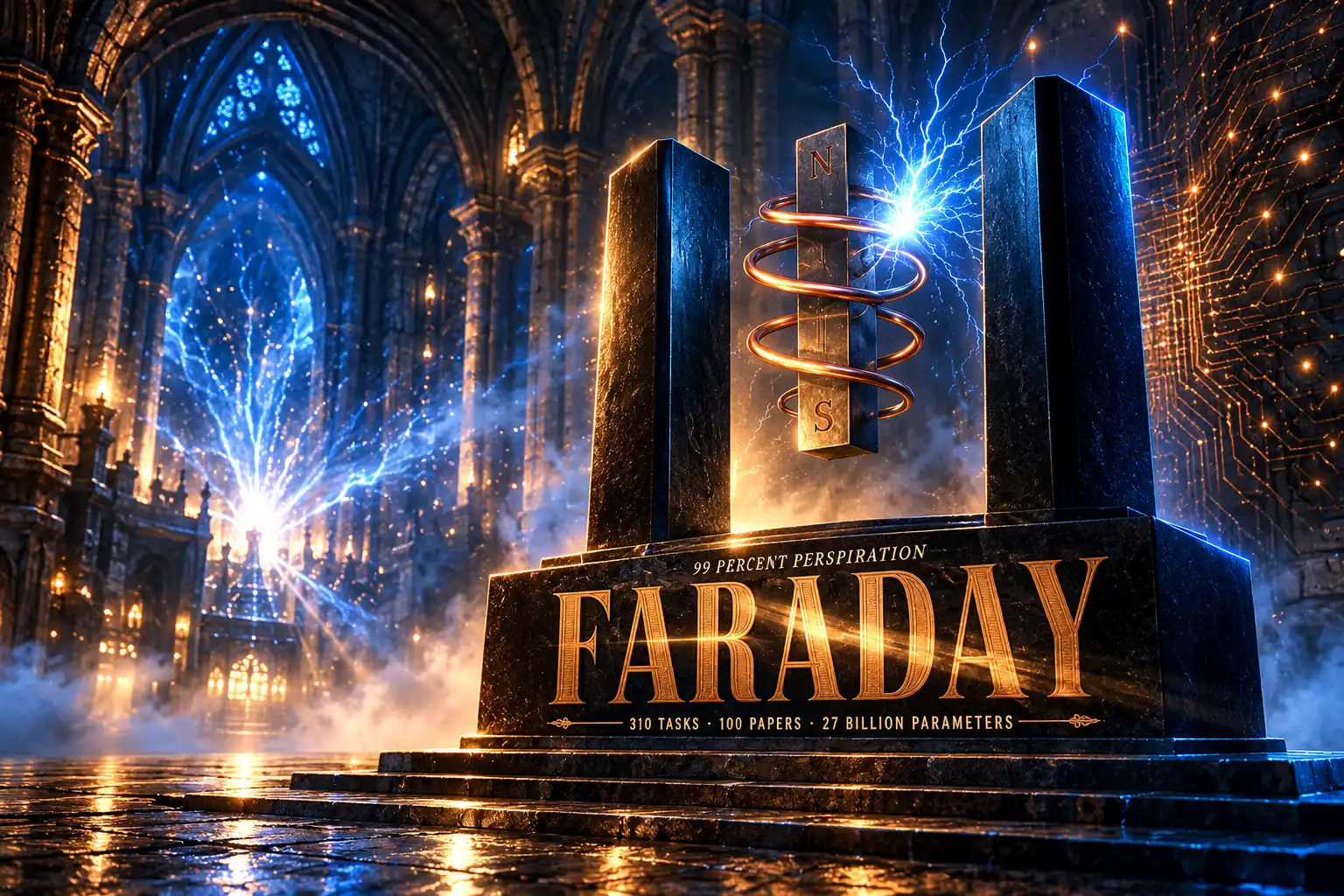
What Faraday Beat on the Replica Benchmark
Faraday is a 27 billion-parameter “AI Scientist” agent. Inherent post-trained Qwen3.6-27B with long-horizon reinforcement learning so the model would use coding agents as tools. On August 14 the lab said that agent outperforms Claude Opus 4.8 and GPT-5.5 at replicating research.
The exam is Replica, a task space Inherent built. Each task asks an agent to rebuild a figure from a paper under a fixed time and compute budget, without the original plot. The first suite has 310 tasks from 100 machine-learning and AI-for-science papers, covering natural language processing, materials science and weather forecasting.
The the 27B Faraday replication paper reports the head-to-head as a win rate, not as a share of pixels matched. Faraday outperforms both Claude and GPT-5.5 on 73% of in-distribution machine-learning tasks and on 60% of held-out AI-for-science tasks, according to Inherent’s rubric-based judge. On the test split, Faraday’s average score sits 6% above Claude and 8% above GPT-5.5, which the paper nicknames Codex.
FARADAY ON REPLICA
| System | Setup | What Inherent measured |
|---|---|---|
| Faraday | Qwen3.6-27B, RL post-trained, Codex as a tool | Outperforms both baselines on 73% of in-distribution ML tasks and 60% of held-out AI-for-science tasks |
| Claude Opus 4.8 | Claude Code harness, extra-high thinking | Baseline; Faraday’s test-split average sits 6% higher |
| GPT-5.5 | Codex harness, extra-high thinking; also Faraday’s coding tool | Baseline; Faraday’s test-split average sits 8% higher |
Baselines ran in their own coding harnesses with thinking effort set to extra high. Inherent says Faraday produced more faithful replications in every paper category in the suite and struggled less with recent work, including papers the base model would not have seen in pre-training. The judge is an auto-generated, per-task rubric that the lab checked against a human study, because a raw “does the plot look right” score is easy to game.
Those figures come from Inherent’s judge on Inherent’s tasks. No independent lab has published a rerun of Replica, and the weights are not public. That does not void the paper. It does cap how far the win can be read.
Faraday Directs a Much Larger Coding Model
The architectural claim is easy to miss under the win-rate. Faraday is not trying to out-code GPT-5.5. It is trying to supervise it. Inherent’s Faraday training write-up on Replica puts it plainly: Faraday uses GPT-5.5 Codex as a tool, much as human scientists use coding agents, and directs a model several orders of magnitude larger.
Aaron Rosenberg of Radical later called that a compact layer of scientific intelligence, rather than another attempt to scale a single giant model. If the coding tools keep getting better, the value of the layer that chooses the experiment is supposed to rise with them. Inherent says Faraday can switch to a stronger coder at test time, after training with GPT-5.4-mini, and still improve.
The lab announced the work in an eight-part thread the same day as the blog.
1/ Today, we introduce Faraday, a 27B-parameter AI Scientist that extends the capabilities of coding agents with a layer of scientific intuition. Trained via long-horizon RL, Faraday outperforms Claude Opus 4.8 and GPT-5.5 on the task of replicating research papers. 🧵 pic.twitter.com/nA6ylMNrvj
— Inherent (@inherent_labs) August 14, 2026
HOW FARADAY USES A CODING AGENT
- The split: Faraday keeps the experimental plan, the next hypothesis and the reading of intermediate results, while Codex writes and debugs code.
- The constraint: Each Replica task has a time and compute budget, so the agent often has to design a smaller experiment that still tests the paper’s claim.
- The reward: A rubric judge scores scientific practice, not only whether a chart looks familiar, and assigns credit turn by turn.
- The swap: The scientist layer is trained to call a coder as a tool, so a stronger coder can be dropped in without starting Faraday’s training from scratch.
Practitioners who went through the thread kept returning to that split. A 27B model beating two frontier systems sounds like a size upset until you notice Faraday is calling one of those systems as staff. The cleaner reading is that research judgment, at least on this exam, can sit in a small supervisor if the supervisor is trained on the messy middle of an experiment, not on a style guide about how science ought to look.
Replication Is How Faraday Learns Taste
The seed pitch was open-ended curiosity. The first public task is copying other people’s figures. Inherent treats that gap as a curriculum, not a climb-down.
The lab’s own origin story is the 1821 episode in which Michael Faraday, asked to review electromagnetism, tried to reproduce past results in a basement at the Royal Institution and built an electric motor by accident. Replica is meant to force the same habit. Papers report what worked. They skip the failed runs. An agent that wants a matching figure has to recover the perspiration that never made the PDF, which Inherent calls research taste.
Hughes put the same point in one line the day Faraday shipped.
Replication is the first step towards AI Scientists that will transform the process of discovery, both in silico and in situ.
Edward Hughes, co-founder and chief scientist, on X, August 14, 2026
On the thread, Inherent said it also built 20 paper variants whose results do not appear in the originals, and that Faraday beat GPT-5.5 on those imagined tasks. That is the closest the first paper comes to a discovery claim: the same weights, asked to reconstruct a figure that was never printed, still produce something the lab’s judge likes. It is still a figure-reconstruction game, run in software, with no wet lab attached.
Tantum Collins, another co-founder, described the paper as post-training a model to replicate published work and to grow a sense of research taste. Radical, posting again on September 9, called the Replica result an early signal for a larger bet, that the company can build AI that discovers new knowledge rather than only checking old results. The investor is saying out loud what the scoreboard does not yet show.
London Already Has a Much Larger AI Science Cheque
Seventeen days before Inherent’s seed, another London lab with DeepMind in its blood raised a very different sum for a very different scientific object. Isomorphic Labs’ $2.1 billion Series B, led by Thrive Capital, is for an AI drug-design engine and a pipeline aimed at the clinic. Alphabet and GV joined, as did MGX, Temasek, CapitalG and the UK Sovereign AI Fund.
That is the local comparison that makes Inherent’s wager look small on purpose. Isomorphic is scaling a vertical that already has protein models, pharma contracts and a path into trials. Inherent is trying to train a general scientific supervisor on papers, then, later, point it at domains it has not named in public. Protein design and density-function work have been floated as examples of where the same taste layer might transfer, once the lab takes on partners. No such partnership has been announced.
Other AI-for-science groups have already commercialised literature tools, chemistry planners and protein generators. Faraday’s first artefact is narrower: a 27B supervisor that is good at rebuilding figures under a budget. If that supervisor later becomes the thing that chooses which protein to make, the $50 million will look like a cheap option on a method. If it remains a replication agent, Index and Radical will have paid seed prices for a benchmark paper.
The Founders Met on Cooperative AI at DeepMind
The four co-founders are Tantum Collins, Edward Hughes, Louis Kirsch and Kaloyan Aleksiev. Collins, Hughes and Kirsch came out of DeepMind. Aleksiev came from Reka AI and Microsoft and is the infrastructure specialist in the group. Collins later worked on AI policy in the Biden White House, which is unusual kit for a lab founder and sits behind the public benefit filing.
Collins and Hughes first worked together on cooperative AI at DeepMind. Index leaned on that history. The firm says the day-to-day mix of people and agents inside Inherent is itself a research problem, and that grafting new models onto old lab workflows can only yield small gains. Hughes also conducts choirs, a detail Index used to explain his interest in how groups find a beat.
The company presents Faraday’s gains as something that should compound through Inherent, with humans still in the loop, and says it is looking at scalable oversight and at reward hacking. That is the safety language you would expect from a team that left DeepMind and a co-founder who did White House policy. It is also still a research agenda. The first paper is about teaching an agent not to fake a plot. It is not a deployment report from a partner laboratory.
Faraday Has Not Yet Produced Original Science
The $50 million bet was never scored on Replica. It was scored on whether a small lab can make AI that asks better scientific questions than the tools we already have. August 14 moved that bet from a manifesto to a table of win rates. It did not settle it.
WHAT WE KNOW
- The round: Index led a $50 million seed on May 29, 2026, with Radical alongside, into a public benefit lab in London.
- The agent: Faraday is a Qwen3.6-27B model post-trained with long-horizon RL to direct GPT-5.5 Codex on paper-replication tasks.
- The score: On Inherent’s Replica judge, Faraday beats both named baselines on 73% of in-distribution ML tasks and 60% of held-out AI-for-science tasks.
- The paper: Training AI Scientists to Replicate Research is live as arXiv 2608.13331, with a company blog dated August 14, 2026.
WHAT IS UNCONFIRMED
- Outside reruns: No independent group has published a Replica rerun on the same 310 tasks with the same rubric.
- Open weights: Faraday’s parameters, the Replica suite and the judge stack have not been released for outsiders to inspect.
- Discovery: Inherent has not shown Faraday proposing and confirming a result that was not already in the literature or in a held-out variant the lab wrote.
- Partners: Design partnerships in protein work or other wet-lab fields remain a stated hope, not a signed programme.
The honest limit is the one Radical already accepted on September 9. Replica is evidence that a compact supervisor can be trained to care about experimental depth, and that it can boss a frontier coder on a closed exam. The product the seed round described, a playbook for AI-native science that finds questions nobody thought to ask, is still ahead of the published work.
Frequently Asked Questions
Who founded Inherent and what extra roles do they hold?
The co-founders are Tantum Collins, Edward Hughes, Louis Kirsch and Kaloyan Aleksiev. Hughes is listed as a visiting fellow at the London School of Economics and as an adviser to the Cooperative AI Foundation, details that sit beside his DeepMind and Inherent titles and are not part of the Replica scoreboard.
How did Inherent build the Replica tasks from papers?
The paper describes a pipeline that uses Gemini 2.5 Pro to find result figures and captions in each PDF, then redacts the figure so the agent must rebuild it from the remaining text. The 100 source papers run from 1990 through 2026, which is why older, smaller experiments are easier for every model in the suite than recent work with heavy compute.
Can Faraday change coding tools without a full retrain?
Inherent says yes. Faraday was trained while calling GPT-5.4-mini as the coder and, at test time, adapted to GPT-5.5 Codex, a stronger tool, without a fresh scientist-layer training run. That swap is the practical point of treating the coder as a replaceable instrument rather than as Faraday’s brain.
What are the 20 imagined paper variants in the Faraday thread?
Inherent created 20 altered papers that contain results not present in the originals, then asked models to replicate those unseen figures. The lab said Faraday outperformed GPT-5.5 on that set and described the agent as innovating without realising it, which is still a reconstruction test, not a claim that Faraday found a new physical effect.
Hughes’s 78-day clock started on a stealth-exit morning in May. By mid-August the lab had a paper, a 27B supervisor and a win rate against two systems that cost far more to train. The next score it still has to post is a result nobody printed first.

UPI MDR Delay Hands Traders the Calendar After Paytm Falls

Google Messages Builds Nine In-Chat Games After Samsung’s Exit

Anthropic’s $100 Million Academy Trains the Firms That Bill Both Sides

Toyota’s Electric C-HR Leaves the Cheap Twin to Subaru

Markets Bet the Fed Skips October After Hawkish Minutes

The Orchard Bug Forced Zcash to Open an Empty Pool

The $5.99 Game That Won Steam’s 2026 Summer Sale

Don Lee Joins Hemsworth as Extraction 3 Starts Shooting

YouTube Shorts Retires Dislikes and Swaps Likes for Hearts

Atlantic City Turned WWE’s Return Into a Civic Night
-
 NEWS5 months ago
The Orchard Bug Forced Zcash to Open an Empty Pool
-
 GAMING5 months ago
The $5.99 Game That Won Steam’s 2026 Summer Sale
-
 ENTERTAINMENT7 months ago
Don Lee Joins Hemsworth as Extraction 3 Starts Shooting
-
 NEWS5 months ago
YouTube Shorts Retires Dislikes and Swaps Likes for Hearts
-
 NEWS5 months ago
Atlantic City Turned WWE’s Return Into a Civic Night
-
 NEWS5 months ago
NEURA Robotics Is Spending Its $1.4B on a Machine Stack
-

 BUSINESS6 months ago
Norway’s Export Bank Backs Nscale’s $790 Million Narvik Loan
-

 GAMING5 months ago
Game of Thrones Dragonfire Follows Boston’s Conquest Playbook