
NEWS
Tapo DL130 Palm Vein Lock Delivers Jedi Fun at a Cost
The Tapo DL130 wave-unlock deadbolt stores biometrics on-device and lasts a year, but its price and IFTTT cutoff make the cool factor an ecosystem gamble.

The Tapo DL130 smart deadbolt unlocks when you hold your palm a few inches from its sensor, reading vein patterns that no photo can fake, and it sells for $229.99 on Amazon. After one week in a sunroom, SlashGear’s Adam Doud found the move so addictive that both his 15-year-old daughter and the adults kept locking the door just to wave it open again.
That Jedi moment is real. So is the fine print that arrives with it.
What the DL130 Replaces
This is a deadbolt-only unit. Your existing latch stays mechanical and unlocked. Tapo ships every screw and template you need; a standard screwdriver finishes the job in about 15 minutes. A magnetic door-frame sensor tells the lock when the door is shut so it can auto-bolt.
Inside you get a normal thumb-turn, the battery bay, and a speaker that announces lock and unlock events plus the built-in doorbell chime. Outside sits the palm pad, fingerprint reader, touch-to-wake PIN display, and a discreet key cover.
The install stays simple because nothing touches the latch mechanism. You keep the door’s original spring latch for everyday close-and-push use, while the DL130 only drives the deadbolt throw. That split keeps the hardware light and the retrofit short.
- Palm pad and fingerprint reader on the exterior face
- Touch-to-wake PIN display with decoy digits
- Matching cover over the physical keyhole
- Interior thumb-turn, battery bay, and event speaker
- Magnetic frame sensor for auto-bolt on close
Official specs list seven unlock methods and dual-battery design: palm vein, fingerprint, PIN, Tapo app over Wi-Fi, Bluetooth nearby, voice assistants (Alexa, Google, SmartThings), and the physical key. Failed attempts lock the sensors and push a phone alert. BHMA Grade 2 and IP65 weather sealing cover outdoor exposure.
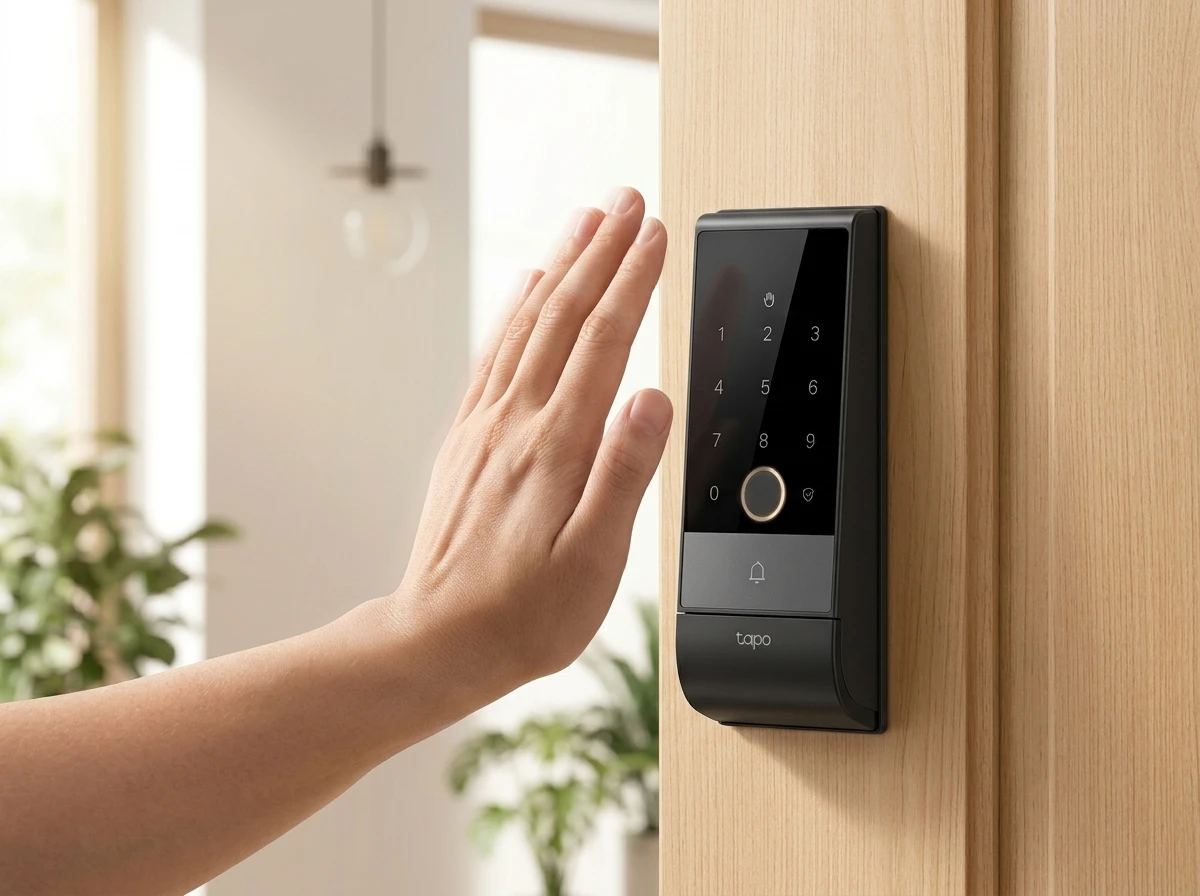
How the Palm Sensor Reads Veins
Near-infrared light maps the hemoglobin pattern under the skin. The template is encrypted with AES-128 and stays on the lock; nothing leaves for the cloud. Liveness detection looks for flowing blood, so a photo or silicone hand fails.
Identical twins produce different maps. Wet, dirty, cold, or elderly hands still register because the system never needs surface ridges. You hold the palm upright and roughly parallel; a miss is usually fixed by straightening the hand. Fingerprint enrollment feels faster than a phone’s multi-angle dance.
| Method | Contact | Spoof risk | Surface conditions |
|---|---|---|---|
| Palm vein | None | Very low (internal + liveness) | Unaffected |
| Fingerprint | Press required | Moderate (lift possible) | Dirt, cuts, moisture hurt |
| PIN pad | Touch | High (shoulder, smudge) | N/A |
Tapo’s own explainer walks through the full near-infrared palm vein mapping process and calls the DL130 the first consumer lock to pair palm and fingerprint as DuoBiometric in one body. Capacity reaches 50 palms, 100 fingerprints, and 200 codes.
Your palm and fingerprint stay on the lock, not online: They’re encrypted and stored on the device itself, never uploaded to the cloud.
That line sits on the official product page and matches every privacy claim Tapo makes for the biometrics. Because the map lives only in local memory, a cloud outage or account breach cannot leak the templates. The same on-device boundary also means a factory reset is the clean way to wipe enrolled users before resale.
Daily Entry Feels Fast Until the App Quirks Appear
Palm and fingerprint both open the bolt quickly in real use. The PIN pad lights random decoy digits first to blunt smudge reading; Doud preferred Lockly’s full randomization but the decoy still works. The keyhole hides under a matching cover and is easy to miss until you need it.
User setup splits biometrics from entry codes. Each person can enroll palm and fingerprint, yet codes live in a separate section. That makes activity logs harder to attribute and feels needlessly siloed. Guest one-time and scheduled codes work fine once you find the menus.
Voice prompts on every latch and unlatch grow old fast. The speaker doubles as the doorbell, so visitors can ring without a separate button.
- Palm vein for hands-full or wet arrivals
- Fingerprint as reliable backup
- PIN with decoy digits for guests who refuse biometrics
- App remote lock or status check from anywhere
- Physical key when power or network dies
All five see daily use in a multi-person home. The lock never replaces a full security system; it only controls the deadbolt. In practice the family settles into a rhythm: palm for the regulars, fingerprint when gloves or bags get in the way, and codes for anyone who will not enroll.
Dual Batteries Keep the Door Alive
One full charge is rated for more than a year at roughly 20 unlocks a day. Doud saw a 1 percent drop after seven days of heavy testing, which tracks. The pack pulls out for USB-C charging. A built-in backup cell keeps the lock powered while the main pack sits on the charger, and the main pack can top up the backup later.
Emergency reverse charge from a compatible phone or power bank is possible through the same USB-C port. No disposable AAs appear anywhere.
- Rated life: over 12 months typical use
- Design: swappable main + always-on backup
- Charge: USB-C, no proprietary cradle
- Fallback: phone reverse charge or physical key
Lockly’s Visage uses a similar hot-swap idea at a higher price. Tapo’s version removes the “dead battery lockout” fear that still dogs many Wi-Fi deadbolts. The dual pack also means you never leave the door unlocked while a single cell charges on a counter; the backup holds the line until the main pack returns.
Smart Actions Stay Inside the Tapo Walls
The same app that pairs the lock also runs Tapo plugs, bulbs, and cameras. Open the door and lights can switch on. Motion plus open-door logic can fire alerts. Those automations work cleanly when every device wears the Tapo badge.
Cross-brand reach is thinner. Vivint or Home Assistant users already know the friction. The bigger hit lands on August 1. TP-Link confirmed that IFTTT services end August 1 2026 for every Tapo and Kasa product. The company points owners toward its own Smart Actions and AI features instead.
Owners who built multi-vendor routines lose that bridge. The DL130 still talks to Alexa, Google Assistant, and SmartThings, yet complex if-this-then-that chains outside Tapo’s walls shrink. Buying the lock is also a quiet bet on staying inside one app family.
- Today: IFTTT still links Tapo gear to outside services
- August 1 2026: IFTTT support ends for all Tapo and Kasa products
- After the cutoff: Smart Actions and native voice platforms remain the path
Households already deep in Tapo bulbs and plugs feel almost no change. Homes that leaned on IFTTT for mixed brands will rebuild those flows inside Alexa, Google, SmartThings, or Tapo’s own rules engine.
Price Sits Next to Camera-Free Rivals
At $229.99 the DL130 matches a current Schlage Encode Wi-Fi deadbolt and undercuts Lockly Visage face models that run near $350. Eufy FamiLock S3 Max palm units with 2K cameras land closer to $400. Wyze and TCL have already shipped lower-cost palm options that trade some polish or features for the sticker.
| Lock | Approx. price | Standout | Battery note |
|---|---|---|---|
| Tapo DL130 | $230 | Palm + fingerprint DuoBio | Dual, 1 year |
| Schlage Encode | $230 | Wi-Fi, no palm | AA pack |
| Lockly Visage | $350 | Face unlock | Hot-swap dual |
| Eufy S3 Max | $400 | Palm + video doorbell | Higher capacity |
A plain keyed deadbolt still costs about $20. Once you add any smart layer the price jumps. The DL130’s premium buys the palm sensor, local biometric storage, and the dual pack. It does not buy a camera or latch replacement. Deals would change the math; full retail keeps it in “coolest gadget in the security kit” territory rather than everyday necessity.
Stack the DL130 against the Schlage Encode at the same roughly $230 sticker and the choice turns on biometrics versus plain Wi-Fi. Stack it against the Eufy S3 Max near $400 and the extra spend buys video. The middle ground is deliberate: palm plus fingerprint without a camera tax.
Why Capacity Limits Rarely Bite at Home
Fifty palm templates, one hundred fingerprints, and two hundred codes sound abstract until a household starts enrolling. A family of four can give every person both biometrics and still leave room for grandparents, sitters, and cleaners. Codes fill the gaps for anyone who refuses a scan.
The siloed menus still force a mental map: biometrics in one place, codes in another. That split does not shrink the raw headroom, yet it slows log review when you want to see who came through at noon. For most homes the ceilings stay high enough that the real limit is patience during setup, not the lock’s memory.
Guest one-time and scheduled codes draw from the same two-hundred pool. Heavy short-term rental use could burn through slots faster than a typical family, but the article’s multi-person home never pressed that edge in a week of testing.
Who Leaves Happy and Who Should Wait
Households already running Tapo bulbs and plugs get the most from Smart Actions and a single app. Families who want contactless entry for kids, greasy hands after the garden, or guests who hate codes will use the palm sensor every day. The on-device templates and auto-lock sensor remove two common smart-lock worries.
Buyers who need deep Home Assistant or multi-brand IFTTT chains lose ground after August 1. Anyone who wants the latch replaced too, or a built-in camera, should look at higher-priced video locks. Renters facing non-standard doors or landlords who forbid permanent hardware stay better with temporary options.
Doud’s verdict after the week matched the hardware’s split personality: the palm wave is silly fun that still impresses, the app is simple if slightly disorganized, and full price feels high unless the biometric theater is the point. Catch it on sale and the balance tips. At $229.99 it remains the lock you buy when you specifically want to feel like Obi-Wan every time you come home.
Frequently Asked Questions
How does palm vein recognition actually work on the Tapo DL130?
Near-infrared light passes through the skin and is absorbed by blood hemoglobin, creating a unique internal map that is turned into an encrypted template stored only on the lock. Liveness checks for real blood flow so static fakes fail; the scan works from multiple angles and ignores surface dirt or moisture.
Where is my biometric data stored and is it uploaded?
Palm and fingerprint templates stay encrypted inside the lock with AES-128 and two-step authentication; Tapo states they are never sent to the cloud or accessible online.
How long does the dual-battery system really last?
Lab rating is more than one year at about 20 unlocks per day in Wi-Fi mode. The removable main pack charges via USB-C while a built-in backup keeps the lock alive; the main pack can later recharge the backup.
Does the DL130 replace both the deadbolt and the latch?
No. It is a deadbolt replacement only. The mechanical latch remains and is normally left unlocked; a magnetic sensor on the frame triggers auto-lock of the bolt once the door closes.
What weather and security ratings does it carry?
The external unit is IP65 dust- and water-resistant and carries BHMA Grade 2 certification for residential durability and forced-entry resistance.


ChapsVision Quiet Roll-Up Now Holds French and German Intel Keys

Culkin’s Home Alone Pitch Flips Kevin Into the Locked-Out Dad

Sigvi’s €1.2M AI Layer Cracks Idle Fleet Rental Moat

Tapo C675D Dual Lenses Cut Multi-Camera Install Costs

Tapo DL130 Palm Vein Lock Delivers Jedi Fun at a Cost

LiberNovo Maxis Gives Big Frames a True Fit Before Deal Ends

Google Find Hub Remove Button Clears Years of Ghost Earbuds

Nadella Warns Single AI Reliance Kills Firms He Also Funds

Robinhood Faces Earnings Test After Slide Toward 93

Apple’s 194-CVE Drop Quietly Shields Older Macs Too

CLARITY Act Final Text Expected This Weekend as 60-Vote Hurdle Looms

Kalshi Loses Major NY Prediction Markets Ruling to Judge Torres

Fed Minutes Cite AI Demand as Inflation Risk, Put a 2026 Hike Back on the Map

Marker AI Writing Startup Lands $13M Seed Led by Index Ventures

Dota 2 Esports World Cup 2026: Spirit Defends $2M Title In Paris

Meta’s Muse Spark 1.1 Beats Rivals on Price, Trails on Coding

CS2 Premier Season 5 Lands With Cache and a C4 Damage Rework

ARC Intelligence Closes €4M Seed Round in Roughly a Week

Finto Picks Munich Over Silicon Valley After YC, Raises $3.4M

Backrooms Returns to Theaters as the Everything Must Go Edition
-
 FINANCE2 months ago
Zcash Patched a Double-Spend Bug as ZEC Climbed 5%
-
 ENTERTAINMENT2 months ago
Steam Summer Sale 2026 Locks In June 25 to July 9 Dates
-
 NEWS3 months ago
Meta Adds AI Replies to Threads, But Users Can’t Block It
-
 FINANCE4 weeks ago
CLARITY Act Final Text Expected This Weekend as 60-Vote Hurdle Looms
-
 ENTERTAINMENT2 months ago
‘Widow’s Bay’ Review: Apple TV’s Sleeper Horror-Comedy Earns Its Fog
-
 NEWS7 months ago
FolderFresh Review: This Free Tool Automates Windows File Organizing
-
 NEWS4 months ago
U.S. Navy Deploys Solar-Powered Lightfish Drone to Patrol Oceans
-
 FINANCE3 weeks ago
Kalshi Loses Major NY Prediction Markets Ruling to Judge Torres