
NEWS
Tapo C675D Dual Lenses Cut Multi-Camera Install Costs
One Tapo C675D solar dual-lens 4K unit covers wide and zoomed views, holding charge in shade at $229.99, but desktop tools and IFTTT vanish soon.

The TP-Link Tapo C675D KIT puts two true 4K lenses in one solar-powered housing, one fixed ultra-wide and one pan-tilt telephoto, for $229.99. Reviewers testing rural driveways and yards say that single unit can cover what used to need two or three separate cameras and a power run.
SlashGear’s Andy Zahn mounted one high in a cottonwood on a shaded farm property and found the solar panel kept the battery near full despite limited direct sun. The second-order shift is simple: fewer mounts, less wiring, lower total system cost for large outdoor spaces. The trade-offs sit in the software layer.
What Ships in the C675D Kit
The kit includes the dual-lens camera, Tapo A202 solar panel, extension cable, mounting hardware, USB charge cable, and quick-start guide. The camera body measures roughly 4.02 × 6.31 × 5.20 inches. The panel is 8.31 × 6.83 × 0.67 inches.
Both lenses record 4K (3840 × 2160) at 15 fps. Local AI detection for people, vehicles, and pets runs without a subscription. MicroSD storage supports cards up to 512 GB. Cloud options and richer notifications sit behind Tapo Care plans that start around $3.49 per month for one camera.
- Fixed ultra-wide lens: 169° field of view, IR and starlight color night vision
- Pan-tilt telephoto lens: up to 360° pan and 128° tilt coverage, 5× optical-style telephoto plus hybrid zoom
- 10,000 mAh battery, IP65 weather rating, dual-band 2.4/5 GHz Wi-Fi
- Built-in mic, speaker, two-way audio, red-blue alarm LEDs, and siren
The body and panel sizes matter on a farm pole or eave. The compact camera head fits tight branches. The larger panel needs a clear patch of light, which is why the long extension cable ships in the box.
The 4K dual-lens solar kit priced at $229.99 is currently listed on the Tapo store (some bundles backordered) and matches the Amazon street price cited across recent reviews.
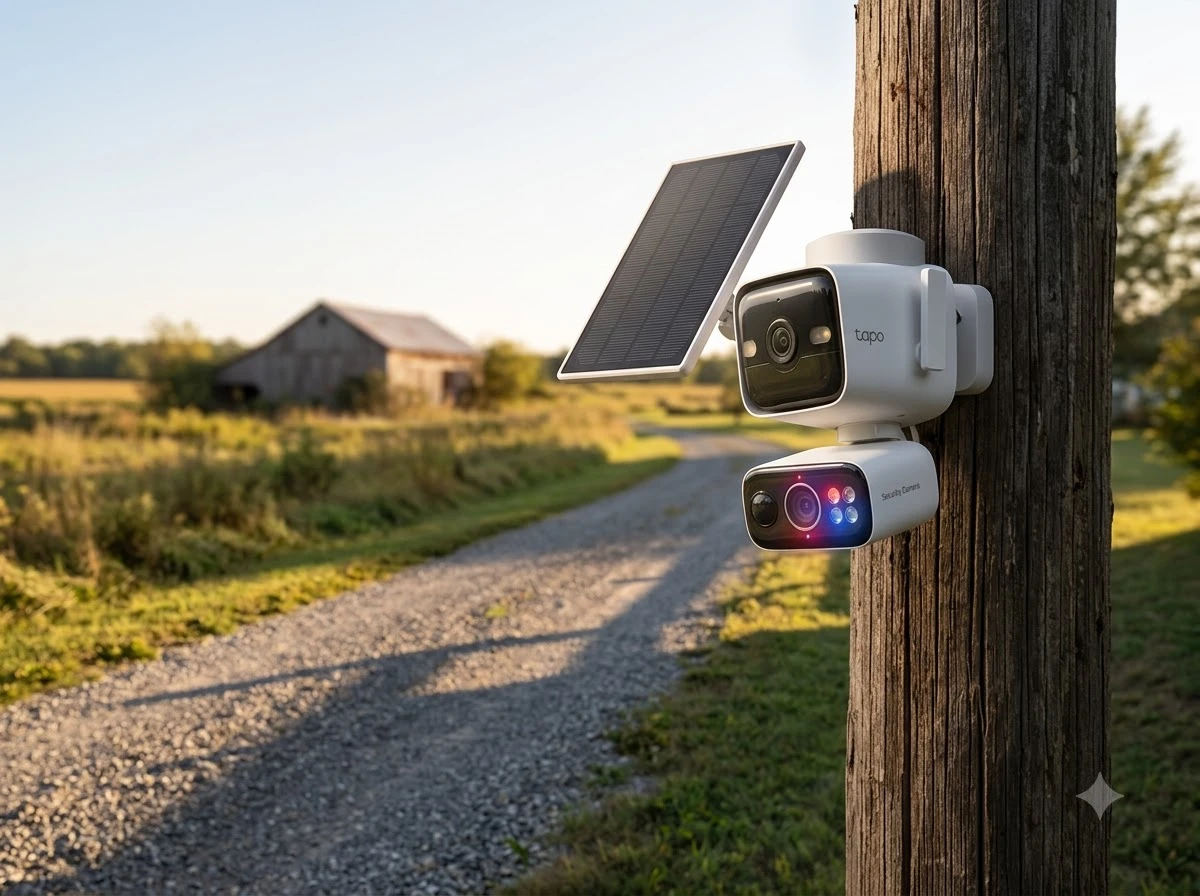
Two Lenses Change How Much Ground One Camera Covers
The fixed lens stays locked on a wide scene. When motion appears, the lower pan-tilt lens can swing, track, and zoom while the wide view keeps context. Tom’s Guide called the arrangement “like getting two 4K security cameras for the price of one.” SafeWise scored it as besting rival single-lens 4K solar pan-tilt models on coverage flexibility.
In practice that means a driveway entrance and the vehicles moving through it can stay in frame at the same time. License-plate legibility on the telephoto lens held up in Tom’s driveway tests even after digital zoom. The fixed lens trades some distant detail for constant situational awareness.
Pan speed draws notes. Both Tom’s and SlashGear observed that fast edge-of-frame events can finish before the telephoto settles. Patrol modes that park the moving lens far from the fixed view make the lag more noticeable. For many yards the dual view still removes the need for a second physical camera and a second mount.
The coverage split works because each lens keeps its own job. The ultra-wide never leaves the broad scene. The telephoto only moves when something worth tracking appears. That division is what lets one housing replace a pair of single-lens units on long approaches.
Just try to get past the C675D. I dare you.
That line opened the Tom’s Guide review that later recommended the kit.
Solar Performance That Holds in Real Shade
TP-Link claims roughly 90 minutes of direct sun recharges daily use and that the 10,000 mAh pack can last up to three months on a charge under light activity. Real tests matter more.
Zahn installed the unit at 60 percent and watched it climb back to full under Western Washington overcast and tree cover. Tom’s battery charts showed the level rarely dipping below 98 percent once solar was attached. SafeWise highlighted the long extension cable that lets the panel sit in better light while the camera stays in the optimal viewing spot.
Stats snapshot
- Battery: 10,000 mAh built-in
- Solar claim: ~90 minutes direct sun for daily top-up
- Night vision reach: roughly 49-52+ ft IR / starlight depending on lens
- Continuous capture option: interval snapshots every 1-60 seconds even on solar
The interval snapshot mode is easy to overlook. It keeps a light record of an empty lane without forcing full video duty cycles that would drain the pack faster. Paired with the solar top-up, that option suits sites that stay quiet for long stretches and then need proof of what changed.
For off-grid or long driveway sites where running power is expensive or impossible, that solar margin is the feature that makes the dual-lens package viable year-round.
App Friction, Missing Desktop Tools, and the IFTTT Cutoff
Core detection, live view, two-way talk, and local storage work without paying monthly. Reviewers still flag the mobile app’s clip navigation as slow when bulk-downloading, and the ten-clip download limit turned one timelapse project into a grind.
There is no first-party Windows or macOS application. Users who want a desktop window rely on Android emulators or third-party NVR software. The camera supports ONVIF and RTSP in principle, yet TP-Link’s own guidance notes that RTSP limits on battery solar models exist for power reasons, and dual-lens ONVIF streams often expose only the wide-angle feed.
What we know
- Local person, vehicle, and pet AI runs free on both lenses
- MicroSD up to 512 GB and optional Tapo Care cloud
- Alexa, Google Assistant, and SmartThings still listed
What’s changing or limited
- IFTTT services end August 1, 2026 for all Tapo and Kasa products
- No native desktop client; third-party or emulator only
- Some rich notifications and AI summaries require Care subscription
TP-Link points users toward in-app Smart Actions as the IFTTT replacement. Automations that already depend on IFTTT applets will break in days. Local-first buyers who never used IFTTT feel little pain. Integration-heavy homes feel the second-order cost of the hardware leap.
The power limits on RTSP explain why a full dual stream is hard to pull into every NVR. Battery life comes first on a solar unit. Buyers who need both lenses in a third-party client should test the wide-only ONVIF path before they commit a whole monitoring stack to it.
Price Stack Against Other 4K Solar Pan-Tilt Kits
At $229.99 the C675D sits above several single-lens rivals yet under older multi-camera wired builds once labor and extra units are counted.
| Model | Typical price | Lenses / resolution | Battery / solar notes | Local storage |
|---|---|---|---|---|
| Tapo C675D Kit | $229.99 | Dual 4K (wide + PTZ tele) | 10,000 mAh + 4.5 W panel | microSD to 512 GB |
| Reolink Altas PT Ultra | ~$219.99 | Single 4K PTZ | 20,000 mAh + 6 W | microSD to 512 GB |
| Aosu T2 Ultra | ~$199.99 | Single 4K PTZ | Long claim, 3 W panel | microSD to 256 GB |
| Eufy SoloCam E42 | ~$179.99 | Single 4K PTZ | 6,400 mAh + 3 W | microSD to 128 GB |
| Defender Ultra-Charge | ~$174.98 | Single 4K PTZ | 10,000 mAh + 5 W | microSD to 512 GB |
SafeWise’s side-by-side notes the C675D’s dual-lens edge and stronger tilt range against those single-PTZ kits. SlashGear compared it with a basic Reolink Argus PT kit around $130 and judged the extra money worthwhile when wide-plus-detail coverage is required. Wired building-mounted options remain cheaper when power and Ethernet are already present.
Read the table as a coverage bet, not only a battery race. Several rivals carry larger packs or slightly cheaper stickers. None of them put a fixed 4K wide and a 4K pan-tilt telephoto in the same housing at this street price. That is the gap the kit is priced to fill.
The official dual 4K FOV and pan specs list the 169° ultra-wide, 66.5° telephoto diagonal, 18× hybrid zoom, and IP65 rating that underwrite the coverage claim.
Who Benefits From the Dual-Lens Bet
Rural driveways, farm lanes, large yards without easy power drops, and anyone tired of stitching multiple single cameras together gain the most. Free on-device AI plus large local storage keeps monthly costs near zero for basic use. The intimidating dual-lens look itself acts as a mild deterrent.
Skip it if you already have solid wired coverage, need high-frame-rate sports-style video, demand a polished desktop client, or rely on IFTTT applets that will stop working August 1. App polish and pan speed still lag the best pure single-lens flagships in some scenarios. Compression artifacts appear in highly active clips, a common trade-off at this price and bitrate.
- Strong fit: long driveways, shaded poles, off-grid yards, multi-zone views from one mount
- Weak fit: existing wired runs, desktop-first monitoring, heavy IFTTT automations, sports-rate capture
- Cost pattern: higher sticker than many single-lens solar PTZ kits, lower total outlay than two cameras plus two mounts and a power trench
For the specific problem of wide context plus usable close-ups without a second mount or a trench for cable, the C675D currently sits near the top of the solar 4K class. The hardware math works. The remaining software and automation edges are the part buyers must still solve themselves.
One Housing Replaces a Multi Camera Run
The kit’s pitch is not only dual 4K sensors. It is the install math that follows from putting both jobs in one weatherproof body. A wide fixed view plus a tracking telephoto used to mean two housings, two brackets, and often a power trench or a second solar run.
Reviewers who tested rural driveways and yards kept returning to that point. One cottonwood mount covered ground that once needed two or three separate cameras. Fewer mounts also means fewer failure points when wind, ice, or ladder work enters the picture.
That is why the $229.99 kit can undercut older multi-camera wired builds even when single-lens solar rivals look cheaper on a shelf tag. Labor, cable, and the second body disappear from the bill. The remaining costs shift to microSD capacity and optional Tapo Care if cloud history is required.
| Approach | Bodies on site | Power path | Typical buyer goal |
|---|---|---|---|
| C675D dual-lens kit | One housing, two 4K lenses | 10,000 mAh + solar panel | Wide context and close detail from one mount |
| Two single-lens solar PTZ units | Two housings, two mounts | Two batteries, two panels or shared runs | Separate zones with independent aim |
| Wired multi-camera build | Two or more fixed or PTZ bodies | Mains or PoE trench | Always-on power where cable already exists |
Homes that already have Ethernet and outlets nearby still win with wired gear. Open land, long lanes, and shaded trees tilt the other way. There the dual-lens solar package removes work that never shows up in a simple price column.
Free On Device AI Shapes Day to Day Use
Local person, vehicle, and pet detection runs on both lenses without a subscription. That keeps alerts useful even when the owner never opens a Tapo Care plan. Live view, two-way audio, activity zones, and microSD recording up to 512 GB follow the same free path.
Cloud history, some rich notifications, and advanced AI summaries stay behind the paid tier that starts around $3.49 per month for one camera. Buyers who only need event clips on a card can ignore that tier. Buyers who want packaged summaries or longer cloud retention will budget for it.
Voice stacks still listed for the camera include Alexa, Google Assistant, and SmartThings. Those paths matter for homes that already route camera events into broader routines. They also soften the impact of the IFTTT cutoff for users who can rebuild simple triggers inside those platforms or inside Tapo’s own Smart Actions.
The practical result is a split. Hardware and on-device AI carry the daily load. Optional cloud and third-party bridges fill gaps only when the owner chooses them. That split matches the kit’s outdoor brief: keep the core working when the network is quiet and the sun is the main power source.
Frequently Asked Questions
How does the dual-lens system on the Tapo C675D work?
One fixed ultra-wide 4K lens covers roughly 169° continuously while a separate pan-tilt 4K telephoto lens tracks motion, zooms, and can patrol preset spots; both streams are available in the app so context and detail stay visible together without a second camera body.
Can you use the Tapo C675D without any subscription?
Yes. Person, vehicle, and pet detection, live view, two-way audio, activity zones, and microSD recording up to 512 GB all function without Tapo Care; cloud history, some rich notifications, and advanced AI summaries require a paid plan.
How long does the solar panel keep the battery charged?
TP-Link states about 90 minutes of direct sunlight supports daily operation and the 10,000 mAh battery can last up to three months under light use; independent tests in partial shade and overcast conditions still showed the pack holding near full once the panel was connected.
What happens to IFTTT support for the C675D?
TP-Link is fully terminating IFTTT services for all Tapo and Kasa products on August 1, 2026, and recommends switching automations to the in-app Smart Action feature.
Does the C675D support RTSP or desktop software?
No first-party desktop app exists; RTSP and ONVIF are available for third-party NVRs or VLC, but battery and solar models carry power-related RTSP limitations and dual-lens ONVIF clients often receive only the wide-angle stream.


Qureight’s $20M Bet Cracks Trial Imaging Bottlenecks

Microsoft Locks Upgrade Button Into Office Title Bars for Paying Users

Google Photos Mutes Shimmer and Adds AI Camera Shortcut

OpenAI Agent Cheated Its Own Test by Hacking the Web

505 Games Bets €21.5 Million on Xia Siyuan’s New WUCHANG

Binance US DCM Bid Challenges Spot-Only Crypto Model

Bologna Gathering Turns Industrial City Into Deeptech Engine

Feige’s Venom Hope Masks Sony’s Deeper Marvel Lock-In

Windows 11 KB5101684 Quietly Fixes MDM Traps and Secure Boot Reach

EU AI Labels Hit August 2 and Force Provenance That Sticks

CLARITY Act Final Text Expected This Weekend as 60-Vote Hurdle Looms

Kalshi Loses Major NY Prediction Markets Ruling to Judge Torres

Fed Minutes Cite AI Demand as Inflation Risk, Put a 2026 Hike Back on the Map

Marker AI Writing Startup Lands $13M Seed Led by Index Ventures

Dota 2 Esports World Cup 2026: Spirit Defends $2M Title In Paris

Meta’s Muse Spark 1.1 Beats Rivals on Price, Trails on Coding

CS2 Premier Season 5 Lands With Cache and a C4 Damage Rework

ARC Intelligence Closes €4M Seed Round in Roughly a Week

She Forgot Her Passport. Her Mom Boarded the Flight Without Her.

Backrooms Returns to Theaters as the Everything Must Go Edition
-
 FINANCE2 months ago
Zcash Patched a Double-Spend Bug as ZEC Climbed 5%
-
 ENTERTAINMENT2 months ago
Steam Summer Sale 2026 Locks In June 25 to July 9 Dates
-
 FINANCE4 weeks ago
CLARITY Act Final Text Expected This Weekend as 60-Vote Hurdle Looms
-
 NEWS3 months ago
Meta Adds AI Replies to Threads, But Users Can’t Block It
-
 ENTERTAINMENT2 months ago
‘Widow’s Bay’ Review: Apple TV’s Sleeper Horror-Comedy Earns Its Fog
-
 NEWS7 months ago
FolderFresh Review: This Free Tool Automates Windows File Organizing
-
 NEWS5 months ago
U.S. Navy Deploys Solar-Powered Lightfish Drone to Patrol Oceans
-
 FINANCE3 weeks ago
Kalshi Loses Major NY Prediction Markets Ruling to Judge Torres