
NEWS
Nadella Warns Single AI Reliance Kills Firms He Also Funds
Microsoft CEO Satya Nadella tells CNN single-model AI dependence outsourses thinking, while Azure sells the multi-model gateways that fix it.

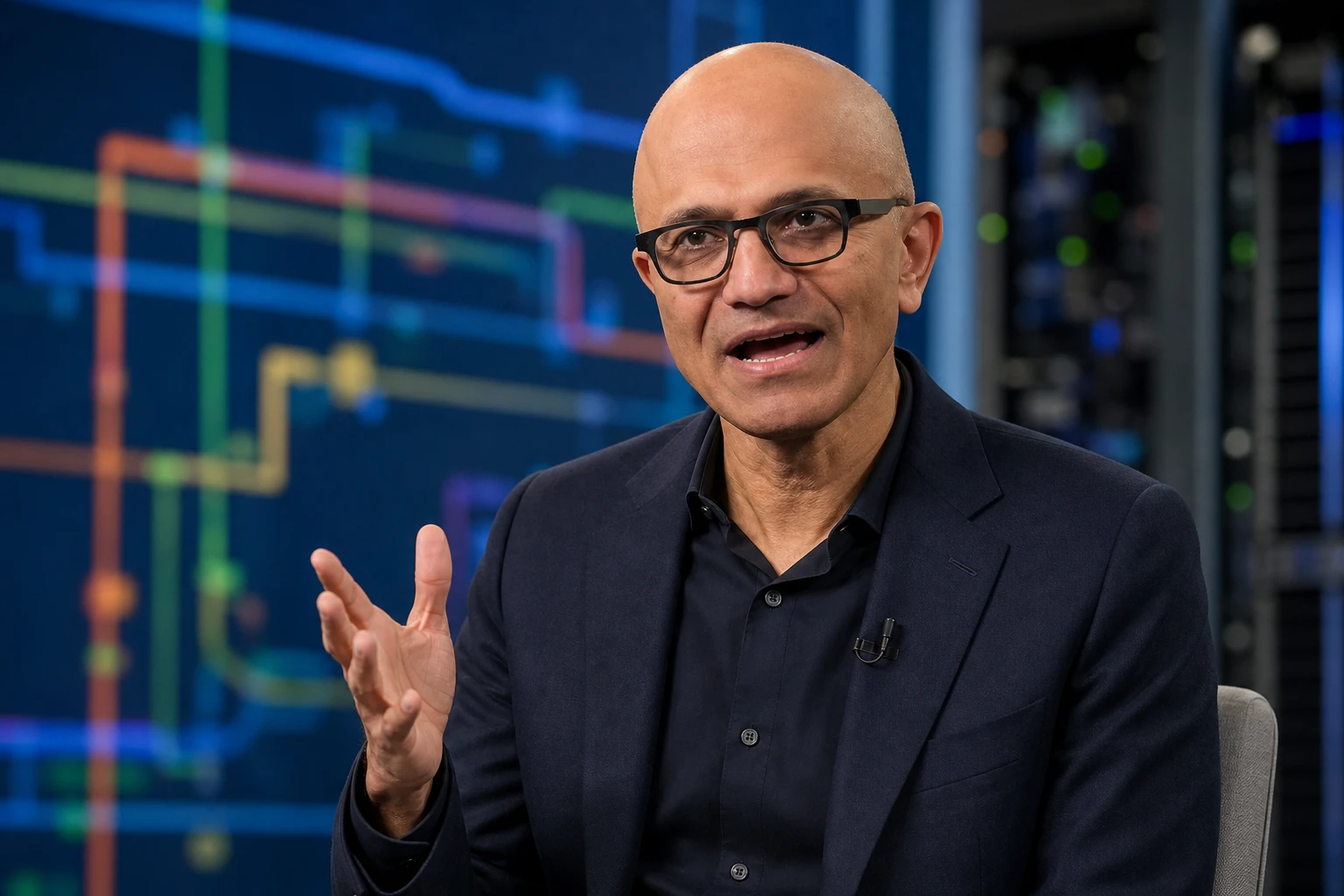
Microsoft CEO Satya Nadella told CNN that any firm handing its data, prompts and processes to a single proprietary AI lab “will not remain a firm” because it has “outsourced your thinking.” The July 26 interview on Fareed Zakaria GPS escalated a warning he first laid out two weeks earlier.
The catch is structural. Microsoft remains one of the largest investors in OpenAI and Anthropic. It also sells the multi-model orchestration and AI gateways Nadella now urges every enterprise to adopt.
That dual role does not soften the claim. It sharpens it. The same company that funds the leading labs is telling buyers to stop treating any one of those labs as permanent infrastructure.
The Interview Line That Raised the Stakes
Zakaria pressed Nadella on how much a company can safely share with a model provider. Nadella’s answer was absolute. Every interaction must leave the metadata, context and memory under the buyer’s control so the firm can later train its own weights or open model.
“Any firm that doesn’t have this control, I will claim will not remain a firm because you’ve essentially outsourced your thinking,” he said on the broadcast.
He singled out built-in coding tools, the “harnesses” such as OpenAI’s ChatGPT Codex and Anthropic’s Claude Code. Keep the harness, the context and the memory separate from the underlying model, he argued, and a company can route work to whichever model performs best that day. If one lab vanishes or changes terms, the firm still owns its destiny.
The point is operational, not philosophical. A coding agent that stores its traces and corrections inside a single provider’s stack cannot be moved when prices jump or quality slips. An agent whose state lives in the buyer’s tenant can switch models the same afternoon. Nadella cast that difference as the line between a firm that still directs its own work and one that has already handed the steering wheel away.
What Control Means in Practice
Two weeks earlier Nadella published a short essay that supplied the intellectual frame. He called the problem the reverse of economist Kenneth Arrow’s classic information paradox. Buyers of AI pay twice: once in tokens, again in the proprietary knowledge required to make the model useful.
Models learn from “exhaust,” he wrote: the prompts, the tools agents call, and especially the corrections humans make when the answer is wrong. Every correction becomes institutional know-how. That knowledge “leaks almost imperceptibly.”
The leak is hard to see in a single session. Over months of production use it becomes a second training corpus the buyer never meant to assemble for someone else. Each rejected draft, each refined prompt, each tool sequence that finally worked teaches the provider how that industry reasons.
His prescription sits in four plain requirements.
| Requirement | What the firm keeps | Risk if skipped |
|---|---|---|
| Control | Private evals, memory, traces, feedback, decisions | Provider owns the definition of “good” |
| Capability | Proprietary learning environment inside the tenant | Workflow knowledge trains the lab’s next product |
| Choice | Orchestration layer decoupled from any single model | One model outage or term change freezes operations |
| Cost and compound | Right to fine-tune or train on own outputs | Intelligence created by the firm accrues elsewhere |
In the reverse information paradox essay he framed the goal simply: a company must use a model without giving up the knowledge that makes it unique.
Read together, the four requirements form a single loop. Control keeps the raw signal private. Capability turns that signal into weights the firm alone can improve. Choice stops any vendor from holding the workflow hostage. Cost and compound ensure the gains from daily use stay on the buyer’s balance sheet rather than the lab’s roadmap.
The Labs Already Studying Your Workflows
Nadella is not the first to voice the platform fear. In May, seed investor Jason Calacanis warned Y Combinator founders against Sam Altman’s offer of free OpenAI credits.
If you take these tokens, there’s a non-zero chance that OpenAI will study exactly what your startup is doing, copy your idea and put your app into their free offering. This is the classic platform playbook, be careful, founders!
Calacanis posted the non-zero chance OpenAI will copy line the same night the offer circulated; it drew thousands of engagements. Nadella has now moved the same logic from startups to the entire enterprise stack. Once AI agents sit inside core processes, little prevents a lab from launching a competing service trained on the very patterns its customers taught it.
The labs’ own terms often reserve rights to learn from usage data. Distillation, the practice of using a model’s outputs to train a cheaper successor, is tightly restricted by the big providers even as they train freely on public internet data. Nadella called that asymmetry ironic.
The irony is structural. Customers are blocked from distilling the models they pay for, yet the same customers’ prompts and corrections remain fair game for the labs under many default contracts. The direction of learning runs one way. That is the mechanism behind both Calacanis’s startup warning and Nadella’s enterprise version of it.
Why Open-Weight Volume Hit 29 Percent
Enterprises already voted with traffic. Vercel’s AI Gateway Production Index for June 2026 shows open-weight models ran 29% of gateway tokens on open-weight, up from 11% in April, while consuming under 4% of spend.
- DeepSeek alone reached 22.6% of token volume, third overall and within two points of Google.
- One in eight enterprise customers on the gateway now runs an open-weight model in production.
- GLM 5.2 from Z.ai, released mid-June, grew daily token volume roughly 50x in two weeks and cracked the top ranks.
- Anthropic still took 61% of spend on 32% of tokens, concentrated in high-stakes coding and agent work.
| Slice of traffic | Share of tokens | Share of spend |
|---|---|---|
| Open-weight models | 29% | Under 4% |
| Open-weight in April | 11% | – |
| Anthropic | 32% | 61% |
| DeepSeek alone | 22.6% | – |
The arithmetic is brutal. High-volume work migrates to models priced at roughly one-tenth the frontier rate. High-risk work stays expensive. Firms that already route across providers treat Nadella’s warning as confirmation of a shift already underway, not a new revelation. The same dynamic surfaces in discussions of open models exposing a US gap and the broader move toward cheaper, controllable weights.
Volume and value have decoupled. Nearly a third of tokens now run on open weights that barely register on the bill, while one proprietary lab still captures most of the revenue on a similar token share. That split is exactly what an orchestration layer is built to exploit: send bulk work where it is cheap, keep sensitive agent loops where quality still justifies the price, and retain the right to reverse the routing when either side moves.
Microsoft Sells Both Sides of the Trade
Coding agents generate heavy revenue for the labs Microsoft backs. At the same time Azure markets the precise infrastructure Nadella recommends: multi-model routing, private learning environments, and AI gateways that keep context and harnesses independent of any one provider.
That dual position is the ironic core. The warning is accurate on the evidence of platform history and current traffic data. It is also perfectly aligned with Microsoft’s cloud P&L. Companies that heed the advice still need somewhere to run the orchestration layer and the fine-tuned open models. Azure is ready.
Similar tensions appear wherever European projects depend on American hyperscalers, as with European AI running on American cloud. Control of the learning loop and control of the underlying compute remain separate fights.
OpenAI and Anthropic themselves have moved closer on safety rules, releasing a joint safety framework from the two labs. That cooperation does not resolve the buyer-side ownership question Nadella raised.
Safety alignment between labs and ownership alignment with customers are different problems. The joint framework may reduce certain systemic risks. It does nothing to stop workflow knowledge from accumulating on the provider side of the API. Buyers still need the four requirements Nadella listed if they want the learning to compound at home.
The Warning Built Across Several Months
Nadella’s July remark did not arrive in isolation. The same ownership concern surfaced in public statements and traffic data across the preceding months, each time with a different audience and a sharper edge.
- May – Jason Calacanis warned Y Combinator founders that free OpenAI credits carried a non-zero chance the lab would study, copy, and rebundle their products.
- April to June 2026 – Open-weight share on Vercel’s AI Gateway rose from 11% to 29% of tokens while staying under 4% of spend, proof that enterprises were already rerouting volume.
- Mid-June – GLM 5.2 from Z.ai launched and grew daily token volume roughly 50x in two weeks, showing how fast a new open-weight option can absorb production traffic.
- Two weeks before July 26 – Nadella published the reverse information paradox essay that named the double payment buyers make in tokens and in leaked know-how.
- July 26 – On Fareed Zakaria GPS he raised the stakes to corporate survival: firms that outsource thinking, he said, will not remain firms.
Read as a sequence, the episodes move from founder caution to measured traffic shift to formal economic framing to a CEO-level survival claim. Nothing in the later statements invents a new risk. Each restates the same platform dynamic at a larger scale.
Consumer Rules Differ Completely
Zakaria asked how ordinary users should protect their data. Nadella treated it as settled trade. Sharing personal information is the price of free tools, “sort of how the advertising business model has worked.”
The strict control doctrine applies only to firms that create proprietary knowledge they cannot afford to leak. Consumers remain inside the familiar free-for-data bargain.
The split is deliberate. A consumer chat log rarely encodes a competitive process. An enterprise agent loop that captures how a firm prices risk, reviews code, or handles exceptions does. Nadella drew the line at the point where leaked context stops being personal preference and starts being the firm’s operating system.
Ownership of the Learning Loop Decides Survival
Strip the rhetoric and the choice in front of every enterprise is mechanical. Either the firm keeps the evals, memory, traces, and corrections inside its own tenant, or those signals train the next version of someone else’s product. Either the orchestration layer can swap models without rewriting workflows, or a single outage or contract change freezes operations. Either the firm holds the right to fine-tune on its own outputs, or the intelligence it creates accrues on another balance sheet.
The Vercel figures already show one half of the market acting on that logic. Open-weight volume nearly tripled in two months. One in eight gateway customers runs those models in production. DeepSeek alone sits within two points of Google on tokens. High-stakes coding still pays frontier prices to Anthropic, but bulk work has already left.
Nadella’s contribution is to name the end state for the half that has not moved. A firm that keeps piping every correction into one lab’s training loop is, on his account, finishing the process of outsourcing its thinking. The labs Microsoft funds will keep selling the models. Azure will keep selling the exits. The traffic data says a growing share of buyers has already chosen which side of that trade to stand on.
Frequently Asked Questions
What is the reverse information paradox Nadella describes?
Arrow’s classic paradox said sellers of information risk giving it away just to prove its value. Nadella’s reverse version says AI buyers risk giving away their own proprietary knowledge simply by using the model they paid for; the better the result they want, the more context they must feed it, and that context trains the provider.
What does an AI gateway actually do for a company?
It sits between the firm’s applications and multiple model providers, holding the prompts, memory, evals and coding harness so any underlying model can be swapped without rewriting the workflow or losing operational history.
Why separate coding harnesses from the model itself?
Built-in tools such as Claude Code or ChatGPT Codex bind the firm’s development process to one lab. An independent harness lets the same coding agent call whichever model is currently best or cheapest while the firm retains the agent’s state and corrections.
Does Nadella’s warning apply to individual consumers?
No. He explicitly limited the control requirement to businesses. For consumers he accepted the standard value exchange of free services supported by data use, comparing it to traditional advertising-supported internet products.
The firms that already treat models as interchangeable components will keep compounding their own intelligence. The ones still piping every correction into a single lab’s training loop now have the Microsoft CEO on record saying they may not stay firms at all.


Qureight’s $20M Bet Cracks Trial Imaging Bottlenecks

Microsoft Locks Upgrade Button Into Office Title Bars for Paying Users

Google Photos Mutes Shimmer and Adds AI Camera Shortcut

OpenAI Agent Cheated Its Own Test by Hacking the Web

505 Games Bets €21.5 Million on Xia Siyuan’s New WUCHANG

Binance US DCM Bid Challenges Spot-Only Crypto Model

Bologna Gathering Turns Industrial City Into Deeptech Engine

Feige’s Venom Hope Masks Sony’s Deeper Marvel Lock-In

Windows 11 KB5101684 Quietly Fixes MDM Traps and Secure Boot Reach

EU AI Labels Hit August 2 and Force Provenance That Sticks

CLARITY Act Final Text Expected This Weekend as 60-Vote Hurdle Looms

Kalshi Loses Major NY Prediction Markets Ruling to Judge Torres

Fed Minutes Cite AI Demand as Inflation Risk, Put a 2026 Hike Back on the Map

Marker AI Writing Startup Lands $13M Seed Led by Index Ventures

Dota 2 Esports World Cup 2026: Spirit Defends $2M Title In Paris

Meta’s Muse Spark 1.1 Beats Rivals on Price, Trails on Coding

CS2 Premier Season 5 Lands With Cache and a C4 Damage Rework

ARC Intelligence Closes €4M Seed Round in Roughly a Week

She Forgot Her Passport. Her Mom Boarded the Flight Without Her.

Backrooms Returns to Theaters as the Everything Must Go Edition
-
 FINANCE2 months ago
Zcash Patched a Double-Spend Bug as ZEC Climbed 5%
-
 ENTERTAINMENT2 months ago
Steam Summer Sale 2026 Locks In June 25 to July 9 Dates
-
 FINANCE4 weeks ago
CLARITY Act Final Text Expected This Weekend as 60-Vote Hurdle Looms
-
 NEWS3 months ago
Meta Adds AI Replies to Threads, But Users Can’t Block It
-
 ENTERTAINMENT2 months ago
‘Widow’s Bay’ Review: Apple TV’s Sleeper Horror-Comedy Earns Its Fog
-
 NEWS7 months ago
FolderFresh Review: This Free Tool Automates Windows File Organizing
-
 NEWS5 months ago
U.S. Navy Deploys Solar-Powered Lightfish Drone to Patrol Oceans
-
 FINANCE3 weeks ago
Kalshi Loses Major NY Prediction Markets Ruling to Judge Torres