
NEWS
microagi’s European AI Push Now Runs on American Cloud
microagi raised Germany’s largest-ever seed round to build European robotics AI, then expanded its Google Cloud and NVIDIA Blackwell partnership.

Munich robotics startup microagi says Europe must control its own artificial intelligence infrastructure or risk irrelevance. The deal it announced this week to scale that ambition runs on Google Cloud servers and NVIDIA chips, both built and controlled by American companies.
microagi is deepening its partnership with Google Cloud and NVIDIA, gaining access to NVIDIA’s Blackwell generation GPUs to train Atlas, its platform for fine-tuning industrial robotics models. The announcement lands about a week after microagi closed a $55 million seed round, the largest in German history, raised in just five days of active fundraising.
Blackwell Chips and Google Cloud Now Run Atlas
The expanded partnership gives microagi access to NVIDIA RTX PRO 6000 Blackwell Server Edition GPUs, delivered through Google Cloud’s G4 virtual machines, along with NVIDIA GB300 NVL72 rack scale systems running on A4X Max instances. Both will power training and inference for Atlas, the software layer microagi uses to fine-tune AI models on each customer’s own operational data.
Atlas works as a layer between a customer’s existing infrastructure and frontier AI models. microagi describes it as hardware and model agnostic, meaning it can plug into different robot manufacturers and different foundation models without locking a customer into one vendor.
microagi already worked with Google Cloud before this week’s announcement. “We’d already been working with Google Cloud, but this partnership significantly deepens that relationship,” said Bercan Kilic, microagi’s chief executive and co-founder.
Dr. Itxaso Araque, Google Cloud’s director of digital natives and startups for EMEA North, said, “Google Cloud’s AI stack is designed to power complex, multimodal data pipelines like microagi’s,” in the companies’ joint announcement. Tobias Halloran, NVIDIA’s director of EMEAI startups, called robotics “one of the most demanding frontiers for AI, requiring massive physical-world datasets, accelerated compute and a full-stack platform to turn models into intelligent machines.”
Google Cloud has been racing to build out Blackwell capacity broadly. It was first cloud provider offering NVIDIA HGX B200 and GB200 NVL72 through its A4 and A4X virtual machines, the same instance family microagi now taps for its own workloads. Google itself is not fully reliant on NVIDIA either. It is developing an in-house Frozen v2 chip architecture it recently delayed, even as it sells NVIDIA’s Blackwell hardware to partners such as microagi.
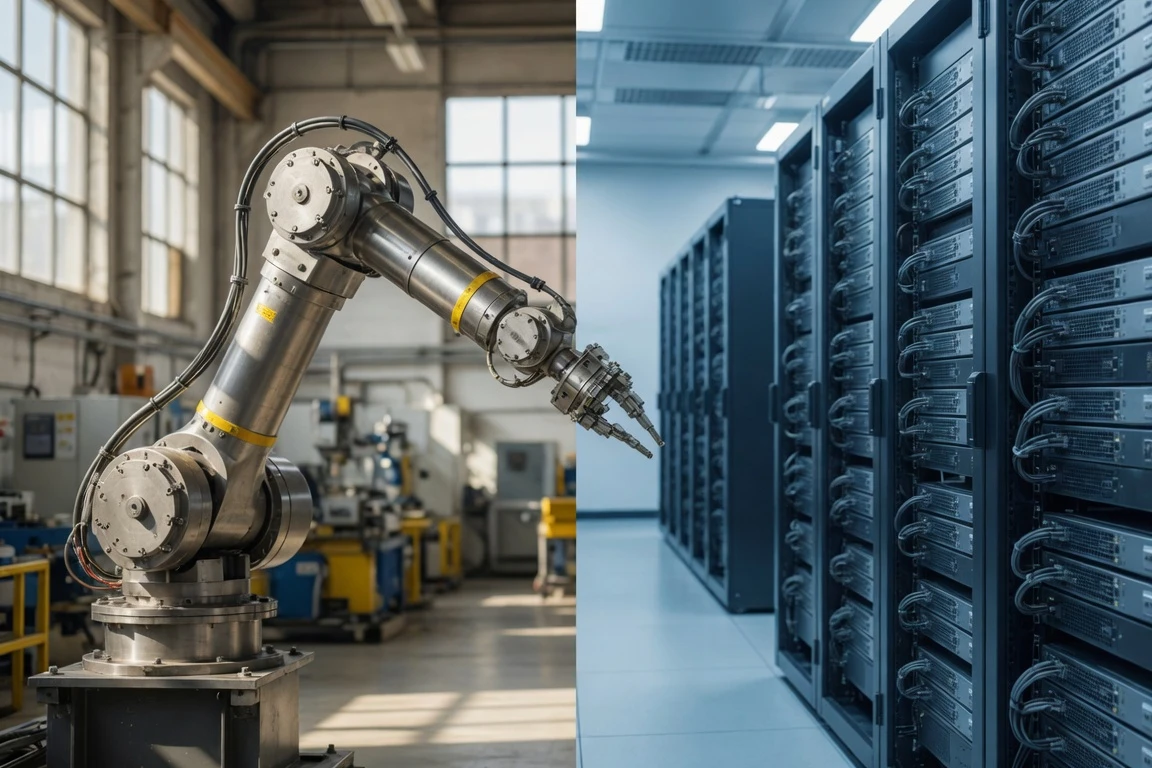
A Press Release Datelined Sunnyvale and Munich
The joint statement announcing the deal carried two datelines: Sunnyvale, California, and Munich. Both companies supplying the infrastructure, Google Cloud and NVIDIA, are Silicon Valley firms, not European ones.
Kilic frames microagi’s mission around European independence anyway. He believes that if Europe does not act quickly, its technology gap with the US and China could grow larger than its current gap with developing economies.
What Kilic Says Europe Still Lacks
Kilic did not originally set out to start a company. A former aerodynamics engineer at Red Bull Racing, he co-founded microagi with engineers who also came from Mercedes-AMG Petronas, another Formula 1 team.
“The moment that really hit me was seeing open-source Vision-Language-Action (VLA) models emerge,” Kilic said. “As a mechanical engineer, robotics has always been close to my heart, and I realised the next frontier had arrived, yet almost nobody in Europe was building for it.”
The more he studied the field, he said, the clearer it became that Europe lacked three things.
- Large-scale robotics data – the physical-world demonstrations needed to train models, which do not exist at internet scale the way text data does for language models
- Massive compute capacity – the GPU clusters required to train and fine-tune those models
- Deployment infrastructure – the systems needed to actually train and run embodied AI on real robots
“Without all three, Europe risks becoming irrelevant over the next 20 to 30 years,” he said.
Kilic points to China as a model. Rather than replacing factory workers, he said, successful Chinese manufacturers expanded capacity by opening new factories that produce more at lower cost, using automation to push prices down while output kept rising.
Europe’s Compute Gap by the Numbers
Kilic’s warning lines up with what researchers have found all year. U.S. private investment in AI reached $285.88 billion in 2025, according to the Stanford HAI 2026 AI Index Report. Europe’s total was roughly $20.92 billion, and China’s was $12.41 billion.
Energy tells a similar story. Data centres consumed 415 terawatt hours of electricity globally in 2024, the International Energy Agency has estimated, with 45 percent of that in the United States, 25 percent in China and just 15 percent in Europe. On new capacity, the US built 5.8 gigawatts of data centre space in 2024 alone, versus 1.6 gigawatts added across the entire European Union.
Europe is not short of pledges. Several American hyperscalers have committed billions of euros to build data centres on the continent this year.
| Company | Country | Commitment | Capacity Detail |
|---|---|---|---|
| SoftBank | France | Up to 75 billion euro (Phase 1: 45 billion euro) | Up to 5 GW; Phase 1 delivers 3.1 GW by 2031 |
| Amazon | Spain | 33.7 billion euro | Investment runs through 2035 |
| Germany | 5.5 billion euro | 2026 to 2029; new site in Dietzenbach, expanded Hanau campus | |
| Microsoft | Portugal | 8.6 billion euro | Sines facility running 12,600 NVIDIA Blackwell Ultra GPUs since early 2026 |
The money is genuine, but ownership is not primarily European. One analysis of the buildout published in June concluded the investments add real capacity even as the underlying infrastructure stays in American hands.
Brussels-based think tank Bruegel argued in a strategy to close the compute gap that dependence on foreign infrastructure risks a structural loss of economic autonomy as AI becomes the general-purpose technology of the century. Boston Consulting Group reached a similar conclusion in its own analysis of the US-China AI divide, finding “the US has maintained its lead, fueled by its strength in talent and capital deployment.”
Cost compounds the problem. Digitimes, the semiconductor trade publication, reported that European data centres run 20 to 30 percent above US operating costs, citing energy prices, permitting delays and grid constraints, with lead times of up to a decade in major markets.
At VivaTech 2026, Siemens Digital Industries chief executive Cedrik Neike asked an audience how much of a premium they would pay for European compute. Few hands went up for anything above 10 percent. “5 to 10%, that’s the maximum somebody’s willing to pay for European compute,” he said. “And that’s a lot already.”
Hyperscalers are having similar conversations everywhere. Meta’s negotiations over Anthropic’s compute needs exposed cracks in Amazon and Google’s cloud bets earlier this year, a reminder that even the biggest AI labs do not fully control their own infrastructure.
How microagi Defends the Foreign Cloud Bet
Kilic does not see the Google Cloud deal as a contradiction. He points to efficiency gains and data protections instead.
“Google’s engineers have helped us optimise our clusters so we’re effectively achieving roughly twice the computational efficiency while using substantially less energy per unit of work,” Kilic said. “That optimisation work is ongoing.”
He also points to geography. “Whenever possible, we want our workloads to run on European-based infrastructure,” Kilic said. He gave two reasons: microagi’s manufacturing customers hold sensitive production data they may not want processed outside Europe, and keeping workloads inside the bloc keeps them under the General Data Protection Regulation (GDPR, the EU’s data privacy law), which he said gives customers additional confidence.
microagi customers also keep ownership of their own data and models, Kilic said, unlike rivals whose customer data feeds into shared foundation models. “We ensure each customer’s intellectual property remains protected,” he said.
Five Days From First Call to a Signed Term Sheet
The partnership follows a fundraising process that moved unusually fast, even by European tech standards.
- $55 million raised in the seed round, the largest in German startup history
- 5 days of total active fundraising, split between the pre-seed and seed rounds
- 3 days from Hummingbird Ventures’ visit to a signed term sheet
- 10 months between microagi’s founding and the seed round closing
“That’s unusual, but it reflects the fact that investors had been tracking our progress long before we formally opened a round,” Kilic said. “We were demonstrating our technology to research labs, customers and robotics partners, showing progress across data collection, compute infrastructure and robot training.”
Hummingbird had been watching microagi for months before reaching out and visiting the team in Munich. Other investors circled too, but Hummingbird was already making introductions and offering strategic support before the round formally opened.
Asked how the milestone felt, Kilic gave Sifted a blunt answer: “It’s one-billionth of what Europe needs.” He argues the continent’s manufacturing base will not survive without heavy investment in robot automation. He also frames the urgency in demographic terms. The European Union’s median age hit 44.9 in 2025, up from 39.6 two decades earlier, and the European Commission estimates the bloc could lose 18.8 million workers by 2050.
Figure, Skild and the Rest of the Robotics Field
microagi collects its training data in an unusual way. The company pays operators roughly $20 an hour to wear cameras while performing everyday tasks, and more than 10,000 operators across 15 countries collectively earned over $5 million in the first quarter of 2026 alone.
| Company | Funding | Valuation | Approach |
|---|---|---|---|
| microagi | $55 million seed round | Not disclosed | Hardware and model agnostic; fine-tunes third-party models on customer data |
| NEURA Robotics | Up to $1.4 billion Series C, closed June 2026 | Not disclosed | Builds hardware, AI and data infrastructure in house |
| Figure AI | Not fully disclosed | Around $39 billion | Builds its own humanoid robots |
| Skild AI | $1.4 billion raised | $14 billion | General-purpose robot foundation models |
| Physical Intelligence | $400 million raised | Not disclosed | Backed by OpenAI |
NEURA Robotics, based near Munich, closed its round with backing from Tether, Amazon and NVIDIA the same month microagi opened its own. Unlike microagi, NEURA builds hardware, models and data infrastructure itself rather than staying agnostic across vendors.
What Happens if Chip Export Rules Tighten?
Kilic’s biggest worry is not competition from other startups. It is that export controls on advanced chips could freeze Europe out entirely, leaving the continent dependent on whatever compute capacity it already has, most of it owned and operated by American cloud providers.
AI is advancing so rapidly that governments are increasingly likely to treat advanced models and compute as strategic national assets. If export restrictions become commonplace, countries without sufficient domestic compute infrastructure will struggle to compete.
Kilic said that. “Europe needs to invest in energy, data centres and advanced compute now,” he added, extending the stakes beyond microagi to Europe’s broader innovation ecosystem. “If advanced chips become subject to export restrictions or geopolitical tensions increase, the only compute Europe can rely on will be the infrastructure already located here.”
Washington’s own chip export policy has already shifted more than once this year. Its recent reversal on H200 chip sales to China still fell short of what AI labs there wanted, evidence of how quickly export rules can move once governments start treating chips as strategic assets.
Hummingbird’s managing partner Firat Ileri, who led the investment, frames the stakes around talent, not just chips. “Europe trains some of the best roboticists in the world, then watches them build companies in California,” he said. “What it has lacked is ambition on a meaningful scale.”
microagi is now one of the companies trying to close that gap. Its compute, for now, still runs through Sunnyvale.
Frequently Asked Questions
What Is Embodied AI?
Embodied AI refers to artificial intelligence systems built to perceive and act inside physical environments, such as factory floors, rather than operate purely on digital inputs like text or images. microagi’s Atlas platform applies this idea to industrial robots, fine-tuning models so they can complete specific tasks inside a customer’s real operating environment.
What Is a Vision-Language-Action (VLA) Model?
A Vision-Language-Action model combines visual perception, language understanding and physical action generation in a single system, letting a robot interpret its surroundings and instructions, then carry out a task. Kilic has said watching open-source VLA models emerge from research labs convinced him robotics had reached a turning point Europe was not building for.
How Much Total Funding Has microagi Disclosed?
microagi has disclosed $55 million from its seed round, the largest in German startup history. The company also closed an earlier pre-seed round in two days, though it has not disclosed that round’s size.
What Does GDPR Mean for microagi’s Cloud Strategy?
The General Data Protection Regulation is the European Union’s data privacy law, and it shapes where companies can process sensitive information. Kilic has said keeping workloads on infrastructure based in Europe, even when it runs on Google Cloud or NVIDIA hardware, keeps that data under GDPR’s protections, which he says reassures manufacturing customers wary of sending production data abroad.


Veridue Raises $4 Million to Speed Energy Deal Diligence

Healey Adds a £150m Rung for Northern Scale-Ups

Ten Deals Took Most of Europe’s August Tech Money

Holmes Hired Fielder to Film Her Last Days

Molten Bets £100m of Plc Cash on Late-Stage Tech

Garlinghouse Cited Dutch Gold, and London Got the Bars

byFounders Bets $4.3 Million on Fluencify After $2M ARR

Alpha Gang Puts A-List Stars on a Zellner Wager

Angel Bets a Recut PG-13 Chase on Ritchson and Wilson

Flex IT and T1A Combine to Own Corporate Device Supply

Walter’s TWG Insists No Fraud as Insurer Probes Force Cleanup

30-Year Yield Hits 5.32% Highest Since 2007 as Debt Supply Locks In Costs

PCE Stays at 3.7% as Gas and Tariffs Outrun Coming Revisions

Evernorth S-4 Clears Path for Active XRP Treasury on Nasdaq

Astute’s $1.2M bet makes B2B creator deals feed AI discovery

Strategy Parks $1.59B Cash While Bitcoin Stack Stays Flat

Instinct Hits $2.5 Billion as AI Agent Access Sparks Trust Fights

Oracle’s 2.8 GW Bloom Deal Exposes the AI Power Bypass

CLARITY Act Cloture Opens a Door Ethics Still Blocks

Amber’s €7M locks Mittelstand knowledge inside Europe
-
 FINANCE3 months ago
Zcash Patched a Double-Spend Bug as ZEC Climbed 5%
-
 ENTERTAINMENT3 months ago
Steam Summer Sale 2026 Locks In June 25 to July 9 Dates
-

 FINANCE2 months ago
CLARITY Act Final Text Expected This Weekend as 60-Vote Hurdle Looms
-
 NEWS4 months ago
Meta Adds AI Replies to Threads, But Users Can’t Block It
-
 ENTERTAINMENT5 months ago
Extraction 3 Is Officially Coming to Netflix in 2027
-

 NEWS3 months ago
YouTube Shorts is testing a heart in place of the thumbs-up
-

 NEWS1 month ago
Senators Force Apple Off Chinese Memory as Big Three Cash In
-

 NEWS3 months ago
NEURA Robotics’ $1.4B Series C Redraws Europe’s Physical AI Bet