
BUSINESS
OSHA Judge Upholds $16,782 Fine on Rochester Commercial Roofer
An administrative law judge ordered Rochester roofer Elmer W. Davis Inc. to pay $16,782 in OSHA penalties for fall protection and ladder safety violations.

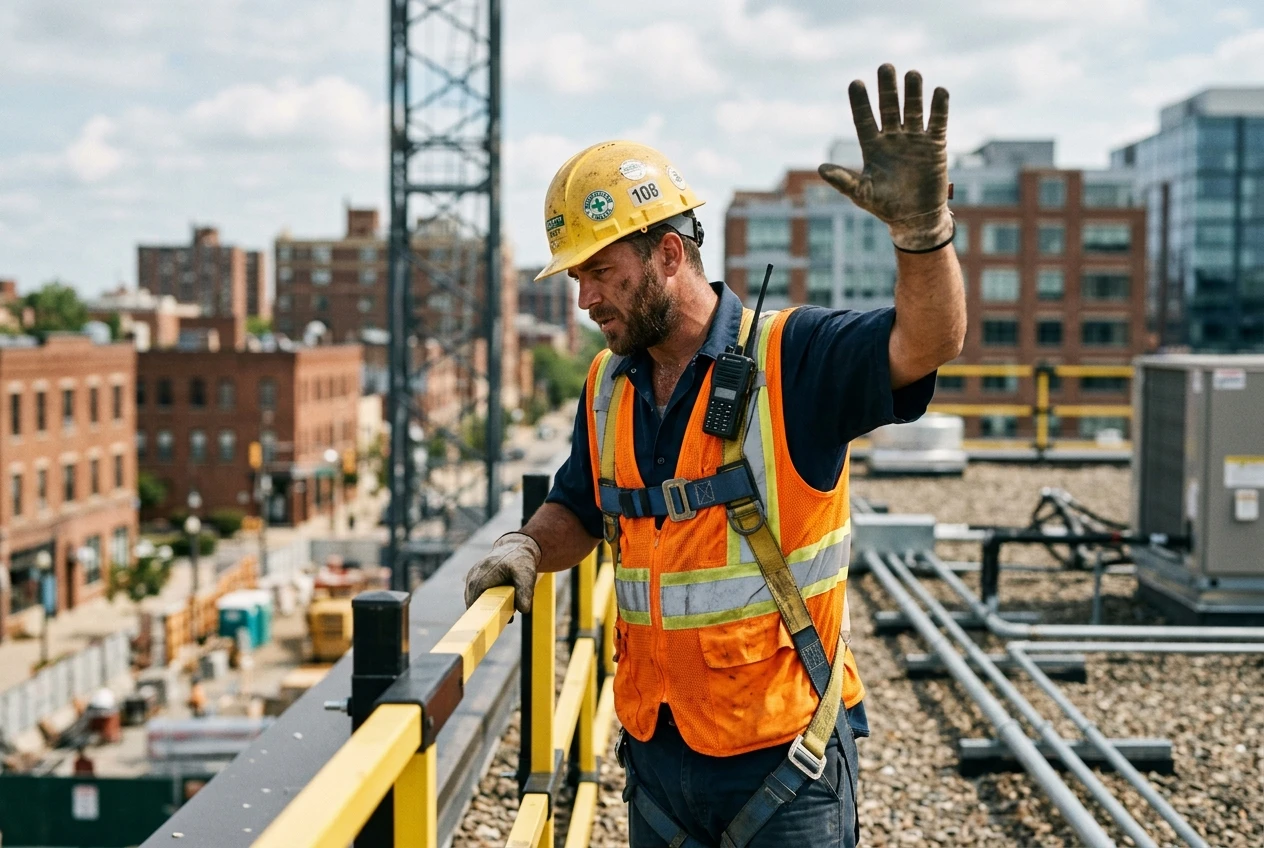
An administrative law judge has ordered Rochester commercial roofer Elmer W. Davis Inc. to pay $16,782 in penalties for two serious fall protection and ladder safety violations at a Village of Newark municipal building, after the company lost every defense it raised at trial. The Department of Labor announced the order in October 2024, after an April 2022 Occupational Safety and Health Administration (OSHA) inspection of the project found a worker standing past a guardrail and signaling a crane operator over a 40-foot drop. Trial attorney Julie Pittman and senior trial attorney David Rutenberg of the regional Office of the Solicitor in New York litigated the case.
The fine is small for a company that employs more than 250 people across Western and Central New York and Pennsylvania. The legal ripples are not. Administrative Law Judge William S. Coleman rejected the roofer’s Fourth Amendment challenge, narrowed its unpreventable employee misconduct defense, and affirmed the citation tied to the worker who stepped through a guardrail gap to signal the crane over a four-story drop. Elmer W. Davis filed an appeal petition on October 18, 2024, the Department of Labor said.
The Inspector’s Window on a Newark Roof
The case began with a drive-by. On April 4, 2022, an OSHA compliance officer was driving near the municipal building at 100 E. Miller Street in the Village of Newark, New York, when he noticed a worker standing at the edge of the flat roof without any apparent fall protection. The worker was signaling to a crane operator hoisting materials onto the building. That observation set in motion a 30-month enforcement case that ended with a federal judge’s order against Elmer W. Davis Inc. The case file from the Occupational Safety and Health Review Commission reads like a step-by-step record of a workplace safety inspection in real time.
The officer pulled into a parking lot about 200 feet away and watched. From a second lot roughly 500 feet from the building, he observed three more workers on an 8-by-10-foot bulkhead roof, also without apparent fall protection, the Commission decision records. The officer then went onto the roof, where he saw that a portable ladder the three workers had used to access the bulkhead roof was extended less than three feet above the upper landing surface, short of the standard the regulation requires.
The job was a re-roofing of the four-story municipal building. The main roof was about 60 by 100 feet, with a 28-inch parapet around the perimeter. A crane set up in the parking lot on the west side lifted materials to the top, and Gabriel Calas-Alvarez, an Elmer W. Davis employee, stood at the west edge of the roof to signal the operator below, who had no view of the landing zone. The inspector watched Calas-Alvarez past the guardrail for about three minutes from street level, the Commission decision records.
What the Judge Affirmed, and What He Threw Out
OSHA’s Syracuse office cited Elmer W. Davis for three serious violations of the agency’s construction industry standards. Administrative Law Judge Coleman affirmed two of the three citations and vacated one. The total penalty landed at $16,782, down from the $26,106 OSHA originally proposed. The three violations each carried a different layer of workplace safety risk. Two involved a worker positioned past a guardrail on a four-story roof; the third involved a ladder that did not extend far enough above the upper landing.
| Citation | Standard | What it covered | Status |
|---|---|---|---|
| Item 1 | 29 C.F.R. § 1926.501(b)(3) | Worker signaling crane from past the guardrail | Affirmed |
| Item 2 | 29 C.F.R. § 1926.501(b)(10) | Fall protection on the low-slope bulkhead roof | Vacated |
| Item 3 | 29 C.F.R. § 1926.1053(b)(1) | Portable ladder side rails extending three feet above landing | Affirmed |
Citation Item 1 covered the employee who had been signaling the crane operator, a violation of the standard that prescribes permissible forms of fall protection for employees in hoist areas. The judge ruled that Elmer W. Davis’s foreman had constructive knowledge of the violation and that the company’s safety program was inadequate. Citation Item 3 covered the ladder, whose side rails did not extend the required three feet above the bulkhead roof. Both citations stayed on the books.
Citation Item 2, which dealt with fall protection methods on the low-slope bulkhead roof, was vacated because the evidence was insufficient to establish that the company was non-compliant with that specific standard. OSHA had argued that workers on the bulkhead roof were not protected by a compliant safety monitoring system. The judge disagreed.
The hearing in front of the Commission judge ran March 30 to 31, 2023, in Rochester. Post-hearing briefing closed on August 18, 2023. The judge announced his decision on September 19, 2024. The full Commission decision and order includes the factual record on each citation.
Three Defenses, Three Rejections
Elmer W. Davis, represented by attorney Michael Rubin of Ogletree Deakins, brought three main defenses. Coleman rejected all three. The rejections are the part of the ruling that travels. Each defense was a recognizable tool in the kit of construction employers who challenge OSHA citations, and each lost in this case on the specific facts. Read together, the three rulings form a tighter leash for future cases across the Second Circuit.
First, the company argued that the OSHA inspector’s rooftop entry violated the Fourth Amendment’s protection against unreasonable searches and seizures. The judge disagreed, finding that Elmer W. Davis “could have no reasonable expectation of privacy on the rooftop of a construction site that it did not own,” the Department of Labor summarized in announcing the ruling. The inspector, the judge concluded, had acted reasonably during the inspection. The Newark building is a publicly owned municipal property, a fact the decision leans on.
Second, Elmer W. Davis tried to use a defense of unpreventable employee misconduct, the long-standing employer argument that a citation should be vacated because the company had done everything it could to train the worker and the worker’s lapse was unforeseeable. The judge held that the company was not automatically entitled to credit for that defense just because a prior, unrelated Commission case had accepted it. The elements of collateral estoppel were not present, the decision concluded.
Third, the company argued that the foreman’s knowledge of the violation could not be imputed to Elmer W. Davis. The foreman, a fifteen-year Elmer W. Davis employee who had spent the last five as a foreman, was working less than 100 feet from the unguarded worker on the roof’s edge, the Commission decision records. The violation was “readily visible,” the Department of Labor said in its summary of the ruling. The decision also noted that the foreman described himself as a “working foreman” who customarily performed roofing work in addition to supervisory duties. Coleman concluded that the foreman’s constructive knowledge was imputable to the company, on top of the company’s inadequate safety program.
The decision pulls two pieces of standard contractor defense playbook off the table. It also reminds future defendants that an OSHA inspector who climbs onto a construction site roof that the employer does not own has authority to look around. The first inspection of this kind is not a constitutional violation, this case now says on the published record. The third ruling tightens the connection between supervisor knowledge and corporate liability for fall protection failures.
Where the $16,782 Comes From
The final figure is a fraction of what OSHA originally proposed. The agency initially sought $26,106 in penalties for the three citations. After the low-slope roof citation was vacated, the remaining two citations carried the rest of the load, and the fine landed at $16,782.
The Department of Labor framed the result as a vindication of its litigation strategy. Regional Solicitor of Labor Jeffrey S. Rogoff in New York put the agency’s reaction in a post-trial decision announcement the same day the decision became public. The same press release also pointed to the company’s failure to maintain a complete and adequate safety program as the deciding factor on the knowledge question. OSHA’s Area Office in Syracuse conducted the original inspection in 2022. The Solicitor’s office in New York handled the case through trial and post-hearing briefing.
As the U.S. Department of Labor’s vigorous litigation showed, and the judge appropriately held, Elmer W. Davis Inc. failed to protect employees from fall hazards and cannot claim permanent and complete freedom to commit violations. The department takes protecting employees from fall hazards very seriously.
The Precedent That Travels Beyond This Case
The case will outlast the fine. Coleman’s rejection of the Fourth Amendment challenge locks in OSHA’s authority to inspect the rooftops of construction sites the employer does not own. The Newark building is a publicly owned municipal property, a fact the decision leans on. The ruling removes one of the more common arguments that employers have used to push back against the agency’s enforcement record.
The narrowing of the unpreventable employee misconduct defense matters too. Elmer W. Davis had pointed to a prior Commission ruling that had accepted the same defense, and the judge held that collateral estoppel did not apply, the specific facts of the earlier case did not transfer. Future employers citing that earlier win in Newark or elsewhere in the Second Circuit now have one less published point to lean on.
Elmer W. Davis is not done. The company filed an appeal petition on October 18, 2024, the Department of Labor said. The decision becomes a final Commission order on October 30, 2024, unless the OSHRC directs review of the decision before that date. The Department of Labor has signaled it will defend the ruling on every point. The agency’s federal fall protection resources offer safety information and video presentations in English and Spanish to teach workers about fall hazards and proper safety procedures.
The agency’s framing of the larger stakes sits in the same release. OSHA’s own data point on the industry is stark, the regulator said. Roofing and other elevated work is the leading cause of death in the construction industry. The case is one citation among many, but the precedent the judge set is a constraint on the defenses other employers can carry into the next fight.
Falls from roofs and other elevations are the leading cause of death in the construction industry, needlessly killing hundreds of workers each year and leaving many more with permanent and often disabling injuries. Elmer W. Davis Inc. violated mandatory federal safety regulations and put workers in danger.


Capital Clusters and the Dual Tracks of European Tech Finance

Microsoft Shrinks Windows 11 Memory for 8GB PCs

XRP Ledger Brings Back Bugged Features Fixed for Institutions

The Shards Trailer Turns Ellis Nightmare Into Murphy Glamour

WhatsApp Folder Hides Business Messages After Hours

Mova LiDAX Ultra 3000 AWD Cracks the Robot Mower Moat

Urban Arrow FamilyNext Turns Costco Runs Into Bike Trips

Reddit Builds Spoken Video Layer to Reclaim Its Own Viral Stories

Nuggit £5m Fund Treats YouTube Channels as Real Businesses

Galaxy Z Fold 8 Makes Foldables Daily Drivers but Drops Flex Mode

CLARITY Act Final Text Expected This Weekend as 60-Vote Hurdle Looms

Kalshi Loses Major NY Prediction Markets Ruling to Judge Torres

Fed Minutes Cite AI Demand as Inflation Risk, Put a 2026 Hike Back on the Map

Marker AI Writing Startup Lands $13M Seed Led by Index Ventures

Dota 2 Esports World Cup 2026: Spirit Defends $2M Title In Paris

Meta’s Muse Spark 1.1 Beats Rivals on Price, Trails on Coding

CS2 Premier Season 5 Lands With Cache and a C4 Damage Rework

ARC Intelligence Closes €4M Seed Round in Roughly a Week

Finto Picks Munich Over Silicon Valley After YC, Raises $3.4M

Backrooms Returns to Theaters as the Everything Must Go Edition
-
 FINANCE2 months ago
Zcash Patched a Double-Spend Bug as ZEC Climbed 5%
-
 ENTERTAINMENT2 months ago
Steam Summer Sale 2026 Locks In June 25 to July 9 Dates
-
 FINANCE4 weeks ago
CLARITY Act Final Text Expected This Weekend as 60-Vote Hurdle Looms
-
 NEWS3 months ago
Meta Adds AI Replies to Threads, But Users Can’t Block It
-
 ENTERTAINMENT2 months ago
‘Widow’s Bay’ Review: Apple TV’s Sleeper Horror-Comedy Earns Its Fog
-
 NEWS5 months ago
U.S. Navy Deploys Solar-Powered Lightfish Drone to Patrol Oceans
-
 NEWS8 months ago
FolderFresh Review: This Free Tool Automates Windows File Organizing
-
 FINANCE4 weeks ago
Kalshi Loses Major NY Prediction Markets Ruling to Judge Torres