
NEWS
Subaru’s Trailseeker Is a Toyota Twin That Pays Toyota Either Way
Subaru’s Trailseeker undercuts its Toyota twin by $5,305, but Toyota’s 20% Subaru stake and EU emissions rules mean it profits regardless of the badge chosen.

The 2026 Subaru Trailseeker starts at $39,995. Its closest rival, the Toyota bZ Woodland, charges $45,300 for the identical motor, battery and chassis underneath, a gap of $5,305 for hardware that does not differ by a single bolt. Same 74.7 kWh battery. Same 375 horsepower. Same 4.4 second sprint to 60 mph.
Buyers get to pick a badge and a color. Toyota gets paid either way. It owns 20 percent of Subaru Corporation outright, and European Union emissions rules give Subaru little choice but to keep leaning on Toyota’s electric hardware regardless of which nameplate rolls off the line. The showroom choice between these two SUVs looks close. The financial and regulatory picture behind it is not.
Same Bones, Different Badges
Underneath the sheet metal, the Trailseeker and the bZ Woodland are the same vehicle wearing different clothes. Both use a 74.7 kWh battery, dual electric motors making a combined 375 horsepower, standard all-wheel drive and a NACS charging port that plugs straight into Tesla Superchargers. Both hit 60 mph in 4.4 seconds. Both trace back to Toyota’s eTNGA electric platform, the same architecture underneath the Solterra and the standard bZ.
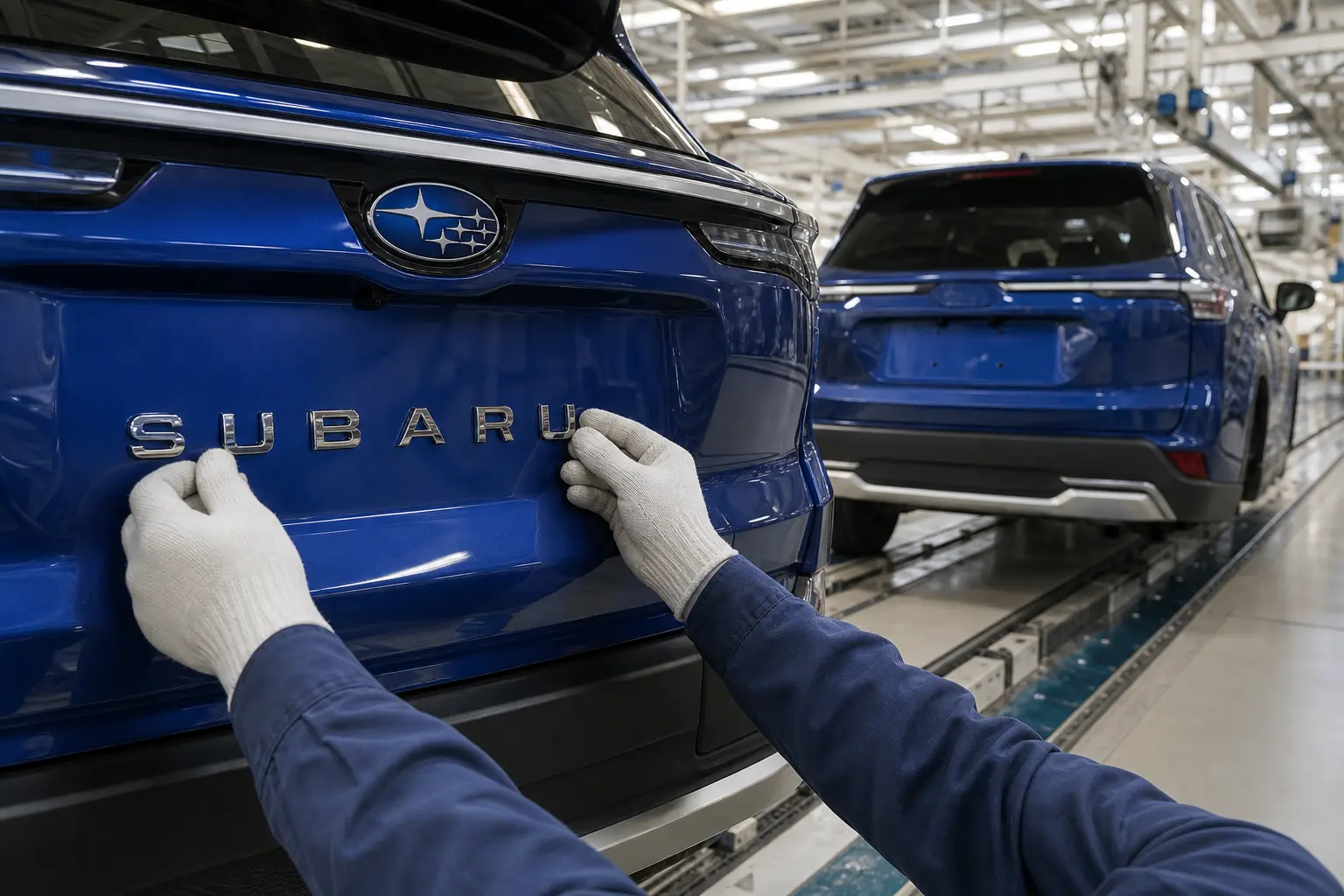
Subaru calls its version the quickest and most powerful regular production car to ever wear the brand’s Pleiades badge. That claim comes with an asterisk worth noting: the Trailseeker does not actually wear the star cluster badge on its tailgate. Individual illuminated letters spell out the brand name instead, a detail Subaru borrowed straight from modern Toyota styling.
| Spec | Subaru Trailseeker | Toyota bZ Woodland |
|---|---|---|
| Starting MSRP | $39,995 | $45,300 |
| Battery | 74.7 kWh | 74.7 kWh |
| Horsepower | 375 | 375 |
| 0 to 60 mph | 4.4 seconds | 4.4 seconds |
| EPA Range | Up to 281 miles (274 on Limited/Touring) | Up to 281 miles (260 with all-terrain tires) |
| Cargo, seats folded | 71.8 cubic feet | 74.9 cubic feet |
A U.S. News review of the bZ Woodland put the pricing gap plainly, noting that being able to get the Subaru version for less undercuts the Toyota’s own value case. Against the wider field, the Trailseeker still trades blows rather than dominating. Ford’s Mustang Mach-E tops out around 300 miles of range but gives up cargo room at 59.7 cubic feet, and the Tesla Model Y stretches to 327 miles at the top of its lineup.
Toyota’s Cut Doesn’t Care Which Badge Sells
Toyota first bought into what was then Fuji Heavy Industries in 2005, taking an 8.7 percent stake. It kept buying. By September 2019, Toyota had raised its position to 20 percent, up from 16.83 percent, a deal that also saw Subaru acquire shares in Toyota worth roughly $675 million. The 20 percent line was not an accident. It cleared the threshold for Toyota to book Subaru as an equity affiliate, meaning a share of Subaru’s profit flows directly onto Toyota’s own books.
That structure explains why a Trailseeker sale and a bZ Woodland sale are not really rival outcomes for Toyota. One helps its own balance sheet through direct vehicle sales. The other helps it through equity income from Subaru’s results. Subaru keeps its own board and design decisions, but the alliance now touches everything from the boxer-engine BRZ and Toyota GR86 twins to the entire electric lineup.
- 20 percent: Toyota’s voting stake in Subaru Corporation, unchanged since 2019 after growing from an initial 8.7 percent stake bought in 2005
- Equity-method affiliate: the accounting status Toyota assigned Subaru, meaning a slice of Subaru’s profit lands directly on Toyota’s own income statement
- 169.9 g/km: Subaru’s average EU fleet CO2 in 2025, against a 91.3 g/km target for the brand, the widest gap of any automaker tracked
- January 2026: the month Subaru began building battery electric vehicles in-house for the first time, at its retooled Gunma Yajima plant
None of that shows up on a window sticker. It shows up in who actually benefits when the sale closes.
The EU’s Emissions Math Is a Silent Third Party
For European readers, there is a second hidden stakeholder in this story, and it wears a regulator’s hat rather than a shareholder’s. Subaru’s European fleet averaged 169.9 grams of CO2 per kilometer in 2025 against a 91.3 g/km target, according to calculations by market analysts at Dataforce, the widest exceedance among tracked manufacturers. Subaru avoids direct fines only by pooling its emissions with Toyota, Tesla and Stellantis under the EU’s CO2 pooling arrangement, a workaround that depends on the alliance staying intact.
That is part of why the Trailseeker matters as much in Stuttgart or Rotterdam as it does in suburban American driveways. In Europe it is sold as the e-Outback, following Subaru’s own naming pattern for electrified versions of its combustion cars, and it began arriving at dealers this spring. Production of the Trailseeker also just shifted to Subaru’s own Gunma Yajima plant, the brand’s first in-house battery electric vehicle after the Solterra was built entirely at a Toyota factory. Subaru finished retooling that line between August 2025 and January 2026 to build gas, hybrid and electric models side by side.
The wider alliance now spans a growing list of shared vehicles:
- Toyota bZ4X and Subaru Solterra, the original electric twins, both still built at Toyota’s Motomachi plant
- Toyota bZ Woodland and Subaru Trailseeker, the newest pair, now split across two separate plants for the first time
- Subaru Uncharted, a smaller electric SUV joining showrooms alongside the Trailseeker
- Toyota GR86 and Subaru BRZ, the sports car side of the partnership that predates the electric push
Toyota and Subaru marked 20 years of this alliance in 2025, with as many as eight new or refreshed EVs due between the two brands in the U.S. market in 2026 alone.
The Sticker Price Lost Its Cushion
Every one of these numbers now lands on buyers without a safety net that existed as recently as last year. The federal EV tax credit, worth up to $7,500 on a new purchase, ended for good on vehicles acquired after Sept. 30, 2025 under the One Big Beautiful Bill Act. The commercial lease credit dealers used to pass along as a quiet discount closed on the same date. Jessica Caldwell, head of insights at auto data firm Edmunds, called the loss of the credit
pretty daunting
for automakers already juggling tariffs and high interest rates.
Subaru has not blinked on price since. Subaru of America confirmed the Trailseeker’s $39,995 starting MSRP when the SUV launched, and a new release just weeks ago confirmed the 2027 model holds that same $39,995 MSRP, with the Touring trim still $46,555. The one number that did move is the destination fee, which climbed $25 to $1,475 for 2027, nudging a fully loaded Touring trim to roughly $48,030 out the door instead of last year’s $48,005. The sticker held. The fine print crept.
Does the Range Match the Window Sticker?
Not quite. The Trailseeker’s higher trims are EPA-rated for 274 miles, but Edmunds’ own real-world range test came up 12 miles short, covering 262 miles before the battery gave out. Energy use matched the EPA figure almost exactly, which means the shortfall was not a fluke of hard driving. It is simply what the car does in mixed conditions.
The Trailseeker’s original reviewer guessed that any range gap with the Toyota twin came down to tires, and the spec sheets back that up. Toyota’s own numbers show the bZ Woodland’s range sliding from 281 miles on standard tires to 260 with the optional all-terrain rubber, the same wheel-and-tire tradeoff that pulls the Trailseeker down from 281 to 274 on its bigger-wheeled trims. Neither car is a road-trip range leader. The Hyundai Ioniq 5 and Honda Prologue both beat it in independent testing, and charging speed tops out at 150 kW on both Subaru and Toyota versions, a number that is merely average against 2026’s competitive field.
Charging hardware brought its own friction, too. The NACS port opens the door to Tesla’s Supercharger network natively, but away from it, a bundled CCS adapter does not always play nicely with every third-party charging network, a real-world snag no spec sheet captures.
It Comes Down to Badge Loyalty and Color
Strip away the ownership structure and the emissions math, and the showroom decision really is close. Cargo space is nearly a wash. Performance is identical to a tenth of a second. Toyota’s own review of the Woodland’s interior praises the same materials, the same 14-inch touchscreen and the same switchgear that Subaru borrowed wholesale, because it is the same parts bin. Toyota’s own take on this platform earned its own writeup as an EV wrestling with a split identity, and that identity crisis runs in both directions.
What is not close is the price for identical hardware, and that gap belongs entirely to Subaru’s favor right now. A shopper who wants the badge with the AWD heritage and the lower sticker price has an easy case for the Trailseeker. A shopper loyal to Toyota’s dealer network or its résumé for long-term reliability has an equally rational case for paying more. Either way, roughly a fifth of the profit finds its way back to the same company in Aichi Prefecture, and Subaru’s European compliance math gets a little easier. The badge on the tailgate is the only part of this deal that actually belongs to just one side.
Frequently Asked Questions
Is the Subaru Trailseeker just a rebadged Toyota bZ Woodland?
Mechanically, yes, down to the battery, motors and 4.4 second 0-60 time. But the two are no longer built in the same factory. The original Solterra and bZ4X are still assembled side by side at Toyota’s Motomachi plant, while the Trailseeker moved to Subaru’s own Gunma Yajima plant in January 2026, the first time the two badges have split assembly locations.
Does the Trailseeker qualify for any tax credit in 2026?
No federal credit applies. The $7,500 new-vehicle credit and the dealer-facing commercial lease credit both ended for vehicles acquired after Sept. 30, 2025, closing off the lease workaround that many shoppers used to access the discount indirectly. Some state or utility-level rebates may still apply depending on location.
Is the Trailseeker sold outside the United States?
Yes. In Europe it is badged the e-Outback, following Subaru’s naming convention for electrified versions of its combustion-engine models, and it began reaching dealer lots this spring.
How much does the smaller Subaru Uncharted EV cost?
The Uncharted, a compact electric SUV joining the Trailseeker in showrooms, starts at $36,500 for its front-wheel-drive-only configuration, the first front-wheel-drive-only Subaru sold in the U.S. in three decades.
Is the Trailseeker heavier than the Toyota bZ Woodland?
The base Trailseeker Premium weighs just under 4,400 pounds, more than 300 pounds lighter than the next-lightest rival in its class. The higher Touring trim, loaded with a sunroof and leather, weighs more at 4,510 pounds, since added equipment adds mass regardless of badge.


Samsung’s Texas Move Cuts 739 New Jersey Jobs at a Year-Old Campus

Lo Bosworth’s Slow-Build Playbook Is Beating Femtech’s Funding Bust

Super Troopers 3 Chases a Comedy Revival as Trackers Brace for a Miss

Brussels Bets €48 Million That Wooden Blades Can Beat Fibreglass

Laifen’s $99 Hair Dryer Lands at Costco, Testing Dyson’s Price Wall

Chamath’s $135 Million Software Factory Puts Europe’s IT Giants on Notice

Subaru’s Trailseeker Is a Toyota Twin That Pays Toyota Either Way

India-UK Trade Deal Kicks In, but Indian States Hold the Real Price Lever

goNEON Secures €160,000 to Push Its AI Infrastructure Planner to Market

Judge’s Pause on Paramount’s Warner Bros. Deal Starts a Costly Countdown

CLARITY Act Final Text Expected This Weekend as 60-Vote Hurdle Looms

Fed Minutes Cite AI Demand as Inflation Risk, Put a 2026 Hike Back on the Map

Kalshi Loses Major NY Prediction Markets Ruling to Judge Torres

Marker AI Writing Startup Lands $13M Seed Led by Index Ventures

Meta’s Muse Spark 1.1 Beats Rivals on Price, Trails on Coding

Dota 2 Esports World Cup 2026: Spirit Defends $2M Title In Paris

CS2 Premier Season 5 Lands With Cache and a C4 Damage Rework

Trump Calls Iran ‘Islamic Republic of Japan’ as Ceasefire Ends

Finto Picks Munich Over Silicon Valley After YC, Raises $3.4M

Backrooms Returns to Theaters as the Everything Must Go Edition
-
 FINANCE2 months ago
Zcash Patched a Double-Spend Bug as ZEC Climbed 5%
-
 ENTERTAINMENT2 months ago
Steam Summer Sale 2026 Locks In June 25 to July 9 Dates
-
 NEWS2 months ago
Meta Adds AI Replies to Threads, But Users Can’t Block It
-
 FINANCE2 weeks ago
CLARITY Act Final Text Expected This Weekend as 60-Vote Hurdle Looms
-
 ENTERTAINMENT2 months ago
‘Widow’s Bay’ Review: Apple TV’s Sleeper Horror-Comedy Earns Its Fog
-
 FINANCE2 weeks ago
Fed Minutes Cite AI Demand as Inflation Risk, Put a 2026 Hike Back on the Map
-
 NEWS7 months ago
FolderFresh Review: This Free Tool Automates Windows File Organizing
-
 ENTERTAINMENT2 months ago
Amazon Scraps Its Stargate Revival After a 20-Week Writers Room